
By Josh Trent | Wellness + Wisdom Podcast Host & Identity Transformation Architect
“You do not need a perfect childhood to build a secure heart. Security is not only something you are given. It is something you can grow, one safe connection at a time.”
Josh Trent
Secure attachment is something adults can build, even if they did not receive it growing up, and that single truth has the power to change how you love for the rest of your life. Many people move through their relationships feeling anxious, avoidant, or unsure why closeness feels so complicated, never realizing that these patterns were set long ago and, more importantly, that they can be rewired. The science of secure attachment adults can create for themselves is one of the most hopeful areas in all of relationship psychology, and it sits right at the heart of the L.I.F.E. Method™.
Here is the joy forward promise. Your early attachment patterns are a starting point, not a life sentence. Whatever you learned about love as a child, you are capable of learning something new and healthier as an adult. This process even has a name in the research, earned security, and it means that a person raised in insecurity can develop the same steadiness, trust, and ease in connection as someone who had it from the start. This article is a map for that journey.
Table of Contents
- What Secure Attachment Looks Like in Adults
- The Four Attachment Styles
- The Hidden Cost of Staying Insecure
- Where Attachment Patterns Come From
- Can Attachment Styles Really Change?
- The Neuroscience of Feeling Safe Together
- How to Build Secure Attachment as an Adult
- Secure Attachment Adults and the L.I.F.E. Method
- Secure Attachment in Your Relationships
- Signs You Are Becoming More Secure
- Frequently Asked Questions
- Studies and External Resources
- About Josh Trent
What Secure Attachment Looks Like in Adults
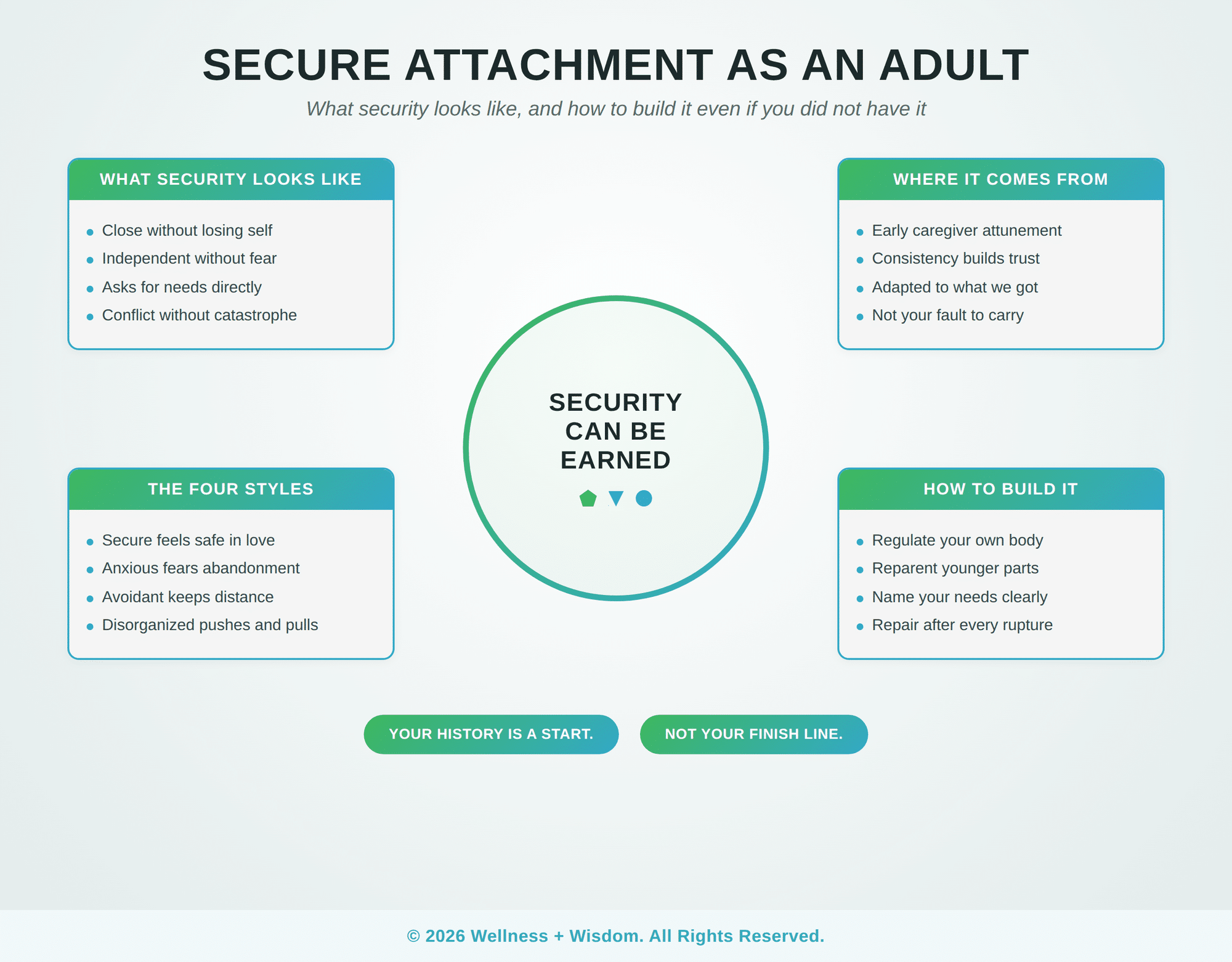
Secure attachment in adults is the felt sense that connection is safe, that you are worthy of love, and that others can generally be trusted to be there. A securely attached person can be close without losing themselves and independent without feeling abandoned. They can ask for what they need, tolerate conflict without catastrophe, and offer comfort as easily as they receive it. In short, they are at ease in the dance of intimacy.
This does not mean securely attached people never struggle or never feel afraid. They do. The difference is that their baseline is trust rather than threat. When a conflict arises, a secure person can stay grounded enough to work through it instead of collapsing into panic or shutting down entirely. When their partner needs space, they can offer it without spiraling. When they need reassurance, they can ask for it directly instead of testing or withdrawing. Their neural system has learned that closeness is safe.
If that description feels far from your own experience, please take heart. This is a learnable way of relating, not a personality type you are locked out of. The very fact that you can recognize what security looks like means part of you already knows the way home. Building it is the work, and it is some of the most rewarding work a person can do, which is why we weave it through everything from our Wellness + Wisdom Podcast conversations to our deepest programs.
The Four Attachment Styles
Attachment research generally describes four broad styles, and understanding them with compassion rather than judgment is the first step toward change. These are not boxes that define you forever. They are descriptions of patterns, and patterns can shift.
Secure attachment, as described above, is marked by comfort with both closeness and independence. Anxious attachment tends to crave closeness while fearing abandonment, often leading to a heightened need for reassurance and a sensitivity to any sign of distance. Avoidant attachment tends to prize independence and self reliance, often keeping others at arm's length and feeling uncomfortable with too much closeness. Disorganized attachment, which often stems from early experiences that were frightening or chaotic, can swing between craving connection and fearing it, creating a push and pull that feels confusing from the inside.
If you recognize yourself in one of the insecure styles, notice the instinct to judge yourself, and then set that instinct down. Every one of these patterns made perfect sense as a child's adaptation to their environment. An anxious style often develops where love felt inconsistent. An avoidant style often develops where needs were met with distance or dismissal. These were intelligent survival strategies. The invitation now is simply to update them for the adult you have become, a process we explore alongside attachment styles and epigenetics.
The Hidden Cost of Staying Insecure
Before we talk about building security, it helps to be honest about what insecure attachment quietly costs, not to create shame, but to make the invitation to change feel worth accepting. Insecure patterns tend to repeat, and the repetition is exhausting. The anxiously attached person may spend years in a low hum of worry about whether they are truly loved, reading tone and timing for signs of danger that may not be there. The avoidant person may build a life that looks independent and free yet feels quietly lonely, with a wall that keeps out the very closeness they long for.
These patterns do not stay confined to romance. They shape friendships, parenting, work relationships, and even the relationship you have with yourself. An insecure baseline can turn ordinary moments of connection into sources of stress, and it can keep you cycling through the same painful dynamics with different people, wondering why love always seems to follow the same script.
There is a physical cost too. Relationships are one of the most powerful influences on our health, and a life of chronic relational stress keeps the body's alarm systems subtly activated. When closeness feels like a threat rather than a refuge, the very connections that are meant to nourish and restore us become another source of wear. Over years, that adds up in both the heart and the body.
I share this not to discourage you but to do the opposite. Every one of these costs is optional, because the pattern underneath them can change. The exhaustion of insecurity is not a permanent tax on your life. It is a signal pointing you toward the healing that is available, and toward the far lighter, warmer way of loving that waits on the other side of the work. Explore how these patterns get passed down, and interrupted, in our piece on breaking generational cycles.
Where Attachment Patterns Come From
Attachment patterns are first shaped in early childhood, in the thousands of small interactions between a baby and their caregivers. When a child's needs are met with warmth, attunement, and consistency, the child's developing brain learns that the world is safe and that connection can be trusted. When those needs are met inconsistently, harshly, or not at all, the child adapts by developing a different strategy for staying as safe and as connected as possible.
The foundational research here traces back decades, and the adult dimension was mapped in an influential study by Cindy Hazan and Phillip Shaver, published in the Journal of Personality and Social Psychology, which showed that the attachment patterns first described in infancy also shape how adults experience romantic love. Their work helped launch an entire field examining how our earliest blueprint for connection continues to operate in our grown up relationships.
It is also worth understanding that attachment patterns can be influenced by more than a single childhood. The landmark Adverse Childhood Experiences study by Vincent Felitti and colleagues, published in the American Journal of Preventive Medicine, showed how deeply early relational experiences shape adult wellbeing across the lifespan. And the emotional atmosphere we grow up in can carry echoes of what our parents and even grandparents experienced, a theme we explore in our work on inherited patterns and the mother and father wounds. None of this is about blame. It is about understanding the origin of a pattern so you can compassionately change it.
Can Attachment Styles Really Change?
Yes. Attachment styles can change, and this is the single most important thing to understand about this entire topic. While our early patterns are deeply rooted, they are not permanent. The brain remains capable of forming new patterns throughout life, a quality known as neuroplasticity, and attachment is no exception. People move toward security all the time, and researchers have a specific term for it, earned secure attachment.
Earned security describes people who did not have a secure childhood but who developed secure functioning as adults. They did the inner work, formed corrective relationships, and gradually taught their systems that connection could be trusted. The existence of earned security is proof, written into the research itself, that becoming securely attached is possible no matter where you started. Your history sets your starting line, not your finish line.
How does this change happen? Largely through new experiences of safety that gently contradict the old expectations. Every time you have a repair after a conflict instead of an abandonment, every time you ask for a need and it is met with care, every time you stay present with closeness instead of fleeing it, you lay down a new neural track. Over time, these new experiences accumulate into a new baseline. This is the same principle of rewiring that underlies all of identity transformation.
The Neuroscience of Feeling Safe Together
One of the most important ideas in attachment science is co regulation, the way our bodies help each other find calm. Human beings are not designed to regulate entirely on our own. From infancy, we settle our internal states in the presence of a calm, attuned other. A baby cannot soothe itself, so it borrows the steadiness of a caregiver, and over countless repetitions it slowly builds its own capacity for calm. This same process continues throughout our whole lives.
What this means is profound. When you are with someone whose neural system is calm and present, your own system tends to settle toward safety. And when you are with someone who is anxious or dysregulated, your system tends to pick that up too. We are constantly, and mostly unconsciously, tuning to one another. Secure attachment is built through thousands of these small moments of co regulation, each one teaching the body that connection brings calm rather than threat.
The stress science makes the stakes clear. The researcher Bruce McEwen described how a chronically activated stress response produces allostatic load, the cumulative wear that builds when the body's alarm stays switched on. When relationships are a source of chronic threat, they add to that load. When they are a source of genuine safety, they help discharge it. Safe connection is not a luxury. It is one of the body's primary tools for returning to balance.
This is also why the breath is such a powerful ally in attachment work. A few slow, conscious breaths can shift your own state toward calm, which not only helps you stay grounded in a hard moment but also offers a steadier presence for the person you are with. In this way, learning to regulate yourself becomes a gift you give to every relationship, a foundational skill we teach through the BREATHE™ program.
How to Build Secure Attachment as an Adult
Building secure attachment as an adult is a practice, not a switch you flip. It happens gradually, through consistent choices that teach your body that connection is safe. Here are the practices that make the biggest difference.
1. Regulate Your Own Neural System
Security begins in the body. Before you can feel safe with another person, you have to be able to help your own system feel safe. Breath, rest, and self soothing tools give you the internal steadiness that secure connection is built on. A regulated body is far less likely to be hijacked by old attachment fears.
2. Reparent the Younger Parts of You
Many attachment wounds live in the younger parts of us that did not get what they needed. Learning to offer yourself the attunement, reassurance, and care you may have missed is powerful medicine. This inner work, which we explore in reparenting yourself, helps heal the root rather than just managing the symptoms.
3. Practice Naming Your Needs
Secure attachment requires the ability to know what you need and to ask for it directly. Start small. Practice saying what you feel and what you would like, clearly and kindly, without testing, hinting, or withdrawing. Each direct request is a vote for a more secure way of relating.
4. Choose Relationships That Can Meet You
You become secure partly through corrective experiences, so the company you keep matters enormously. Seek out relationships and community where safety, honesty, and repair are possible. Being consistently met with care is one of the fastest paths toward security, which is exactly why the Liberated Life Tribe exists.
5. Learn to Repair After Rupture
Security is not the absence of conflict. It is the presence of reliable repair. Practice coming back together after a disagreement, taking responsibility for your part, and restoring connection. Each successful repair teaches your neural system that closeness survives conflict, which is the very heart of security.
Choose one of these and begin. Security is built the way trust is built, through many small, consistent proofs that connection is safe. Be patient with yourself, and let the new pattern grow at the pace of lived experience.
Secure Attachment Adults and the L.I.F.E. Method
The journey toward the security that secure attachment adults can build maps beautifully onto the L.I.F.E. Method™, our system for identity transformation built on four pillars: Liberation, Integration, Frequency, and Embodiment. Attachment healing is not separate from becoming who you are meant to be. It is a central part of it.
Liberation is where you free yourself from the old attachment story, recognizing that the anxious or avoidant pattern was a survival strategy, not the truth of who you are. Integration is where you gather the fragmented, protective parts of yourself and bring them into a coherent, secure whole. Frequency is where you cultivate an inner state of safety and worthiness that others can feel and meet. And Embodiment is where security stops being an idea in your head and becomes a felt reality in your body and your relationships.
Seen this way, becoming securely attached is not a narrow relationship fix. It is a whole person transformation that touches your identity, your biology, and your spiritual sense of belonging, including your Connection to Creator and God. This is why we treat attachment work as sacred work, and why it lives at the core of our programs and wellness tools.
Secure Attachment in Your Relationships
As you build security within yourself, it naturally begins to transform your relationships. You start to choose partners and friends differently, drawn less to the familiar chaos of old patterns and more to the steady warmth of people who can actually meet you. You communicate more directly, trust more easily, and recover from conflict more gracefully.
One of the most beautiful things about secure attachment is that it is contagious in the healthiest way. When one person in a relationship becomes more secure, it often invites the other toward security too. A grounded, regulated presence is regulating for the people around you. This is why doing your own attachment work is one of the most generous gifts you can give your partner, your children, and your community, a theme at the center of conscious relationships.
None of this requires you to already be perfect at it. Security grows through practice and through the willingness to keep showing up, keep repairing, and keep choosing trust even when the old fear whispers. Every step you take toward becoming securely attached ripples outward into every connection in your life, and forward into the generations who will learn love by watching you. When you want support and community for this journey, our latest episodes and the Liberated Life Tribe are here to walk with you.
Signs You Are Becoming More Secure
Because attachment change is gradual, it helps to know what progress actually looks like, so you can recognize and celebrate it along the way. The shift toward security rarely arrives as a dramatic breakthrough. It shows up as a quiet, growing steadiness in how you love.
You might notice that a partner needing space no longer sends you into a spiral, or that you can name a hurt directly instead of going cold or clingy. You might find that you recover from a conflict in hours rather than days, that you can soothe yourself when the old fear rises, and that you are drawn toward people who feel calm and consistent rather than familiar and chaotic. You might notice you can receive love without waiting for it to be taken away.
These signs can be subtle at first, which is exactly why they are worth watching for. Each one is evidence that your body is learning a new expectation, that connection is safe. When you catch yourself responding in a more grounded way than you once would have, pause and let it land. You are witnessing the very rewiring this whole journey is about, and noticing it helps reinforce it.
Be patient and kind with yourself when the old patterns still show up too, because they will, especially under stress. Becoming securely attached is not about never feeling the old fear again. It is about the fear having less and less power to run the show, as trust slowly becomes your new default. Every step counts, and the direction matters far more than the pace.
Frequently Asked Questions
What does secure attachment look like in adults?
Secure attachment in adults is the felt sense that connection is safe and that you are worthy of love. Securely attached people can be close without losing themselves and independent without feeling abandoned. They ask for needs directly, tolerate conflict without catastrophe, and give and receive comfort with ease because their baseline is trust rather than threat.
Can adults really become securely attached if they were not as children?
Yes. Researchers call this earned secure attachment, and it describes people who did not have a secure childhood but developed secure functioning as adults. Through inner work, corrective relationships, and repeated experiences of safety, the brain forms new patterns. Your history sets your starting line, not your finish line.
What are the four attachment styles?
The four broad styles are secure, anxious, avoidant, and disorganized. Secure is comfortable with closeness and independence. Anxious craves closeness while fearing abandonment. Avoidant prizes independence and keeps others at arm's length. Disorganized swings between craving and fearing connection. These are patterns that can change, not permanent boxes.
How long does it take to change your attachment style?
There is no fixed timeline, because it depends on consistency more than speed. Attachment shifts through the gradual accumulation of new experiences of safety, direct communication, and reliable repair. Some people notice meaningful change within months of focused practice, while deeper patterns take longer. What matters most is steady, repeated experiences that teach your body connection is safe.
How do I start building secure attachment as an adult?
Begin by regulating your own neural system through breath and rest, reparent the younger parts of you that missed what they needed, practice naming your needs directly, choose relationships where safety and repair are possible, and learn to reliably reconnect after conflict. Security grows through many small, consistent proofs that closeness is safe.
How does attachment work connect to the L.I.F.E. Method?
Becoming securely attached maps onto the four pillars of the L.I.F.E. Method™: Liberation from the old attachment story, Integration of protective parts into a secure whole, Frequency as a cultivated inner state of safety and worthiness, and Embodiment where security becomes a felt reality rather than an idea. Attachment healing is a whole person transformation.
Studies and External Resources
The science in this article rests on peer reviewed research. These are the sources referenced throughout.
- Hazan C, Shaver P. (1987). Romantic love conceptualized as an attachment process. Journal of Personality and Social Psychology. PubMed: 3572722
- Felitti VJ, et al. (1998). Relationship of Childhood Abuse and Household Dysfunction to Many of the Leading Causes of Death in Adults. American Journal of Preventive Medicine. PubMed: 9635069
- McEwen BS. (1998). Protective and damaging effects of stress mediators. New England Journal of Medicine. PubMed: 9428819
About Josh Trent
Josh Trent is an Identity Transformation Architect and the award winning host of the Wellness + Wisdom Podcast, with over 15 million downloads since 2015. He is the creator of the L.I.F.E. Method™ Identity Transformation System and steward of the Emotional Epigenetics™ and BREATHE: Breath + Wellness™ systems of self mastery, impacting over 1,000 students worldwide. Join the Liberated Life Tribe and receive your 10 day Self Liberation Blueprint at liberatedlife.com. Josh lives in Austin, Texas with his wife Carrie, daughter Nayah, and son Novah.
Disclosure: We may earn a commission from certain links on this site when you make a purchase, at no extra cost to you. These commissions help support Wellness + Wisdom and do not affect the products or resources we choose to recommend. Full disclosure .