
By Josh Trent | Wellness + Wisdom Podcast Host & Identity Transformation Architect
“Motivation is not something you wait for. It is something you grow from the inside, by remembering why you started and taking one small step toward it. Learning how to find motivation is learning to let your values lead.”
Josh Trent
Learning how to find motivation is one of the most life giving skills you can develop, because motivation is the energy that turns intentions into action and dreams into reality. Almost everyone knows the feeling of losing it. The goal that once excited you now feels heavy. The project sits untouched. The workout plan fades after week two. Many people assume they simply lack willpower or discipline. But motivation is not a personality trait that some people have and others lack. It is a state that rises and falls, and it can be cultivated through understanding what truly drives you. That inside out approach is the heart of the L.I.F.E. Method™.
Here is the joy forward truth at the center of it all. The most lasting motivation does not come from pressure, guilt, or someone else's expectations. It comes from within, from connecting with what you genuinely care about and feeling yourself grow toward it. When you learn how to find motivation from the inside, you stop needing to force yourself forward and start feeling pulled toward the life you want. Let us explore exactly how.
Table of Contents
- What Motivation Really Is
- Why Motivation Fades
- The Gift of Inner Drive
- The Science of Motivation
- How to Find Motivation
- Inner Motivation Versus Outer Pressure
- How to Find Motivation With the L.I.F.E. Method™
- Celebrating Progress
- Motivation Is a Lifelong Practice
- When Motivation Feels Gone
- Frequently Asked Questions
- Studies and External Resources
- About Josh Trent
What Motivation Really Is
Motivation is the inner energy and desire that moves you to take action toward a goal. It is the “why” behind what you do. Some motivation comes from within, because something feels meaningful, interesting, or aligned with who you are. Other motivation comes from outside, like rewards, deadlines, or the approval of others.
Psychologists often describe two broad types. Intrinsic motivation is doing something because you find it satisfying, meaningful, or enjoyable in itself. Extrinsic motivation is doing something to gain a reward or avoid a consequence. Both have their place. A paycheck, a deadline, or a friendly competition can get you started. But intrinsic motivation tends to be more durable, more joyful, and more connected to high quality work and wellbeing over time.
It also helps to know that motivation often follows action rather than preceding it. Many people wait to feel motivated before they begin. But often the feeling arrives after you start, as momentum builds and you see progress. Understanding this simple truth can free you from waiting for inspiration that may never come on its own. This interplay between action and inspiration is a theme we explore often on the Wellness + Wisdom Podcast.
Why Motivation Fades
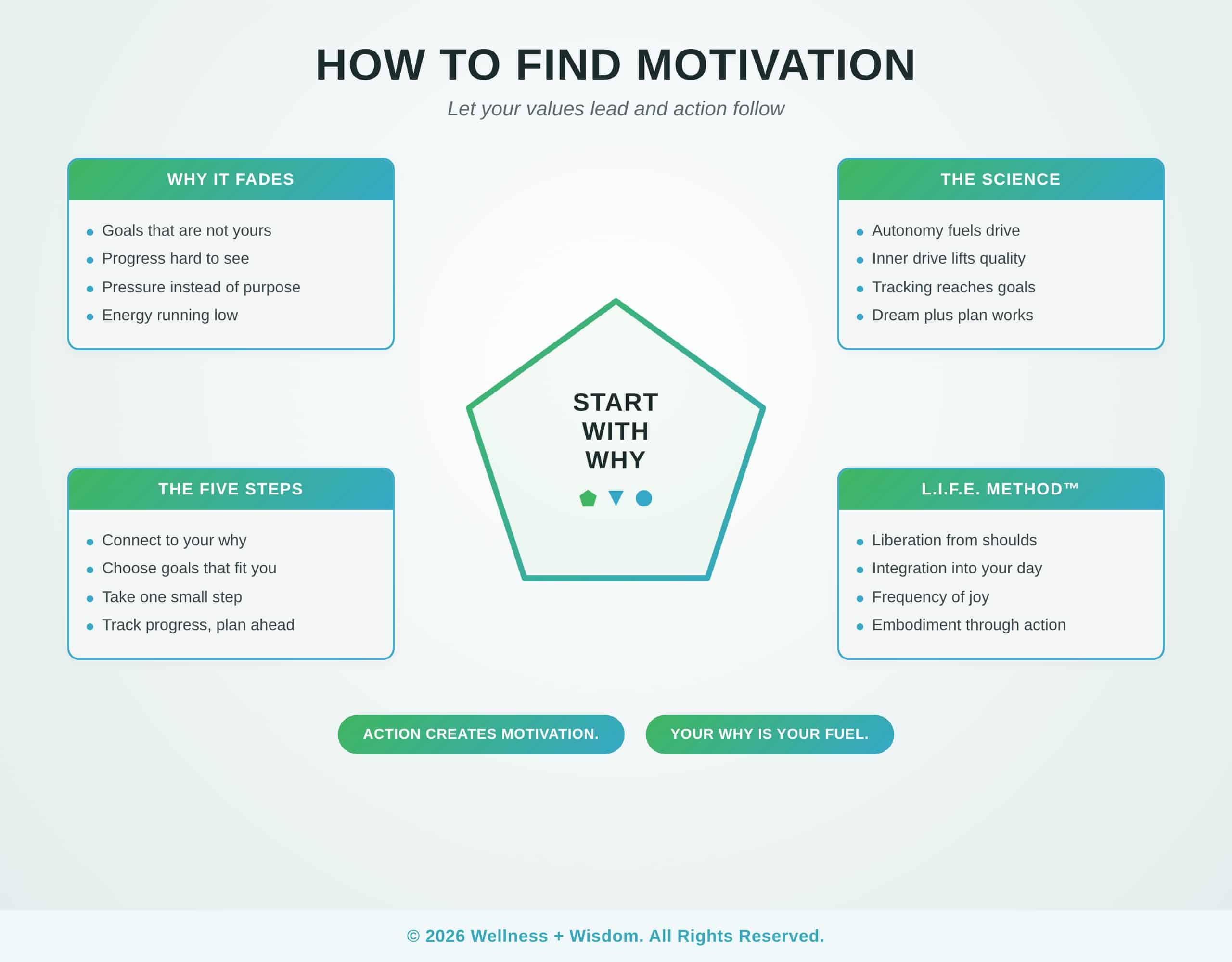
Motivation fades when goals feel disconnected from what we truly value, when progress is hard to see, when we feel pressured rather than inspired, or when our energy is depleted. Each of these drains the inner fuel that keeps us moving.
Many goals start with a burst of excitement but are not deeply rooted in personal meaning. We set them because we think we should, because someone else expects it, or because it looks good on paper. When the novelty wears off, there is nothing deeper to sustain us. Goals that are too big or too vague also drain motivation, because it is hard to see progress or know where to begin. And when we try to motivate ourselves with harsh self criticism, we often end up feeling worse and wanting to avoid the task altogether, which is explored in how to stop procrastinating.
Energy matters too. When you are exhausted, stressed, or emotionally drained, motivation naturally dips. That is not a character flaw. It is your body asking for care. Poor sleep, chronic stress, and a lack of joy in daily life can all quietly sap your drive. Sometimes the most motivating thing you can do is rest. Learning to rest without guilt often restores the energy that motivation needs.
The Gift of Inner Drive
Inner drive gives you energy, focus, resilience, and a deep sense of meaning in what you do. When your motivation comes from within, work feels less like a burden and more like an expression of who you are.
Think about times when you were deeply motivated. Maybe you were learning something that fascinated you, building something you believed in, or helping someone you cared about. Time probably flew. Obstacles felt like puzzles rather than walls. You did not need to force yourself forward because you genuinely wanted to be there. That is the power of intrinsic motivation, and it is available to you in far more areas of life than you might think.
Inner drive also builds resilience. When you know why something matters, setbacks are easier to weather. You can fail, learn, and try again without losing your sense of purpose. And here is the part I love most. When your actions align with your values, you feel a deep sense of integrity and joy. You are not just checking boxes. You are living a life that feels like yours. If your sense of purpose feels foggy right now, the practices in how to find your purpose and how to reconnect with your purpose can help.
The Science of Motivation
The science of motivation shows that people are most motivated when they feel autonomy, competence, and connection, that intrinsic motivation strongly predicts quality of performance, that tracking progress helps people reach goals, and that pairing positive visions with realistic planning boosts follow through. Lasting drive can be designed.
Start with the foundations. In an influential paper published in American Psychologist, Richard Ryan and Edward Deci described self determination theory, which proposes that people thrive and stay motivated when three basic needs are met: autonomy, the sense that you are choosing your actions; competence, the sense that you are growing and capable; and relatedness, the sense of connection with others. When these needs are supported, intrinsic motivation flourishes. When they are thwarted, motivation tends to wither.
Intrinsic motivation also matters for results. A meta analysis led by Christopher Cerasoli in Psychological Bulletin, spanning four decades of research, found that intrinsic motivation was a strong predictor of performance, particularly the quality of work, while external incentives were more closely tied to the quantity of work. Doing something because it matters to you tends to produce your best work, the kind you are genuinely proud to put your name on.
Progress and planning matter too. A meta analysis led by Benjamin Harkin in Psychological Bulletin found that monitoring progress toward goals reliably helped people achieve them, especially when progress was recorded or shared. And research led by Angela Duckworth found that students who learned a strategy combining positive visions of their goals with honest planning for obstacles, known as mental contrasting with implementation intentions, completed significantly more practice for a major exam than students in a control group. Dreaming and planning work best together, because hope gives you energy and planning gives that energy somewhere useful to go.
How to Find Motivation
You learn how to find motivation by connecting to your deeper why, choosing goals that feel like yours, taking one small step, tracking your progress, and planning for obstacles. These five steps build inner drive that lasts beyond the first burst of excitement. Here is how I practice and teach them.
1. Connect to Your Deeper Why
Ask yourself why this goal matters to you, then ask “why” again, and again, until you reach something that truly moves you. “I want to exercise” becomes “I want energy” becomes “I want to be fully present and playful with my kids for decades.” That deeper why is your fuel. Write it down and keep it somewhere you will see it often.
2. Choose Goals That Feel Like Yours
Notice whether your goals come from genuine desire or from pressure and expectation. Where possible, reshape them so they feel like your own choice. Even within required tasks, look for the part you can choose: how you approach it, when you do it, or what you want to learn from it. A sense of choice, or autonomy, is one of the strongest motivators there is.
3. Take One Small Step
Do not wait for motivation to arrive. Take one tiny action toward your goal, something so small it feels almost too easy. Open the document. Put on your running shoes. Write one sentence. Motivation often follows action. Once you begin, momentum tends to carry you forward. This is the same principle behind how to build healthy habits.
4. Track Your Progress
Keep a simple record of your progress, whether that is a checklist, a journal, or a calendar where you mark each day you take action. Seeing progress builds a sense of competence, which fuels further motivation. As the research shows, recording progress helps people reach their goals. Sharing it with a supportive friend can make it even more powerful.
5. Plan for Obstacles
Picture the outcome you want, then honestly name the obstacles most likely to get in your way. For each one, make a simple plan: “If I feel too tired after work, then I will do just ten minutes.” This blend of hopeful vision and realistic planning keeps you moving when challenges arise. It also connects beautifully with the practices in how to build self discipline.
Your environment can also quietly support your motivation. Surround yourself with reminders of your why, like a photo, a written goal, or a vision board where you will see it each morning. Spend time with people who are working toward meaningful goals of their own, because motivation is surprisingly contagious. Reduce the friction around your goal by preparing what you need in advance, and add friction to distractions by putting your phone in another room. When your surroundings point toward your goals, you need far less inner effort to stay on track.
Start with just one of these steps today. You do not need to overhaul your whole life to feel more motivated. One small spark can light the way. And if you would love encouragement from people who share your values, the Liberated Life Tribe is a warm and supportive community.
Inner Motivation Versus Outer Pressure
Inner motivation comes from what you value and enjoy, while outer pressure comes from fear, guilt, or the expectations of others. Both can move you, but they feel very different and lead to very different results over time.
Outer pressure sounds like, “I have to do this or I will disappoint everyone.” “I should be further along by now.” “If I do not hit this goal, I am a failure.” It can create short bursts of action, but it often leads to stress, resentment, and burnout. When the pressure lifts, the motivation disappears with it. Many people who rely on outer pressure swing between frantic effort and complete exhaustion, which is closely tied to the perfectionism explored in how to let go of perfectionism.
Inner motivation sounds different. “I want to do this because it matters to me.” “I am curious where this could lead.” “I love how I feel when I show up for this.” It is calmer, more sustainable, and more joyful. It does not depend on anyone watching. It keeps you going on quiet days when no one else notices. The shift from pressure to inner motivation is one of the most freeing changes you can make, and it often begins with releasing the need for approval, which is explored in how to stop seeking approval.
How to Find Motivation With the L.I.F.E. Method™
The L.I.F.E. Method™ offers a complete framework for lasting motivation through four pillars: Liberation, Integration, Frequency, and Embodiment. Each pillar addresses a different reason motivation fades, and together they help you build drive from the inside out.
Liberation means freeing yourself from goals and expectations that are not truly yours. Notice where you are chasing someone else's version of success, and gently release what no longer fits. Liberation clears the way for goals that genuinely light you up.
Integration means weaving your goals into your everyday life rather than treating them as separate projects. When your actions connect to your daily rhythms and your deeper values, motivation becomes part of how you live rather than something you have to summon.
Frequency is about the energy you bring to your goals. When you approach them with curiosity, gratitude, and joy, motivation feels natural and renewing. When you approach them with fear or obligation, it feels draining. Your emotional state shapes your drive.
Embodiment means letting motivation live in your body through action. Every time you take a step toward your goal, you feel your identity shift a little more toward the person who lives that goal. Over time, you stop chasing motivation and simply become someone who shows up. This shift from knowing to doing is beautifully explored in embodiment, the missing piece between knowing and doing.
Celebrating Progress
Celebrating progress is one of the most powerful ways to sustain motivation, because your brain responds to reward and recognition. When you notice and appreciate how far you have come, you build the sense of competence that fuels further effort.
Many people only celebrate when they reach the finish line, which means they go weeks or months without any sense of reward. Try celebrating along the way. Finished the first chapter? Celebrate. Showed up for your workout three times this week? Celebrate. Took one small step on a hard day? Celebrate that most of all. A smile, a quiet “well done,” or sharing the win with a friend is enough.
Looking back at your progress record can be especially motivating on hard days. When you can see all the steps you have already taken, it becomes easier to take the next one. There is a whole practice around this in celebrating small wins, and it is one of my favorite tools for keeping momentum alive.
Motivation Is a Lifelong Practice
Motivation is a lifelong practice, because your goals, energy, and circumstances will keep changing. Some seasons you will feel unstoppable. Other seasons, motivation will feel quiet or distant. Both are part of a full human life, and neither means you have lost your way.
It also helps to vary how you pursue your goals. Doing the same thing in the same way day after day can dull even the most meaningful pursuit. Try a new route for your run, a new place to write, a new partner to train with, or a fresh challenge within your work. Novelty reawakens curiosity, and curiosity is one of the purest forms of intrinsic motivation. Small changes can make a familiar goal feel exciting again.
When motivation dips, treat it as information rather than failure. Is your goal still meaningful to you? Is your energy depleted? Do you need more connection, rest, or support? Sometimes the answer is to adjust your goal. Sometimes it is to rest. Sometimes it is simply to take one small step and let momentum rebuild. Getting curious instead of critical keeps you moving forward over the long run.
This is also where the Wellness Pentagon™ becomes helpful. Motivation draws on every dimension of your wellbeing. When you sleep well, move your body, care for your emotions, feel financially steady, and nurture your Connection to Creator and God, you have a deeper well of energy and meaning to draw from. Many people find that a sense of spiritual purpose is the most enduring source of motivation of all. You will hear many guests share how they found and sustained their drive across our latest episodes.
When Motivation Feels Gone
If motivation feels completely gone right now, you are in very good company, and it is completely understandable. Learning how to find motivation does not mean you will feel inspired every day. It means you will gently rebuild your inner drive, a little at a time, at a pace that honors where you are.
When motivation feels absent, make the step tiny. Two minutes. One task. One small action that moves you even slightly forward. Pair it with something you enjoy, like your favorite music or a walk outside. Connect with someone who believes in you. Rest if you need to. Simple practices that calm your neural system, like slow breathing with BREATHE™, can also restore energy. Supportive tools like a goal journal or habit tracker can help, and you can find a few we trust in our wellness tools store.
It is also important to know that a persistent loss of motivation, especially when combined with low mood, loss of interest in things you used to enjoy, changes in sleep or appetite, or feelings of hopelessness, can be a sign of depression or another health concern that deserves care. A qualified health professional can offer compassionate, effective support. There is real strength in asking for help. Wherever you are, be patient and kind with yourself, and trust that learning how to find motivation is something you can absolutely grow, one small step at a time. If stress is draining your drive, the practices in neural system regulation are a gentle next step.
Ready to go deeper? Join the Liberated Life Tribe and receive your 10 day Self Liberation Blueprint at liberatedlife.com. It is free, it is guided, and each day offers a small, meaningful step that helps you reconnect with what drives you.
Frequently Asked Questions
How do I find motivation when I have none?
Start with one tiny action rather than waiting to feel motivated, since motivation often follows action. Connect the task to a deeper reason that matters to you, track even small progress, and care for your energy through rest and movement. If low motivation persists with low mood, consider speaking with a health professional.
What is the difference between intrinsic and extrinsic motivation?
Intrinsic motivation comes from within, doing something because it is meaningful, interesting, or enjoyable. Extrinsic motivation comes from outside, like rewards, deadlines, or approval. Research shows intrinsic motivation is especially linked to high quality performance and wellbeing over time.
Why do I lose motivation so quickly?
Motivation often fades when goals are not connected to personal meaning, when progress is hard to see, when we rely on pressure or guilt, or when energy is depleted. Rooting goals in your values, breaking them into small steps, and tracking progress help motivation last.
Does tracking progress really help?
Yes. A meta analysis in Psychological Bulletin found that monitoring progress toward goals reliably helped people achieve them, especially when progress was physically recorded or shared with others. Seeing progress builds a sense of competence that fuels further motivation.
What is mental contrasting?
Mental contrasting is a strategy where you imagine the positive outcome you want, then honestly identify the obstacles in your way and make if then plans to handle them. Research found that students who used this approach completed significantly more practice for a major exam.
Should I wait until I feel motivated to start?
No. Waiting for motivation often means waiting indefinitely. Taking a small first step tends to create momentum, and the feeling of motivation frequently arrives after you begin. Start small and let action lead the way.
Studies and External Resources
The science in this article rests on peer reviewed research. These are the sources referenced throughout.
- Ryan RM, Deci EL. (2000). Self determination theory and the facilitation of intrinsic motivation, social development, and well being. American Psychologist. PubMed: 11392867
- Cerasoli CP, Nicklin JM, Ford MT. (2014). Intrinsic motivation and extrinsic incentives jointly predict performance: a 40 year meta analysis. Psychological Bulletin. PubMed: 24491020
- Harkin B, et al. (2016). Does monitoring goal progress promote goal attainment? A meta analysis of the experimental evidence. Psychological Bulletin. PubMed: 26479070
- Duckworth AL, et al. (2013). From Fantasy to Action: Mental Contrasting with Implementation Intentions Improves Academic Performance in Children. Social Psychological and Personality Science. PubMed: 25068007
About Josh Trent
Josh Trent is an Identity Transformation Architect and the award winning host of the Wellness + Wisdom Podcast, with over 15 million downloads since 2015. He is the creator of the L.I.F.E. Method™ Identity Transformation System and steward of the Emotional Epigenetics™ and BREATHE: Breath + Wellness™ systems of self mastery, impacting over 1,000 students worldwide. Join the Liberated Life Tribe and receive your 10 day Self Liberation Blueprint at liberatedlife.com. Josh lives in Austin, Texas with his wife Carrie, daughter Nayah, and son Novah. Peace and power.
Disclosure: We may earn a commission from certain links on this site when you make a purchase, at no extra cost to you. These commissions help support Wellness + Wisdom and do not affect the products or resources we choose to recommend. Full disclosure .