
By Josh Trent | Wellness + Wisdom Podcast Host & Identity Transformation Architect
“Conflict is not the opposite of connection. Handled with care, it is the doorway to a deeper one. Learning how to handle conflict is learning to stay on the same team, even when you see things differently.”
Josh Trent
Learning how to handle conflict well is one of the most relationship changing skills you can ever build, because disagreement is a natural part of every close connection. Partners, children, parents, friends, coworkers. Anyone you care about will eventually see something differently than you do. Many of us learned to treat conflict as dangerous, so we either avoid it until it explodes or fight to win at the expense of the relationship. There is a third way. When conflict is handled with calm, curiosity, and care, it can actually bring people closer, because it is how two people learn what truly matters to each other. That third way begins inside your own body and the emotional patterns you inherited, which is the heart of Emotional Epigenetics™.
Here is the joy forward truth at the center of it all. Healthy relationships are not conflict free. They are repair rich. The couples, families, and teams who thrive are not the ones who never disagree. They are the ones who know how to disagree with respect and come back together afterward. When you learn how to handle conflict this way, disagreements stop feeling like threats and start feeling like opportunities to understand each other more deeply. Let us explore exactly how.
Table of Contents
- What Healthy Conflict Really Looks Like
- Why Conflict Feels So Hard
- The Gift of Conflict Done Well
- The Science of Conflict
- How to Handle Conflict
- Solving the Problem Versus Winning the Argument
- How to Handle Conflict With Emotional Epigenetics™
- Celebrating Every Repair
- Healthy Conflict Is a Lifelong Practice
- When Conflict Feels Overwhelming
- Frequently Asked Questions
- Studies and External Resources
- About Josh Trent
What Healthy Conflict Really Looks Like
Healthy conflict is a respectful disagreement where both people feel safe enough to express their needs, listen to each other, and work toward an outcome that honors the relationship. It is not about avoiding hard topics, and it is not about one person dominating. It is about two people staying on the same team while working through a difference.
In healthy conflict, voices may rise a little and emotions may run strong, but there is an underlying sense of respect. Each person speaks about their own experience rather than attacking the other's character. Each person tries to understand before trying to be understood. And when things get heated, either person can call a pause without the other feeling abandoned. Afterward, there is repair: an acknowledgment, an apology where it is needed, and a return to warmth.
This looks very different from the kinds of conflict many of us grew up with. Some of us saw explosive arguments. Others saw cold silence. Many saw both. If you did not have a model for healthy conflict, it makes complete sense that it feels unfamiliar now. The beautiful news is that these skills can be learned at any age, and they are a frequent theme on the Wellness + Wisdom Podcast, because they quietly shape the quality of every relationship we have.
Why Conflict Feels So Hard
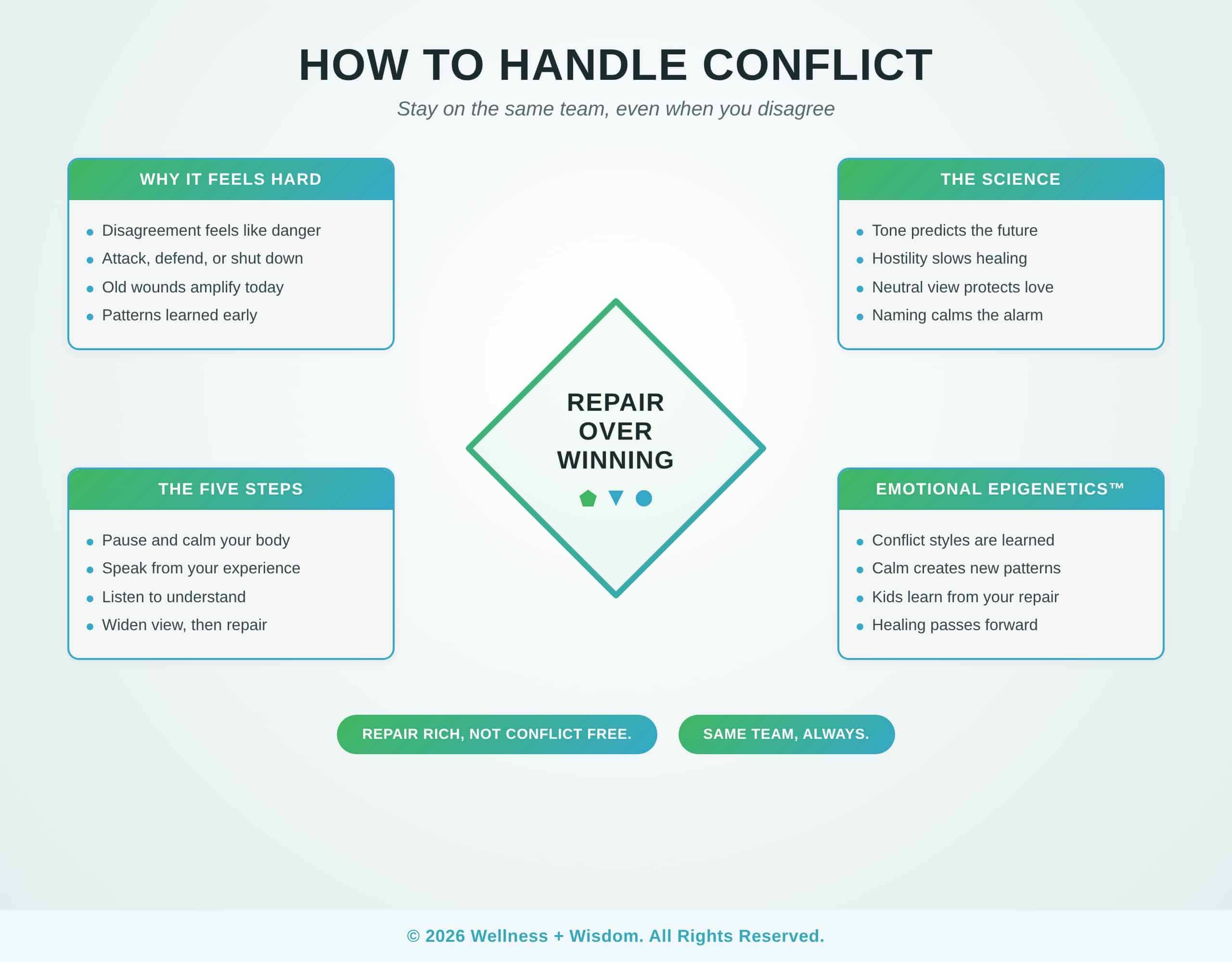
Conflict feels hard because disagreement with someone we care about can trigger the same protective responses in our neural system as physical danger. When we feel criticized, misunderstood, or rejected, our heart rate rises, our breathing quickens, and the thinking part of our brain becomes harder to access. In that state, we are wired to defend, not to connect.
Under stress, people tend to fall into familiar patterns. Some go on the attack, raising their voice or listing every past mistake. Some defend, explaining why they are right. Some shut down completely, going quiet and withdrawing. None of these responses are bad intentions. They are protective strategies the body learned long ago. But they make it very hard for either person to feel heard. If you recognize yourself in any of these patterns, the practices in how to have a difficult conversation without triggering are a beautiful support.
There is also a deeper layer. Conflict often touches old wounds. A partner forgetting a plan can feel like every time you were overlooked as a child. A boss's feedback can echo a critical parent. When the emotional charge of the present moment is amplified by the past, our reactions can feel much bigger than the situation seems to warrant. Seeing this clearly replaces blame with compassion, both for yourself and for the other person, who is likely carrying their own history into the room too.
The Gift of Conflict Done Well
Conflict done well gives you deeper trust, clearer understanding, stronger boundaries, and relationships that can weather real life. When people know they can disagree with you safely, they stop hiding their true thoughts and feelings, and that honesty is the foundation of real intimacy.
Think about the relationships where you feel most secure. Chances are, they are not the ones where you never disagree. They are the ones where you know that a disagreement will not end the relationship. That security is built through conflict that is handled with care. Every time two people work through a difference and come out the other side still connected, they build evidence that the relationship is strong. This is the heart of secure attachment in adult relationships.
Healthy conflict also helps you grow. Disagreements reveal what you value, what you need, and where your boundaries are. They invite you to articulate things you may never have said out loud. They expose blind spots, gently and lovingly, when handled well. And they give you the chance to practice speaking your truth while also honoring someone else's. Few practices build character and connection as powerfully as learning to disagree with love.
The Science of Conflict
The science of conflict shows that the balance of warmth and negativity during disagreements predicts the future of relationships, that hostile conflict affects physical healing, that reframing conflict from a neutral perspective protects relationship quality, and that naming emotions calms the brain's alarm center. How you handle conflict matters for both your relationships and your health.
Start with the long view. In a landmark study published in the Journal of Personality and Social Psychology, John Gottman and Robert Levenson observed couples discussing an area of disagreement and followed them over the following years. Couples whose conflict conversations held more positive moments relative to negative ones were less likely to later consider separation than couples whose conversations tilted toward negativity. Disagreement itself was not the issue. The emotional tone of the disagreement was.
Conflict also reaches the body. In a study published in Archives of General Psychiatry, Janice Kiecolt Glaser and colleagues made small, harmless blister wounds on couples' arms and then had them discuss either a supportive topic or an area of disagreement. Wounds healed more slowly after the conflict discussion, and couples who were especially hostile with each other healed at a notably slower rate than less hostile couples. The way we argue literally affects how our bodies repair.
The good news is that small shifts help. In a study published in Psychological Science, Eli Finkel and colleagues asked married couples to spend just a few minutes, three times over a year, writing about their most recent disagreement from the perspective of a neutral third party who wanted the best for both of them. Couples who did this short exercise maintained their marital quality over the year, while couples who did not showed a decline. And research led by Matthew Lieberman in Psychological Science found that simply putting feelings into words reduced activity in the amygdala, the brain's alarm center. Naming what you feel helps you stay calm enough to connect.
How to Handle Conflict
You learn how to handle conflict by pausing to calm your body, speaking from your own experience, listening to understand, looking at the situation from a wider perspective, and repairing afterward. These five steps help you stay connected even when you see things differently. Here is how I practice and teach them.
1. Pause and Calm Your Body
When you feel your heart racing or your voice rising, pause. Take a few slow breaths with a long exhale. If the conversation is getting too heated, say something like, “I want to keep talking about this, and I need twenty minutes to calm down first. I will come back.” A pause is not abandonment. It is a gift to the relationship, because nobody can listen well while their neural system is in alarm. Many people find the 90 second emotion rule helpful here.
2. Speak From Your Own Experience
Instead of “You never listen to me,” try “I feel unheard when I am interrupted, and I would love to finish my thought.” Speaking about your own feelings and needs, rather than labeling the other person, makes it far easier for them to hear you without getting defensive. Name the feeling, name the need, and make a clear, kind request.
3. Listen to Understand
When the other person speaks, try to understand their experience rather than preparing your rebuttal. Reflect back what you hear: “It sounds like you felt overwhelmed when I made plans without checking with you.” You do not have to agree to understand. Feeling understood often softens people immediately. This is the same skill explored in how to be a better listener.
4. Take a Wider Perspective
Imagine how a wise, neutral friend who cares about both of you would see the disagreement. What would they notice that you might be missing? What would they hope for both of you? This simple shift, supported by the research above, helps you step out of the heat of the moment and see the bigger picture. It also helps you stop taking things personally.
5. Repair Afterward
After a conflict, come back together. Acknowledge what happened. Apologize for your part, specifically and sincerely. Share what you learned. Reaffirm the relationship with a hug, a kind word, or a shared moment of warmth. Repair is what turns a hard conversation into a deeper bond. If trust has been seriously shaken, the steps in how to rebuild trust after betrayal can guide a deeper healing.
Timing matters too. Whenever possible, choose a calm moment for important conversations rather than raising a sensitive topic when either of you is hungry, exhausted, rushing out the door, or already stressed. A simple “Is now a good time to talk about something that matters to me?” invites the other person in instead of catching them off guard, and it sets a cooperative tone from the very first sentence.
Start with one of these steps in your next disagreement and notice what changes. You will not do this perfectly, and that is okay. Every attempt builds skill. And if you would love to practice these relational skills in a supportive community, the Liberated Life Tribe is a warm place to grow.
Solving the Problem Versus Winning the Argument
Healthy conflict is about solving the problem together, not winning the argument. When the goal becomes winning, someone has to lose, and in close relationships, when one person loses, the relationship loses too. When the goal is solving the problem, both people can win.
Winning focused conflict sounds like keeping score, bringing up past mistakes, and trying to prove the other person wrong. It often feels satisfying in the moment, but it leaves the other person feeling defeated or resentful. Even if you win the argument, you may lose some of the trust and warmth that hold the relationship together. Over time, these small losses add up.
Problem solving conflict sounds different. “We both want to feel respected here. How can we make that happen?” “What would help you feel supported next time?” It treats the disagreement as a shared puzzle rather than a battle. This approach also makes it easier to set clear boundaries without creating enemies, which is beautifully explored in how to set healthy boundaries with love. When both people feel like teammates, solutions come far more easily.
How to Handle Conflict With Emotional Epigenetics™
Emotional Epigenetics™ shows that the way you handle conflict today was shaped by the emotional patterns you grew up with, and that you can consciously rewrite those patterns for yourself and for the people who come after you. Your conflict style is not fixed. It is learned, and what is learned can change.
Think about how conflict worked in your family. Did people yell? Go silent? Pretend nothing was wrong? Did anyone ever apologize and repair? Your neural system absorbed these patterns as the normal way to handle disagreement, and it may still reach for them automatically today. This is why some conflicts feel so charged. You are not only responding to the present moment. You are also responding to every similar moment you have ever experienced.
The beautiful truth is that every time you handle conflict with more calm and care than you learned growing up, you create a new emotional experience in your body. Repeated over time, these experiences reshape your patterns. If you are a parent, this is especially powerful. When your children watch you disagree respectfully and then repair, they learn that conflict is survivable and that love can hold difference. That is how one generation's healing becomes the next generation's normal, which is explored in how to break the parenting cycle. To go deeper with identity level change, explore our L.I.F.E. Method™ programs.
Celebrating Every Repair
Celebrating every repair is one of the most powerful ways to strengthen your relationships and your conflict skills. When you notice and appreciate the moments you came back together after a disagreement, you reinforce the patterns that make relationships resilient.
So many of us focus on the fights, not the repairs. We remember the hurtful words, not the hug that followed. Try flipping that focus. After a conflict that ends well, take a moment to appreciate it, together if you can. “I am really glad we worked through that.” “Thank you for listening to me.” These small acknowledgments tell both of your neural systems that conflict can be safe and that the relationship is strong.
You can also celebrate your own growth. Maybe you paused instead of yelling. Maybe you said “I feel” instead of “you always.” Maybe you apologized first. These are real victories, and they deserve recognition. There is a whole practice around appreciating the people in your life in how to celebrate the people you love, and it pairs beautifully with healthy conflict.
Healthy Conflict Is a Lifelong Practice
Healthy conflict is a lifelong practice, because relationships keep growing and changing, and every new season brings new things to navigate together. A new baby, a move, a career change, aging parents, or a shift in values can all bring fresh disagreements. That is not a sign that something is wrong. It is a sign that two growing people are sharing a life.
Over time, you will notice patterns in your conflicts. Maybe the same topic keeps coming up, or certain times of day are more charged, or stress from work spills into home. Noticing these patterns lets you address them proactively, perhaps with a regular check in conversation when you are both calm, rather than waiting for the next blowup. Many couples and families find that a weekly conversation about what is working and what needs attention prevents small issues from becoming big ones.
This is also where the Wellness Pentagon™ becomes helpful. Conflict often gets harder when other parts of life are depleted. Poor sleep, money stress, physical exhaustion, or spiritual disconnection can all make us shorter with each other. Caring for every dimension of wellbeing, including your Connection to Creator and God, gives you more patience and grace when disagreements arise. You will find many guests sharing their own relationship wisdom across our latest episodes.
When Conflict Feels Overwhelming
If conflict feels overwhelming right now, you are in very good company, and it is completely understandable. Learning how to handle conflict does not mean every disagreement will go smoothly. It means you will gently build the skills to stay connected through difference, a little at a time, at a pace that honors where you are.
When conflict feels like too much, start with the smallest possible step. One slow breath before you respond. One “I feel” statement instead of a criticism. One sincere apology for your part. These small changes can shift the tone of an entire conversation. Practicing calm breathing daily, such as box breathing, also makes it easier to stay steady when emotions rise. Supportive tools like a breath training device or a journal for reflecting after conversations can help, and you can find a few we trust in our wellness tools store.
It is also important to know that conflict involving threats, intimidation, or any kind of abuse is not healthy conflict, and your safety comes first. If you feel unsafe, reach out to a trusted person or a local support service. For ongoing conflict that feels stuck, a qualified couples or family therapist can offer compassionate, effective support. There is real strength in asking for help. Wherever you are, be patient and kind with yourself, and trust that learning how to handle conflict is something you can absolutely grow, one respectful conversation at a time. If calming your body in heated moments feels hard, the practices in neural system regulation are a gentle next step.
Ready to go deeper? Join the Liberated Life Tribe and receive your 10 day Self Liberation Blueprint at liberatedlife.com. It is free, it is guided, and each day offers a simple practice for meeting life and relationships with more calm and connection.
Frequently Asked Questions
What is the healthiest way to handle conflict?
Pause to calm your body, speak about your own feelings and needs, listen to understand the other person, look at the situation from a wider perspective, and repair afterward. The goal is solving the problem together rather than winning the argument, so both people feel respected.
Is conflict bad for relationships?
No. Conflict is a natural part of every close relationship. Research by John Gottman and Robert Levenson found that the emotional tone of disagreements, especially the balance of positive and negative moments, mattered more than whether couples disagreed at all. Healthy relationships are not conflict free. They are repair rich.
How do I stay calm during an argument?
Notice the early signs of rising tension, like a racing heart or a tight jaw, and take a few slow breaths with a long exhale. Name what you feel, silently or out loud. If things get too heated, ask for a short pause and agree on a time to return to the conversation.
Why do I shut down during conflict?
Shutting down is often a protective response your neural system learned long ago, especially if conflict felt unsafe growing up. It is not a character flaw. Calming your body, asking for a pause when needed, and practicing small steps of speaking up can gradually help you stay present.
How do I repair after an argument?
Come back together once you are both calm. Acknowledge what happened, apologize specifically for your part, share what you understand about the other person's experience, and reaffirm the relationship with warmth. Repair is what turns a hard conversation into deeper trust.
When should we get help with conflict?
If conflicts keep repeating without resolution, feel consistently hurtful, or involve threats, intimidation, or abuse, reach out for support. A qualified couples or family therapist can help with stuck patterns, and anyone who feels unsafe should contact a trusted person or local support service.
Studies and External Resources
The science in this article rests on peer reviewed research. These are the sources referenced throughout.
- Gottman JM, Levenson RW. (1992). Marital processes predictive of later dissolution: behavior, physiology, and health. Journal of Personality and Social Psychology. PubMed: 1403613
- Kiecolt Glaser JK, et al. (2005). Hostile marital interactions, proinflammatory cytokine production, and wound healing. Archives of General Psychiatry. PubMed: 16330726
- Finkel EJ, et al. (2013). A brief intervention to promote conflict reappraisal preserves marital quality over time. Psychological Science. PubMed: 23804960
- Lieberman MD, et al. (2007). Putting Feelings Into Words: Affect Labeling Disrupts Amygdala Activity in Response to Affective Stimuli. Psychological Science. PubMed: 17576282
About Josh Trent
Josh Trent is an Identity Transformation Architect and the award winning host of the Wellness + Wisdom Podcast, with over 15 million downloads since 2015. He is the creator of the L.I.F.E. Method™ Identity Transformation System and steward of the Emotional Epigenetics™ and BREATHE: Breath + Wellness™ systems of self mastery, impacting over 1,000 students worldwide. Join the Liberated Life Tribe and receive your 10 day Self Liberation Blueprint at liberatedlife.com. Josh lives in Austin, Texas with his wife Carrie, daughter Nayah, and son Novah. Peace and power.
Disclosure: We may earn a commission from certain links on this site when you make a purchase, at no extra cost to you. These commissions help support Wellness + Wisdom and do not affect the products or resources we choose to recommend. Full disclosure .