
By Josh Trent | Wellness + Wisdom Podcast Host & Identity Transformation Architect
“Friendship is not something that happens to lucky people. It is something brave people practice. Every great friendship you will ever have begins with one small, warm hello.”
Josh Trent
Learning how to make friends as an adult is one of the most rewarding things you can invest in, because the people we share our lives with shape our joy, our resilience, and even our health. Yet so many adults quietly feel that friendship got harder after school. Schedules filled up, people moved away, and the easy daily contact that once made friendships effortless disappeared. If you have been longing for deeper connection, you are not alone, and nothing is wrong with you. Friendship as an adult simply works differently, and once you understand how, it becomes far more doable. As we explore in the opposite of addiction is connection, human beings are wired to belong.
Here is the joy forward truth at the center of it all. Other people are far more open to connecting with you than you probably think, and the research proves it. Friendships grow through small, repeated moments of warmth, curiosity, and presence, not through grand gestures or perfect social skills. When you approach friendship this way, you discover that connection is a practice you can grow, and that practice brings more laughter, support, and meaning into every part of your life. Let us explore exactly how.
Table of Contents
- What Adult Friendship Really Needs
- Why Friendship Feels Harder Now
- The Gift of Real Friendship
- The Science of Connection
- How to Make Friends as an Adult
- Depth Versus Numbers
- How to Make Friends as an Adult With the L.I.F.E. Method™
- Celebrating the People Who Show Up
- Friendship Is a Lifelong Practice
- When Connection Feels Hard
- Frequently Asked Questions
- Studies and External Resources
- About Josh Trent
What Adult Friendship Really Needs
Adult friendship needs three simple ingredients: repeated contact, shared time, and growing openness. When you see the same people regularly, spend meaningful time together, and gradually share more of who you are, friendship tends to grow naturally.
Think back to how friendships formed when you were younger. You saw the same classmates every day. You had long stretches of unstructured time together. You were thrown into shared experiences, like sports teams, group projects, or summer camps, that created natural closeness. None of this required planning. It simply happened because life put you in the same place over and over again.
As adults, those conditions rarely appear on their own. That means we have to create them with a little more intention. The good news is that once you know what friendship needs, you can design your life to support it. You can choose activities that bring you into regular contact with the same people. You can make time for shared experiences. And you can practice the gentle courage it takes to open up. These are themes we return to often on the Wellness + Wisdom Podcast, because connection is one of the deepest foundations of a joyful life.
Why Friendship Feels Harder Now
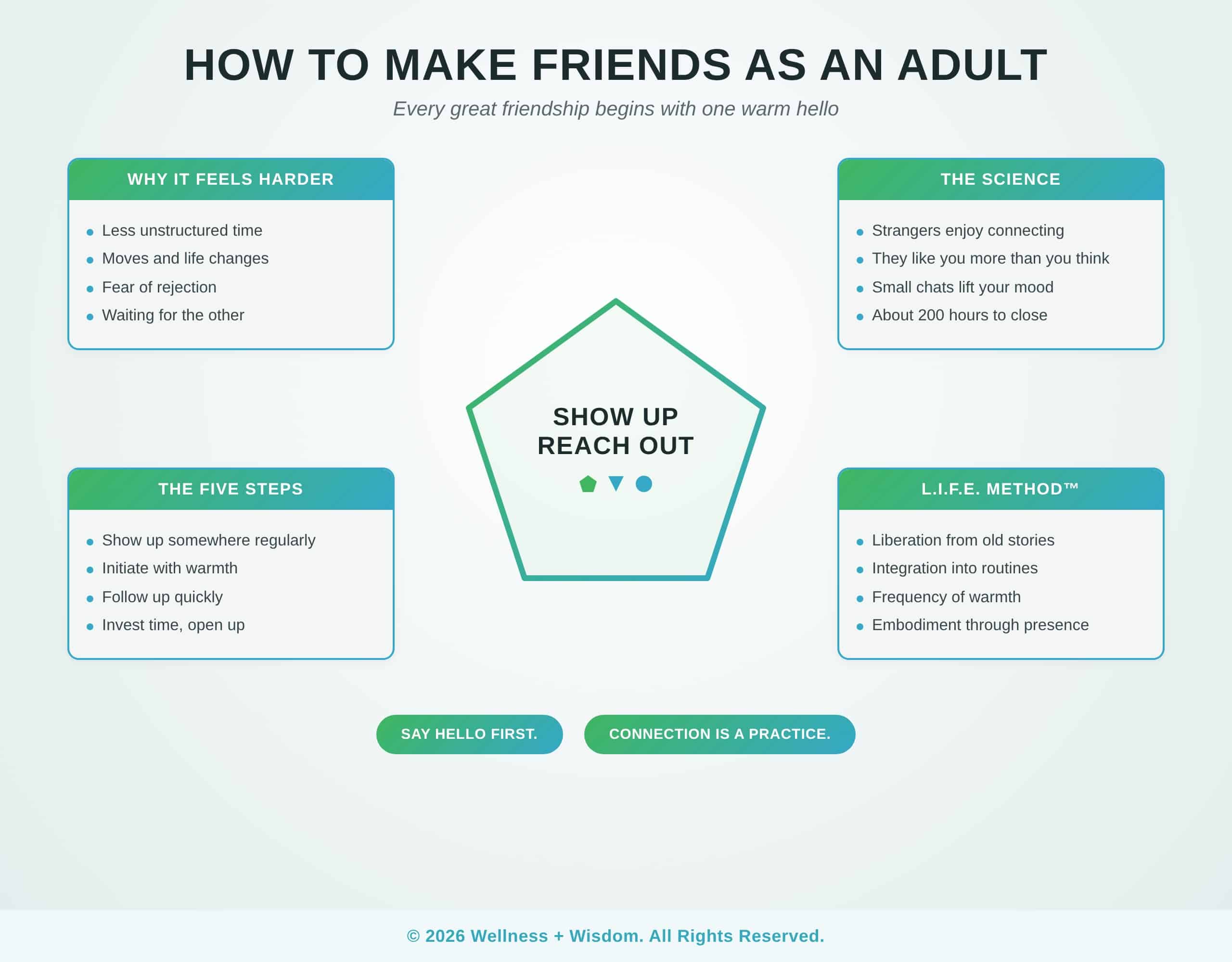
Friendship feels harder as an adult because work, family, and busy schedules leave less unstructured time, while moves, life changes, and digital habits reduce the natural face to face contact that friendships grow from. It is not that you have lost the ability to connect. The environment around you has changed.
There is also an emotional layer. Many adults carry quiet fears about reaching out. What if they think I am weird? What if they already have enough friends? What if I am rejected? These fears are deeply human, and they often keep us waiting for someone else to make the first move, while that someone else is waiting for us. If you notice a habit of holding back, the practices in how to build self confidence and how to stop seeking approval can be a beautiful support.
Some of our hesitation also traces back to early experiences. If you grew up feeling left out, moved often, or learned that relationships were unpredictable, your neural system may have learned to protect itself by staying at a distance. That protection made sense once. Today, it can be gently updated with new experiences of safe connection. That process is closely tied to building secure attachment as an adult, and it is absolutely possible at any age.
The Gift of Real Friendship
Real friendship gives you more joy, more support, a deeper sense of belonging, and measurable benefits for your health and longevity. Friends are the people who laugh with you on good days, sit with you on hard days, and remind you who you are when you forget.
Friends multiply our joys. A promotion, a new baby, a finished project, or a beautiful sunset all feel bigger when shared with someone who cares. Friends also soften our struggles. Knowing that someone has your back makes hard seasons feel more manageable, and simply talking things through with a trusted friend can bring clarity that is hard to find alone. Learning to let that care in is its own beautiful practice, which is explored in how to receive love.
Friendship also helps you grow. Good friends reflect you back to yourself. They encourage your dreams, challenge your blind spots with kindness, and model new ways of living. Over time, the people closest to you shape your habits, your values, and your vision of what is possible. That is why choosing and nurturing friendships with intention is one of the most powerful forms of self care there is.
The Science of Connection
The science of connection shows that strangers are more open to talking than we expect, that people like us more than we think after a conversation, that even small everyday interactions boost wellbeing, that friendships grow with time spent together, and that social connection is strongly linked to longevity. In short, reaching out is both safer and more rewarding than our fears suggest.
Start with our predictions. In a study published in the Journal of Experimental Psychology: General, Nicholas Epley and Juliana Schroeder asked train and bus commuters to either talk with a stranger or sit in solitude. Participants expected that conversation would be unpleasant, yet those who connected reported a more positive commute than those who stayed quiet. We consistently underestimate how much others want to connect.
Next, consider how we come across. Research led by Erica Boothby and published in Psychological Science found that after conversations with new people, participants systematically underestimated how much their conversation partners liked them and enjoyed their company. The researchers called this the liking gap. In plain terms, people probably like you more than you think. Small connections matter too. A study by Gillian Sandstrom and Elizabeth Dunn in Personality and Social Psychology Bulletin found that people felt happier and more connected on days when they had more interactions with weak ties, like classmates or familiar faces at a cafe.
Time is the bridge from acquaintance to friend. Jeffrey Hall, publishing in the Journal of Social and Personal Relationships, estimated that it takes roughly 50 hours together to move from acquaintance to casual friend, around 90 hours to become a friend, and more than 200 hours to become a close friend. And the stakes are real: a meta analysis led by Julianne Holt Lunstad in Perspectives on Psychological Science found that loneliness and social isolation were associated with a meaningfully higher risk of mortality. Investing in friendship is investing in a longer, more joyful life.
How to Make Friends as an Adult
You learn how to make friends as an adult by showing up somewhere regularly, initiating with warmth, following up quickly, investing time together, and gradually opening up. These five steps turn chance meetings into lasting connections. Here is how I practice and teach them.
1. Show Up Somewhere Regularly
Choose one or two activities you enjoy and attend them consistently, like a weekly class, a running club, a volunteer group, a faith community, or a regular spot at the same cafe. Repeated contact with the same faces is the soil friendship grows in. Familiarity makes conversation easier, and conversation makes connection possible.
2. Initiate With Warmth
Be the one who says hello first. Ask a simple, curious question. “How did you get into this?” “What are you working on these days?” Remember the liking gap: people are likely more open to you than you expect. A warm smile and genuine interest go a long way. Being a good listener is one of the fastest ways to make people feel comfortable with you, which is the same gift of presence explored in how to be present.
3. Follow Up Quickly
When you enjoy a conversation with someone, follow up within a few days. Send a message referencing something you talked about. Suggest a specific plan, like coffee next Tuesday or a walk on Saturday morning. Specific invitations are easier to say yes to than vague ones like “we should hang out sometime.” Following up is often the step that turns a nice moment into a real friendship.
4. Invest Time Together
Friendships grow with time, so make room for regular shared experiences. Recurring plans, like a monthly dinner or a weekly walk, take the effort out of scheduling and give the friendship a steady rhythm. Doing things together, like cooking, hiking, or working on a project, often builds closeness faster than talking alone.
5. Open Up Gradually
As trust grows, share a little more of yourself. Talk about what you care about, what you are excited for, and eventually what you find hard. Gradual openness invites the other person to open up too, and that mutual sharing is what turns acquaintances into close friends. It takes courage, and it is beautifully supported by the practices in how to speak your truth.
Start with just one of these steps this week and notice what happens. You do not need to become a social butterfly overnight. And if you would love to connect with people who share your values, the Liberated Life Tribe is a warm community full of people walking the same path.
Depth Versus Numbers
When it comes to friendship, depth matters far more than numbers. A few close friends who truly know and support you can bring more joy and resilience than a large circle of casual acquaintances. This is freeing, because it means you do not need a huge social life to feel deeply connected.
Social media can make it easy to confuse quantity with connection. Hundreds of followers or contacts can still leave you feeling unseen if none of those relationships carry real depth. Comparing your social life to the highlight reels of others can also make you feel behind, which is why the practices in how to stop comparing yourself to others can help here too.
Focus instead on nurturing a small number of relationships with care. Check in regularly. Remember what matters to them. Show up when it counts. Celebrate their wins. Over time, these few relationships can become the deep, steady friendships that carry you through every season. And while you nurture your inner circle, keep enjoying those lighter everyday connections too, because the research shows that friendly moments with familiar faces lift your mood as well.
How to Make Friends as an Adult With the L.I.F.E. Method™
The L.I.F.E. Method™ offers a beautiful framework for building friendships through four pillars: Liberation, Integration, Frequency, and Embodiment. Each pillar addresses a different part of what makes connection feel hard, and together they help you become someone who naturally attracts and nurtures deep friendship.
Liberation means freeing yourself from old stories about connection, like “I am awkward,” “people do not want to know me,” or “I am too busy for friends.” These beliefs often formed long ago and no longer reflect who you are. Gently noticing and releasing them opens the door to new experiences.
Integration means weaving connection into the rhythm of your existing life, rather than treating it as one more task. Invite a friend to join your morning walk. Turn a regular errand into a shared outing. Use the same consistent cues that help you build healthy habits, so friendship becomes part of your routine.
Frequency is about the energy you bring into your relationships. When you show up with warmth, curiosity, and generosity, people feel it and want to be around you. When you show up guarded or anxious, connection feels harder. A few slow breaths before a social event can shift your frequency toward calm and openness.
Embodiment means living your friendships through presence and action, not just intention. Put your phone away when you are together. Make eye contact. Show up in person when you can. To go deeper with identity level change, explore our L.I.F.E. Method™ programs.
Celebrating the People Who Show Up
Celebrating the people who show up for you is one of the most powerful ways to deepen friendship, because appreciation makes people feel valued and strengthens the bond between you. Gratitude is the glue that holds friendships together over time.
Tell your friends what they mean to you. Send a quick message saying you were thinking of them. Thank them specifically for something they did. Remember their birthdays and milestones. Show up for their big moments. These small acts of appreciation communicate something that words like “we should hang out” never can: you matter to me.
Celebrating your own progress matters too. Every time you reach out, follow up, or open up a little more, you are building the courage that friendship requires. Give yourself credit for those brave moments. There is a whole practice around honoring the people in your life in how to celebrate the people you love, and it pairs beautifully with the work of making new friends.
Friendship Is a Lifelong Practice
Friendship is a lifelong practice, because people grow, move, and change, and relationships naturally ebb and flow across the seasons of life. Some friendships will last decades. Others will be beautiful for a season. Both are gifts.
Major life transitions, like moving to a new city, becoming a parent, changing careers, or retiring, often reshape our social circles. These moments can feel lonely at first, but they are also invitations to build new connections that fit the person you are becoming. Each transition is a chance to practice the skills in this article again, and each time it gets a little easier.
Maintaining friendships matters just as much as making them. As life gets busy, even close friendships can quietly drift if no one tends them. A few simple habits keep connection alive across distance and changing schedules. Set a recurring reminder to check in with the people you care about most. Send a voice message when a song or memory makes you think of someone. Plan one shared experience each season, even if it is just a long phone call while you both take a walk in your own neighborhoods. When a friend goes quiet, reach out rather than assuming they have moved on. Most of the time, they are simply busy and will be grateful you made the effort. Friendships rarely end because of one big rupture. They usually fade from small neglect, which means small care keeps them strong.
Friendship also connects to the bigger picture of your wellbeing, which is why it is woven into the Wellness Pentagon™. Strong relationships support your emotional, mental, and physical health, and many people find that shared values and community deepen their Connection to Creator and God as well. You will hear many guests share how friendship and community transformed their lives across our latest episodes.
When Connection Feels Hard
If connection feels hard right now, you are in very good company, and it is completely understandable. Learning how to make friends as an adult does not mean every interaction will feel natural. It means you will gently build your capacity for connection, a little at a time, at a pace that honors where you are.
When reaching out feels daunting, start with the smallest step. Smile at a neighbor. Ask a coworker one curious question. Reply to an old friend's message. Join a group where the activity itself carries the conversation, like a hiking club or volunteer project, so you do not have to rely on small talk alone. If you need support asking for connection, the gentle steps in how to ask for help apply beautifully to friendship too. Tools that help you feel calm and grounded before social situations, like a breath training device, can also help, and you can find a few we trust in our wellness tools store.
It is also worth knowing that persistent loneliness, or social anxiety that makes connecting feel overwhelming, deserves real care. A qualified therapist can offer compassionate, effective tools for building confidence and connection. There is strength in asking for help. Wherever you are, be patient and kind with yourself, and trust that friendship is something you can absolutely grow, one warm hello at a time. A calmer body makes connection easier, which is why the breath practices in BREATHE™ are a wonderful companion to this work.
Ready to go deeper? Join the Liberated Life Tribe and receive your 10 day Self Liberation Blueprint at liberatedlife.com. It is free, it is guided, and it connects you with a community of people who believe in growing together.
Frequently Asked Questions
Why is it so hard to make friends as an adult?
Adult life offers less unstructured time and fewer natural settings where you see the same people repeatedly. Work, family, and moves also reduce casual contact. Fears of rejection can add hesitation. The good news is that friendship can be built intentionally by creating regular contact and shared time.
Where can adults meet new friends?
Look for places you can attend regularly, such as classes, clubs, running groups, volunteer projects, faith communities, or a favorite cafe. Activities that bring you into repeated contact with the same people are ideal, because familiarity makes conversation easier and gives friendships time to grow.
How long does it take to make a close friend?
Research by Jeffrey Hall estimated roughly 50 hours together to become casual friends, around 90 hours to become friends, and more than 200 hours to become close friends. Regular shared time, along with meaningful conversation, is what moves a relationship from acquaintance to close friendship.
What if I feel awkward starting conversations?
That is very common, and research shows people tend to like us more than we think after a conversation. Start with a simple, curious question about the other person, listen well, and let the conversation unfold. Practice makes it easier, and awkward moments are far less noticeable to others than they feel to you.
Does friendship really affect health?
Yes. A large meta analysis found that loneliness and social isolation were associated with a meaningfully higher risk of mortality. Strong social connections are linked with better emotional wellbeing, resilience, and physical health, making friendship one of the most valuable investments in your long term wellbeing.
How do I turn an acquaintance into a friend?
Follow up soon after a good conversation with a specific invitation, like coffee or a walk. Spend time together regularly, ideally through a recurring plan. Gradually share more about yourself and show interest in their life. Mutual openness and shared time are what deepen a connection into friendship.
Studies and External Resources
The science in this article rests on peer reviewed research. These are the sources referenced throughout.
- Epley N, Schroeder J. (2014). Mistakenly seeking solitude. Journal of Experimental Psychology: General. PubMed: 25019381
- Boothby EJ, et al. (2018). The Liking Gap in Conversations: Do People Like Us More Than We Think? Psychological Science. PubMed: 30183512
- Sandstrom GM, Dunn EW. (2014). Social Interactions and Well Being: The Surprising Power of Weak Ties. Personality and Social Psychology Bulletin. PubMed: 24769739
- Hall JA. (2019). How many hours does it take to make a friend? Journal of Social and Personal Relationships. DOI: 10.1177/0265407518761225
- Holt Lunstad J, et al. (2015). Loneliness and social isolation as risk factors for mortality: a meta analytic review. Perspectives on Psychological Science. PubMed: 25910392
About Josh Trent
Josh Trent is an Identity Transformation Architect and the award winning host of the Wellness + Wisdom Podcast, with over 15 million downloads since 2015. He is the creator of the L.I.F.E. Method™ Identity Transformation System and steward of the Emotional Epigenetics™ and BREATHE: Breath + Wellness™ systems of self mastery, impacting over 1,000 students worldwide. Join the Liberated Life Tribe and receive your 10 day Self Liberation Blueprint at liberatedlife.com. Josh lives in Austin, Texas with his wife Carrie, daughter Nayah, and son Novah. Peace and power.
Disclosure: We may earn a commission from certain links on this site when you make a purchase, at no extra cost to you. These commissions help support Wellness + Wisdom and do not affect the products or resources we choose to recommend. Full disclosure .