
By Josh Trent | Wellness + Wisdom Podcast Host & Identity Transformation Architect
“Sleep is not time you lose. It is the time your body uses to rebuild the person you get to be tomorrow. Learning how to sleep better is one of the most loving promises you can make to yourself.”
Josh Trent
Learning how to sleep better is one of the most powerful upgrades you can make to your entire life, because sleep touches everything: your energy, your mood, your focus, your relationships, and your long term health. So many of us treat sleep as the first thing to sacrifice when life gets busy. We stay up a little later to finish work, scroll a little longer to unwind, and then wonder why we wake up tired. The truth is beautifully simple. When you protect your sleep, almost everything else in your life gets easier. And the path to deeper rest is far more accessible than most people think. It starts with a few gentle rhythms that tell your body it is safe to let go, which is why it pairs so naturally with the breath practices in BREATHE™.
Here is the joy forward truth at the center of it all. Your body already knows how to sleep. You do not need to force it. You simply need to create the conditions where sleep can arrive naturally: consistent rhythms, a calm evening, the right light at the right time, and a neural system that feels safe enough to rest. When you learn how to sleep better, you wake up with more of yourself available for the day ahead. Let us explore exactly how.
Table of Contents
- What Good Sleep Really Means
- Why Sleep Gets Disrupted
- The Gift of Deep Rest
- The Science of Better Sleep
- How to Sleep Better
- Inviting Sleep Versus Forcing It
- How to Sleep Better With the Wellness Pentagon™
- Celebrating Each Restful Night
- Better Sleep Is a Lifelong Practice
- When Sleep Feels Out of Reach
- Frequently Asked Questions
- Studies and External Resources
- About Josh Trent
What Good Sleep Really Means
Good sleep means getting enough rest, at consistent times, with sleep that is deep and continuous enough that you wake up feeling restored. It is not only about the number of hours you spend in bed. Timing, consistency, and quality matter just as much as quantity.
During sleep, your body and brain are incredibly busy. Your muscles repair. Your immune system strengthens. Your brain sorts through the day, storing what matters and clearing what does not. Your emotions get processed, which is why a hard day often feels a little lighter after a good night's rest. Sleep is not downtime. It is some of the most productive time of your entire day.
Most adults do best with roughly seven to nine hours of sleep, though individual needs vary. A simple test is how you feel during the day. If you wake up without an alarm most days, feel alert through the morning, and do not rely on caffeine to function, your sleep is likely serving you well. If not, there is wonderful room to grow. Sleep comes up again and again in conversations on the Wellness + Wisdom Podcast, because almost every expert we talk to points back to it as a foundation.
Why Sleep Gets Disrupted
Sleep gets disrupted when our daily rhythms, evening habits, and stress levels send mixed signals to the body about when it is time to rest. Your internal clock relies on cues like light, darkness, meals, and routine. Modern life often scrambles those cues.
Light is one of the biggest factors. Bright screens late at night tell your brain it is still daytime, while days spent indoors deprive your body of the bright morning light that helps set its clock. Irregular schedules add to the confusion. When you go to bed at ten one night and one the next, your body struggles to know when to release the hormones that help you feel sleepy. Caffeine and late meals can also linger in your system longer than you might expect.
Then there is the mind. Many of us bring the whole day to bed with us, replaying conversations and planning tomorrow while lying in the dark. A busy mind keeps the neural system alert, which makes it hard to drift off. If this sounds familiar, the practices in how to stop overthinking and how to quiet the noise in your mind can be a gentle support. None of this means you are bad at sleeping. It simply means your sleep environment and rhythms are ready for some loving attention.
The Gift of Deep Rest
Deep rest gives you more energy, steadier emotions, sharper thinking, stronger immunity, and a brighter outlook on life. When you sleep well, you show up as the best version of yourself, not because you are trying harder, but because your body and mind have been fully restored.
Your emotional life changes first. After a good night's sleep, small frustrations feel smaller. You have more patience with your partner, your children, and yourself. Hard conversations feel more manageable. Sleep and emotional regulation are deeply connected, and many people are amazed by how much calmer they feel once they consistently protect their rest.
Your body changes too. Good sleep supports healthy metabolism, steady energy, and a strong immune system. It helps your muscles recover after exercise and supports healthy hunger and fullness signals. Your mind sharpens as well. Focus improves, creativity flows more freely, and decisions feel clearer. And here is the part I love most. When you are well rested, joy becomes easier to access. Colors feel brighter. Laughter comes more naturally. Life feels less like something to get through and more like something to savor. That is why sleep is one of the most important ways to honor your body.
The Science of Better Sleep
The science of better sleep shows that consistent sleep timing is strongly linked to long term health, that evening screen light delays your internal clock, that caffeine can disrupt sleep even six hours before bed, and that regular exercise improves sleep quality. Each of these findings points to simple changes you can make tonight.
Start with consistency. In a study published in Sleep, Daniel Windred and colleagues analyzed sleep data from about 60,000 adults in the UK Biobank and found that sleep regularity, meaning how consistent your sleep and wake times are from day to day, was a stronger predictor of mortality risk than sleep duration. Going to bed and waking up at similar times each day appears to be one of the most valuable sleep habits you can build.
Next, consider light. In a carefully controlled study published in the Proceedings of the National Academy of Sciences, Anne Marie Chang and colleagues compared reading on a light emitting tablet before bed with reading a printed book. When participants used the tablet in the evening, they took longer to fall asleep, felt less sleepy at bedtime, had lower melatonin, showed a later internal clock, and were less alert the next morning. Evening screens do more than keep us busy. Their light changes our biology.
Caffeine and movement matter too. A study led by Christopher Drake in the Journal of Clinical Sleep Medicine found that a large dose of caffeine taken even six hours before bedtime reduced total sleep time by more than an hour. And a meta analysis led by Alexandra Kredlow in the Journal of Behavioral Medicine found that regular exercise improved sleep quality and helped people fall asleep faster and sleep more efficiently. The encouraging message is clear: small daily choices add up to much better nights.
How to Sleep Better
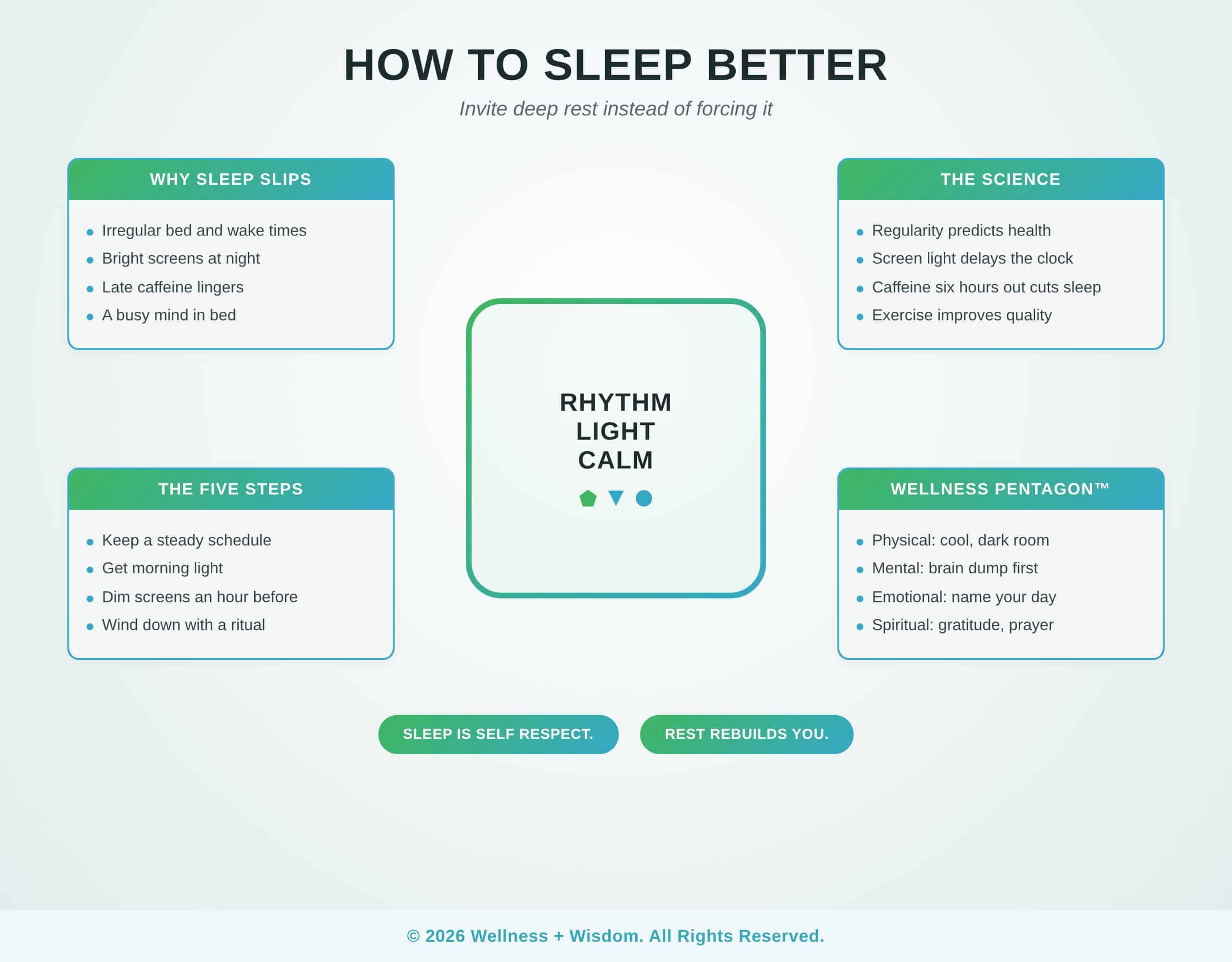
You learn how to sleep better by keeping a consistent schedule, getting morning light, dimming screens in the evening, timing caffeine wisely, and creating a calming wind down ritual. These five steps work with your natural biology to invite deep, restorative rest. Here is how I practice and teach them.
1. Keep a Consistent Schedule
Go to bed and wake up at roughly the same times every day, including weekends. This gives your internal clock a steady rhythm to follow, making it easier to fall asleep at night and wake up feeling alert. If your schedule is currently all over the place, start by anchoring your wake time and let your bedtime gradually follow. Consistency is one of the most powerful sleep tools there is.
2. Get Morning Light
Step outside or sit by a bright window soon after waking. Morning light helps set your internal clock, which makes you feel more alert during the day and sleepier at night. Even a few minutes makes a difference. This pairs perfectly with the practices in how to create a morning routine, because a great night of sleep truly begins in the morning.
3. Dim the Screens in the Evening
Aim to put screens away at least an hour before bed. If that feels like too much at first, start with thirty minutes. Swap scrolling for reading a printed book, stretching, journaling, or talking with someone you love. Dim the lights in your home as evening falls, too. Lower light tells your body that night is approaching and helps it prepare for rest.
4. Time Caffeine Wisely
Caffeine can linger in your system for many hours, so try to enjoy your last cup by early afternoon. Notice how different cutoff times affect your sleep and adjust accordingly. Many people are surprised by how much better they sleep once they move their last coffee a few hours earlier. Alcohol close to bedtime can also fragment sleep, so notice how it affects you as well.
5. Create a Calming Wind Down Ritual
Give yourself twenty to thirty minutes before bed to transition from the day into rest. You might take a warm shower, stretch gently, write down tomorrow's to do list so your mind can let it go, or practice a few minutes of slow breathing. A consistent ritual teaches your body that sleep is coming. Writing before bed can be especially helpful, which is supported by the research on journaling and brain health.
Start with one or two of these steps this week, rather than all five at once. Small, consistent changes build lasting habits, which is exactly the approach in how to build healthy habits. And if you would love daily encouragement from a supportive community, the Liberated Life Tribe is a warm place to grow.
Inviting Sleep Versus Forcing It
Sleep comes most easily when you invite it rather than force it. Trying hard to fall asleep usually makes it harder, because effort keeps the neural system alert. The secret is to create the right conditions and then let go.
Think about the last time you lay in bed thinking, “I need to fall asleep right now.” That pressure probably made you feel more awake, not less. Your mind started calculating how many hours you had left, your body tensed, and sleep slipped further away. This is a common pattern, and it is completely understandable. But it shows us something important: sleep is a process of surrender, not achievement.
Inviting sleep looks different. You do your wind down ritual, you get into bed when you feel sleepy, and you let your body rest without demanding anything of it. If you cannot fall asleep after a while, it often helps to get up, go to another dim room, and do something calm until you feel drowsy, then return to bed. This keeps your bed connected with rest rather than frustration. Simple practices of presence, like those in how to practice mindfulness, can help you rest in the moment instead of worrying about the clock. Remember, even quiet rest with your eyes closed is restorative.
How to Sleep Better With the Wellness Pentagon™
The Wellness Pentagon™ shows that sleep is shaped by every dimension of your life: physical, mental, emotional, spiritual, and financial. When you care for each one, deep rest becomes far more natural, because the things that keep you awake at night often start long before bedtime.
Physical. Move your body during the day, get morning light, time your caffeine, and keep your bedroom cool, dark, and quiet. These physical foundations give your body clear signals about when to be awake and when to rest.
Mental. Close the mental loops of your day before bed. A simple brain dump, where you write down everything on your mind and one next step for tomorrow, helps your thoughts settle so they do not follow you into the night.
Emotional. Give your feelings a place to land before sleep. Unprocessed emotions often surface at night, so a few minutes of reflection, a conversation with someone you love, or simply naming what you feel can help you rest more peacefully.
Spiritual. Ending the day with prayer, gratitude, or quiet stillness nurtures your Connection to Creator and God and helps you release what you cannot control. Many people find that a short evening practice of surrender brings a deep sense of peace that makes sleep come more easily.
Financial. Money worries are one of the most common reasons people lie awake. Spending a few minutes each week reviewing your finances during the day, rather than worrying about them at night, can quiet that late night loop. To explore the full framework, visit our mission and the Wellness Pentagon™.
Celebrating Each Restful Night
Celebrating each restful night helps reinforce the habits that made it possible. Your brain learns through reward, so when you notice how good it feels to wake up refreshed, you strengthen your motivation to protect your sleep again tonight.
Take a moment each morning to notice how you feel. If you slept well, connect that feeling to what you did the night before. Maybe you put your phone away earlier, finished your coffee by noon, or took a walk in the afternoon. Naming these connections helps you see that your choices are working, which makes them easier to repeat.
You can also celebrate the small steps, not just the perfect nights. Choosing to put the screen down thirty minutes earlier is a win, even if you still woke up once during the night. Keeping your wake time consistent on a Saturday is a win. These small victories build a foundation for lasting change. There is a whole practice around honoring these moments in celebrating small wins, and it pairs beautifully with better sleep.
Better Sleep Is a Lifelong Practice
Better sleep is a lifelong practice, because your sleep needs and challenges will shift across different seasons of life. A new baby, a big move, travel, a busy season at work, or changes in your body can all affect how you sleep. That is normal, and it does not mean you have lost your progress.
When sleep gets disrupted, return to the foundations. Anchor your wake time. Get morning light. Protect your wind down ritual. Be extra gentle with yourself during these seasons, and know that your body will find its rhythm again. Rest during the day can help too, whether that is a short nap, a quiet moment of stillness, or simply allowing yourself to slow down, which is beautifully explored in how to rest without guilt.
Your bedroom itself deserves a little loving attention as well. A cool, dark, quiet room tells your body that this space is for rest. Consider removing work materials, keeping clutter to a minimum, and choosing soft, warm lighting for the evening hours. Many people find that making their bed feel like a sanctuary, with comfortable bedding and a calming scent, turns going to sleep into something they look forward to rather than something they put off.
Over time, many people find that their relationship with sleep transforms. Instead of seeing it as something that gets in the way of their goals, they begin to see it as the foundation that makes their goals possible. Sleep becomes a daily act of self respect. You will find many experts sharing practical sleep insights across our latest episodes, and it is one of my favorite topics to explore.
When Sleep Feels Out of Reach
If sleep feels out of reach right now, you are in very good company, and it is completely understandable. Learning how to sleep better does not mean every night will be perfect. It means you will gently build habits that support deeper rest, a little at a time, at a pace that honors where you are.
When sleep feels hard, start with the smallest possible change. Put your phone in another room tonight. Step outside for five minutes tomorrow morning. Try a few rounds of slow breathing when you get into bed, such as box breathing or simply lengthening your exhale. Small changes can create surprising shifts. Supportive tools like blackout curtains, a sleep mask, or a breath training device can also help, and you can find a few we trust in our wellness tools store.
It is also important to know that ongoing trouble falling or staying asleep, loud snoring, gasping during sleep, or persistent daytime exhaustion can point to sleep conditions that deserve care from a qualified health professional. Effective, evidence based treatments are available, and there is real strength in asking for help. Wherever you are, be patient and kind with yourself, and trust that learning how to sleep better is something you can absolutely grow, one restful night at a time. If a calmer body would help you drift off, the practices in neural system regulation are a gentle next step.
Ready to go deeper? Join the Liberated Life Tribe and receive your 10 day Self Liberation Blueprint at liberatedlife.com. It is free, it is guided, and each day offers a simple practice that supports a calmer mind and deeper rest. To go further with identity level change, explore our L.I.F.E. Method™ programs.
Frequently Asked Questions
What is the fastest way to sleep better?
Keep a consistent wake time, get morning light, put screens away an hour before bed, and finish caffeine by early afternoon. These simple changes work with your natural biology and often improve sleep within a week or two. A calming wind down ritual and slow breathing in bed can also help.
How many hours of sleep do adults need?
Most adults do best with roughly seven to nine hours of sleep, though individual needs vary. A good sign that you are getting enough is waking without an alarm most days, feeling alert through the morning, and not relying on caffeine to function.
Do screens really affect sleep?
Yes. A study in the Proceedings of the National Academy of Sciences found that reading on a light emitting tablet before bed made it take longer to fall asleep, lowered melatonin, delayed the internal clock, and reduced alertness the next morning compared with reading a printed book.
How late can I drink coffee and still sleep well?
Caffeine can linger for many hours. Research found that a large dose of caffeine taken even six hours before bed reduced total sleep by more than an hour. Many people sleep better when they enjoy their last caffeinated drink by early afternoon.
Why is a consistent sleep schedule important?
Your internal clock relies on regular timing. A large study of about 60,000 adults found that sleep regularity was a stronger predictor of mortality risk than sleep duration. Going to bed and waking at similar times each day helps your body know when to rest and when to be alert.
When should I see a professional about my sleep?
If you regularly struggle to fall or stay asleep, snore loudly, gasp during sleep, or feel exhausted during the day despite enough time in bed, talk with a qualified health professional. Many sleep conditions respond well to evidence based treatment.
Studies and External Resources
The science in this article rests on peer reviewed research. These are the sources referenced throughout.
- Windred DP, et al. (2024). Sleep regularity is a stronger predictor of mortality risk than sleep duration: A prospective cohort study. Sleep. PubMed: 37738616
- Chang AM, et al. (2015). Evening use of light emitting eReaders negatively affects sleep, circadian timing, and next morning alertness. Proceedings of the National Academy of Sciences. PubMed: 25535358
- Drake C, et al. (2013). Caffeine effects on sleep taken 0, 3, or 6 hours before going to bed. Journal of Clinical Sleep Medicine. PubMed: 24235903
- Kredlow MA, et al. (2015). The effects of physical activity on sleep: a meta analytic review. Journal of Behavioral Medicine. PubMed: 25596964
About Josh Trent
Josh Trent is an Identity Transformation Architect and the award winning host of the Wellness + Wisdom Podcast, with over 15 million downloads since 2015. He is the creator of the L.I.F.E. Method™ Identity Transformation System and steward of the Emotional Epigenetics™ and BREATHE: Breath + Wellness™ systems of self mastery, impacting over 1,000 students worldwide. Join the Liberated Life Tribe and receive your 10 day Self Liberation Blueprint at liberatedlife.com. Josh lives in Austin, Texas with his wife Carrie, daughter Nayah, and son Novah. Peace and power.
Disclosure: We may earn a commission from certain links on this site when you make a purchase, at no extra cost to you. These commissions help support Wellness + Wisdom and do not affect the products or resources we choose to recommend. Full disclosure .