
By Josh Trent | Wellness + Wisdom Podcast Host & Identity Transformation Architect
“We do not build resilient children by shielding them from every hard feeling. We build them by staying close while they learn to feel it. Connection is the soil that strength grows in.”
Josh Trent
Emotionally resilient children are not born that way, and they are not made by being toughened up. They are grown, patiently, in the soil of safe connection, as they learn that hard feelings can be felt and survived with a steady adult nearby. In a world that often feels dysregulated and overwhelming, raising kids who can meet life's challenges with strength and heart is one of the most important things any parent can do. And the beautiful news is that the science of how to do it is clear, hopeful, and deeply human. This is the heart of conscious parenting and everything we teach about raising the next generation.
Here is the joy forward truth at the center of it all. You do not have to be a perfect parent to raise emotionally resilient children. You do not need to protect them from every difficulty or have all the answers. What children need most is not perfection but presence, a warm, steady adult who stays connected while they learn to navigate their own inner world. In fact, children often learn the most from watching us repair our mistakes, which means your imperfections, handled with honesty, can become some of their best lessons. This article walks through what resilience really is, what the science shows, and how to nurture it in the children you love.
Table of Contents
- What Emotional Resilience in Children Really Is
- Signs of an Emotionally Resilient Child
- Why Resilience Matters More Than Ever
- The Science of How Resilience Is Built
- Resilience Is Not the Same as Toughness
- How to Raise Emotionally Resilient Children
- Nurturing Resilience as They Grow
- Emotionally Resilient Children and Conscious Parenting
- Breaking the Cycle for the Next Generation
- Frequently Asked Questions
- Studies and External Resources
- About Josh Trent
What Emotional Resilience in Children Really Is
Emotional resilience in children is the ability to feel difficult emotions, recover from setbacks, and adapt to challenges while staying fundamentally grounded and connected. It is not the absence of hard feelings or hard times. It is the capacity to move through them and come out the other side intact, and often stronger. A resilient child still cries, still gets scared, still struggles. The difference is that they trust, deep down, that they can handle it and that they are not alone.
It helps to picture resilience not as a wall but as a tree. A wall is rigid and eventually cracks under enough pressure. A tree bends in the storm, its roots holding it steady, and it springs back when the wind passes. Emotionally resilient children are like that tree. They have flexibility and strength together, rooted in a felt sense of safety and connection that lets them weather life's storms without breaking.
This is a capacity that grows over time, through experience and relationship. Children are not simply born resilient or fragile. They develop resilience through thousands of everyday moments in which they face something hard and discover, with support, that they can get through it. Our job as the adults in their lives is to provide the connection and safety that makes that discovery possible, which is the foundation of true emotional intelligence in children. We are not building their strength for them. We are creating the conditions in which their own strength can grow.
Signs of an Emotionally Resilient Child
It helps to know what resilience actually looks like in a child, so you can recognize and encourage it as it grows. Resilience does not mean a child who never melts down or never struggles. In fact, a resilient child often feels things deeply. What sets them apart is how they move through those feelings and what they trust underneath them.
You might notice a resilient child can calm down after being upset, sometimes on their own and sometimes with a little help, rather than staying stuck in distress for hours. You might see them try again after a failure instead of giving up entirely, or reach out for comfort when they need it rather than shutting down completely. They tend to be able to name what they feel, at least in simple terms, and to recover their sense of okayness after a hard moment passes. None of these abilities appear all at once, and none of them require the child to be calm all the time. They are simply signs that the roots of resilience are taking hold.
Importantly, these signs look different at different ages and in different temperaments. A naturally sensitive child and a naturally easygoing child will both show resilience, just in their own ways. The goal is never to turn every child into the same calm, unbothered kid. It is to help each child, with their unique nature, develop their own capacity to feel, recover, and keep going. Resilience wears many faces, and yours will wear the one that fits your child.
If your child does not show these signs yet, please do not worry or compare. Resilience develops gradually and unevenly, with plenty of steps backward along the way, especially during hard seasons or big developmental leaps. Your steady presence is what slowly builds it. Every time you help your child through a hard moment, you are laying down another root, even when you cannot yet see the tree, a process rooted in your own inner work.
Why Resilience Matters More Than Ever
Emotional resilience matters more today than perhaps ever before, because children are growing up in a world that is genuinely dysregulating. The pace of modern life, the constant stimulation of screens, the pressures of comparison, and the general anxiety of the times all place real demands on a developing child's inner world. In an environment like this, the ability to stay grounded and recover from stress is not a luxury. It is essential.
Children are also, by their nature, exquisitely attuned to the emotional states of the adults around them. When the grown ups in a child's life are chronically stressed and dysregulated, children absorb that, because their developing systems borrow regulation from ours. This means that in a dysregulated world, the calm, resilient presence of even one steady adult becomes profoundly protective for a child. You do not have to fix the whole world. You have to be a steady harbor within it. Children are remarkably forgiving of an imperfect world when they have one dependable person who helps them feel safe inside it. That single relationship can outweigh a great deal of outside chaos.
The stakes are meaningful, because the emotional patterns children form early tend to follow them into adulthood. A child who learns that feelings are safe and manageable carries that gift for life, while a child who learns that feelings are dangerous may spend years unlearning it. The patterns we help set now become the inner default they will live from long after they leave our homes. By nurturing resilience now, we are not just helping children cope today. We are shaping the adults they will become, a truth we explore throughout the Wellness + Wisdom Podcast.
The Science of How Resilience Is Built
The science of resilience points to one factor above all others: the presence of at least one stable, caring relationship. Decades of developmental research show that what most reliably protects children through adversity and builds their resilience is a secure, supportive bond with a caring adult. Connection is not the soft part of raising strong kids. It is the very mechanism by which strength is built.
This is illuminated by the landmark Adverse Childhood Experiences study by Vincent Felitti and colleagues, published in the American Journal of Preventive Medicine, which showed how deeply early experiences shape long term health and wellbeing. The flip side of that research is equally powerful. Just as adversity can leave a mark, supportive, attuned relationships can buffer stress and foster resilience, changing the trajectory of a child's life for the better.
The mechanism runs largely through the stress response. The researcher Bruce McEwen described in the New England Journal of Medicine how chronic, unbuffered stress produces allostatic load, the cumulative wear that builds when the body's alarm stays activated. A caring adult acts as a buffer, helping a child's neural system return to calm again and again. Over time, through this repeated co regulation, the child internalizes the ability to regulate themselves. Resilience, in other words, is built through connection, one soothed moment at a time. Each time a child is helped back to calm, their own capacity to find calm grows a little stronger, until one day they can do for themselves what you once did for them.
Resilience Is Not the Same as Toughness
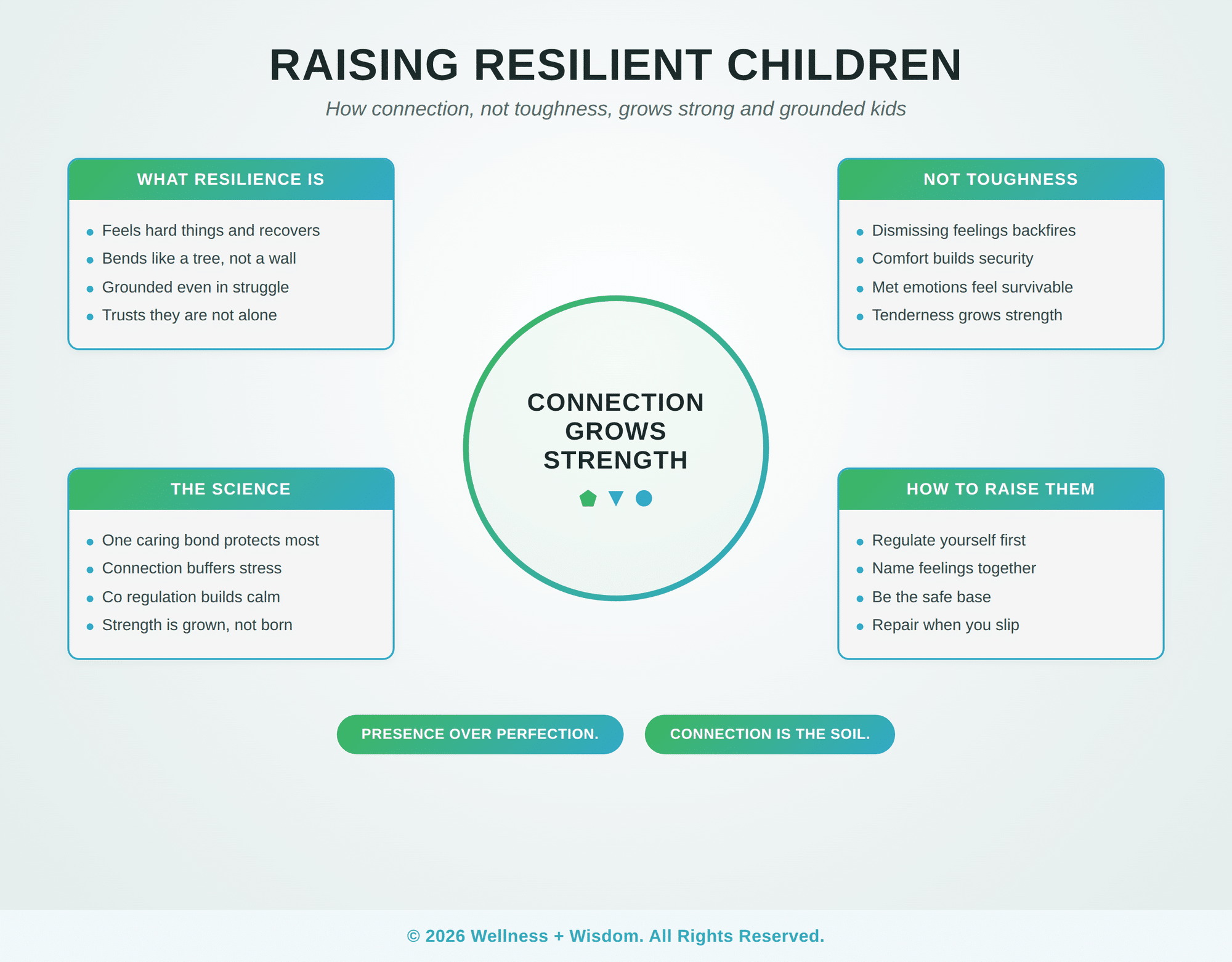
One of the most important things to understand is that emotional resilience is not the same as toughness, and confusing the two can actually undermine the very strength we are trying to build. The old model said we make children strong by hardening them, by dismissing their tears, telling them to toughen up, or refusing to comfort them so they do not become soft. The science tells a very different story.
Children do not become resilient by having their feelings dismissed. They become resilient by having their feelings met and helped, so that they learn feelings are manageable rather than overwhelming. A child who is comforted when upset does not become weak or dependent. They become secure, and security is the ground resilience grows from. The child who knows comfort is available is the very child who grows brave enough to venture out and try. Meeting a child's emotions is not coddling. It is teaching their body that hard feelings can be survived.
This means the goal is not to remove all struggle from a child's life, which would be both impossible and unhelpful. Children do need to experience manageable challenges to grow. The goal is to let them face age appropriate difficulties while staying connected and supported, so that struggle becomes a teacher rather than a trauma. Strength and tenderness are not opposites here. Tenderness is precisely how lasting strength is grown, a theme we return to in our work on emotional courage. The child who was met with warmth in their hardest moments becomes the adult who can meet their own hard moments with steadiness.
How to Raise Emotionally Resilient Children
Raising emotionally resilient children is less about specific techniques and more about a consistent way of being with them. Here are the practices that research and experience show matter most.
1. Regulate Yourself First
Because children co regulate with us, your own steadiness is the foundation. When you can stay relatively calm during a child's storm, you lend them your regulation. This is why your own inner work, breath, and self care are not separate from parenting. They are the most important parenting tools you have.
2. Name Feelings With Them
Help your child put words to what they feel. You seem really frustrated right now. Naming emotions, as research on affect labeling shows, actually calms the brain's alarm center, and it teaches children an emotional vocabulary they will use for life. This simple practice builds lifelong emotional literacy.
3. Be the Safe Base
Let your child know, through your consistent presence, that you are a safe harbor they can always return to. A child who trusts they have a secure base is far more willing to venture out, take risks, and recover from falls, which is the very definition of resilience. This is the heart of secure attachment.
4. Allow Struggle, Offer Support
Resist the urge to rescue your child from every difficulty. Instead, let them face age appropriate challenges while you stay near, offering encouragement rather than taking over. This teaches them that they are capable, and that support is available, both of which build genuine confidence that no amount of rescuing could ever provide.
5. Repair When You Get It Wrong
You will lose your patience and get it wrong sometimes, and that is not the failure. The failure would be never repairing. Coming back to reconnect, and even to apologize, teaches your child that relationships survive rupture, which is one of the most resilience building lessons of all.
None of this requires perfection. It requires showing up, again and again, with warmth and steadiness. Resilience is built in the accumulation of ordinary caring moments, and every one of them counts. There is no single conversation or perfect response that does it. It is the pattern over time, the reliable return to warmth, that slowly grows a resilient heart. When you want support and community for this journey, the Liberated Life Tribe is here for you.
Nurturing Resilience as They Grow
The way we nurture resilience shifts as children grow, even though the foundation of safe connection stays the same throughout. Understanding what each stage needs can help you meet your child where they actually are.
With babies and toddlers, resilience is built almost entirely through responsive caregiving. When you soothe a distressed little one consistently, you are wiring in the deep sense that the world is safe and that comfort is available. This is not spoiling. It is laying the foundation, and a few slow breaths of your own, the kind we teach through box breathing, help you stay the calm they borrow from.
With young children, naming feelings and gentle guidance become central. This is the age to build an emotional vocabulary, to narrate feelings out loud, and to let them experience small, manageable frustrations while you stay close. You are teaching them that big feelings are normal and survivable, and that you are a reliable safe base to return to.
With older children and teens, resilience grows through increasing autonomy paired with unwavering connection. They need room to face real challenges and even to fail, while knowing without doubt that you are still there. The steady message across every age is the same, that they are capable and they are not alone. That combination, freedom plus connection, is what allows resilience to mature into genuine independence over time, and it is part of healing our own early wounds in the process.
Emotionally Resilient Children and Conscious Parenting
Raising emotionally resilient children is at the very heart of conscious parenting, the approach we champion at Wellness + Wisdom. Conscious parenting means bringing awareness to how we show up as parents, healing our own patterns so we do not unconsciously pass them on, and meeting our children as whole people rather than problems to manage. It is parenting from presence rather than reactivity.
This matters enormously for resilience, because so much of what we transmit to our children happens below the level of words. When we do our own inner work through the tools of the L.I.F.E. Method™, learning to regulate our own neural systems and feel our own feelings, we naturally become the calm, steady presence that grows resilience in our kids. In this way, our own healing becomes one of the greatest gifts we give our children.
Conscious parenting also honors the spiritual dimension of raising children, recognizing that we are shepherding not just their behavior but their whole developing being, including their Connection to Creator and God. When we parent from this place of presence and reverence, we create the safe, loving container in which emotionally resilient children naturally flourish. Explore this deeper through our conscious parenting teachings and latest episodes.
Breaking the Cycle for the Next Generation
Perhaps the most powerful reason to raise emotionally resilient children is that in doing so, we often heal something in ourselves and break patterns that have run in our families for generations. Many of us were raised by well meaning parents who simply did not have these tools, who dismissed feelings because their feelings were dismissed, passing an unconscious inheritance down the line.
When you choose to parent differently, to meet your child's emotions with presence rather than avoidance, you are not just helping your child. You are interrupting a generational pattern and writing a new story for your whole family line. This is deep work, and it is often the very reason we are drawn to our own healing in the first place. The desire to give our children what we did not receive can be a powerful catalyst for our own growth, a theme at the center of breaking generational cycles. In learning to soothe our children, many of us finally learn to soothe the child still living within us.
This is the beautiful, hopeful heart of it all. The resilience you build in your children today can ripple forward for generations, just as the healing you do in yourself ripples both backward and forward through your family. You are not only raising strong kids. You are participating in a kind of generational healing that can change the trajectory of your entire lineage. There are few more meaningful reasons to do this work, and you do not have to do it alone. Our programs and community are here to walk with you.
Frequently Asked Questions
What does it mean for a child to be emotionally resilient?
Emotional resilience in children is the ability to feel difficult emotions, recover from setbacks, and adapt to challenges while staying grounded and connected. It is not the absence of hard feelings. A resilient child still cries and struggles, but trusts deep down that they can handle it and that they are not alone. It is more like a tree that bends and springs back than a wall that cracks.
Are children born resilient, or is it built?
It is built. Children develop resilience through thousands of everyday moments in which they face something hard and discover, with support, that they can get through it. Decades of research show that the single most protective factor is at least one stable, caring relationship. Connection is the mechanism by which strength is grown, one supported moment at a time.
Does comforting my child make them weak or dependent?
No. Children become resilient by having their feelings met and helped, not dismissed. A child who is comforted when upset does not become weak, they become secure, and security is the ground resilience grows from. Meeting a child's emotions teaches their body that hard feelings can be survived, which is the opposite of fragility.
How do I help my child build resilience?
Start by regulating yourself, since children co regulate with us. Name feelings with them to build emotional literacy, be a consistent safe base they can return to, allow age appropriate struggle while offering support rather than rescuing, and repair when you get it wrong. Resilience is built through the accumulation of ordinary caring moments, not through toughening kids up.
What is the difference between resilience and toughness?
Toughness, in the old sense, means hardening a child by dismissing their feelings. Resilience means helping them feel and move through emotions so they learn feelings are manageable. Children do not become strong by having emotions dismissed, but by having them met. Tenderness is precisely how lasting strength is grown, not its opposite.
How does raising resilient children connect to conscious parenting?
Conscious parenting means bringing awareness to how we show up, healing our own patterns so we do not pass them on, and parenting from presence rather than reactivity. Because children absorb our emotional states, our own inner work makes us the calm, steady presence that grows resilience. Our healing becomes one of the greatest gifts we give our children.
Studies and External Resources
The science in this article rests on peer reviewed research. These are the sources referenced throughout.
- Felitti VJ, et al. (1998). Relationship of Childhood Abuse and Household Dysfunction to Many of the Leading Causes of Death in Adults (The Adverse Childhood Experiences Study). American Journal of Preventive Medicine. PubMed: 9635069
- McEwen BS. (1998). Protective and damaging effects of stress mediators. New England Journal of Medicine. PubMed: 9428819
- Lieberman MD, et al. (2007). Putting Feelings Into Words: Affect Labeling Disrupts Amygdala Activity in Response to Affective Stimuli. Psychological Science. PubMed: 17576282
About Josh Trent
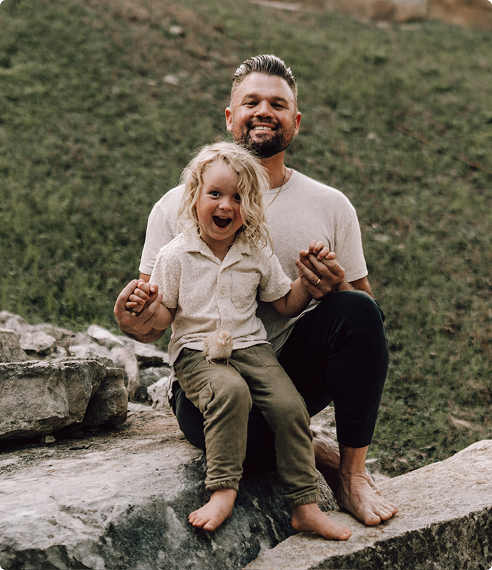
Josh Trent is an Identity Transformation Architect and the award winning host of the Wellness + Wisdom Podcast, with over 15 million downloads since 2015. He is the creator of the L.I.F.E. Method™ Identity Transformation System and steward of the Emotional Epigenetics™ and BREATHE: Breath + Wellness™ systems of self mastery, impacting over 1,000 students worldwide. Join the Liberated Life Tribe and receive your 10 day Self Liberation Blueprint at liberatedlife.com. Josh lives in Austin, Texas with his wife Carrie, daughter Nayah, and son Novah.
Disclosure: We may earn a commission from certain links on this site when you make a purchase, at no extra cost to you. These commissions help support Wellness + Wisdom and do not affect the products or resources we choose to recommend. Full disclosure .