By Josh Trent | Emotional Intelligence | April 9, 2026
“Between stimulus and response there is a space. In that space is our power to choose our response. In our response lies our growth and our freedom.” — Viktor Frankl
Let me ask you something before we get into the science. Think about the last time you were gripped by a strong emotion. Anger, grief, embarrassment, fear, maybe a sudden crushing sadness that seemed to come from nowhere. How long did it actually last in your body before your mind got involved and started telling stories about it?
Most people never separate those two things: the raw biological event in the body and the narrative the mind constructs on top of it. That confusion is what keeps people trapped inside emotional states that feel permanent but are not. That confusion is the prison, and understanding the 90 second emotion rule is one of the most powerful keys to walking out of it.
The science is straightforward and extraordinary at the same time. According to Harvard trained neuroanatomist Dr. Jill Bolte Taylor, whose discoveries emerged from a deeply personal experience of witnessing her own brain during a massive stroke, the physiological lifespan of an emotional response is approximately 90 seconds. A wave of anger, a surge of grief, a flash of panic: the brain chemistry that drives each of these peaks and dissipates in roughly a minute and a half. What persists beyond that window is not biology. It is choice, conscious or unconscious, to keep stoking the fire. On the Wellness + Wisdom Podcast, we have explored this truth from dozens of angles, and every single time it lands as a revelation for the people hearing it for the first time.
Today I want to go deep on why this matters, what the latest neuroscience is actually saying about how long emotions last, how this connects to Emotional Epigenetics and your inherited patterns, and most importantly, how you can use this understanding as a daily liberation practice. Because that is what this is. Not a productivity hack. Not another mindfulness technique to add to your list. A genuine pathway to authentic joy through one of the most surprising truths in all of modern neuroscience.
What the 90 Second Emotion Rule Actually Means
Before anything else, I want to make sure we are talking about the same thing, because there is a lot of oversimplification floating around about this concept, and oversimplification in the realm of emotion science can actually do more harm than good.
The 90 second emotion rule does not mean you should be over your grief in 90 seconds. It does not mean trauma resolves in a minute and a half. It does not mean you are failing if you feel something for longer than that. What it means is that the raw neurochemical event, the flood of chemicals your limbic system releases in response to a trigger, has a biological lifespan of approximately 90 seconds. After that window, if the emotion persists, something else is keeping it alive. And that something else is the mind re engaging with the story.
Dr. Jill Bolte Taylor described it this way in her landmark book My Stroke of Insight: “When a person has a reaction to something in their environment, there's a 90 second chemical process that happens in the body; after that, any remaining emotional response is just the person choosing to stay in that emotional loop.” This distinction between the automatic biological event and the chosen continuation of the story is the entire game when it comes to emotional intelligence and freedom.
Think of it like a wave. The ocean generates the wave, it rises, it crests, it crashes. The ocean does not keep the wave going indefinitely. But if you are standing there frantically recreating the wave with your arms, you can make it last much longer than nature intended. Your thoughts are the arms. Your interpretations, your judgments, your narratives about what just happened are what extend a 90 second biological event into an hours long emotional siege.
This is not a blame statement. It is a biology statement. And understanding it changes everything. You can explore more foundational tools for emotional intelligence at the L.I.F.E. Method programs we have built specifically to help people move through this process with real support.
The Brain Science Behind the 90 Second Emotion Rule
The Limbic System and the Chemical Cascade
To understand the 90 second emotion rule, you need a brief tour of your limbic system. The limbic system is the part of the brain responsible for processing emotions, forming memories, and triggering survival responses. When your brain perceives a threat, real or imagined, the amygdala (the brain's alarm center) fires and initiates a cascade of neurochemical events. Stress hormones including cortisol and adrenaline flood the bloodstream. Your heart rate increases. Your muscles tense. Your attention narrows. Your body is mobilized for action.
This cascade happens fast, faster than conscious thought. It was designed for survival in a world where predators were real and instant physical response was the difference between life and death. The problem is that your brain does not know the difference between a charging lion and your boss sending a critical email. The threat detection system does not require the threat to be real. It requires it to feel real.
Here is what most people do not know: this cascade, as powerful as it feels, is chemically self limiting. The stress hormones that flood your system are processed and metabolized. The wave breaks. According to Dr. Taylor's framework, this cycle completes in approximately 90 seconds from the moment of triggering. Your biology is designed to move through it, not to live in it.
What Happens at the 90 Second Mark
At approximately the 90 second point, if you have not re engaged the story, something remarkable happens. The chemistry begins to normalize. Heart rate slows. Muscle tension releases. The prefrontal cortex, the seat of clear thinking and wise decision making, begins to come back online. You move from reactive to responsive. You regain access to your full intelligence.
This is the biology of emotional freedom. And it is available to every human being who is willing to sit inside the wave for 90 seconds without feeding it new fuel. The key phrase there is “without feeding it new fuel.” Because the moment you start replaying what happened, building your case, imagining future conversations, or judging yourself for feeling this way, you reset the clock. The limbic system reactivates. The chemistry flows again. And you are back to zero.
You can learn more about the neural system regulation tools that support this process on the Wellness Pentagon page, where we walk through all five dimensions of whole person health that this kind of emotional skill supports and strengthens.
How Long Do Emotions Last: What the Science Now Reveals
The Stanford 2025 Discovery
In May 2025, researchers at Stanford Medicine published extraordinary findings that add significant depth to what we understand about how long emotions last and how the brain maintains emotional states beyond their initial trigger. Their work, published in Science, mapped brainwide neuronal processing during emotional responses triggered by sensory experiences, revealing that the brain can sustain emotional states long after the initiating stimulus has ended.
What this means practically is that the brain is capable of extending the emotional experience well beyond the 90 second initial chemical window, not through continued external threat, but through internal processing networks that recycle and maintain the emotional signal. This is not contradicting Dr. Taylor's framework. It is expanding it. The biology of the initial response may complete in 90 seconds. But the brain's architecture for holding and replaying emotional experience is considerably more complex, and considerably more influenced by habit, attention, and what we might call emotional programming.
This Stanford discovery is particularly significant for understanding chronic emotional states, the kind that persist day after day and begin to feel like personality rather than passing weather. The brain, especially a brain shaped by trauma or inherited emotional patterns, has learned to be very efficient at maintaining certain emotional frequencies. The good news is that what is learned can be unlearned. What is practiced can be repracticed. That is the heart of both emotion regulation science and the work I do through the L.I.F.E. Method.
Onset Bound vs. Offset Bound Emotional Processing
A peer reviewed study published in Social Cognitive and Affective Neuroscience and available through PubMed Central identified two primary constituents of emotional experience over time: onset bound processes, which are associated with the explosive arrival of an emotion, and offset bound processes, which are associated with how the emotion accumulates and lingers.
The researchers found that different emotions have different temporal profiles. Fear, disgust, and happiness showed characteristic two phase patterns. Sadness showed a single prolonged phase. This research is significant because it confirms that not all emotions are created equal when it comes to duration, and that different emotions engage different brain regions over time. What this means for you is that the question of how long emotions last does not have a single universal answer. It has a relational answer: it depends on the emotion, it depends on the individual's neural system patterns, and critically, it depends on whether the person is feeding the emotion with continued thought or allowing it to complete its natural arc.
For more on how these patterns show up in inherited emotional programming, you can explore our latest podcast episodes where we regularly feature neuroscientists, therapists, and researchers working at the cutting edge of emotion science.
Why Emotions Outlast Their Biology: The Thought Loop Problem
The Re Triggering Loop
Here is where the rubber meets the road. If the biological event of an emotion completes in 90 seconds, why do most people experience emotions that last for hours, days, or even years? The answer is the thought loop.
Every time you return to the triggering thought, your limbic system receives a signal that the threat is still present. Every replay of the conversation that upset you, every imagined version of what you should have said, every internal monologue about how unfair the situation was, is a new signal to your amygdala that danger is still here. This re triggers the chemical cascade. And the 90 second clock resets.
This is not weakness. This is the default behavior of a brain that has not yet learned to distinguish between actual present moment threat and mental rehearsal of past events. Both generate the same neurochemical response. The body cannot tell the difference between something happening now and a vivid memory or imagination of something happening. This is the same mechanism that makes breathwork so powerful for releasing stored emotion. You can learn more about this at our Best of 2025 solocast episodes.
The invitation here is not to stop thinking. That is neither possible nor desirable. The invitation is to develop the witnessing capacity to notice when you are in a thought loop and to interrupt it consciously. That interruption is one of the most valuable skills available to any human being who wants to live in genuine freedom.
Emotional Epigenetics: When the Loop Goes Generational
Now here is where this gets profound, and where I bring in the framework that has shaped my entire approach to wellness and healing: Emotional Epigenetics.
The thought loop problem does not begin with you. For many people, the emotional patterns that extend emotions far beyond their 90 second biological window were not learned in their own lifetime. They were inherited from parents, grandparents, and even earlier ancestors who lived through experiences that were never fully processed or metabolized.
Research on epigenetic inheritance, including the landmark work of Dias and Ressler at Emory University demonstrating that mice can pass fear responses associated with specific scents to their offspring without any direct exposure, shows that emotional states have a biological downstream. When a family carries a pattern of hypervigilance, explosive anger, chronic sadness, or fear, it is often not simply a matter of learned behavior. It may be a matter of genuinely inherited neural system programming that predisposes the children and grandchildren to extend emotional responses far beyond the 90 second window because their baseline is already elevated.
A 2024 scoping review published in MDPI Medicine examining epigenetic and coping mechanisms of stress in affective disorders found that various stress factors including childhood trauma are associated with epigenetic changes such as DNA methylation and altered gene expression in key stress response genes. The implication is clear: how you regulate your emotions is not purely a psychological choice. It is shaped by biology, by inheritance, and by years of patterned neural system conditioning.
This is not a reason to despair. It is a reason to bring extraordinary compassion to yourself and your family. And it is a reason to take the work of emotional regulation seriously as a form of healing that extends beyond this lifetime. Every pattern you interrupt, every 90 second wave you actually ride to completion instead of feeding, is a signal you are sending to your own biology that says: this is not the baseline anymore. We can do this differently. Explore more about this work at the Liberated Life Tribe.
Emotional Wave Riding: A Practice for the 90 Second Window
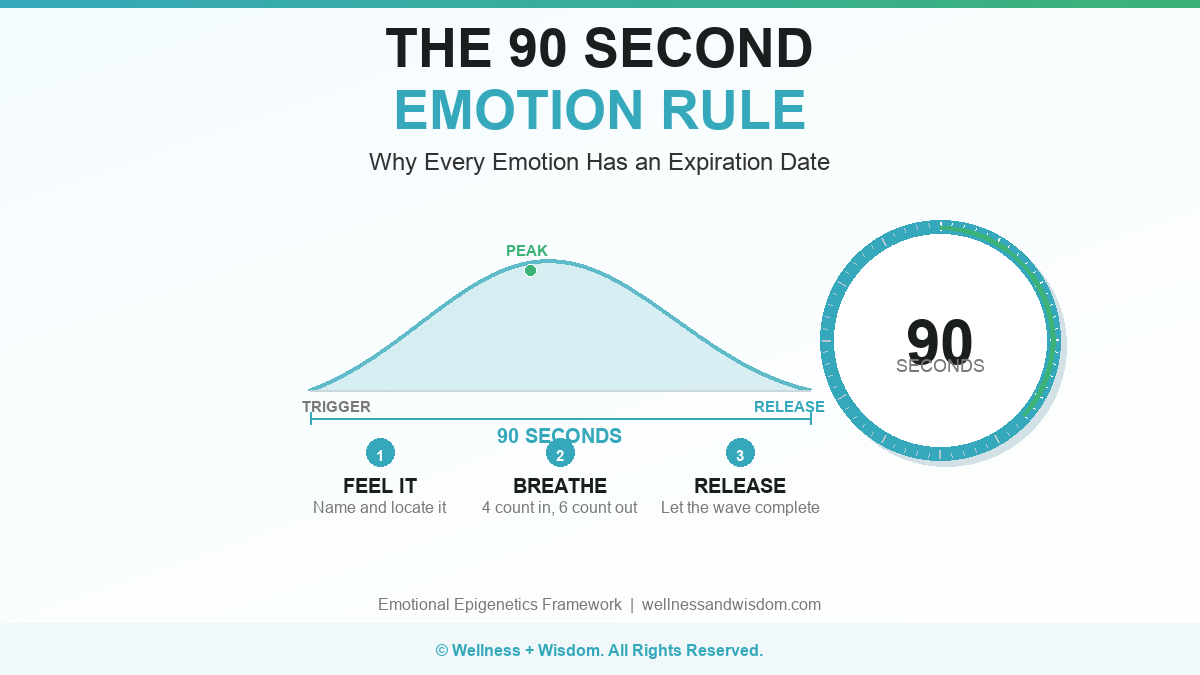
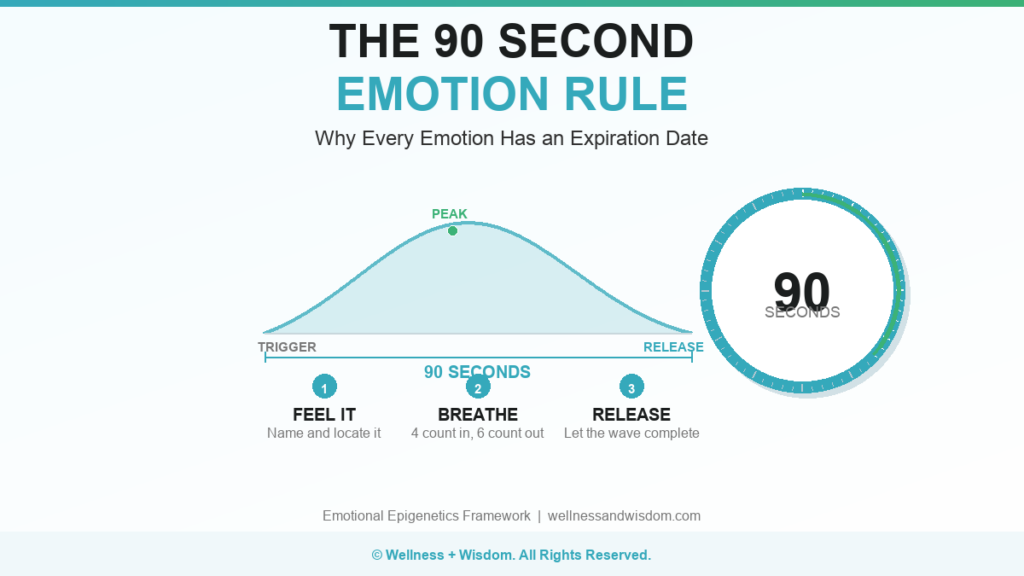
Emotional wave riding is the practical application of the 90 second emotion rule. It is the skill of allowing an emotion to move through you without either suppressing it or amplifying it. Neither stuffing it down nor inflaming it with story. Just riding it the way a skilled surfer rides a wave: present, balanced, neither forcing nor fleeing.
This is a learnable skill. It requires practice. And it begins with four steps that anyone can start using today.
Step 1: Name the Emotion
Neuroscience research has consistently shown that naming an emotion reduces its intensity by activating the prefrontal cortex and partially deactivating the amygdala. This is sometimes called “affect labeling” in the research literature, and it is one of the most powerful and accessible tools in all of emotion regulation science.
The moment you feel an emotion arrive, get specific. Not just “I feel bad.” Instead: “I feel afraid.” “I feel ashamed.” “I feel furious.” The specificity matters because different emotions have different biological profiles and different invitations for resolution. Name it as precisely and honestly as you can. Then pause and notice what happens in the body.
Step 2: Locate It in the Body
Once you have named the emotion, bring your attention to where it is living in your physical body. Tightness in the chest. Heat in the face. Hollowness in the stomach. Heaviness in the shoulders. Every emotion has a somatic signature, a physical location and texture that is distinct from the thought about it.
Moving your attention into the body does several things. It shifts your awareness away from the thought loop, which is what re triggers the chemical cascade. It grounds you in the present moment, where the actual threat (in most cases) does not exist. And it allows the physical sensation of the emotion to complete its natural arc without being interrupted or inflamed. This is the foundation of somatic healing, and it is something we explore in depth through the breathwork practices in the L.I.F.E. Method.
Step 3: Breathe Through the 90 Second Window
Your breath is the most direct tool you have for influencing your neural system in real time. It is the only physiological function that is simultaneously automatic and consciously controllable, which makes it the bridge between the unconscious emotional response and your conscious choice about what to do next.
During the 90 second window, breathe slowly and deliberately. Long exhales activate the parasympathetic branch of your neural system, which signals safety and begins the process of returning your body to equilibrium. A simple practice: inhale for four counts, exhale for six counts. Do this five times. That is approximately 90 seconds. You are literally breathing through the biological window of the emotion.
For a more structured practice, you can explore the breathwork resources on the Wellness + Wisdom store or listen to the dedicated breathwork episodes on the Wellness + Wisdom Podcast that walk you through this process step by step.
Step 4: Release and Reset
After 90 seconds of conscious breath and body awareness, if you have not been feeding the thought loop, most of the chemical intensity will have passed. What remains is the information the emotion was trying to convey. Emotions are not random events. They are signals. Anger says a boundary has been crossed or a value has been violated. Fear says something feels like a threat. Grief says something or someone important has been lost.
Once the heat of the chemistry has passed, you are in a position to receive the signal clearly rather than being overwhelmed by it. Ask yourself: what is this emotion actually telling me? What does it need me to know? What action, if any, does it call for? From this place of clarity, you can respond wisely rather than react automatically.
The 90 Second Rule and Emotional Epigenetics
I want to be clear about why this topic sits inside the Emotional Epigenetics framework rather than existing as a standalone skill. Because the 90 second emotion rule, understood at its deepest level, is not just about managing your mood in the moment. It is about breaking inherited biological patterns that may have been running in your family for generations.
The Emotional Epigenetics framework rests on three pillars: emotional patterns, which include inherited emotions and bioenergetic memory; unconscious beliefs, which include inherited mindset and limiting beliefs absorbed from family; and environment, which includes the epigenetic signals sent by lifestyle, relationships, and stress. The 90 second emotion rule touches all three.
When you practice riding the 90 second wave rather than feeding the thought loop, you are doing something extraordinary. You are sending a new epigenetic signal to your biology. You are demonstrating, through repeated action, that the environment inside your body is safe enough to feel and release without catastrophe. Over time, this practice literally begins to change the baseline from which your neural system operates.
Research published in Nature by Dias and Ressler in 2014 demonstrated that fear responses encoded in the amygdala could be transmitted to offspring through epigenetic modification of sperm DNA. This means emotional patterns are not just psychologically inherited through modeling and conditioning. They can be biologically transmitted. The implication for your healing practice is staggering: when you change your emotional pattern, you may be changing your biological inheritance forward in time, not just for yourself but for your children and grandchildren. You can learn more about this generational dimension of healing on the Wellness + Wisdom mission page.
Every time you sit inside a difficult emotion for 90 seconds instead of exploding, collapsing, or numbing out, you are writing new biological code. That is not metaphor. That is the science of Emotional Epigenetics applied at the most personal level possible.
When the Rule Gets Complicated: Trauma, Grief, and Chronic Emotion
I want to speak directly to something that can feel invalidating if not addressed carefully. For people who are carrying unprocessed trauma, or who are in the active throes of grief, the 90 second emotion rule can sound reductive. Like you are being told that what you feel should be manageable in a minute and a half, and since it is clearly not, something is wrong with you.
That is not what this rule says, and I want to be absolutely clear about that.
Trauma does not operate through a single 90 second chemical event. Trauma is a neural system condition in which the brain becomes dysregulated in ways that cause it to remain in a constant or easily re triggered state of threat response. The 90 second window applies to an individual activation within that state, but when the baseline neural system is dysregulated, those activations may occur many times per minute. You can do the math. That is not a character flaw. That is a biology that needs support, not just mindfulness.
Similarly, grief is not a single emotion with a 90 second biological event. Grief is a complex, layered, and sacred process of reorganizing your entire sense of reality in the aftermath of profound loss. The emotions within grief, the waves of sorrow, the surges of anger, the hollow moments of disbelief, each of these has a 90 second biological arc. But the totality of grief is not reducible to that.
The 90 second rule is a tool for individual emotional moments. For deeper and more persistent conditions, the tools need to go deeper too. The L.I.F.E. Method and the work we do in the Liberated Life Tribe are designed for exactly this: the deeper, longer arc of genuine transformation. The 90 second rule is one tool in a full toolkit, not the whole answer.
A 2024 study in MDPI Medicine found that active coping strategies were associated with better outcomes in stress related disorders, while emotion focused coping that re engaged with the distress could exacerbate symptoms. The 90 second wave riding practice is a form of active coping: present, engaged, and moving through rather than around.
Using the 90 Second Emotion Rule in Real Life
In Your Relationships
Relationships are the single greatest emotional training ground available to any human being. The people closest to you are precisely the ones most capable of triggering your inherited patterns. A partner's tone of voice, a parent's critical look, a friend's absence when you needed them: these everyday relational moments can activate limbic responses within milliseconds.
The 90 second rule in relationships looks like this: when you feel triggered, instead of responding immediately, excuse yourself if possible for 90 seconds of conscious breath. Not to suppress the emotion. Not to build your case. Just to let the chemistry complete its cycle before you speak. What you say from the other side of that window will be fundamentally different from what you would have said in the first 10 seconds of the activation.
This is conscious communication at the neural system level. It is something I explore in depth alongside the conscious parenting solocast, because the same principle that makes you a better partner makes you a more present and regulated parent.
At Work
Professional environments are loaded with emotional triggers: feedback, conflict, uncertainty, comparison, failure. Most of the damage done in workplace relationships happens not because of the triggering event itself but because of the immediate reactive response to it.
Practicing the 90 second rule at work might look like: receiving a difficult piece of feedback, feeling the heat of defensiveness or shame rise in your chest, breathing quietly through it for 90 seconds before responding, and then engaging from a place of genuine curiosity rather than self protection. This is not weakness. This is among the highest forms of professional intelligence.
You can find more tools for navigating professional and life challenges in our Wellness + Wisdom blog and through the guests we feature on the Wellness + Wisdom Podcast who bring real world wisdom from leadership, psychology, and human performance.
With Your Children
Perhaps the most impactful application of the 90 second emotion rule is in parenting. Children are extraordinarily sensitive to the emotional states of their caregivers. When a parent responds to a child's misbehavior or a parenting challenge from the first 10 seconds of limbic activation, the message the child receives is not the intended message. It is the one carried by the chemistry: threat, danger, shame.
When a parent rides the 90 second wave first, the child experiences something entirely different: a regulated adult who is fully present, who takes the situation seriously, and who responds with both firmness and love. This is conscious parenting in action. And it is one of the most powerful gifts you can give the next generation: the direct experience of what a regulated adult looks like when faced with difficulty. That experience becomes their template. You can explore more of this framework in the conscious parenting solocast and on the Wellness Pentagon mission page.
What the Wellness World Is Saying Right Now
In 2026, the wellness conversation has matured in exactly the direction this work points toward. Across multiple trend reports and research compilations, emotional fitness is no longer being treated as a supplement to physical health. It is being recognized as the foundation of all wellness. The era of treating the neural system like an afterthought is ending.
The concept of neural system regulation, which is at the core of what the 90 second emotion rule helps you practice, has become one of the dominant wellness themes of the year. Whether people are exploring vagus nerve stimulation, somatic practices, breathwork, or any number of other tools, the underlying need is the same: a regulated neural system that can move through emotional experience without getting stuck in loops that drive chronic stress, inflammation, and disconnection.
The science confirming the link between unregulated emotion and epigenetic change is also becoming more mainstream, with research from Stanford and multiple international institutions demonstrating that how we process our emotions has measurable biological consequences at the cellular level. This is the exact territory that the Emotional Epigenetics framework has been mapping for years, and it is extraordinarily gratifying to see the broader culture catching up to what we have known.
You can stay current on all of these developments and more through the latest episodes of the Wellness + Wisdom Podcast, where we consistently bring the leading voices in emotional science, epigenetics, breathwork, and human transformation. And if you are ready to take this work from concept to embodied practice, the Liberated Life Tribe is the community where that transformation happens in real time, with real support.
A One Week Practice to Start Today
Theory is valuable. Practice is transformational. Here is a one week experiment I want you to try, drawn from the principles of the 90 second emotion rule and the broader emotion regulation science we have explored today.
Day 1 through Day 3: Observation only. Do not try to change anything yet. Simply begin noticing when an emotion arrives. What triggered it? Where did you feel it in the body? How long did the raw sensation last before your mind picked up the story and extended it? You are building awareness before you build skill.
Day 4 through Day 5: Name and locate. When an emotion arrives, name it precisely and locate it physically in the body. Stay with the physical sensation for a full 90 seconds without narrating it. Set a timer if it helps. Notice what happens when the timer goes off.
Day 6 through Day 7: Full wave ride. Add the breath. Inhale four counts, exhale six counts, for 90 seconds, while holding attention on the body sensation of the emotion. After 90 seconds, ask what the emotion is telling you. Write it down. Respond from that clarity rather than the original reactivity.
At the end of seven days, reflect on what shifted. Not what you think should have shifted. What you actually experienced. This is the beginning of genuine emotional wave riding as a living practice rather than a concept you read about once.
For a more structured journey through this kind of practice, I invite you to explore the L.I.F.E. Method programs and everything we have built at Liberated Life to support your ongoing growth.
Frequently Asked Questions About the 90 Second Emotion Rule
What is the 90 second emotion rule?
The 90 second emotion rule is a neuroscience concept introduced by Harvard trained neuroanatomist Dr. Jill Bolte Taylor in her book My Stroke of Insight. It holds that the physiological response to an emotional trigger, specifically the neurochemical cascade initiated by the limbic system, completes its biological cycle in approximately 90 seconds. Any emotional experience that persists beyond that window is being sustained by ongoing thought, memory replay, or narrative rather than fresh biological chemistry. Understanding this gives you a window of conscious choice that most people never know exists.
Is the 90 second emotion rule scientifically proven?
The 90 second timeframe as a precise claim has not been confirmed by a single definitive controlled study, and Dr. Taylor herself did not cite specific research to support the exact number. However, the underlying mechanism is well supported by neuroscience research. Studies including a peer reviewed 2017 study in Social Cognitive and Affective Neuroscience confirm that emotional intensity follows distinct temporal profiles that vary by emotion type and individual, and that the initial neurochemical activation does have a natural arc. The spirit of the rule is neurobiologically sound even if the exact timing is a useful approximation rather than a hard universal law.
How long do emotions last if you are dealing with trauma?
For individuals carrying unprocessed trauma, the question of how long emotions last becomes significantly more complex. Trauma creates a neural system that operates at a chronically elevated baseline, making it far easier to re trigger and far harder to complete the natural emotional arc. Individual moments of emotional activation may still follow the 90 second biological window, but they occur so frequently and with such intensity that the cumulative experience feels continuous. This is not a failure of the 90 second rule. It is an indicator that deeper neural system healing is needed alongside the practice. Tools like breathwork, somatic therapy, and the kind of community based healing offered through the Liberated Life Tribe are designed specifically for this deeper work.
What is emotional wave riding and how does it help with emotion regulation?
Emotional wave riding is the practice of allowing an emotion to move through the body without suppressing it or inflaming it with thought. It draws directly from the 90 second emotion rule and uses breath, body awareness, and precise emotional naming to ride the natural arc of the emotion to its completion. The skill is rooted in principles from somatic therapy, dialectical behavior therapy's distress tolerance modules, and mindfulness traditions. Research consistently shows that approaching emotions with this kind of presence rather than avoidance or amplification produces measurable improvements in emotional wellbeing and neural system regulation over time.
How does the 90 second emotion rule connect to Emotional Epigenetics?
The connection is profound. Emotional Epigenetics holds that our emotional patterns, including the predisposition to extend emotional responses beyond their biological window, can be inherited through epigenetic mechanisms from previous generations. When you practice the 90 second emotion rule consistently, you are not just managing individual moments. You are sending new signals to your biology that gradually shift the baseline from which your neural system operates. Over time, this practice participates in what researchers call epigenetic reprogramming: changing how genes are expressed without changing the underlying DNA sequence. This is why the 90 second wave riding practice is not just emotional hygiene. It is potentially generational healing.
Can children learn the 90 second emotion rule?
Yes, and teaching it to children may be one of the highest leverage investments a parent can make. Children as young as four can begin learning to name emotions and notice them in their bodies with age appropriate guidance. By the time they are seven or eight, many children can understand the concept that feelings arrive, peak, and pass, and that they can breathe through them rather than acting them out. The key is that children learn this most effectively by watching a regulated adult model it in real time, not from instruction alone. Every time you ride your own 90 second wave in front of your child, you are teaching them something that no classroom can provide. You can explore this through the conscious parenting resources at Wellness + Wisdom.
Ready to Ride the Wave All the Way to Freedom?
Join the Liberated Life Tribe and receive your free 10 day Self Liberation Blueprint. This is where the science becomes a lived experience, and where your emotional patterns begin to change at the root.
A Final Word
The 90 second emotion rule is a doorway, not a destination. Walking through that doorway means agreeing to feel what you feel, fully and consciously, for the 90 seconds that your biology actually needs, and then releasing it rather than re invoking it. That agreement, made again and again across a lifetime of emotional moments, is what authentic liberation actually looks and feels like in practice.
It is not dramatic. It does not require a retreat in the mountains or a mystical experience. It requires the willingness to be present with yourself in the ordinary moments of an ordinary day, to breathe through the 90 second window that your own neuroscience has provided, and to trust that on the other side of the wave, there is clarity, freedom, and the specific joy that only comes from having moved through something real rather than around it.
That is the work. And every single time you do it, you are doing it not just for yourself. You are doing it for everyone who comes after you. That is the promise of Emotional Epigenetics. And it starts with one wave, one breath, and 90 seconds of genuine courage. Find more resources, community, and ongoing support at the Wellness + Wisdom press kit and through everything we create at the W+W blog.
About Josh Trent
Josh Trent is the founder of Wellness + Wisdom and the creator of the Emotional Epigenetics framework, the L.I.F.E. Method, and the Liberated Life Tribe. For over a decade he has been helping people globally dissolve the inherited and self created barriers that stand between them and authentic joy. He is the host of the Wellness + Wisdom Podcast, one of the most listened to wellness shows in the world, and the author of the Self Liberation Blueprint. Josh lives in Dripping Springs, Texas with his family and is committed to the principle that healing one person heals all the people connected to them. You can explore his full story and mission at wellnessandwisdom.com/joshs-story.
References and Further Reading:
1. Taylor, Jill Bolte (2008). My Stroke of Insight: A Brain Scientist's Personal Journey. Penguin Books. [Original source of the 90 second emotion framework]
2. Zavala Vazquez, E. et al. (2017). The neural basis of emotions varies over time: different regions go with onset and offset bound processes underlying emotion intensity. Social Cognitive and Affective Neuroscience. PubMed Central: PMC5597870
3. Stanford Medicine (2025, May). Sustained in the brain: How lasting emotions arise from brief stimuli. med.stanford.edu
4. Dragasevic, S. et al. (2024). Epigenetic and Coping Mechanisms of Stress in Affective Disorders: A Scoping Review. MDPI Medicine. mdpi.com/1648-9144/60/5/709
5. Dias, B.G. and Ressler, K.J. (2014). Parental olfactory experience influences behavior and neural structure in subsequent generations. Nature Neuroscience. PubMed: 24292232