
By Josh Trent | Wellness + Wisdom Podcast Host & Identity Transformation Architect
“Your beliefs are not just ideas floating in your head. They are instructions your body listens to. Change the belief, and you begin to change the biology that grows from it.”
Josh Trent
The biology of belief describes something both ancient and increasingly well documented: the way your thoughts, expectations, and deep beliefs measurably influence your body. This is not wishful thinking or magic. It is a real and fascinating area of science showing that the mind and body are not separate machines but one deeply connected system, in constant conversation. What you believe shapes how you feel, how you behave, and even, through several well understood pathways, how your biology responds. This sits right at the heart of Emotional Epigenetics™.
Here is my joy forward and honest promise. The real science of how belief shapes biology is genuinely empowering, because it means you are not simply a passive victim of your genes or circumstances. At the same time, I will be clear about where the evidence is strong and where popular claims run ahead of it, because you deserve the truth, not hype. The grounded reality is more than inspiring enough, and it does not ask you to believe anything that is not actually true. Let us explore how your inner world quietly shapes your physical one.
Table of Contents
- What the Biology of Belief Really Means
- The Placebo Effect: Belief Made Physical
- Belief Becomes Behavior Becomes Biology
- How Beliefs Shape Your Stress Response
- The Biology of Belief and Emotional Epigenetics
- How Inherited Beliefs Shape You
- The Words You Say to Yourself
- Where the Science Is Solid and Where It Overreaches
- From Passenger to Author of Your Biology
- How to Work With Your Beliefs
- Frequently Asked Questions
- Studies and External Resources
- About Josh Trent
What the Biology of Belief Really Means
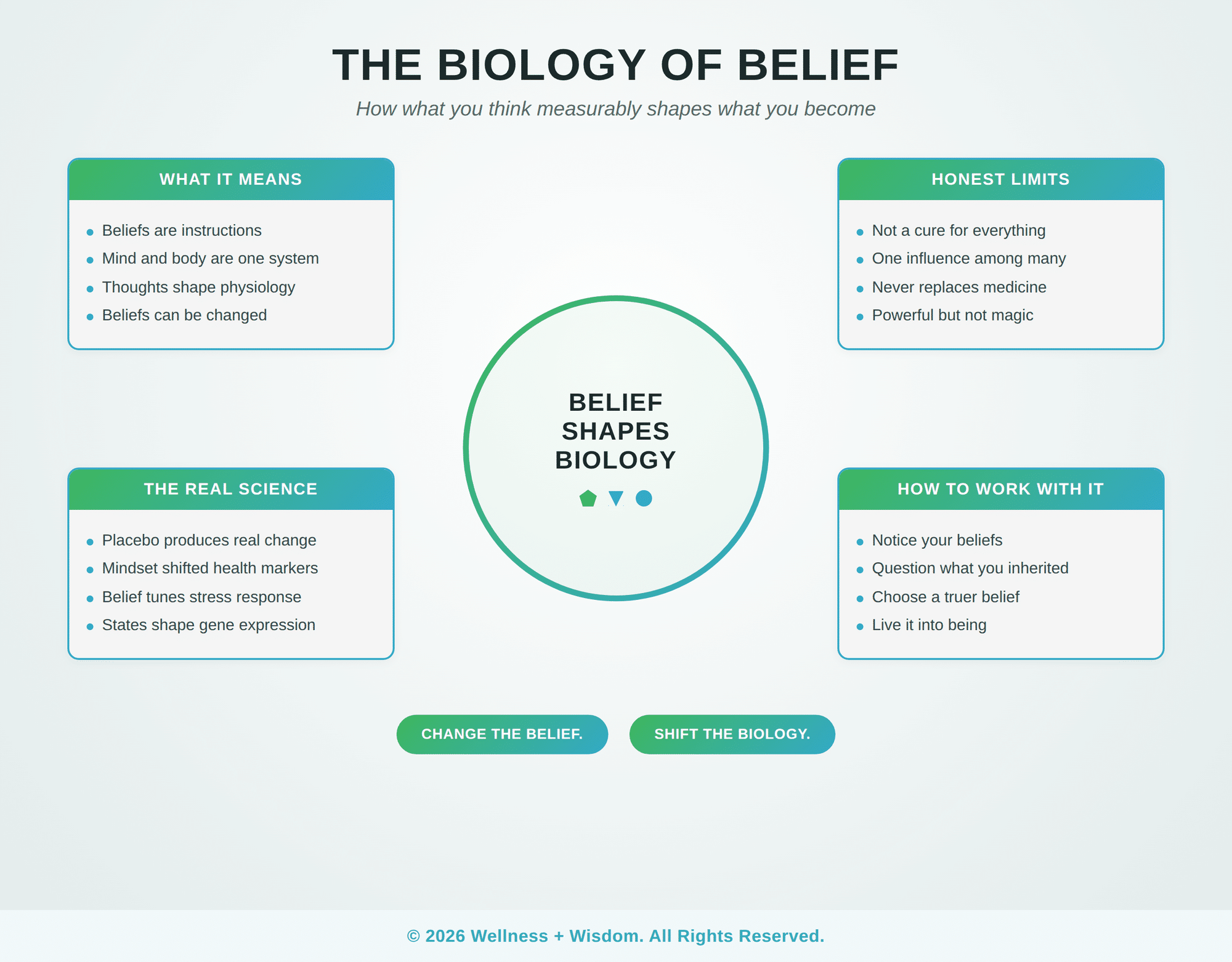
The biology of belief means that your beliefs and expectations are not confined to your mind but ripple outward into your physical body through real, traceable pathways. A belief is not just a passive opinion. It actively shapes what you notice, how you interpret events, how you behave, and how your body responds to stress and to healing, coloring your entire experience of being alive. In this sense, your beliefs become a kind of quiet instruction set that your biology listens to.
This happens through several grounded mechanisms rather than any single mysterious force. Beliefs shape behavior, and behavior shapes health. Beliefs shape how you appraise stress, which changes your body's stress response. And beliefs shape expectation, which, as the placebo effect shows, can produce measurable physical changes. None of this requires magic. It simply requires taking seriously how deeply connected the mind and body actually are, a connection science keeps confirming.
Understanding this is genuinely empowering, because beliefs, unlike genes, can be examined and changed. If your inner world is quietly shaping your biology, then becoming aware of your beliefs and gently updating the ones that no longer serve you becomes a real form of self care. This is why we treat the work of examining our beliefs as foundational, not fluffy, across all of our programs and the Wellness + Wisdom Podcast.
The Placebo Effect: Belief Made Physical
The placebo effect is perhaps the clearest scientific proof that belief produces real physical change. When people believe they are receiving a helpful treatment, they often experience genuine improvement, even when the treatment itself is inert. This is not people imagining they feel better. Measurable physiological changes can follow from expectation alone, which is why every rigorous drug trial must account for it.
A striking demonstration comes from a study by Alia Crum and Ellen Langer, published in Psychological Science. They studied hotel room attendants, whose daily work is genuinely physically demanding. One group was simply informed that their work qualified as good exercise and met health guidelines, while the other was not. Weeks later, the group who now believed their work was exercise showed measurable improvements in health markers, despite no change in their actual activity. Their belief about their work appeared to shape their bodies, even though the work itself was identical.
This is the biology of belief made visible. The same physical activity produced different physical results depending on what the person believed about it. Expectation and mindset are not add ons to our biology. They are woven into it. This does not mean belief can replace medicine or accomplish anything at all, but it does prove that what we believe has real and measurable physical weight, a theme that echoes throughout the science of how beliefs become biology.
Belief Becomes Behavior Becomes Biology
The most grounded and undeniable way beliefs shape biology is through behavior, and this pathway alone is enough to take beliefs seriously. What you believe about yourself and the world quietly steers thousands of daily choices, and those choices accumulate into the physical reality of your health over time.
Consider a person who deeply believes they are not an athletic person. That single belief will shape countless decisions, whether to move their body, whether to try a new activity, whether to persist when something feels hard. None of these choices feel dramatic in the moment, but over years they compound into a very different physical life than the person who believes movement is for them. The belief did not magically alter their cells. It steered the behaviors that did.
The same is true across every dimension of health. A belief that you are worthy of care leads to choices that nourish you. A belief that rest is lazy leads to chronic depletion. A belief that you cannot change leads you to stop trying, which guarantees the very outcome you feared. In each case, the belief becomes behavior, and the behavior becomes biology, slowly and reliably.
This is actually the most empowering part of the whole picture, because behavior is something you can influence directly. Even before a belief fully shifts, you can choose a single action that contradicts it, and that action begins to build new evidence. Over time, aligned action and updated belief reinforce each other, reshaping both your habits and your health, which is the practical engine behind all real change and self sabotage work.
How Beliefs Shape Your Stress Response
One of the most powerful ways beliefs shape biology is through how they change your stress response. The same event can be experienced as a threat or a challenge depending on what you believe about it and about your ability to handle it. And that appraisal, that inner judgment, directly influences how your body responds at a physiological level.
The researcher Bruce McEwen described in the New England Journal of Medicine how a chronically activated stress response creates allostatic load, the cumulative wear that builds when the body's alarm stays switched on. Crucially, whether a situation triggers that alarm depends heavily on how you perceive it. A belief that you are helpless keeps the alarm ringing, while a belief that you are capable helps the body return to calm. Your beliefs are, in effect, tuning your stress physiology.
This connects to the deep mind body link mapped by the field of psychoneuroimmunology, including foundational work by Sheldon Cohen and colleagues showing how psychological states measurably influence physical resilience. Because beliefs shape our emotional and psychological states, they become one more powerful influence on this whole system. When you shift a belief from threat to capability, you are not just thinking differently. You are, quite literally, changing the signals your neural system sends throughout your body.
The Biology of Belief and Emotional Epigenetics
The biology of belief fits naturally within the framework of Emotional Epigenetics™, which holds that your emotional patterns, your beliefs, and your environment converge to shape how your genes express themselves. Beliefs are one of the three core pillars of this framework, precisely because they are such a powerful input into your biology.
The pathway is grounded and sensible. Your beliefs shape your chronic emotional states and your stress levels, and those states are known inputs that influence gene expression through the same lifestyle and stress pathways that all epigenetic research explores. A life lived under the belief that the world is dangerous produces a very different internal biological environment than a life lived under the belief that one is fundamentally safe and capable. Over time, these different inner climates leave different marks, quietly shaping the body that carries them.
This is why examining and updating your beliefs is such meaningful work. You are not just improving your mood, though you are doing that. You are tending the emotional and psychological environment that your genes are constantly responding to. This is the deep promise of belief work, and it connects directly to our teaching on how emotions influence gene expression and how practices like meditation shape our biology.
How Inherited Beliefs Shape You
Many of the beliefs that shape your biology were not chosen by you at all. They were absorbed in childhood, downloaded from the family and culture you grew up in, long before you had the capacity to question them. These inherited beliefs about yourself, about safety, about what is possible, run quietly in the background, shaping your emotional states and your body without your conscious awareness.
A child raised to believe they are not enough, or that the world is hostile, absorbs that belief into their very sense of self, and it continues to shape their stress physiology and their choices well into adulthood. This is not their fault, and it is not a permanent sentence. It is simply an inherited pattern, and like any pattern, it can be brought into the light and gently rewritten over time, as we explore in our work on inherited limiting beliefs.
Recognizing that some of your deepest beliefs were inherited rather than chosen is profoundly freeing. It means those beliefs are not the unchangeable truth of who you are. They are simply the programming you received, and programming can be updated. When you become aware of an inherited belief that has been quietly shaping your biology, you gain the power to question it and choose something truer, which is one of the most liberating acts of healing negative conditioning.
The Words You Say to Yourself
One of the most immediate places the biology of belief shows up is in your inner dialogue, the near constant stream of words you say to yourself all day long. This self talk is belief in action, and because it runs almost continuously, its effect on your inner state and your body is cumulative and profound.
Harsh, critical self talk keeps the body in a subtle state of threat, as if you were under attack, because in a sense you are, from within. A steady inner voice of not good enough, of you always fail, of something is wrong with you, signals danger to the body again and again throughout the day. Over time, that constant low grade threat contributes to the very wear on the body that chronic stress produces.
Kinder, more encouraging self talk does the opposite. When your inner voice is supportive and compassionate, it helps your body feel safe, which supports calm and recovery. This is not about forced positivity or lying to yourself. It is about speaking to yourself with the same basic respect and encouragement you would offer a good friend, which most of us withhold from ourselves without ever realizing we are doing it.
Becoming aware of your self talk is one of the most practical forms of belief work available, because you can catch and gently redirect it in real time. Each time you notice a harsh inner statement and soften it, you are changing the signals your body receives in that moment. This is quiet, powerful work, and it pairs beautifully with practices of gratitude that gently retrain your attention and your inner voice.
Where the Science Is Solid and Where It Overreaches
Because I care about truth as much as inspiration, it is important to be clear about the boundaries of this topic, so you can hold it wisely. The solid, well supported science is real and substantial. The placebo effect is thoroughly documented. Stress appraisal genuinely influences physiology. Beliefs shape behavior, and behavior shapes health. Chronic psychological states are legitimate inputs into the systems that influence gene expression. All of this stands on firm ground.
At the same time, some popular versions of this idea run well ahead of the evidence, and you deserve to know that. Claims that you can cure any disease through belief alone, or that your thoughts directly and instantly rewrite your DNA at will, or that illness simply reflects wrong thinking, are not supported by rigorous science and can even become harmful. Belief is a genuine and powerful influence on the body, but it is one influence among many, not an all powerful force, and it never replaces medical care or wise action in the world.
This honest framing actually makes the truth more useful, not less. You do not need to believe any exaggerated claim to benefit from tending your beliefs. The documented reality, that your expectations, your stress appraisals, and your chronic mental states genuinely shape your body, is empowering enough on its own. Approaching this with both an open heart and a discerning mind is exactly the grounded spirituality we champion across the Wellness Pentagon™.
From Passenger to Author of Your Biology
Perhaps the most beautiful implication of the biology of belief is that it moves you from feeling like a passenger in your own life to becoming an active author of it. If your biology were purely fixed by your genes and circumstances, you would have little say in your own wellbeing. But because your beliefs are a genuine input, and because beliefs can be examined and changed, you have real influence over the inner environment your body responds to.
It is important to hold this truth with care, because empowerment can curdle into blame if we are not thoughtful. The point is never that people are at fault for their illnesses or struggles, which would be both cruel and untrue. Life is complex, and many forces beyond belief shape our health, from genetics to environment to plain circumstance. The point is simply that within the circumstances you find yourself in, your beliefs are one lever you can actually reach, and that is genuinely good news.
This is the spirit we bring to all of our work, captured in a phrase I return to often: it may not be your fault, but it is your responsibility. The wounds and beliefs you inherited were not your choice, and no shame belongs to you for carrying them. Yet you are the only one who can now choose to tend them. That combination of compassion and agency is where real transformation lives.
When you truly grasp that your inner world shapes your outer one, you stop waiting passively for life to happen to you and start participating consciously in your own becoming. You cannot control everything, and you were never meant to. But the space you can influence, through the beliefs you hold and tend, is far larger than most people ever realize, and stepping into it is one of the most liberating shifts a person can make.
How to Work With Your Beliefs
If beliefs shape biology, then learning to work with them becomes a genuine form of self care. Here are grounded practices for tending the beliefs that shape your inner and outer world.
1. Notice Your Beliefs
You cannot change a belief you cannot see. Begin by simply noticing the beliefs running beneath your reactions, especially the harsh or fearful ones. When you feel a strong reaction, ask what you must be believing for this to feel true. Awareness is always the first step, and it is one you can take in any moment.
2. Question Inherited Beliefs
When you catch a limiting belief, gently ask whether it is actually true, and whether it is even yours. Many of our most limiting beliefs are inherited programming we never chose. Simply asking is this true and is this mine begins to loosen their grip.
3. Update the Belief Consciously
Once you see an old belief clearly, you can consciously choose a truer, kinder one to practice in its place. This is not forced positivity or denial. It is the honest work of replacing an outdated belief with one that better reflects reality and serves your life.
4. Live the New Belief Into Being
Beliefs change most powerfully through experience, not just thought. Take small actions consistent with the new belief, and let the lived evidence reinforce it. Each action that contradicts an old fear helps rewire it a little more, which is the embodied heart of the L.I.F.E. Method™.
5. Tend Your Inner State
Because beliefs shape your stress physiology, practices that calm the body also support healthier beliefs. Breath, stillness, and self compassion all help create the internal safety in which new, more empowering beliefs can take root and grow.
Begin with awareness, and let the rest unfold from there. Working with your beliefs is a lifelong practice, and every belief you bring into the light and gently update is a real investment in both your wellbeing and your biology. When you want support and community for this inner work, the Liberated Life Tribe is here for you.
Frequently Asked Questions
What is the biology of belief?
The biology of belief describes how your thoughts, expectations, and deep beliefs measurably influence your body through real, traceable pathways. Beliefs shape behavior, how you appraise stress, and expectation, all of which affect your physiology. It reflects the reality that mind and body are not separate machines but one deeply connected system in constant conversation.
Can beliefs really change your body?
Yes, through documented mechanisms. The placebo effect shows that expectation alone can produce measurable physical change. A study by Crum and Langer found that hotel workers who believed their work was good exercise showed health improvements without changing their activity. Beliefs also shape stress appraisal, which directly influences your physiology.
Does the biology of belief mean I can cure any illness with my mind?
No, and this is where honesty matters. Belief is a genuine and powerful influence on the body, but it is one influence among many, not an all powerful force. Claims that you can cure any disease through belief alone, or that thoughts instantly rewrite DNA, are not supported by rigorous science. Belief supports health but never replaces medical care.
How do beliefs connect to Emotional Epigenetics?
Beliefs are one of the three core pillars of Emotional Epigenetics™. Your beliefs shape your chronic emotional states and stress levels, which are known inputs that influence gene expression through lifestyle and stress pathways. Living under a belief that the world is dangerous creates a different internal biological environment than living under a belief that you are safe and capable.
Where do my limiting beliefs come from?
Many were absorbed in childhood, downloaded from your family and culture before you could question them. These inherited beliefs about yourself, safety, and what is possible run quietly in the background, shaping your emotional states and body. Recognizing that they were inherited rather than chosen is freeing, because it means they can be questioned and rewritten.
How do I start changing a limiting belief?
Begin by noticing the belief beneath a strong reaction, then gently question whether it is actually true and whether it is even yours. Consciously choose a truer, kinder belief to practice in its place, and take small actions consistent with it so lived experience reinforces the change. Calming practices like breath and stillness help new beliefs take root.
Studies and External Resources
The science in this article rests on peer reviewed research. These are the sources referenced throughout.
- Crum AJ, Langer EJ. (2007). Mind-set matters: exercise and the placebo effect. Psychological Science. PubMed: 17425538
- McEwen BS. (1998). Protective and damaging effects of stress mediators. New England Journal of Medicine. PubMed: 9428819
- Cohen S, Tyrrell DA, Smith AP. (1991). Psychological stress and susceptibility to the common cold. New England Journal of Medicine. PubMed: 1713648
About Josh Trent
Josh Trent is an Identity Transformation Architect and the award winning host of the Wellness + Wisdom Podcast, with over 15 million downloads since 2015. He is the creator of the L.I.F.E. Method™ Identity Transformation System and steward of the Emotional Epigenetics™ and BREATHE: Breath + Wellness™ systems of self mastery, impacting over 1,000 students worldwide. Join the Liberated Life Tribe and receive your 10 day Self Liberation Blueprint at liberatedlife.com. Josh lives in Austin, Texas with his wife Carrie, daughter Nayah, and son Novah.
Disclosure: We may earn a commission from certain links on this site when you make a purchase, at no extra cost to you. These commissions help support Wellness + Wisdom and do not affect the products or resources we choose to recommend. Full disclosure .