
By Josh Trent | Wellness + Wisdom Podcast Host & Identity Transformation Architect
“Curiosity is how we stay young at heart. Ask one more question, follow one more spark, and watch how much bigger and brighter life becomes.”
Josh Trent
Learning how to be more curious is one of the most joyful ways to grow, heal, and fall back in love with your life. Think about how a child explores the world. Every bug, cloud, and new word is fascinating. Every question leads to another. That sense of wonder makes learning effortless and days feel full. Somewhere along the way, many of us lose some of that spark. We get busy, we stick to what we know, and life can start to feel flat or routine. The good news is that curiosity can be rekindled at any age. In fact, after more than a decade of interviewing hundreds of guests on the podcast, I can tell you that curiosity is one of the common threads among the most joyful, resilient people I know. It is also a natural fuel for the identity change at the heart of the L.I.F.E. Method™.
Here is the joy forward truth at the center of it all. Curiosity is not a luxury. It is a doorway to learning, connection, meaning, and fun. One curious question can change a conversation, a relationship, or even the direction of your life. Let us explore what the science says and exactly how to bring more curiosity into your days.
Table of Contents
- What Curiosity Really Is
- Why Curiosity Matters
- The Gift of a Curious Life
- The Science of Curiosity
- How to Be More Curious
- Curiosity Versus Judgment
- How to Be More Curious With the L.I.F.E. Method™
- Celebrating Your Discoveries
- Curiosity in Relationships, Work, and Growth
- When Curiosity Feels Hard
- Frequently Asked Questions
- Studies and External Resources
- About Josh Trent
What Curiosity Really Is
Curiosity is the desire to explore, learn, and understand, the inner pull that makes us ask questions, seek new experiences, and wonder how things work. It is the motivation to close the gap between what we know and what we want to know.
Curiosity shows up in many ways. Intellectual curiosity is the desire to learn about ideas, facts, and how the world works. Social curiosity is interest in other people: their stories, feelings, and perspectives. Sensory curiosity is the desire to explore new tastes, sounds, places, and experiences. And there is a gentle, inward curiosity that helps us understand our own thoughts, feelings, and patterns. Each form enriches life in its own way.
Curiosity is closely related to openness. Curious people tend to approach the unfamiliar with interest rather than fear. They ask “What if?” and “Why?” and “How?” They see questions as invitations rather than threats. These themes come up often on the Wellness + Wisdom Podcast, where guests share how following their curiosity led to their life's work.
Curiosity is also something you can grow. While some people seem naturally more curious, curiosity is shaped by habits, environments, and mindset. Learning how to be more curious is less about becoming a different person and more about clearing away the busyness and fear that can bury your natural sense of wonder.
Why Curiosity Matters
Curiosity matters because it fuels learning, deepens relationships, adds meaning to life, and helps us adapt to change. It keeps the mind engaged, the heart open, and life interesting.
When you are curious, learning feels less like work and more like discovery. You remember more, you understand more deeply, and you enjoy the process. Curiosity also helps you grow in your career, because curious people tend to ask good questions, solve problems creatively, and keep developing their skills. In a fast changing world, that adaptability is a powerful asset.
Curiosity also transforms relationships. When you are genuinely curious about the people in your life, they feel seen and valued. You discover new things about your partner after years together. You understand your children more deeply. You connect with strangers in surprising ways. If you want to grow in this area, the ideas in how to be a better listener pair beautifully with curiosity.
The Gift of a Curious Life
The gift of a curious life is a world that never stops being interesting. Curiosity turns ordinary days into opportunities for discovery and keeps us growing, learning, and feeling alive at every age.
Curious people often describe their lives as rich and full, even when their circumstances are simple. They find fascination in a conversation with a stranger, a new recipe, a book, a walk in an unfamiliar neighborhood, or a question their child asks. Curiosity invites us to engage with life rather than just get through it. That engagement brings a deep sense of joy and meaning.
Curiosity also helps us grow through challenges. When something difficult happens, a curious mind asks, “What can I learn here?” rather than just “Why me?” That shift does not erase pain, but it opens a path forward. Curiosity and a growth mindset go hand in hand, as explored in how to develop a growth mindset.
The Science of Curiosity
The science of curiosity shows that curiosity activates the brain's reward circuitry, that curious states improve memory for both the topic of interest and surrounding information, and that curiosity is linked with greater wellbeing and meaning in daily life. Curiosity is good for the brain and the heart.
Start with the brain. In a study published in Psychological Science, Min Jeong Kang and colleagues at the California Institute of Technology scanned people's brains while they read trivia questions. The more curious people felt, the more activity they showed in brain regions linked to anticipated reward. People were also willing to spend more scarce resources to learn answers they were curious about, and higher curiosity was linked with better recall of surprising new information.
Curiosity boosts learning broadly. In a study published in Neuron, Matthias Gruber, Bernard Gelman, and Charan Ranganath found that when people were in a state of high curiosity, they remembered the information they were curious about better, and they also remembered unrelated information they encountered during that curious state. Brain imaging showed increased activity in the midbrain and nucleus accumbens, reward related regions, along with the hippocampus, which is central to memory. Curiosity primes the brain to learn.
Curiosity also supports wellbeing. In research published in Motivation and Emotion, Todd Kashdan and Michael Steger found that people who were more curious reported greater meaning in life and wellbeing, and that on days when people felt more curious, they also reported more meaning and satisfaction. Curiosity seems to bring both a sense of growth and a sense of purpose.
How to Be More Curious
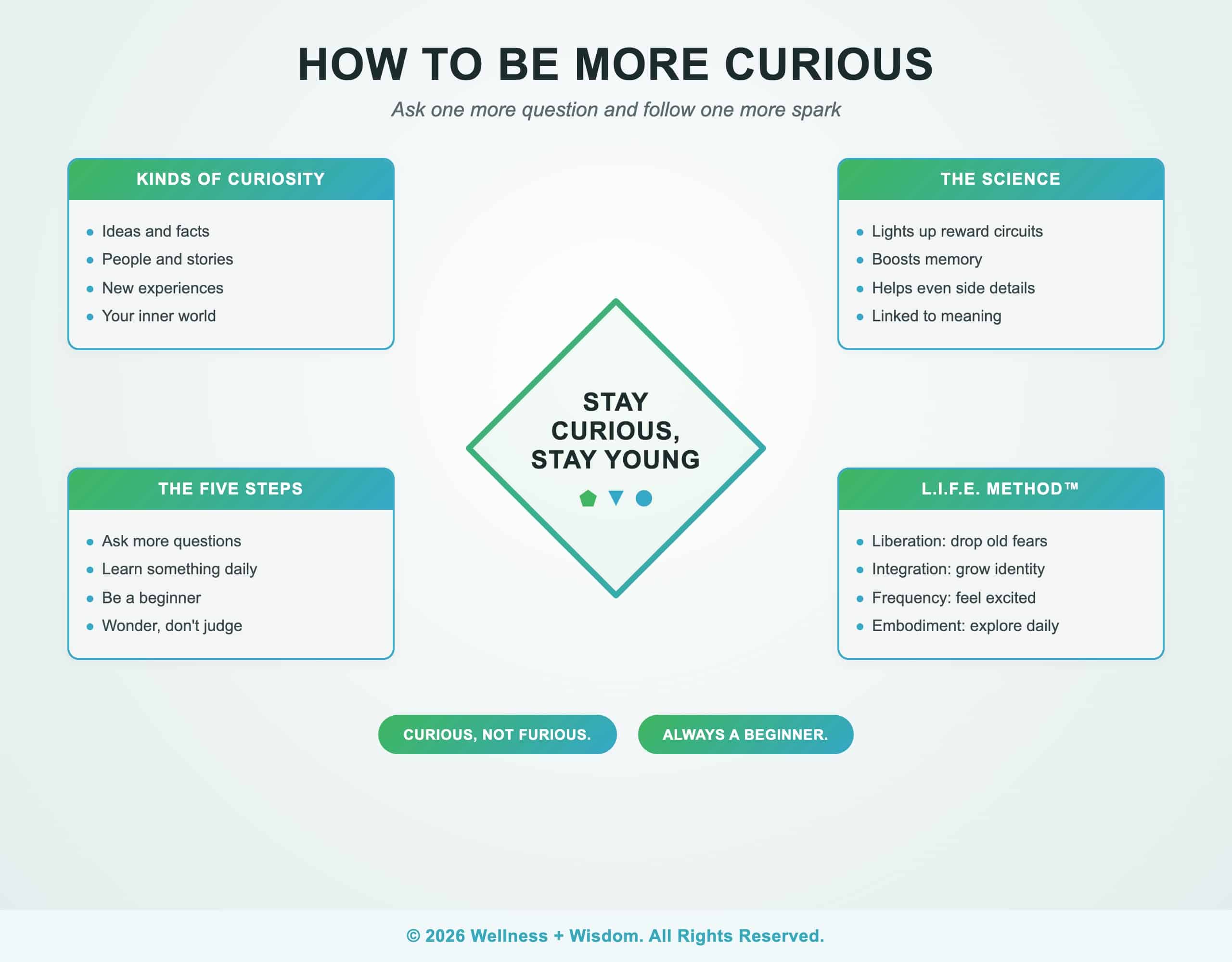
You learn how to be more curious by asking more questions, learning something new each day, exploring beginner experiences, getting curious about people, and turning judgment into wonder. These five practices rekindle the spark of curiosity and make it part of daily life. Here is how I practice and teach them.
1. Ask More Questions
Make questions a habit. When you encounter something unfamiliar, ask why, how, and what if. When someone shares an idea, ask them to say more. When you read or hear something interesting, look it up and go one layer deeper. Questions are the engine of curiosity. Keep a running list of things you are curious about and explore one each week.
2. Learn Something New Each Day
Commit to learning one new thing every day. Read an article on an unfamiliar topic, watch a short documentary, listen to a podcast episode, or ask someone to teach you something. Small doses of learning add up quickly and keep your mind fresh. Many people find that a few minutes of learning in the morning sets a curious tone for the whole day. The ideas in how to create a morning routine can help you build it in.
3. Explore Beginner Experiences
Try something you have never done before: a new sport, an instrument, a craft, a cuisine, a dance class, or a new route to work. Being a beginner can feel awkward, but it is also exhilarating. Beginner experiences wake up curiosity and remind you that you are always capable of growth. If fear of failure holds you back, the practices in how to stop fearing failure can help.
4. Get Curious About People
Everyone has a story worth hearing. Ask the people in your life questions that go beyond small talk: What lights you up? What was a turning point in your life? What are you learning right now? Then listen with genuine interest. Curiosity about people deepens relationships and often leads to surprising connections. The ideas in how to make friends as an adult show how powerful this can be.
5. Turn Judgment Into Wonder
When you notice yourself judging someone or something, pause and ask, “I wonder why?” I wonder why they see it that way. I wonder what they have been through. I wonder what I might be missing. This simple shift opens your mind and heart and often leads to more understanding and connection. It works on yourself too: instead of judging your reactions, get curious about them.
Start with one or two of these practices this week. Curiosity grows quickly when you feed it. And if you would love a supportive community on your growth journey, the Liberated Life Tribe is a warm place to begin.
Here is a simple daily rhythm if you are wondering how to be more curious in a busy life. In the morning, write down one question you would love to explore. During the day, ask one person a deeper question than usual. In the evening, spend ten minutes learning something new, whether through a book, video, or conversation. Before bed, note one thing that surprised or fascinated you. These small habits keep curiosity alive and growing.
Your environment can spark curiosity too. Keep interesting books within reach. Put a world map or a star chart on your wall. Follow a few accounts or newsletters that share fascinating ideas instead of outrage. Spend time with curious people, because curiosity is contagious. Small changes to what surrounds you can quietly invite more questions into your days.
Travel, even close to home, is another wonderful curiosity booster. Visit a neighborhood you have never explored, try a restaurant with food from a culture you know little about, or spend an afternoon at a local museum or historic site. New surroundings naturally wake up the mind and remind you how much there is still to discover.
Nature is endlessly fascinating as well. Learn the names of the trees, birds, or flowers in your area. Watch how the light changes through the seasons. Look up at the night sky and learn a few constellations. Curiosity about the natural world often leads to awe, and awe in turn fuels more curiosity. Time outdoors is one of the easiest ways to practice how to be more curious, and the ideas in spending time outdoors show how much it can lift your mood too.
Curiosity Versus Judgment
Curiosity and judgment are two very different ways of meeting the world. Judgment closes the door: it decides quickly and stops asking questions. Curiosity opens the door: it stays open to learning and discovery. Both are natural, but curiosity tends to lead to more growth, connection, and peace.
Judgment often comes from fear or the need for certainty. When something is unfamiliar or uncomfortable, it can feel safer to label it and move on. But judgment can keep us stuck, limit our relationships, and prevent us from learning. Curiosity asks us to tolerate a little uncertainty so we can understand more deeply. That openness can feel vulnerable at first, but it leads to richer experiences and relationships.
This applies to how we treat ourselves too. Many people are quick to judge their own feelings and mistakes. Self curiosity, asking “What is going on for me right now?” or “What is this feeling trying to tell me?”, can be far more healing than self criticism. If your inner critic tends to be loud, the ideas in how to quiet your inner critic pair beautifully with curiosity.
A helpful phrase to remember is, “Curious, not furious.” When you feel irritation, defensiveness, or judgment rising, take a breath and choose curiosity instead. Ask a question. Seek to understand. You will often find that the situation is more complex, more human, and more interesting than you first thought.
How to Be More Curious With the L.I.F.E. Method™
The L.I.F.E. Method™ offers a meaningful framework for curiosity, because each of its four pillars, Liberation, Integration, Frequency, and Embodiment, helps you clear away what blocks curiosity and build a life fueled by wonder and growth.
Liberation is about releasing the fears and old beliefs that dampen curiosity, like “I am not good at learning” or “It is safer to stick with what I know.” Many of these beliefs were absorbed early in life, which is where Emotional Epigenetics™ offers insight. Integration is about weaving new discoveries into your sense of self. As you learn and explore, you begin to see yourself as a curious, growing person.
Frequency is about the emotional energy you bring to life. Curiosity naturally raises your frequency, bringing interest, excitement, and joy. Embodiment is about living your curiosity in daily action: asking questions, trying new things, and approaching each day as an adventure. When you move through these four pillars, curiosity becomes a natural expression of who you are. To learn more about how this framework came to life, visit my story.
Curiosity can also soften fear. When you face something new or uncertain, try shifting from “What if this goes wrong?” to “I wonder what I will learn.” This small reframe turns anxiety into interest and makes change feel less threatening. Many people find that curiosity is one of the most practical tools they have for navigating transitions, from a new job to a move to a new season of family life. The ideas in how to embrace change show how curiosity can turn uncertainty into growth.
Reading widely is one of the simplest curiosity habits of all. Alternate between topics you love and topics you know nothing about. Biographies, science, history, poetry, and travel writing each open different windows on the world. Even a few pages a day can keep your mind fresh and full of questions.
Celebrating Your Discoveries
Celebrating your discoveries helps curiosity become a lasting habit, because your brain learns through reward. When you notice and enjoy what you learn, you naturally want to keep exploring.
Keep a discovery journal. Each day or week, write down something new you learned, a question you explored, or a surprising conversation you had. Over time, your journal becomes a record of your growth and a reminder of how much there is to discover. Share your discoveries with friends and family too. Teaching others what you have learned deepens your own understanding and spreads the joy of curiosity.
Celebrate your courage as a beginner. Trying something new takes bravery. Every class you take, every new skill you practice, and every question you ask is worth celebrating. There is a whole practice around noticing these moments in celebrating small wins, and curious discoveries are some of the most fun to celebrate.
Curiosity in Relationships, Work, and Growth
Curiosity in relationships, work, and personal growth can transform each area of life. When you bring an open, questioning mind to everything you do, you find more connection, creativity, and meaning.
In relationships, curiosity keeps love fresh. Ask your partner questions you have never asked before. Plan new experiences together. Get curious about your children's interests, even when they are different from yours. In friendships, curiosity deepens connection and helps you understand each other more fully. At work, curiosity helps you solve problems, learn new skills, and see opportunities others might miss. Asking “Why do we do it this way?” or “What if we tried something different?” can spark innovation.
In personal growth, curiosity is a gentle guide. Instead of forcing change, you can get curious about your habits, emotions, and patterns. Why do I react this way? What do I really want? What would happen if I tried something new? This kind of gentle inquiry often leads to deeper insight and lasting change. This is also where the Wellness Pentagon™ becomes helpful. You can bring curiosity to every dimension of wellbeing, physical, mental, emotional, spiritual, and financial, including exploring your Connection to Creator and God with fresh eyes. You will find many guests sharing how curiosity shaped their lives across our latest episodes.
Families can nurture curiosity together. Ask your children “I wonder” questions at dinner. Explore museums, nature trails, and libraries together. Encourage questions, even the endless “why” questions of young children, because they are the seeds of lifelong learning. When kids see parents who are curious and excited to learn, they learn that curiosity is a joyful way to live.
When Curiosity Feels Hard
If curiosity feels hard right now, you are not alone, and it is completely understandable. Stress, exhaustion, fear, and busy schedules can all crowd out curiosity. Learning how to be more curious in these seasons starts with being gentle with yourself and starting small.
When curiosity feels distant, try one tiny step. Ask one question you have been wondering about. Read one page of a book on a topic that interests you. Notice one new detail on your daily walk. Small sparks can rekindle the fire. Supportive tools like a discovery journal or a set of conversation cards can help, and you can find a few we trust in our wellness tools store.
Sometimes a loss of curiosity is connected to deeper exhaustion, burnout, or low mood. If you notice persistent loss of interest in things you once enjoyed, please reach out to a qualified health professional. There is real strength in asking for help. Wherever you are, trust that curiosity can return. If you feel stuck, the practices in how to get out of a rut are a gentle next step.
Ready to go deeper? Join the Liberated Life Tribe and receive your 10 day Self Liberation Blueprint at liberatedlife.com. It is free, it is guided, and each day offers a gentle practice to help you rediscover your curiosity and step into who you are becoming.
Frequently Asked Questions
What is curiosity?
Curiosity is the desire to explore, learn, and understand. It shows up as interest in ideas, people, experiences, and even our own inner world, and it motivates us to ask questions and seek new knowledge.
Can you become more curious?
Yes. Curiosity is shaped by habits, environment, and mindset. Asking more questions, learning something new daily, trying beginner experiences, and replacing judgment with wonder can all help curiosity grow.
What are the benefits of curiosity?
Research links curiosity with activity in the brain's reward circuitry, better memory and learning, and greater meaning in life and wellbeing. Curiosity also deepens relationships and helps people adapt to change.
How does curiosity help learning?
Studies show that when people feel curious, they remember the information they were curious about better and even remember unrelated information encountered during that curious state, thanks to increased activity in reward and memory regions.
How can I be more curious about people?
Ask questions that go beyond small talk, such as what lights someone up or what they are learning right now, and listen with genuine interest. Follow up later on what they shared. Curiosity about people builds deep connection.
How can I encourage curiosity in my kids?
Welcome their questions, ask “I wonder” questions together, explore new places and topics as a family, and model your own excitement about learning. Children learn that curiosity is joyful by watching curious adults.
Studies and External Resources
The science in this article rests on peer reviewed research. These are the sources referenced throughout.
- Kang MJ, et al. (2009). The wick in the candle of learning: epistemic curiosity activates reward circuitry and enhances memory. Psychological Science. PubMed: 19619181
- Gruber MJ, Gelman BD, Ranganath C. (2014). States of curiosity modulate hippocampus dependent learning via the dopaminergic circuit. Neuron. PubMed: 25284006
- Kashdan TB, Steger MF. (2007). Curiosity and pathways to well being and meaning in life: Traits, states, and everyday behaviors. Motivation and Emotion. View the study via DOI
About Josh Trent
Josh Trent is an Identity Transformation Architect and the award winning host of the Wellness + Wisdom Podcast, with over 15 million downloads since 2015. He is the creator of the L.I.F.E. Method™ Identity Transformation System and steward of the Emotional Epigenetics™ and BREATHE: Breath + Wellness™ systems of self mastery, impacting over 1,000 students worldwide. Join the Liberated Life Tribe and receive your 10 day Self Liberation Blueprint at liberatedlife.com. Josh lives in Austin, Texas with his wife Carrie, daughter Nayah, and son Novah. Peace and power.
Disclosure: We may earn a commission from certain links on this site when you make a purchase, at no extra cost to you. These commissions help support Wellness + Wisdom and do not affect the products or resources we choose to recommend. Full disclosure .