
By Josh Trent | Wellness + Wisdom Podcast Host & Identity Transformation Architect
“You are not a finished product. Every challenge is an invitation to grow, and every mistake is a teacher in disguise. The moment you believe you can learn, your whole life opens up.”
Josh Trent
Learning how to develop a growth mindset can change the way you meet every challenge, setback, and dream in your life. A growth mindset is the belief that your abilities, skills, and even your character can grow through effort, learning, and support. When you hold that belief, failure stops feeling like a verdict and starts feeling like feedback. Hard things become interesting rather than threatening. And you find yourself saying “not yet” instead of “I can't.” I have watched this shift transform my own life and the lives of so many guests on the podcast. It is one of the quiet foundations of real identity change, and it sits right at the heart of the L.I.F.E. Method™.
Here is the joy forward truth at the center of it all. You are not stuck with the person you were yesterday. Your brain is built to learn, adapt, and grow throughout your whole life. A growth mindset simply helps you cooperate with that design. Let us explore what the science really says, where the hype goes too far, and exactly how to begin.
Table of Contents
- What a Growth Mindset Really Is
- Why Mindset Matters
- The Gift of Believing You Can Grow
- The Science of Growth Mindset
- How to Develop a Growth Mindset
- Growth Mindset Versus Fixed Mindset
- How to Develop a Growth Mindset With the L.I.F.E. Method™
- Celebrating Effort and Progress
- Growth Mindset in Everyday Life
- When Growth Feels Slow
- Frequently Asked Questions
- Studies and External Resources
- About Josh Trent
What a Growth Mindset Really Is
A growth mindset is the belief that your abilities and qualities can be developed through effort, good strategies, and help from others, rather than being fixed traits you are born with. The term was popularized by psychologist Carol Dweck, whose research explored how people's beliefs about ability shape the way they learn and respond to challenge.
The opposite is a fixed mindset, the belief that intelligence, talent, and personality are set in stone. With a fixed mindset, every challenge feels like a test of your worth. If you succeed, you feel smart. If you struggle, you may feel like you are simply not good enough. That belief makes people avoid challenges, give up quickly, and feel threatened by the success of others.
It is important to know that nobody has a pure growth mindset or a pure fixed mindset. We all carry a mix, and our mindset can shift depending on the situation. You might feel very open to learning in your career but convinced you are “just not a creative person” or “not good with money.” Developing a growth mindset means noticing those fixed beliefs and gently choosing a more hopeful, accurate story. These themes come up often on the Wellness + Wisdom Podcast, where guests share how changing their beliefs changed their lives.
A growth mindset is also not the same as positive thinking. It does not mean pretending everything is easy or that effort alone guarantees success. It means believing that improvement is possible and then doing the work, using good strategies, asking for help, and learning from feedback. It is hopeful and practical at the same time.
Why Mindset Matters
Mindset matters because the beliefs you hold about your abilities shape the goals you choose, how you respond to setbacks, and whether you keep going when things get hard. Beliefs quietly steer behavior, and behavior shapes results.
When you believe you can grow, you are more likely to try new things, seek out challenges, and treat mistakes as information. You ask, “What can I learn from this?” instead of “What does this say about me?” That shift keeps you engaged and moving forward. Over time, those small choices to keep learning add up to real growth in skills, relationships, and confidence.
When you believe your abilities are fixed, you are more likely to protect yourself by avoiding situations where you might fail. You may procrastinate, quit early, or stay in your comfort zone. Many people who struggle with perfectionism carry a fixed mindset underneath, because every mistake feels like proof of inadequacy. If that resonates, the practices in how to let go of perfectionism may help. Learning how to develop a growth mindset can loosen that grip and help you enjoy the process of becoming.
The Gift of Believing You Can Grow
The gift of believing you can grow is freedom: freedom to try, to fail, to learn, and to become more of who you are meant to be. A growth mindset turns life into an adventure of learning rather than a series of tests.
With a growth mindset, challenges become exciting. You can pick up a new skill at forty, fifty, or seventy. You can learn to communicate better in your marriage, become a more patient parent, or build a business from scratch. You can recover from setbacks and keep going. That sense of possibility brings a deep kind of joy, because you know your future is not limited by your past.
A growth mindset also softens your relationship with yourself. Instead of harsh self judgment when you fall short, you can respond with curiosity and kindness. “I did not get it right this time. What can I try next?” That inner voice is much easier to live with, and it keeps you moving forward. If your inner critic is loud, the practices in how to quiet your inner critic are a wonderful companion.
The Science of Growth Mindset
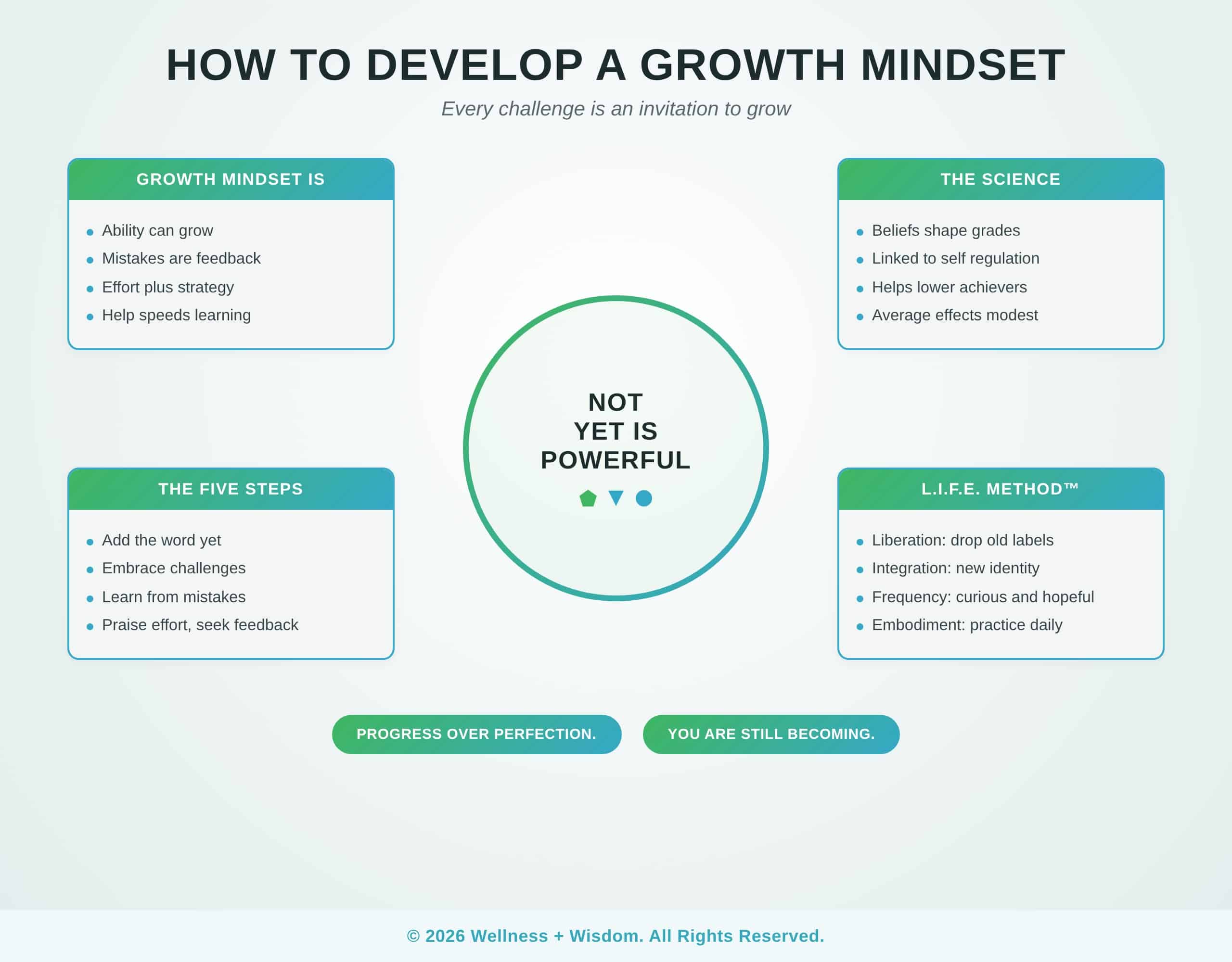
The science of growth mindset shows that believing abilities can grow is linked with better learning behaviors and, in some groups, better achievement, though the effects of mindset interventions on their own are generally modest and depend on context. The honest picture is encouraging but not magical.
Early research was promising. In a study published in Child Development, Lisa Blackwell, Kali Trzesniewski, and Carol Dweck followed students through the transition to junior high school. Students who believed intelligence could grow showed an upward trajectory in math grades over two years, while those who believed intelligence was fixed did not. In a second study, teaching students that the brain can grow like a muscle helped reverse a decline in their grades.
A large meta analysis by Jeni Burnette and colleagues in Psychological Bulletin examined how mindsets relate to self regulation. They found that growth mindsets were associated with more mastery oriented goals, more effective strategies, and more positive expectations, all of which support persistence and learning.
Larger studies offer a more nuanced view. In a national experiment published in Nature, David Yeager and colleagues tested a short online growth mindset program with more than 12,000 ninth grade students across the United States. The program improved grades among lower achieving students and increased enrollment in advanced math courses, especially in schools with supportive peer norms. Meanwhile, a pair of meta analyses by Victoria Sisk and colleagues in Psychological Science found that the overall links between mindset and academic achievement, and the effects of mindset interventions, were weak on average, though some groups, such as students from lower income backgrounds or those at academic risk, appeared to benefit more.
What does this mean for you? Mindset matters, but it works best when paired with real strategies, supportive environments, and consistent practice. Believing you can grow opens the door. Effort, good methods, and support help you walk through it.
How to Develop a Growth Mindset
You learn how to develop a growth mindset by adding the word “yet,” embracing challenges, learning from mistakes, praising effort and strategy, and seeking feedback. These five practices turn the belief that you can grow into daily habits that make growth real. Here is how I practice and teach them.
1. Add the Word “Yet”
When you catch yourself saying “I can't do this” or “I'm not good at this,” add one word: yet. “I can't do this yet.” “I'm not good at public speaking yet.” This tiny change reminds your brain that ability is a journey, not a fixed state. It sounds simple, and it is. That is what makes it powerful. Say it out loud, write it down, and teach it to your kids.
2. Embrace Challenges
Choose challenges on purpose. Take on a project slightly beyond your current skills, sign up for a class, or try a new physical activity. Challenges are where growth happens. When you feel the discomfort of not knowing, remind yourself that this feeling is the sensation of your brain learning. The ideas in how to embrace change can help you lean in.
3. Learn From Mistakes
After a mistake or setback, ask three questions: What happened? What did I learn? What will I try next time? Write the answers down. This turns failure from a source of shame into a source of wisdom. Many of the most successful people in the world have a long history of mistakes they learned from. The practices in how to stop fearing failure go deeper.
4. Praise Effort and Strategy
Shift your praise, for yourself and others, from talent to process. Instead of “You're so smart,” try “You worked really hard on that” or “I love how you tried a new approach when you got stuck.” Praising effort and strategy teaches that progress comes from what we do, not just who we are. Be careful not to praise effort that is not working, though. If a strategy is failing, celebrate the effort and help find a better approach.
5. Seek Feedback
Ask for feedback from people you trust, and receive it as a gift. Feedback shows you where to grow. It can sting at first, but with a growth mindset, it becomes valuable information. Try asking, “What is one thing I could do better next time?” The practices in how to handle criticism can help you receive feedback with grace.
Start with one or two of these practices this week. Mindset grows through repetition. If you would love a supportive community as you grow, the Liberated Life Tribe is a warm place to begin.
Here is a simple daily routine that brings these practices together. In the morning, choose one small challenge for the day, something just outside your comfort zone. During the day, catch one fixed thought and add the word “yet.” In the evening, write down one thing you learned, one mistake you grew from, and one effort you are proud of. This takes less than ten minutes, but repeated over weeks, it rewires the way you see yourself.
Your environment matters too. Surround yourself with people who encourage growth, who celebrate learning, and who are honest with you in a kind way. Read books and listen to podcasts by people who have grown through challenges. Notice how the voices around you talk about ability and effort. The beliefs of the people closest to us shape our own beliefs more than we realize, so choose your circle with intention.
Growth Mindset Versus Fixed Mindset
A growth mindset and a fixed mindset lead to very different responses to the same situations. A growth mindset sees challenges as opportunities, effort as the path to mastery, and feedback as useful. A fixed mindset sees challenges as threats, effort as a sign of low ability, and feedback as criticism. Recognizing the difference helps you choose your response.
Here is how it looks in practice. Facing a challenge, a fixed mindset thinks, “What if I fail and look foolish?” A growth mindset thinks, “This will stretch me.” After a setback, a fixed mindset says, “I'm just not good at this.” A growth mindset asks, “What can I learn?” When someone else succeeds, a fixed mindset feels threatened. A growth mindset feels inspired and curious about how they did it. If comparison often pulls you down, the ideas in how to stop comparing yourself to others may help.
There is also something called a false growth mindset. This happens when people say the right words, like “I love challenges,” but do not change how they actually respond to struggle. Or when they praise effort alone, even when a strategy clearly is not working. True growth mindset is not a slogan. It shows up in what you do when things get hard: whether you try new strategies, ask for help, and keep learning.
Learning a new skill is one of the best ways to practice. Pick something you have always wanted to try, like a musical instrument, a language, a sport, or a craft. Notice how it feels to be a beginner again. Celebrate small improvements. Watch how your fixed beliefs try to show up, and practice responding with “not yet.” Few things build a growth mindset faster than proving to yourself, one small step at a time, that you really can learn.
How to Develop a Growth Mindset With the L.I.F.E. Method™
The L.I.F.E. Method™ offers a powerful framework for developing a growth mindset, because each of its four pillars, Liberation, Integration, Frequency, and Embodiment, helps you move from fixed beliefs toward an identity built on learning and growth.
Liberation is about releasing the fixed beliefs that hold you back, like “I'm not smart enough” or “people like me don't succeed.” Many of these beliefs were absorbed in childhood from family, school, or culture. This is where Emotional Epigenetics™ offers insight into how inherited patterns shape our beliefs. Integration is about weaving new beliefs into your sense of self. You begin to see yourself as someone who learns, grows, and adapts.
Frequency is about the emotional state you bring to challenges. Curiosity, hope, and gratitude make learning easier, while fear and shame make it harder. Embodiment is about living your growth mindset in daily action: trying new things, practicing consistently, and responding to setbacks with resilience. When you work through these four pillars, a growth mindset stops being an idea and becomes part of who you are. To learn more about how this framework came to life, visit my story.
A growth mindset also changes how you see other people. When you believe people can grow, you give them room to change, offer encouragement instead of labels, and invest in their development. Leaders, parents, and partners with a growth mindset tend to bring out the best in those around them.
Celebrating Effort and Progress
Celebrating effort and progress helps a growth mindset take root, because your brain learns through reward. When you notice and appreciate your learning, you reinforce the habits that make growth possible.
Look for the small signs of growth. The first time you tried something new despite feeling unsure. The moment you asked for feedback instead of avoiding it. The day you bounced back from a setback faster than you used to. These moments matter more than any single result. Write them down, share them with a friend, or simply pause and acknowledge them.
Celebration also keeps you motivated during long journeys. Big goals take time, and focusing only on the finish line can feel discouraging. Celebrating progress along the way keeps the fire lit. There is a whole practice around noticing these moments in celebrating small wins, and it pairs perfectly with a growth mindset.
Growth Mindset in Everyday Life
A growth mindset in everyday life shows up in small choices: how you talk to yourself, how you respond to your kids' mistakes, how you approach a hard conversation, and how you handle a new challenge at work. It is a daily practice, not a one time decision.
At work, it might mean volunteering for a project that stretches you or asking a colleague to teach you a skill. In relationships, it might mean believing that you and your partner can learn to communicate better, rather than assuming “this is just how we are.” In parenting, it might mean praising your child's effort and modeling how you handle your own mistakes. In health, it might mean seeing a missed workout as a reason to adjust your plan rather than a sign you lack discipline. The ideas in how to build self discipline pair well here.
This is also where the Wellness Pentagon™ becomes helpful. You can bring a growth mindset to every dimension of wellbeing: physical, mental, emotional, spiritual, and financial. In your spiritual life, it might mean trusting that your Connection to Creator and God can deepen over time. You will find many guests sharing how mindset shifts changed their lives across our latest episodes.
When Growth Feels Slow
If growth feels slow right now, you are in very good company, and it is completely understandable. Learning how to develop a growth mindset is itself a growth process. Old beliefs can be deeply rooted, and change takes time and patience.
When growth feels slow, focus on the process rather than the outcome. Ask yourself, “Am I trying new strategies? Am I learning from setbacks? Am I asking for help?” If the answer is yes, you are growing, even if results take time to show. Look back over a longer time frame, like six months or a year, and you will often see progress you missed day to day. Tools like a growth journal can help you track this, and you can find a few supportive tools we trust in our wellness tools store.
Remember that a growth mindset is not about blaming yourself for every struggle. Some challenges come from circumstances outside your control, and growth also includes recognizing when you need more support, resources, or rest. If you are struggling with persistent low mood, anxiety, or burnout, please reach out to a qualified health professional. There is real strength in asking for help. If you feel stuck, the practices in how to get out of a rut are a gentle next step.
Ready to go deeper? Join the Liberated Life Tribe and receive your 10 day Self Liberation Blueprint at liberatedlife.com. It is free, it is guided, and each day offers a gentle practice to help you release old beliefs and grow into who you are becoming.
Frequently Asked Questions
What is a growth mindset?
A growth mindset is the belief that your abilities and qualities can be developed through effort, good strategies, and help from others. It contrasts with a fixed mindset, the belief that intelligence and talent are set traits that cannot change.
Can adults develop a growth mindset?
Yes. Mindsets can shift at any age. Adults can develop a growth mindset by noticing fixed beliefs, adding the word “yet,” embracing challenges, learning from mistakes, and seeking feedback. Practice and supportive environments help the shift stick.
Does growth mindset really work?
Research is mixed but encouraging. Some studies link growth mindset with better learning behaviors and achievement, and a large national experiment found benefits for lower achieving students. Meta analyses suggest average effects are modest and depend on context.
What are examples of growth mindset statements?
Examples include “I can't do this yet,” “Mistakes help me learn,” “This is hard, so I am growing,” “What can I try differently?” and “Their success shows me what is possible.” These statements focus on learning and progress.
How can I teach my kids a growth mindset?
Praise their effort and strategies rather than their talent, model how you handle your own mistakes, use the word “yet,” and talk about how the brain grows with practice. Celebrate their learning, not just their results.
What is a false growth mindset?
A false growth mindset happens when people use growth mindset language without changing how they respond to challenges, or when they praise effort alone even when a strategy is not working. True growth mindset shows up in actions, not slogans.
Studies and External Resources
The science in this article rests on peer reviewed research. These are the sources referenced throughout.
- Blackwell LS, Trzesniewski KH, Dweck CS. (2007). Implicit theories of intelligence predict achievement across an adolescent transition: a longitudinal study and an intervention. Child Development. PubMed: 17328703
- Burnette JL, et al. (2013). Mind sets matter: a meta analytic review of implicit theories and self regulation. Psychological Bulletin. PubMed: 22866678
- Yeager DS, et al. (2019). A national experiment reveals where a growth mindset improves achievement. Nature. PubMed: 31391586
- Sisk VF, et al. (2018). To What Extent and Under Which Circumstances Are Growth Mind Sets Important to Academic Achievement? Two Meta Analyses. Psychological Science. PubMed: 29505339
About Josh Trent
Josh Trent is an Identity Transformation Architect and the award winning host of the Wellness + Wisdom Podcast, with over 15 million downloads since 2015. He is the creator of the L.I.F.E. Method™ Identity Transformation System and steward of the Emotional Epigenetics™ and BREATHE: Breath + Wellness™ systems of self mastery, impacting over 1,000 students worldwide. Join the Liberated Life Tribe and receive your 10 day Self Liberation Blueprint at liberatedlife.com. Josh lives in Austin, Texas with his wife Carrie, daughter Nayah, and son Novah. Peace and power.
Disclosure: We may earn a commission from certain links on this site when you make a purchase, at no extra cost to you. These commissions help support Wellness + Wisdom and do not affect the products or resources we choose to recommend. Full disclosure .