
By Josh Trent | Wellness + Wisdom Podcast Host & Identity Transformation Architect
“Your journal is the one place where you never have to perform. Put the pen on the page, tell the truth, and watch how much lighter you feel.”
Josh Trent
Learning how to start journaling is one of the simplest and most powerful gifts you can give yourself. All you need is a notebook, a pen, and a few quiet minutes. Yet that small practice can help you clear mental clutter, understand your emotions, notice patterns in your life, and grow gratitude and self awareness. Many of the wisest people I have interviewed on the podcast keep some form of journal. They use it to think clearly, process hard moments, and stay connected to what matters most. Journaling has been one of my own anchors for years, especially in seasons of change. And it pairs beautifully with Emotional Epigenetics™, because writing helps you see the emotional patterns you inherited and choose new ones.
Here is the joy forward truth at the center of it all. Journaling is not homework, and there is no wrong way to do it. It is a conversation with yourself, and with God if you choose, that helps you come home to who you really are. Let us explore exactly how to begin and how to make it a habit you love.
Table of Contents
- What Journaling Really Is
- Why Journaling Works
- The Gift of a Journaling Practice
- The Science of Journaling
- How to Start Journaling
- Journaling Versus Ruminating
- How to Start Journaling With Emotional Epigenetics™
- Celebrating Your Pages
- Journaling Prompts for Every Season
- When Journaling Feels Hard
- Frequently Asked Questions
- Studies and External Resources
- About Josh Trent
What Journaling Really Is
Journaling is the practice of writing down your thoughts, feelings, experiences, and reflections on a regular basis to better understand yourself and your life. It can be as simple as a few sentences each morning or as deep as several pages of reflection at night.
There are many styles of journaling. Free writing means putting down whatever comes to mind without editing. Gratitude journaling focuses on the good things in your life. Expressive writing explores difficult emotions and experiences. Reflective journaling looks back on your day or week to notice lessons and patterns. Prayer journaling turns your writing into a conversation with God. Goal journaling helps you clarify what you want and track your progress. Each style offers different benefits, and you can mix them freely.
At its heart, journaling is about honesty and attention. It gives your inner world a place to land. Thoughts that swirl endlessly in your head often become clearer and smaller once they are on paper. Feelings that seemed overwhelming become easier to understand. And moments of joy become easier to remember and savor. These themes come up often on the Wellness + Wisdom Podcast, where guests share the daily habits that changed their lives.
You also do not need special talent or a fancy notebook. People sometimes put off journaling because they think they are not good writers or do not have anything interesting to say. Your journal is not a performance. A simple spiral notebook works perfectly, and so does a few honest lines scribbled before bed. What matters is that the words are yours. Once you understand how to start journaling in this relaxed, judgment free way, the practice becomes something you look forward to rather than another task on your list.
Why Journaling Works
Journaling works because putting thoughts and feelings into words helps your brain organize experience, calm emotional intensity, and see situations with more clarity and perspective. Writing turns a tangle of thoughts into something you can look at, understand, and work with.
When an emotion or worry stays inside your head, it can loop endlessly. Your mind keeps returning to it because it has not been fully processed. When you write it down, you give it structure. You name what happened, how you felt, and what it might mean. That process of naming and organizing often brings relief. Many people notice that after journaling, they feel calmer, lighter, and more able to focus. If your mind often feels loud, the practices in how to quiet the noise in your mind pair well with journaling.
Journaling also builds self awareness. Over weeks and months, your journal becomes a record of your inner life. You start to notice patterns: situations that tend to trigger stress, habits that lift your mood, relationships that energize or drain you. That awareness is the first step toward meaningful change. You cannot change a pattern you cannot see, and journaling helps you see. This is why learning how to start journaling is such a foundational step in any journey of personal growth.
The Gift of a Journaling Practice
The gift of a journaling practice is a clearer mind, a deeper relationship with yourself, and a growing record of your own growth, wisdom, and joy. Few habits give so much in return for so little time.
A journal becomes a trusted friend. It is always available, never judges, and holds whatever you bring to it. On hard days, it gives you a safe place to process. On good days, it helps you savor and remember. Over time, flipping back through old entries can be deeply encouraging. You see challenges you once thought would break you, and you see how you came through them. That perspective builds resilience and self trust.
Journaling also helps you reconnect with your own voice. In a world full of opinions, notifications, and expectations, it is easy to lose track of what you really think and want. Your journal is a place to listen to yourself. Many people discover their dreams, values, and purpose on the page. The ideas in how to reconnect with yourself are a beautiful companion to this practice.
The Science of Journaling
The science of journaling shows that expressive writing about difficult experiences can support health, that gratitude journaling can boost wellbeing, and that putting feelings into words can calm the brain's emotional alarm system. Writing is a simple tool with real effects.
The research on expressive writing began with psychologist James Pennebaker. In a pioneering study published in the Journal of Abnormal Psychology, James Pennebaker and Sandra Beall asked college students to write about traumatic or upsetting experiences for a few days. Students who wrote about both the facts and their deepest feelings visited the health center less often in the following months than students who wrote about neutral topics. That study launched decades of research into how writing about emotions supports wellbeing.
Gratitude journaling has research behind it too. In a set of experiments published in the Journal of Personality and Social Psychology, Robert Emmons and Michael McCullough found that people who regularly wrote down things they were grateful for reported greater wellbeing, more optimism, and in one study, more time spent exercising, compared with people who wrote about hassles or neutral events.
There is also brain science behind naming feelings. In a study published in Psychological Science, Matthew Lieberman and colleagues found that labeling emotions in words, a process called affect labeling, reduced activity in the amygdala, a brain region involved in emotional reactions, and increased activity in a region of the prefrontal cortex involved in regulation. Simply naming what you feel can help calm emotional intensity, and journaling is a natural way to practice it.
How to Start Journaling
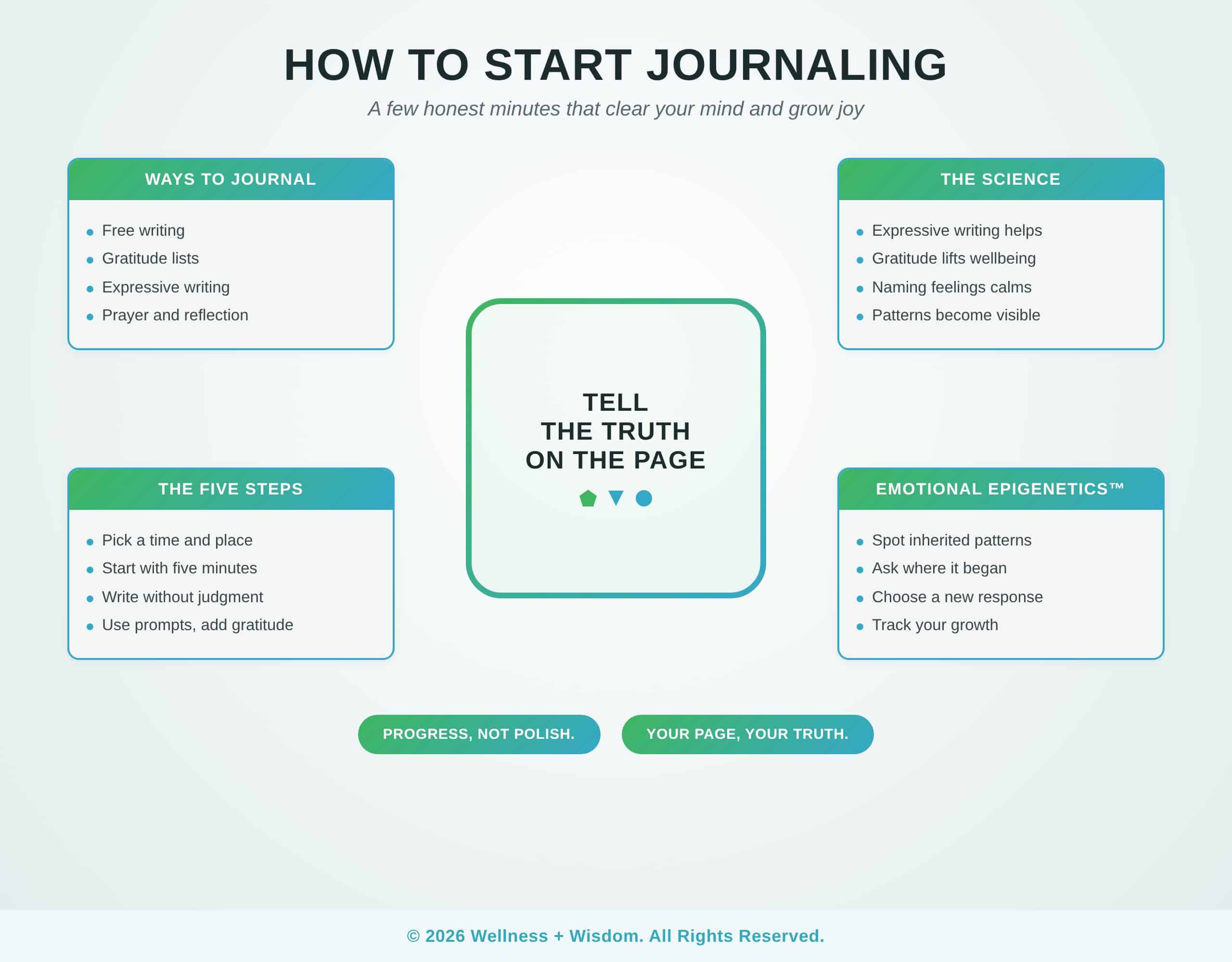
You learn how to start journaling by choosing a simple time and place, starting small, writing without judgment, using prompts when you feel stuck, and including gratitude. These five steps make journaling easy to begin and easy to keep. Here is how I practice and teach them.
1. Choose a Time and Place
Pick a consistent time for journaling. Many people love the morning, with a cup of coffee before the day begins. Others prefer the evening, as a way to reflect and release the day before sleep. Choose a quiet spot and keep your journal and pen there so they are always ready. Linking journaling to an existing habit, like your morning coffee, makes it much easier to remember. The ideas in how to create a morning routine can help you anchor it.
2. Start Small
You do not need to write pages. Start with five minutes or even three sentences. Small, consistent entries build the habit far better than occasional long sessions. Once journaling feels natural, you can write longer when you feel moved to. The goal at first is simply to show up.
3. Write Without Judgment
Your journal is not for anyone else. Do not worry about spelling, grammar, or whether your thoughts sound wise. Let the words flow. If something messy comes up, let it be messy. Honesty is far more valuable than polish. If your inner critic gets loud, notice it and keep writing. The practices in how to quiet your inner critic can help.
4. Use Prompts When You Feel Stuck
A blank page can feel intimidating. Prompts give you a starting point. Try questions like: What am I feeling right now? What is on my mind today? What do I need? What would make today meaningful? What did I learn this week? Keep a short list of favorite prompts in the front of your journal so you always have a place to begin.
5. Include Gratitude
End each entry by writing down three things you are grateful for. They can be big or small: a kind word from a friend, sunshine on your face, a good meal, a prayer answered. As the research shows, gratitude journaling supports wellbeing. It also ends each session on a hopeful note. The ideas in how to cultivate daily gratitude go deeper.
Start with one or two of these steps this week. The best journal is the one you actually use. If you would love a supportive community as you grow, the Liberated Life Tribe is a warm place to begin.
Here is a simple ten minute entry you can try tonight. Write the date at the top. Spend three minutes writing whatever is on your mind, without stopping or editing. Spend three minutes answering one prompt, like “What did today teach me?” Spend two minutes writing three things you are grateful for. Close with one sentence of intention for tomorrow. That is it. This simple structure is often the easiest answer to how to start journaling when you are not sure what to write.
You might also try pairing journaling with a few slow breaths. Before you write, take three deep breaths with long, gentle exhales. This settles your body and helps you drop from busy thinking into honest feeling. Many people find that a calm body makes for more truthful writing. The practices in how to practice breathwork pair beautifully with your journal.
Journaling Versus Ruminating
Journaling and ruminating can look similar, but they lead to very different places. Journaling explores thoughts and feelings in a way that leads to understanding, perspective, and action. Ruminating replays the same worries over and over without moving forward. Healthy journaling helps you process. Ruminating keeps you stuck.
Sometimes people worry that writing about problems will make them feel worse. That can happen if writing turns into a loop of the same complaints. The key is to move from describing to understanding. After writing about what happened and how you feel, ask yourself questions like: What can I learn from this? What is within my control? What would I tell a friend in this situation? What is one small step I can take? These questions turn writing into a path forward.
If you notice your journaling becoming a loop, shift the focus. Write about something you are grateful for, a memory that brings you joy, or a hope for the future. Balance is key. The practices in how to stop overthinking can help you break unhelpful loops, both on and off the page.
A quick note on privacy. Your journal is yours. If you live with others, keep it somewhere safe, or use a password protected app, so you can write with full honesty. Knowing that no one else will read your words frees you to explore your truest thoughts and feelings without holding back.
How to Start Journaling With Emotional Epigenetics™
Emotional Epigenetics™ offers a powerful lens for journaling, because writing helps you notice the emotional patterns you learned from your family and environment, and choose which ones to keep and which ones to transform. Your journal becomes a tool for generational healing.
Many of our reactions are learned. The way we handle stress, conflict, money, and love often echoes what we saw growing up. Journaling helps you catch these patterns in action. Try prompts like: Where did I learn to react this way? Who in my family handled things similarly? What belief sits underneath this feeling? What new response would I like to practice? Writing about these questions brings unconscious patterns into the light.
Once a pattern is visible, you can begin to change it. Your journal can track your progress as you practice new responses. Over time, you may notice that old triggers lose their grip and new ways of being feel more natural. This is the heart of Emotional Epigenetics™: becoming aware of inherited patterns and consciously choosing new ones. To go deeper with identity level change, explore our L.I.F.E. Method™ programs. And if you want to explore early patterns more gently, the ideas in how to heal your inner child are a beautiful next step.
Journaling can also help you notice what you are feeling in the moment, before old patterns take over. If you notice yourself reacting strongly to something, take a few minutes to write: What happened? What did I feel? What did I want to do? What would I like to do instead? This kind of in the moment reflection builds emotional awareness, which is the foundation of real change. The practices in how to feel your feelings go deeper on this.
Celebrating Your Pages
Celebrating your pages helps journaling feel joyful rather than like another obligation. When you notice and appreciate your consistency and growth, you build momentum and make the habit stick.
Celebrate the small wins. The first week you journaled every day. The first time writing helped you calm down after a hard conversation. The moment you reread an old entry and realized how much you have grown. Mark these milestones. Some people put a small star in their calendar each day they journal. Others treat themselves to a beautiful new notebook when they fill one.
You can also use your journal to celebrate your life. Write about your wins, your joys, and the people who make your life brighter. Your journal does not have to be only for problems. It can be a treasure chest of good memories. There is a whole practice around noticing these moments in celebrating small wins, and your journal is the perfect place to do it.
Journaling Prompts for Every Season
Journaling prompts for every season help you keep your practice fresh and meaningful as your life changes. Different seasons call for different questions, and having a few prompts ready makes it easy to keep writing.
For mornings, try: What is my intention for today? What would make today a good day? How do I want to show up for the people I love? For evenings, try: What went well today? What challenged me, and what did I learn? What am I grateful for? For hard seasons, try: What am I feeling, and where do I feel it in my body? What do I need right now? What is one kind thing I can do for myself? For seasons of growth, try: Who am I becoming? What dreams are stirring in me? What is one brave step I can take this week?
For your spiritual life, try: Where did I sense God's presence today? What am I praying for? What is God teaching me in this season? Your journal can become a place to deepen your Connection to Creator and God, alongside the other dimensions of the Wellness Pentagon™. You will find many guests sharing their favorite reflection practices across our latest episodes.
If you are a parent, journaling can also become a family practice. Children can draw or write a sentence about their day, share one thing they are grateful for, or keep a feelings journal. Learning how to start journaling young gives children a lifelong tool for understanding themselves. And when they see you writing, they learn that reflection is a normal, valuable part of life.
When Journaling Feels Hard
If journaling feels hard right now, you are in good company, and it is completely understandable. Many people struggle to stay consistent, feel awkward writing about their feelings, or are not sure what to say. Knowing how to start journaling is one thing. Keeping it going takes patience and self compassion.
If you miss a few days, simply start again. There is no streak to protect and no one keeping score. If writing feels awkward, try a different format, like bullet points, lists, or a single sentence a day. If a blank page feels intimidating, use a guided journal with prompts already printed. You can find a few guided journals and supportive tools we trust in our wellness tools store.
Sometimes journaling brings up difficult memories or emotions. That is a normal part of the process, but you do not have to face heavy experiences alone. If writing stirs up intense distress, trauma, or thoughts of self harm, please pause and reach out to a qualified mental health professional right away. A therapist can help you process what comes up safely. There is real strength in asking for help. If you want to grow your capacity to be with hard emotions, the practices in how to sit with difficult emotions are a gentle next step.
Ready to go deeper? Join the Liberated Life Tribe and receive your 10 day Self Liberation Blueprint at liberatedlife.com. It is free, it is guided, and each day offers a gentle practice and reflection to help you reconnect with who you really are.
Frequently Asked Questions
How do I start journaling as a beginner?
Choose a consistent time, start with five minutes or three sentences, write without judgment, and use simple prompts like “What am I feeling right now?” End by writing three things you are grateful for. Consistency matters more than length.
What should I write about in my journal?
Write about your thoughts, feelings, experiences, goals, and gratitude. You can reflect on your day, explore a challenge, plan your week, or write a prayer. Prompts can help when you feel stuck, and there is no wrong topic.
What are the benefits of journaling?
Research suggests journaling can support wellbeing in several ways. Expressive writing has been linked with fewer health center visits, gratitude journaling with greater wellbeing, and naming feelings in words with reduced emotional reactivity in the brain.
Is it better to journal in the morning or at night?
Both work well. Morning journaling helps you set intentions and clear your mind before the day begins. Evening journaling helps you reflect, release the day, and wind down for sleep. Choose the time you can keep consistently.
Should I journal on paper or digitally?
Either can work. Many people find handwriting slows them down and feels more reflective, while digital journaling can be convenient and searchable. Choose the format you will actually use, and feel free to experiment.
What if journaling makes me feel worse?
If writing turns into replaying the same worries, shift toward understanding and next steps, or write about gratitude and hope. If journaling brings up intense distress or trauma, pause and reach out to a qualified mental health professional for support.
Studies and External Resources
The science in this article rests on peer reviewed research. These are the sources referenced throughout.
- Pennebaker JW, Beall SK. (1986). Confronting a traumatic event: Toward an understanding of inhibition and disease. Journal of Abnormal Psychology. View the study via DOI
- Emmons RA, McCullough ME. (2003). Counting blessings versus burdens: an experimental investigation of gratitude and subjective well being in daily life. Journal of Personality and Social Psychology. PubMed: 12585811
- Lieberman MD, et al. (2007). Putting feelings into words: affect labeling disrupts amygdala activity in response to affective stimuli. Psychological Science. PubMed: 17576282
About Josh Trent
Josh Trent is an Identity Transformation Architect and the award winning host of the Wellness + Wisdom Podcast, with over 15 million downloads since 2015. He is the creator of the L.I.F.E. Method™ Identity Transformation System and steward of the Emotional Epigenetics™ and BREATHE: Breath + Wellness™ systems of self mastery, impacting over 1,000 students worldwide. Join the Liberated Life Tribe and receive your 10 day Self Liberation Blueprint at liberatedlife.com. Josh lives in Austin, Texas with his wife Carrie, daughter Nayah, and son Novah. Peace and power.
Disclosure: We may earn a commission from certain links on this site when you make a purchase, at no extra cost to you. These commissions help support Wellness + Wisdom and do not affect the products or resources we choose to recommend. Full disclosure .