
By Josh Trent | Wellness + Wisdom Podcast Host & Identity Transformation Architect
“The end of a relationship is not the end of your capacity to love. It is an invitation to come home to yourself, and to discover who you are becoming.”
Josh Trent
Learning how to heal from a breakup is one of the most tender and transformative journeys a human being can take. When a relationship ends, it can feel like the ground has shifted beneath your feet. The future you imagined suddenly looks different. Daily routines that included another person now feel strangely quiet. You may find yourself replaying conversations, checking your phone, or wondering who you are without this person in your life. All of this is a natural part of loving someone and letting go. It does not mean anything is wrong with you. It means your heart was open, and that openness is one of your greatest strengths. If you want a framework for walking through this season with intention, the L.I.F.E. Method™ offers a beautiful path.
Here is the joy forward truth at the center of it all. A breakup can become one of the great turning points of your life. Many people come through heartbreak with a clearer sense of who they are, what they value, and what kind of love they truly want. The pain is real, and so is the growth waiting on the other side. Let us explore exactly how to walk this path with grace.
Table of Contents
- What Healing From a Breakup Really Means
- Why Breakups Hurt So Much
- The Gift Hidden Inside Heartbreak
- The Science of Heartbreak
- How to Heal From a Breakup
- Moving On Versus Healing
- How to Heal From a Breakup With the L.I.F.E. Method™
- Celebrating Each Step Forward
- Opening Your Heart Again
- When the Pain Lingers
- Frequently Asked Questions
- Studies and External Resources
- About Josh Trent
What Healing From a Breakup Really Means
Healing from a breakup means moving through the grief of a relationship ending until you can hold the memory with peace, feel whole in yourself again, and open to new connection without fear running the show. It is not about forgetting the person or pretending the relationship did not matter. It is about integrating the experience so it becomes part of your wisdom rather than a weight you carry.
Healing looks different for everyone. For some, it means feeling sadness for a while and then gradually noticing more good days than hard ones. For others, it involves anger, confusion, relief, or a mix of all of these. There is no single correct way to feel. What matters is giving yourself permission to experience your emotions honestly and to care for yourself as you would care for a dear friend going through the same thing.
True healing also includes rediscovering yourself. Relationships shape our routines, our identity, and even our dreams. When one ends, you have a chance to reconnect with parts of yourself that may have been set aside, like old passions, friendships, or goals. This rediscovery is often where the deepest healing happens. Many guests on the Wellness + Wisdom Podcast describe a breakup as the moment they finally came home to themselves.
It can help to remember that healing is not a single moment but a gradual unfolding. You may feel steady one day and tender the next. A song, a place, or an anniversary can bring a wave of emotion months later. These waves do not mean you are going backward. They are part of how the heart integrates a meaningful chapter. Over time, the waves come less often, feel less intense, and pass more quickly.
Why Breakups Hurt So Much
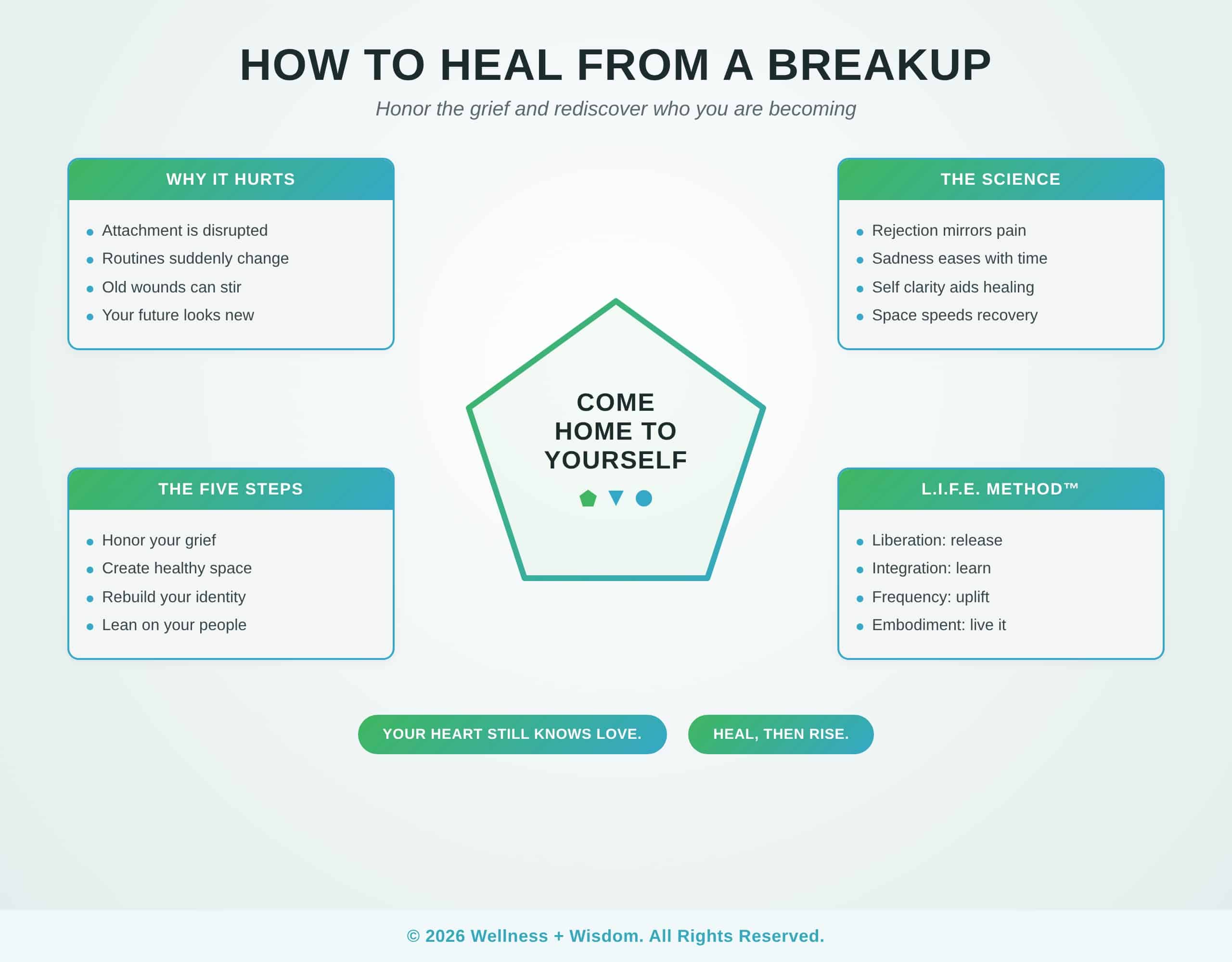
Breakups hurt so much because love involves deep emotional attachment, and when that attachment is disrupted, your brain and body respond as if something essential has been lost. The pain of a breakup is not weakness or overreaction. It is a natural response to losing a significant bond.
When you are in a relationship, your partner becomes part of your sense of safety, your daily rhythm, and your vision of the future. Your brain links them with comfort, reward, and belonging. When the relationship ends, those links do not disappear overnight. You may crave contact, feel anxious, or struggle to focus, much like the longing that comes with any meaningful loss. This is also why learning how to be vulnerable again becomes such an important part of healing.
Breakups can also touch old wounds. If you experienced rejection, abandonment, or instability earlier in life, a breakup may stir those feelings again. This is where Emotional Epigenetics™ offers a helpful lens, showing how earlier emotional patterns can shape our responses today. The encouraging news is that these patterns can be healed. A breakup can become an opportunity to tend to old wounds with new compassion.
The Gift Hidden Inside Heartbreak
The gift hidden inside heartbreak is a deeper relationship with yourself, along with greater clarity about what you need and want in love. Many people look back on a painful breakup as the start of the most meaningful growth of their lives.
Heartbreak has a way of stripping away what is not essential. In the quiet after a relationship ends, you may discover strengths you did not know you had. You learn that you can survive something that once felt unthinkable. You learn to comfort yourself, to lean on friends, and to build a life that feels like your own. These discoveries build a resilience that will serve you in every part of life.
A breakup also offers clarity. When you reflect honestly on the relationship, you can see what worked, what did not, and what you want to do differently next time. You may notice patterns in how you choose partners or how you show up in love. This awareness is a gift, because it allows you to make more conscious choices in the future. The work of building self worth often deepens beautifully during this season, as you come to know your own value apart from any relationship.
The Science of Heartbreak
The science of heartbreak shows that the emotional pain of rejection shares some neural overlap with physical pain, that most people recover from breakups more quickly than they expect, and that rebuilding a clear sense of self is a key part of moving forward. Your heartache is real, and so is your capacity to heal.
Start with the pain itself. In a study published in the Proceedings of the National Academy of Sciences, Ethan Kross and colleagues scanned the brains of people who had recently gone through an unwanted breakup while they viewed photos of their former partner. The researchers found that intense social rejection activated brain regions that overlap with those involved in physical pain. In other words, when people say a breakup hurts, they are describing something real.
The recovery is encouraging. In a study published in Personality and Social Psychology Bulletin, David Sbarra followed young adults after the end of a dating relationship and tracked their emotions over time. He found that sadness and anger generally decreased over the following weeks, and that people who were still very attached to their former partner tended to recover more slowly. Healing tends to unfold gradually, and loosening the grip of attachment supports the process.
Identity matters too. Research by Erica Slotter, Wendi Gardner, and Eli Finkel, also published in Personality and Social Psychology Bulletin, found that breakups can change and shrink a person's sense of self, a phenomenon they described with the question “Who am I without you?” They found that this loss of self clarity was linked with emotional distress after a breakup. Rebuilding a clear and confident sense of who you are is a meaningful part of healing.
How to Heal From a Breakup
You learn how to heal from a breakup by honoring your grief, creating space from your former partner, rebuilding your sense of self, leaning on your support system, and reflecting with compassion. These five steps help you move through pain toward peace and wholeness. Here is how I practice and teach them.
1. Honor Your Grief
Give yourself permission to feel. Cry when you need to. Write in a journal. Talk about what happened with someone who listens well. Grief is not something to rush through or push away. It is the natural way the heart processes loss. When you allow your feelings to move through you, they soften over time. On the quiet nights, the practices in how to overcome loneliness can comfort you.
2. Create Space From Your Former Partner
Healing is much easier when you are not constantly reopening the wound. Consider taking a break from contact, muting or unfollowing on social media, and putting reminders like photos or gifts out of sight for now. This is not about bitterness. It is about giving your heart room to heal. If you share children or close circles, focus on keeping communication calm, kind, and practical.
3. Rebuild Your Sense of Self
Reconnect with the things that make you feel like you. Return to old hobbies or try new ones. Spend time with friends you may have seen less often. Set a personal goal that excites you. Ask yourself what you want your life to look like now. As the research shows, rebuilding a clear sense of self is a powerful part of healing. The ideas in how to discover who you really are are a lovely companion here.
4. Lean on Your Support System
You do not have to heal alone. Reach out to friends and family who love you. Accept invitations, even when part of you wants to stay home. Let people show up for you. Connection reminds you that you are loved and that your life is full of meaningful relationships beyond the one that ended. The practices in how to make friends as an adult can help if your circle feels small right now.
5. Reflect With Compassion
Once the most intense emotions have settled, take time to reflect on the relationship with kindness toward both yourself and your former partner. What did you learn? What would you like to carry forward? What would you do differently? This kind of reflection turns pain into wisdom. Avoid harsh self blame. Every relationship teaches us something, and you deserve the same grace you would offer anyone you love. The practices in how to practice self compassion can help.
Start with one or two of these steps, and go gently. Healing is not a straight line, and every small step matters. If you would love a supportive community as you heal, the Liberated Life Tribe is a warm place to begin.
Your body deserves care during this season too. Heartbreak can disrupt sleep, appetite, and energy. Try to keep simple routines: regular meals, time outside each day, gentle movement, and a consistent bedtime. A few minutes of slow breathing, with a long exhale, can help settle the waves of emotion that rise during the day. When you care for your body, you give your heart a steadier foundation to heal from. The practices in how to sleep better can help on restless nights.
Writing can also be a powerful companion. Some people find relief in writing a letter to their former partner that they never send, saying everything they wish they could say. Others keep a simple daily journal, noting one feeling, one thing they are grateful for, and one small step they took for themselves. Writing helps you process emotions, notice patterns, and see your progress over time.
Moving On Versus Healing
Moving on and healing are not the same thing. Moving on can mean simply getting busy, starting a new relationship quickly, or pushing feelings aside. Healing means actually processing the loss, learning from it, and becoming whole again. You can move on without healing, but true healing allows you to move forward with freedom.
Many people try to skip the hard part of a breakup by distracting themselves or jumping into something new right away. While distraction can offer temporary relief, unprocessed grief tends to resurface later, often in the next relationship. Patterns repeat, old hurts flare up, and the lessons of the past go unlearned. Taking time to heal protects your future relationships.
Healing does not mean you have to be alone for a set amount of time. It means being honest with yourself about where you are. Are you seeking connection because you feel ready and whole, or because you are trying to fill a painful empty space? There is no shame either way, only an invitation to choose consciously. If you want to explore what healthy love looks like going forward, the ideas in how to celebrate the people you love are a great place to start.
If you do choose to date again, go slowly and stay honest with yourself. Notice how you feel before, during, and after time together. Calm, safe, and seen are good signs. Anxious, small, or pressured are signals worth listening to. Your healing gives you a clearer inner compass, so trust it.
How to Heal From a Breakup With the L.I.F.E. Method™
The L.I.F.E. Method™ offers a meaningful framework for heartbreak, because each of its four pillars, Liberation, Integration, Frequency, and Embodiment, supports a different part of healing. Together, they help you move from loss toward a life that feels authentically your own.
Liberation is about releasing what no longer serves you. After a breakup, that might mean letting go of resentment, old stories about your worth, or the hope that things will go back to how they were. Liberation creates space for something new. Integration is about weaving the lessons of the relationship into your wisdom. Instead of seeing the relationship as wasted time, you recognize how it shaped and taught you.
Frequency is about raising your emotional state through practices that nourish you, like gratitude, time in nature, music, prayer, and connection with people who lift you up. Embodiment is about living your healing in daily life. It shows up in how you care for your body, how you set boundaries, and how you treat yourself with respect. When you move through heartbreak with these four pillars, the breakup becomes a doorway to a fuller, freer version of yourself. To explore this work more deeply, visit my story and see how this framework came to life.
Celebrating Each Step Forward
Celebrating each step forward helps you notice how far you have come, which builds hope and momentum during a season that can feel slow. Your brain learns through reward, so acknowledging progress strengthens your healing.
Healing after a breakup often shows up in small moments. The first morning you wake up without thinking about them. The first time you laugh deeply with a friend. The first weekend you enjoy on your own. The first time you see their name and feel calm instead of a jolt. These moments are worth celebrating. Write them down, share them with someone you trust, or simply take a breath and smile.
Celebration also helps quiet the voice that says you should be over it by now. Healing takes the time it takes. When you focus on progress rather than a deadline, the journey feels lighter and kinder. The practice of celebrating small wins is especially powerful during heartbreak.
Opening Your Heart Again
Opening to love again is a natural part of healing, and it happens when you feel whole enough to share your life without needing someone else to complete you. There is no rush. When you are ready, you will know.
Many people fear being hurt again after a breakup, and that fear is completely understandable. Protecting your heart for a while can be wise. Over time, though, healing allows you to approach new relationships with more awareness and less fear. You know your worth, you understand your patterns, and you can recognize what a healthy relationship looks and feels like. That makes it easier to choose well and to love wholeheartedly.
This is also where the Wellness Pentagon™ becomes helpful. Love is just one part of a fulfilling life. When you care for your physical, mental, emotional, spiritual, and financial wellbeing, including your Connection to Creator and God, you build a full life that a partner can join rather than complete. You will find many stories of people who found deeper love after heartbreak across our latest episodes.
When the Pain Lingers
If the pain lingers longer than you expected, you are not alone, and it is completely understandable. Learning how to heal from a breakup takes time, and some relationships leave a deeper mark than others. Long relationships, marriages, or breakups that came as a surprise can take longer to process. Be patient and gentle with yourself as you move through it, one day at a time.
When healing feels slow, return to the basics. Sleep, nourishing food, movement, sunlight, and time with people who care about you all support emotional recovery. A journal can help you track your progress and notice small shifts you might otherwise miss. You can find a few supportive tools we trust, like guided journals, in our wellness tools store.
It is also important to know when to reach out for extra support. If sadness persists for months, makes it hard to function day to day, or comes with thoughts of self harm, please reach out to a qualified mental health professional right away. A therapist can help you process the loss and any older wounds it may have stirred. There is real strength in asking for help. Wherever you are on this path, trust that healing is possible. If you are still working through difficult emotions, the practices in how to let go of the past are a gentle next step.
Ready to go deeper? Join the Liberated Life Tribe and receive your 10 day Self Liberation Blueprint at liberatedlife.com. It is free, it is guided, and each day offers a gentle practice to help you heal, rediscover yourself, and open to joy again.
Frequently Asked Questions
How long does it take to get over a breakup?
There is no fixed timeline. Research suggests that sadness and anger often ease over the weeks after a breakup, but deeper healing can take months, especially after long relationships. Strong lingering attachment to a former partner tends to slow recovery, so creating space helps.
Why does a breakup hurt physically?
Research using brain imaging found that intense social rejection activates brain regions that overlap with those involved in physical pain. That is part of why heartbreak can feel like a real ache in the body. Rest, connection, and self care help ease it.
Should I stay friends with my ex?
It depends on your situation, but many people find that some time with little or no contact helps them heal first. Once strong feelings have settled, a friendship may be possible if both people want it and it feels healthy.
How do I stop thinking about my ex?
Create space by limiting contact and social media reminders, and fill your time with meaningful activities and people. When thoughts arise, notice them without judgment and gently redirect your attention. Over time, the thoughts become less frequent and less intense.
How do I rebuild my identity after a breakup?
Reconnect with hobbies, friends, and goals that feel like you. Try something new, set a personal goal, and ask what you want your life to look like now. Research shows that regaining a clear sense of self supports emotional recovery after a breakup.
When should I seek professional help after a breakup?
If sadness lasts for months, makes daily life hard to manage, or comes with thoughts of self harm, reach out to a qualified mental health professional right away. A therapist can help you process the loss and any older wounds it stirred.
Studies and External Resources
The science in this article rests on peer reviewed research. These are the sources referenced throughout.
- Kross E, Berman MG, Mischel W, Smith EE, Wager TD. (2011). Social rejection shares somatosensory representations with physical pain. Proceedings of the National Academy of Sciences. PubMed: 21444827
- Sbarra DA. (2006). Predicting the onset of emotional recovery following nonmarital relationship dissolution: survival analyses of sadness and anger. Personality and Social Psychology Bulletin. PubMed: 16455858
- Slotter EB, Gardner WL, Finkel EJ. (2010). Who Am I Without You? The Influence of Romantic Breakup on the Self Concept. Personality and Social Psychology Bulletin. DOI: 10.1177/0146167209352250
About Josh Trent
Josh Trent is an Identity Transformation Architect and the award winning host of the Wellness + Wisdom Podcast, with over 15 million downloads since 2015. He is the creator of the L.I.F.E. Method™ Identity Transformation System and steward of the Emotional Epigenetics™ and BREATHE: Breath + Wellness™ systems of self mastery, impacting over 1,000 students worldwide. Join the Liberated Life Tribe and receive your 10 day Self Liberation Blueprint at liberatedlife.com. Josh lives in Austin, Texas with his wife Carrie, daughter Nayah, and son Novah. Peace and power.
Disclosure: We may earn a commission from certain links on this site when you make a purchase, at no extra cost to you. These commissions help support Wellness + Wisdom and do not affect the products or resources we choose to recommend. Full disclosure .