
By Josh Trent | Wellness + Wisdom Podcast Host & Identity Transformation Architect
“Anger is not your enemy. It is a messenger telling you something matters. Learning how to manage anger is learning to hear the message without letting the messenger burn down the house.”
Josh Trent
Learning how to manage anger is one of the most relationship saving and life giving skills you can build, because anger is one of the most powerful emotions we feel. It can protect us, energize us, and point us toward injustice that needs to change. It can also damage relationships, cloud our judgment, and leave us full of regret. Most of us were never taught what to do with anger. Some of us learned to explode. Others learned to bury it until it leaked out sideways as resentment, sarcasm, or exhaustion. There is a better way. When you understand anger, calm your body, and choose your response, anger becomes a source of clarity instead of chaos. The patterns you learned around anger were shaped long ago, which is the heart of Emotional Epigenetics™.
Here is the joy forward truth at the center of it all. Anger is not something to be ashamed of. It is energy with information inside it. When you learn how to manage anger with wisdom, you keep the clarity and courage it offers while letting go of the damage it can cause. You become someone who can stand up for what matters with a calm, steady voice. Let us explore exactly how.
Table of Contents
- What Anger Really Is
- Why Anger Takes Over
- The Gift of Healthy Anger
- The Science of Anger
- How to Manage Anger
- Expressing Anger Versus Venting It
- How to Manage Anger With Emotional Epigenetics™
- Celebrating Calm Responses
- Anger Mastery Is a Lifelong Practice
- When Anger Feels Out of Control
- Frequently Asked Questions
- Studies and External Resources
- About Josh Trent
What Anger Really Is
Anger is a natural emotional response to feeling threatened, wronged, blocked, or disrespected. It mobilizes energy so you can protect yourself, defend what matters, or push through an obstacle. In its healthy form, anger is a signal that a boundary has been crossed or a need is not being met.
Anger often sits on top of other feelings. Underneath it, you may find hurt, fear, embarrassment, exhaustion, or grief. A parent who snaps at a child running into the street is often feeling terror. A partner who erupts over a forgotten plan may be feeling unimportant. Learning to look beneath the anger is one of the most powerful steps you can take, because it reveals what you actually need.
Anger itself is neither good nor bad. What matters is what you do with it. Anger can fuel courageous action, honest conversations, and positive change. It can also lead to hurtful words and damaged trust. The goal is not to stop feeling angry. The goal is to feel it, understand it, and respond in a way you are proud of. This kind of emotional wisdom is a theme we explore often on the Wellness + Wisdom Podcast.
Why Anger Takes Over
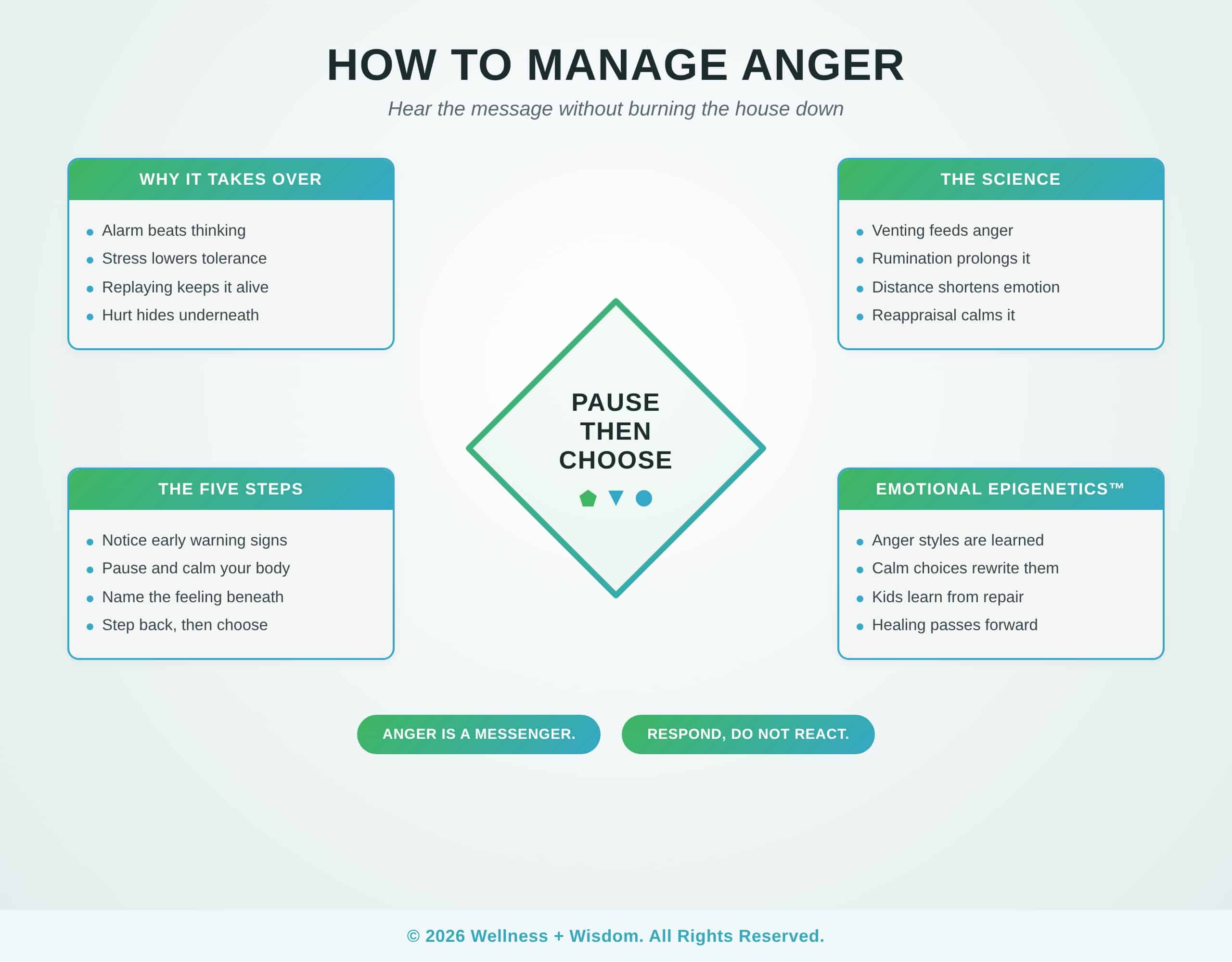
Anger takes over because it activates your body's protective response faster than your thinking mind can catch up. When something triggers anger, your heart rate rises, your muscles tense, and stress hormones flood your system. In that state, the part of your brain that weighs consequences and chooses words becomes harder to access.
Stress and depletion make anger far more likely. When you are tired, hungry, overwhelmed, or in pain, your tolerance shrinks and small frustrations can feel huge. Many people notice their anger spikes at the end of a long day or during stressful seasons. That is not a character flaw. It is a body running low on reserves. Caring for your energy is one of the most effective anger management tools there is, which is why the practices in how to manage stress make such a difference.
Thoughts play a big role too. When we replay what someone did, imagine what they meant by it, or rehearse what we wish we had said, we keep the anger alive long after the moment has passed. This replaying, often called rumination, can turn a brief flash of anger into hours or days of simmering resentment. If you notice yourself replaying hurts, the practices in how to stop overthinking can help you step out of the loop.
The Gift of Healthy Anger
Healthy anger gives you clarity about your values, courage to set boundaries, energy to create change, and the ability to stand up for yourself and others without causing harm. When anger is understood and guided, it becomes one of your most powerful allies.
Think about the times anger helped you. Maybe it gave you the courage to leave a situation that was not good for you. Maybe it pushed you to speak up for someone being treated unfairly. Maybe it showed you that something in your life needed to change. That is the gift of healthy anger. It tells you what you care about and gives you the energy to protect it.
Managing anger well also transforms your relationships. When people know you can feel angry without exploding or shutting down, they feel safe with you. Disagreements become opportunities for honest conversation rather than battles. Your children learn that strong feelings can be handled with care. And here is the part I love most. When you are no longer afraid of your own anger, you stop wasting energy suppressing it or cleaning up after it. You get to live with more honesty and more peace at the same time. Healthy anger is closely tied to setting healthy boundaries.
The Science of Anger
The science of anger shows that venting anger aggressively tends to increase it rather than release it, that ruminating on anger keeps it alive, that stepping back to view a situation from a distance shortens the duration of difficult emotions, and that reappraising a situation calms emotion more effectively than suppressing it. Calm, thoughtful approaches work best.
Start with a common myth. Many people believe that venting anger, like hitting a pillow or yelling, helps release it. In a well known study published in Personality and Social Psychology Bulletin, Brad Bushman found that people who hit a punching bag while thinking about the person who angered them ended up angrier and more aggressive than people who did nothing at all. Venting did not drain the anger. It fed it.
Rumination matters too. In a review published in Personality and Social Psychology Review, Thomas Denson described how angry rumination, repeatedly thinking about an anger provoking event, can maintain and even intensify anger and aggression over time. The more we replay, the longer anger lingers.
The encouraging part is what helps. Research by Philippe Verduyn and colleagues in the journal Emotion found that people who reflected on emotional events from a more distanced perspective, like a neutral observer, experienced negative emotions for shorter periods of time. And research by James Gross in Psychophysiology found that reappraisal, changing how you interpret a situation, reduced emotional experience without the physical costs that come with suppressing feelings. Stepping back and seeing the bigger picture is one of the most effective anger tools available.
How to Manage Anger
You learn how to manage anger by noticing early warning signs, pausing and calming your body, naming the feeling beneath the anger, stepping back to see the bigger picture, and choosing a response you will be proud of. These five steps help you stay in charge of your anger rather than letting it take charge of you. Here is how I practice and teach them.
1. Notice Early Warning Signs
Anger usually sends signals before it peaks. A tight jaw, clenched fists, heat in your face, a racing heart, or a sharp edge in your voice. Learn your personal warning signs. The earlier you notice anger rising, the easier it is to guide. Catching it at a three out of ten is far easier than at a nine.
2. Pause and Calm Your Body
When you notice anger rising, pause before you speak or act. Take a few slow breaths with a long exhale. Unclench your hands. Relax your shoulders. If you need more time, step away: “I need a few minutes to cool down, then I want to keep talking.” Calming your body gives your thinking mind a chance to come back online. The 90 second emotion rule is a powerful companion here.
3. Name the Feeling Beneath
Ask yourself, “What am I really feeling underneath this anger?” Hurt? Fear? Disrespect? Exhaustion? Naming the deeper feeling often softens the anger and shows you what you truly need. It also makes it far easier to communicate in a way others can hear. This connects beautifully to learning to feel your feelings.
4. Step Back and See the Bigger Picture
Imagine viewing the situation from a distance, as a wise friend or neutral observer would. What would they notice? Is there another way to interpret what happened? Will this matter in a week or a year? This simple shift, supported by the research above, helps anger settle and opens space for wiser choices. It also helps you stop taking things personally.
5. Choose a Response You Will Be Proud Of
Once you feel calmer, decide what to do. Maybe you will calmly express your feelings and needs. Maybe you will set a boundary. Maybe you will let it go. The goal is a response that reflects your values, not your old patterns. Healthy expression often sounds like, “I felt hurt when that happened, and I need us to talk about it.” The skills for these conversations are explored in how to handle conflict.
Movement can also be a helpful outlet, as long as it is used to calm down rather than to rehearse the anger. A brisk walk, a run, or some stretching after a frustrating moment can help your body release the tension and energy that anger creates. The key is to let your mind rest while your body moves, rather than replaying the situation over and over. Many people find that by the end of a short walk, the intensity has faded and they can see the situation far more clearly. Pair movement with slow breathing and you have one of the simplest, most reliable reset tools available.
Start with one of these steps the next time anger rises. You will not do it perfectly, and that is okay. Every pause builds new patterns. And if you would love to practice emotional mastery alongside others, the Liberated Life Tribe is a warm community to grow with.
Expressing Anger Versus Venting It
Expressing anger means communicating your feelings and needs clearly and respectfully, while venting anger means releasing it through aggressive words or actions. They may feel similar in the moment, but they lead to very different outcomes.
Venting often looks like yelling, slamming doors, insulting someone, or ranting repeatedly about what happened. It can feel satisfying for a moment, but as the research shows, it tends to fuel more anger rather than release it. Venting also damages relationships, because the people around us feel attacked or unsafe. Over time, frequent venting can become a habit that makes anger harder to manage.
Expressing anger is different. It sounds like, “I am really frustrated that this keeps happening. I need us to find a solution.” It is honest, direct, and focused on the issue rather than on attacking the person. Healthy expression allows you to honor your anger without causing harm, and it often leads to real solutions. It is also different from suppressing anger, which means pushing it down and pretending it is not there. Suppressed anger tends to leak out later as resentment or tension. Healthy expression is the middle path between exploding and burying, and it is beautifully supported by the practices in how to speak your truth.
How to Manage Anger With Emotional Epigenetics™
Emotional Epigenetics™ shows that the way you experience and express anger was shaped by the emotional patterns you grew up with, and that you can consciously rewrite those patterns for yourself and the generations after you. Your anger style was learned, and what is learned can change.
Think about how anger showed up in your family. Did adults yell, throw things, or use harsh words? Did they go silent and withdraw? Was anger forbidden, especially for certain people? Did anyone model calm, honest expression and repair? Your neural system absorbed these patterns as the normal way to handle anger, and they may still run automatically today. If you find yourself reacting in ways that echo a parent, that is not a coincidence. It is learned emotional programming.
The beautiful truth is that every time you pause, breathe, and choose a calmer response, you create a new emotional experience in your body. Repeated over time, these experiences reshape your patterns. If you are a parent, this is especially powerful. When your children see you feel angry and handle it with care, then repair afterward, they learn that strong emotions are safe and manageable. That is how one generation's healing becomes the next generation's normal, which is explored in how to break the parenting cycle. To go deeper with identity level change, explore our L.I.F.E. Method™ programs.
Celebrating Calm Responses
Celebrating every calm response helps reinforce the new patterns you are building. Your brain learns through reward, so when you notice and appreciate a moment when you handled anger well, you strengthen your ability to do it again.
Think about a recent time when you felt angry and responded better than you might have in the past. Maybe you took a breath instead of snapping. Maybe you walked away to cool down. Maybe you named your hurt instead of attacking. These are real victories, and they deserve recognition. Take a moment to acknowledge yourself: “I handled that with care, and I am proud of it.”
You can also celebrate repair. If anger did get the best of you, coming back to apologize and reconnect is a powerful act of growth. Repair builds trust and models healthy emotional skills for everyone around you. There is a whole practice around noticing these moments in celebrating small wins, and it makes the journey feel more joyful.
Anger Mastery Is a Lifelong Practice
Managing anger is a lifelong practice, because life will keep bringing frustrations, injustices, and challenges. You will not reach a point where anger never visits again, and you would not want to, because healthy anger is part of being fully alive. The goal is to keep growing your capacity to meet it with wisdom.
Over time, you will learn your personal triggers. Maybe it is feeling disrespected, being rushed, or seeing someone you love mistreated. Knowing your triggers lets you prepare. You might take extra care with your energy before stressful situations, plan calming strategies in advance, or talk with loved ones about what helps when you feel angry. Preparation turns reaction into response.
Creating a personal anger plan can make a real difference too. When you are calm, write down your common triggers, your early warning signs, and two or three steps that reliably help you settle. Share the plan with the people closest to you, so they understand what you need when anger rises and can support you rather than escalate. Having a plan ready turns a heated moment into a familiar routine, and familiar routines are far easier to follow when emotions run high.
This is also where the Wellness Pentagon™ becomes helpful. Anger is often harder to manage when other parts of life are depleted. Poor sleep, physical pain, money stress, emotional overwhelm, and spiritual disconnection all lower your tolerance. Caring for every dimension of wellbeing, including your Connection to Creator and God, gives you a deeper well of patience and perspective. You will find many guests sharing how they learned to work with anger across our latest episodes.
When Anger Feels Out of Control
If anger feels out of control right now, you are in very good company, and it is completely understandable. Learning how to manage anger does not mean you will never lose your temper again. It means you will gently build the skills to respond with more calm, a little at a time, at a pace that honors where you are.
When anger feels overwhelming, start with the smallest possible step. One slow breath before you speak. One moment of stepping away. One sentence that names your hurt instead of attacking. Daily practices that calm your neural system, like slow breathing with BREATHE™, can lower your baseline reactivity over time. Physical movement also helps release tension in a healthy way. Supportive tools like a breath training device or a journal for reflecting on triggers can help, and you can find a few we trust in our wellness tools store.
It is also important to know that anger that leads to threats, violence, or frightening behavior, or anger that consistently harms your relationships, work, or health, deserves professional support. A qualified therapist or anger management specialist can offer effective, compassionate tools. If you ever feel unsafe because of someone else's anger, reach out to a trusted person or local support service. There is real strength in asking for help. Wherever you are, be patient and kind with yourself, and trust that learning how to manage anger is something you can absolutely grow, one calm breath at a time. If your neural system feels constantly on edge, the practices in neural system regulation are a gentle next step.
Ready to go deeper? Join the Liberated Life Tribe and receive your 10 day Self Liberation Blueprint at liberatedlife.com. It is free, it is guided, and each day offers a simple practice for meeting strong emotions with calm and clarity.
Frequently Asked Questions
What is the fastest way to calm down when angry?
Pause before you speak or act, and take several slow breaths with a long exhale. Unclench your hands and relax your shoulders. If you need more time, step away briefly and let the other person know you will return. Calming your body gives your thinking mind a chance to come back online.
Does venting anger help release it?
Research suggests it usually does not. A study by Brad Bushman found that people who hit a punching bag while thinking about someone who angered them became angrier and more aggressive. Calmly expressing feelings and needs, or stepping back to gain perspective, tends to work far better.
Why do I get angry so easily?
Stress, fatigue, hunger, pain, and overwhelm all lower your tolerance and make anger more likely. Old emotional patterns learned in childhood can also shape how quickly anger rises. Caring for your energy and noticing early warning signs can help you respond more calmly.
Is it healthy to suppress anger?
Not usually. Suppressed anger tends to leak out later as resentment, tension, or sudden outbursts. Research shows that reappraising a situation calms emotion more effectively than suppressing it. Healthy expression, sharing feelings and needs respectfully, is the balanced middle path.
What feelings are often underneath anger?
Anger often sits on top of more vulnerable feelings like hurt, fear, embarrassment, disappointment, or exhaustion. Naming the feeling beneath the anger can soften it and help you understand what you really need, making it easier to communicate in a way others can hear.
When should I seek help for anger?
If anger leads to threats, violence, or frightening behavior, or consistently harms your relationships, work, or health, reach out to a qualified therapist or anger management specialist. If someone else's anger makes you feel unsafe, contact a trusted person or local support service.
Studies and External Resources
The science in this article rests on peer reviewed research. These are the sources referenced throughout.
- Bushman BJ. (2002). Does Venting Anger Feed or Extinguish the Flame? Catharsis, Rumination, Distraction, Anger, and Aggressive Responding. Personality and Social Psychology Bulletin. DOI: 10.1177/0146167202289002
- Denson TF. (2013). The multiple systems model of angry rumination. Personality and Social Psychology Review. PubMed: 23175519
- Verduyn P, et al. (2012). The relationship between self distancing and the duration of negative and positive emotional experiences in daily life. Emotion. PubMed: 22642344
- Gross JJ. (2002). Emotion regulation: affective, cognitive, and social consequences. Psychophysiology. PubMed: 12212647
About Josh Trent
Josh Trent is an Identity Transformation Architect and the award winning host of the Wellness + Wisdom Podcast, with over 15 million downloads since 2015. He is the creator of the L.I.F.E. Method™ Identity Transformation System and steward of the Emotional Epigenetics™ and BREATHE: Breath + Wellness™ systems of self mastery, impacting over 1,000 students worldwide. Join the Liberated Life Tribe and receive your 10 day Self Liberation Blueprint at liberatedlife.com. Josh lives in Austin, Texas with his wife Carrie, daughter Nayah, and son Novah. Peace and power.
Disclosure: We may earn a commission from certain links on this site when you make a purchase, at no extra cost to you. These commissions help support Wellness + Wisdom and do not affect the products or resources we choose to recommend. Full disclosure .