
By Josh Trent | Wellness + Wisdom Podcast Host & Identity Transformation Architect
“Success that costs you your health, your family, and your peace is not success. It is a slow trade of everything that matters for things that do not. True balance means learning to win at work without losing at life.”
Josh Trent
Learning how to find work life balance is one of the most important investments you can make in your long term health, happiness, and even your career. So many driven, caring people pour themselves into their work, believing that more hours and more effort will eventually lead to the life they want. Instead, they end up exhausted, disconnected from the people they love, and wondering where the joy went. Work matters. Purpose matters. Providing for your family matters. But you are not a machine, and a life that is all work eventually breaks down in ways that hurt both your wellbeing and your performance. True balance is not about doing less. It is about living in a rhythm that lets every part of you thrive, which is exactly what the Wellness Pentagon™ is designed to help you do.
Here is the joy forward truth at the center of it all. Rest and recovery are not the opposite of productivity. They are what make sustainable productivity possible. When you learn how to find work life balance, you do not give up your ambition. You give it a foundation strong enough to carry you for decades, while leaving room for the relationships, health, and joy that make the work worthwhile. Let us explore exactly how.
Table of Contents
- What Work Life Balance Really Means
- Why Balance Feels So Hard
- The Gift of a Sustainable Rhythm
- The Science of Work and Recovery
- How to Find Work Life Balance
- Rhythm Versus Perfect Balance
- How to Find Work Life Balance With the Wellness Pentagon™
- Celebrating a Life Well Lived
- Balance Is a Lifelong Practice
- When Balance Feels Impossible
- Frequently Asked Questions
- Studies and External Resources
- About Josh Trent
What Work Life Balance Really Means
Work life balance means creating a sustainable rhythm between your work and the rest of your life, so that your career, health, relationships, and personal joy all receive the time and energy they need. It does not mean a perfect fifty fifty split every day. It means that, over time, no essential part of your life is consistently neglected.
Balance looks different for everyone. A new parent, a startup founder, a teacher, and a retiree working part time will each have very different rhythms. Balance also changes with the seasons of life. Sometimes work will need more of you, like during a big launch or a busy season. Other times, family, health, or rest will need to take priority. The key is that these shifts are intentional and temporary, not a permanent state of imbalance you never question.
At its heart, work life balance is about alignment. It asks whether the way you spend your time and energy reflects what you truly value. If you say family is your top priority but you rarely have dinner together, there is a gap to explore. If you say health matters but you have not exercised in months, that is worth noticing. These questions of alignment are central to so many conversations on the Wellness + Wisdom Podcast.
Why Balance Feels So Hard
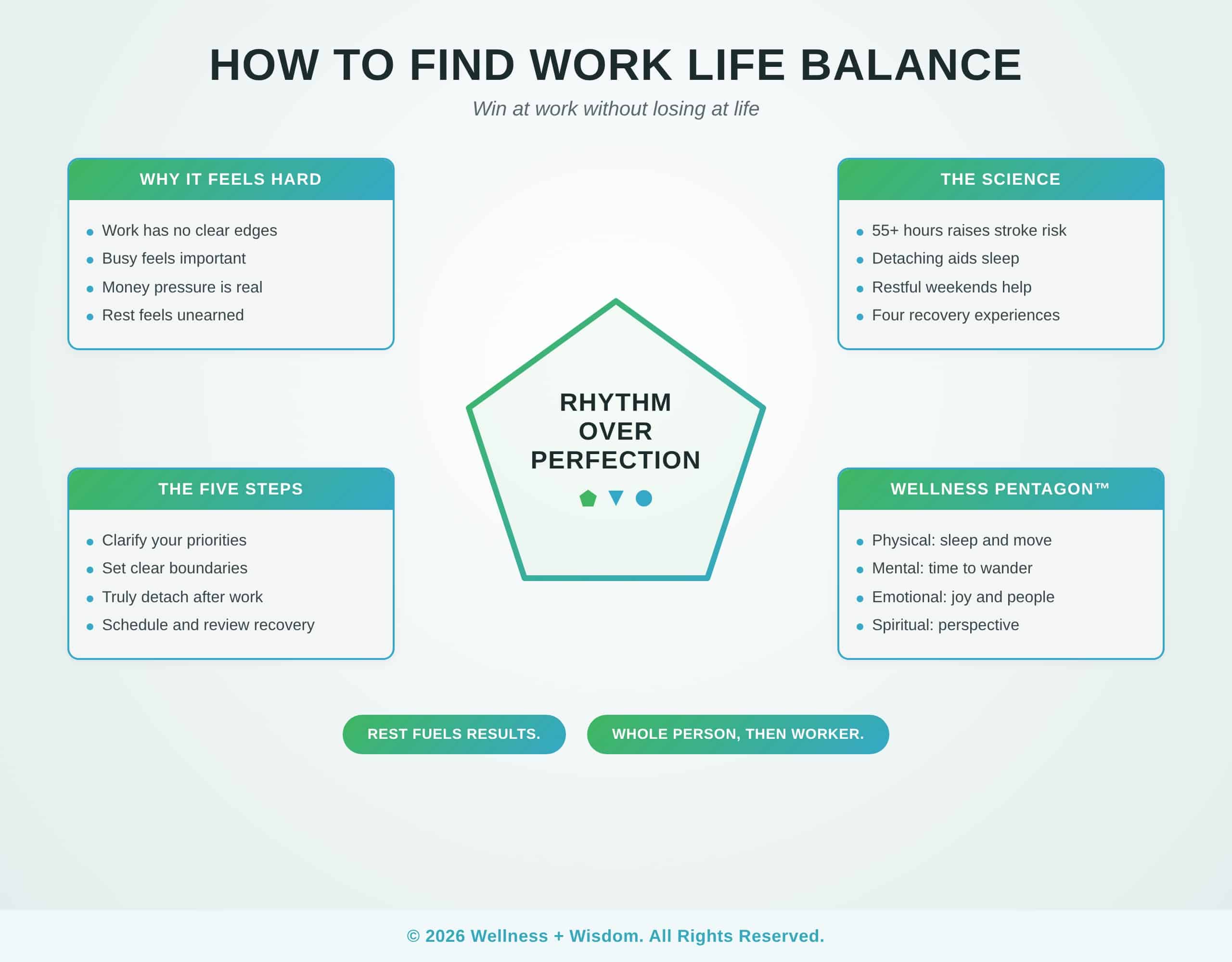
Balance feels hard because modern work rarely has clear edges, many of us tie our worth to our productivity, and the financial pressures of life can make it feel risky to slow down. Each of these pulls us toward constant work, often without our full awareness.
Technology has blurred the line between work and home. Emails arrive at all hours. Phones bring the office into the bedroom, the dinner table, and the vacation. Many people never fully leave work, even when they are physically away from it. This constant connection keeps the mind half engaged with work all the time, which makes true rest difficult.
Culture plays a big role too. Many of us absorbed the belief that being busy means being important, and that rest must be earned. That belief drives people to keep pushing long after their bodies and relationships are asking them to stop, a pattern explored in the hidden cost of hustle culture. And money pressure is real. When bills, debt, or uncertainty loom, working more can feel like the only safe option. Understanding these forces replaces guilt with clarity and opens the door to more intentional choices. The connection between money and wellbeing is explored in why wealth without health fails.
The Gift of a Sustainable Rhythm
A sustainable rhythm gives you better health, deeper relationships, more creativity, and the energy to do your best work for years rather than burning out in months. When work and life support each other, both get better.
Think about your best work days. Chances are, they came after good sleep, time with people you love, or a refreshing break. Rest fuels creativity, problem solving, and focus. Many breakthrough ideas arrive not at the desk but on a walk, in the shower, or during a conversation with a friend. When you protect time away from work, you are not slowing your career down. You are giving your mind the space it needs to do its best thinking.
Your relationships flourish too. When you are present at home, your partner and children feel it. Friendships have room to grow. Community connections deepen. And your health benefits enormously. Adequate rest, movement, and time outdoors reduce stress and protect your body from the wear and tear of constant pressure. Here is the part I love most. When your life is in a sustainable rhythm, you start to enjoy your work again, because it is no longer consuming everything else. Learning to rest without guilt is a big part of that shift.
The Science of Work and Recovery
The science of work and recovery shows that very long working hours are linked with higher risks of heart disease and stroke, that mentally detaching from work during time off supports wellbeing and sleep, that restorative weekends support both wellbeing and performance, and that specific recovery experiences help people bounce back from work demands. Balance is not a luxury. It is a health strategy.
Start with the risks of overwork. In a large meta analysis published in The Lancet, Mika Kivimäki and colleagues combined data from more than 600,000 people and found that those working 55 hours or more per week had a higher risk of stroke and coronary heart disease than those working standard hours. Chronically long hours take a real toll on the body, which is why protecting time away from work is about far more than comfort. It is about health.
Next, consider detachment. A meta analysis by Johannes Wendsche and Andrea Lohmann Haislah in Frontiers in Psychology found that psychologically detaching from work during time off, truly switching off rather than continuing to think about work, was linked with better wellbeing, less exhaustion, and better sleep. They also found that higher job demands made detachment harder, which is why intentional boundaries matter so much.
Recovery shapes performance as well. Research by Charlotte Fritz and Sabine Sonnentag in the Journal of Occupational Health Psychology found that weekend experiences matter for how people feel and perform when they return to work. In related work, Sonnentag and Fritz identified four key recovery experiences: psychological detachment, relaxation, mastery, meaning challenging and enjoyable activities outside work, and a sense of control over your free time. When these experiences are present, people recover more fully from the demands of work.
How to Find Work Life Balance
You learn how to find work life balance by clarifying your priorities, setting clear boundaries, truly detaching after work, scheduling recovery like it matters, and reviewing your rhythm regularly. These five steps help you create a life where work and everything else can thrive together. Here is how I practice and teach them.
1. Clarify Your Priorities
Write down the three to five things that matter most to you in this season of life. Maybe it is your health, your family, a meaningful career goal, your spiritual life, and your friendships. Then look honestly at how you spend your time each week. Where are the gaps? This clarity becomes the compass for every decision about your time. If you are still discovering what matters most, the practices in how to find your purpose can help.
2. Set Clear Boundaries
Decide when your workday starts and ends, and communicate those boundaries to colleagues and clients. Turn off work notifications after hours. Create a physical boundary too, like closing your laptop and putting it away, or leaving your work area at a set time. Boundaries are not selfish. They protect your ability to show up well for both work and home, which is explored beautifully in how to set healthy boundaries.
3. Truly Detach After Work
Create a simple shutdown ritual at the end of your workday. Write down tomorrow's top priorities, close all work tabs, and say to yourself, “Work is done for today.” Then do something that signals the transition, like a walk, a change of clothes, or a few minutes of breathing. As the research shows, mentally switching off is essential for recovery, sleep, and wellbeing.
4. Schedule Recovery Like It Matters
Put rest, exercise, family time, and hobbies on your calendar with the same seriousness as work meetings. Include activities that offer relaxation, like reading or time in nature, and activities that offer mastery, like learning a new skill or playing a sport. Protect at least one day each week as genuinely restorative. Recovery is not what you do when everything else is finished. It is what makes everything else possible.
5. Review Your Rhythm Regularly
Once a week, take ten minutes to look back. Did your time reflect your priorities? Where did work spill over? What do you want to adjust? This regular check in keeps balance from slipping away slowly and helps you make small corrections before burnout sets in. Building this kind of reflective habit is supported by the approach in how to build healthy habits.
Start with one of these steps this week. Small changes add up to a very different life over time. And if you would love support from a community committed to living with more intention, the Liberated Life Tribe is a warm place to grow.
Rhythm Versus Perfect Balance
A healthy approach to work and life focuses on rhythm rather than perfect balance. Perfect balance suggests that every day should have equal parts work and rest, which is neither realistic nor necessary. Rhythm acknowledges that different seasons call for different emphasis, while ensuring nothing essential is permanently sacrificed.
Chasing perfect balance can become another source of stress. If you expect every day to include a workout, family dinner, focused work, meditation, and time with friends, you will often feel like you are failing. Life rarely cooperates with such neat plans. Busy seasons will come, and they are not a sign that you have lost your way. If perfectionism tends to creep into your goals, the practices in how to let go of perfectionism can help.
Rhythm is more forgiving and more sustainable. It might mean a demanding work week followed by a restful weekend, or an intense project season followed by a slower month. The key is that intense periods are balanced by periods of recovery, and that you check in regularly to make sure the overall pattern supports your health and relationships. Think of it like breathing. You do not inhale and exhale at the same moment. You alternate, and that alternation is what keeps you alive.
How to Find Work Life Balance With the Wellness Pentagon™
The Wellness Pentagon™ offers a powerful lens for work life balance, because it reminds you that you have five dimensions that all need care: physical, mental, emotional, spiritual, and financial. Work often feeds the financial dimension while quietly draining the others. Balance means nourishing all five.
Physical. Protect your sleep, move your body daily, and take breaks from sitting. A healthy body has the energy and resilience to handle work demands without breaking down.
Mental. Give your mind time to rest and wander. Constant focus without breaks leads to mental fatigue and poor decisions. Downtime, hobbies, and nature help your mind recover and stay sharp.
Emotional. Make time for the people and activities that bring you joy. Notice when work stress is spilling into your mood and relationships, and address it before it builds.
Spiritual. Nurture your Connection to Creator and God through prayer, reflection, worship, or time in nature. Spiritual grounding offers perspective that reminds you work is part of your life, not the whole of it.
Financial. Work supports your financial wellbeing, and financial peace supports balance. Building savings, reducing debt, and living within your means can reduce the pressure to overwork. A calmer relationship with money gives you more freedom to choose a sustainable rhythm. Financial stress and its effects on the body are explored in how money stress changes your biology. To go deeper with identity level change, explore our L.I.F.E. Method™ programs.
Celebrating a Life Well Lived
Celebrating the moments when your life feels balanced helps you notice what is working and reinforces the choices that create it. Your brain learns through reward, so appreciating a restful evening or a present weekend makes you more likely to protect those moments again.
Take time to notice the good moments. A dinner where your phone stayed in another room. A weekend where you truly unplugged. A workday that ended on time so you could catch your child's game. A morning walk before work. These are the moments that make life rich, and they deserve to be honored. You might even write them down at the end of each week as a reminder of what balance feels like.
Celebrate your professional wins too, alongside your personal ones. Balance is not about rejecting ambition. It is about enjoying your achievements without sacrificing everything else for them. When you can celebrate both a successful project and a beautiful family evening in the same week, you know your rhythm is working. There is a whole practice around noticing these moments in celebrating small wins.
Balance Is a Lifelong Practice
Finding balance is a lifelong practice, because careers change, families grow, and new responsibilities arrive in every season. The rhythm that works for you at thirty may need to shift at forty and again at sixty. That is not a sign of failure. It is a sign that you are paying attention to your life.
Major transitions, like a promotion, a new baby, caring for aging parents, or starting a business, often throw balance off for a while. During these times, be gentle with yourself and focus on the essentials: sleep, a few key relationships, and small moments of rest. As things settle, you can rebuild a fuller rhythm. Asking for help during these seasons is a sign of wisdom, not weakness, and is explored in how to ask for help.
Your workplace culture matters too, and you may have more influence than you think. When you model healthy boundaries, like not sending emails late at night or taking your full vacation, you give colleagues permission to do the same. If you lead a team, your example shapes everyone's rhythm. Small cultural shifts, repeated over time, can make balance easier for an entire organization.
Over time, many people find that balance becomes less about time management and more about identity. They start to see themselves not as workers who sometimes rest, but as whole people who also work. That shift changes everything. You will find many guests sharing how they found their own sustainable rhythm across our latest episodes.
When Balance Feels Impossible
If balance feels impossible right now, you are in very good company, and it is completely understandable. Building balance does not mean your life will suddenly feel perfectly organized. It means you will gently create a more sustainable rhythm, a little at a time, at a pace that honors where you are.
When balance feels out of reach, start with the smallest possible change. Leave work fifteen minutes earlier once this week. Have one meal without your phone. Take a ten minute walk at lunch. Turn off work notifications for one evening. These small steps prove to yourself that change is possible and create momentum for more. Gentle practices that calm your neural system, like slow breathing with BREATHE™, can help you transition from work mode to rest mode. Supportive tools like a quality planner or a breath training device can also help, and you can find a few we trust in our wellness tools store.
It is also important to know that ongoing exhaustion, cynicism about work, trouble sleeping, or feeling emotionally drained can be signs of burnout that deserve real care. A qualified health professional or counselor can offer compassionate support, and it may also help to talk honestly with your employer about workload. There is real strength in asking for help. Wherever you are, be patient and kind with yourself, and trust that learning how to find work life balance is something you can absolutely grow, one intentional choice at a time. If stress is weighing heavily, the practices in how to manage stress are a gentle next step.
Ready to go deeper? Join the Liberated Life Tribe and receive your 10 day Self Liberation Blueprint at liberatedlife.com. It is free, it is guided, and each day helps you build a life where work and joy can thrive together.
Frequently Asked Questions
What is a healthy work life balance?
A healthy work life balance is a sustainable rhythm where your career, health, relationships, and personal joy all receive the time and energy they need over time. It does not require a perfect daily split. It means no essential part of your life is consistently neglected.
How can I stop thinking about work after hours?
Create a shutdown ritual at the end of your workday. Write down tomorrow's priorities, close all work tabs, turn off notifications, and do something that marks the transition, like a walk or a few slow breaths. Research shows mentally detaching from work supports wellbeing and sleep.
Is working long hours bad for your health?
Research suggests chronically long hours carry real risks. A large meta analysis in The Lancet found that people working 55 hours or more per week had a higher risk of stroke and coronary heart disease than those working standard hours.
What are the most important recovery activities?
Research identifies four key recovery experiences: mentally detaching from work, relaxing, engaging in enjoyable and challenging activities outside work, and having a sense of control over your free time. Including all four helps you recover more fully from work demands.
How do I find balance when I have money worries?
Start with small steps that do not threaten your income, like protecting sleep and setting a clear end to your workday. Over time, building savings and reducing debt can ease the pressure to overwork. A calmer relationship with money creates more freedom to choose a sustainable rhythm.
What are signs that I need better balance?
Ongoing exhaustion, irritability, trouble sleeping, neglected relationships, cynicism about work, and feeling unable to switch off are common signs. If these persist, they may point to burnout, and talking with a health professional or counselor can help.
Studies and External Resources
The science in this article rests on peer reviewed research. These are the sources referenced throughout.
- Kivimäki M, et al. (2015). Long working hours and risk of coronary heart disease and stroke: a systematic review and meta analysis. The Lancet. PubMed: 26298822
- Wendsche J, Lohmann Haislah A. (2016). A Meta Analysis on Antecedents and Outcomes of Detachment from Work. Frontiers in Psychology. PubMed: 28133454
- Fritz C, Sonnentag S. (2005). Recovery, health, and job performance: effects of weekend experiences. Journal of Occupational Health Psychology. PubMed: 16060723
- Sonnentag S, Fritz C. (2007). The Recovery Experience Questionnaire: development and validation of a measure for assessing recuperation and unwinding from work. Journal of Occupational Health Psychology. PubMed: 17638488
About Josh Trent
Josh Trent is an Identity Transformation Architect and the award winning host of the Wellness + Wisdom Podcast, with over 15 million downloads since 2015. He is the creator of the L.I.F.E. Method™ Identity Transformation System and steward of the Emotional Epigenetics™ and BREATHE: Breath + Wellness™ systems of self mastery, impacting over 1,000 students worldwide. Join the Liberated Life Tribe and receive your 10 day Self Liberation Blueprint at liberatedlife.com. Josh lives in Austin, Texas with his wife Carrie, daughter Nayah, and son Novah. Peace and power.
Disclosure: We may earn a commission from certain links on this site when you make a purchase, at no extra cost to you. These commissions help support Wellness + Wisdom and do not affect the products or resources we choose to recommend. Full disclosure .