
By Josh Trent | Wellness + Wisdom Podcast Host & Identity Transformation Architect
“Loneliness is not proof that you are unlovable. It is your heart reminding you that you were made for connection. Learning how to overcome loneliness is learning to answer that call, one small step toward people at a time.”
Josh Trent
Learning how to overcome loneliness is one of the most important things you can do for your joy, your health, and your sense of belonging in the world. Loneliness is far more common than most people admit. It can visit you in a crowded room, in a busy marriage, after a move, after a loss, or simply during a season when life pulls people in different directions. Many of us feel embarrassed about it, as if being lonely means something is wrong with us. Nothing is wrong with you. Loneliness is a deeply human signal, like hunger or thirst, telling you that one of your most essential needs is asking for attention. The way we respond to that signal was shaped long ago, which is the heart of Emotional Epigenetics™.
Here is the joy forward truth at the center of it all. Loneliness is not a life sentence. It is an invitation. When you understand what it is really asking for and take small, brave steps in response, connection begins to grow again, often faster than you expect. When you learn how to overcome loneliness, you rediscover that you belong, that people want to know you, and that warmth is closer than it felt. Let us explore exactly how.
Table of Contents
- What Loneliness Really Is
- Why Loneliness Grows
- The Gift of Reconnection
- The Science of Loneliness
- How to Overcome Loneliness
- Being Alone Versus Feeling Lonely
- How to Overcome Loneliness With Emotional Epigenetics™
- Celebrating Every Connection
- Connection Is a Lifelong Practice
- When Loneliness Feels Heavy
- Frequently Asked Questions
- Studies and External Resources
- About Josh Trent
What Loneliness Really Is
Loneliness is the painful feeling that the connection you have does not match the connection you need. It is not about how many people are around you. It is about whether you feel seen, understood, and cared for by them. That is why you can feel lonely at a party and deeply connected while sitting quietly with one close friend.
Researchers often describe loneliness as a biological signal, much like hunger. Hunger tells you to eat. Thirst tells you to drink. Loneliness tells you to reach toward people. For most of human history, being part of a group was essential for survival, so our bodies developed a strong alarm for disconnection. When you feel lonely, that ancient alarm is doing its job, nudging you back toward the warmth and safety of community.
Loneliness comes in different forms too. Some people miss having a close confidant. Some miss having a wider circle of friends. Some miss a sense of belonging to something larger, like a community or a shared purpose. Naming which kind you feel helps you know what kind of connection to seek. These different layers of belonging come up often in conversations on the Wellness + Wisdom Podcast, because they touch every part of a joyful life.
Why Loneliness Grows
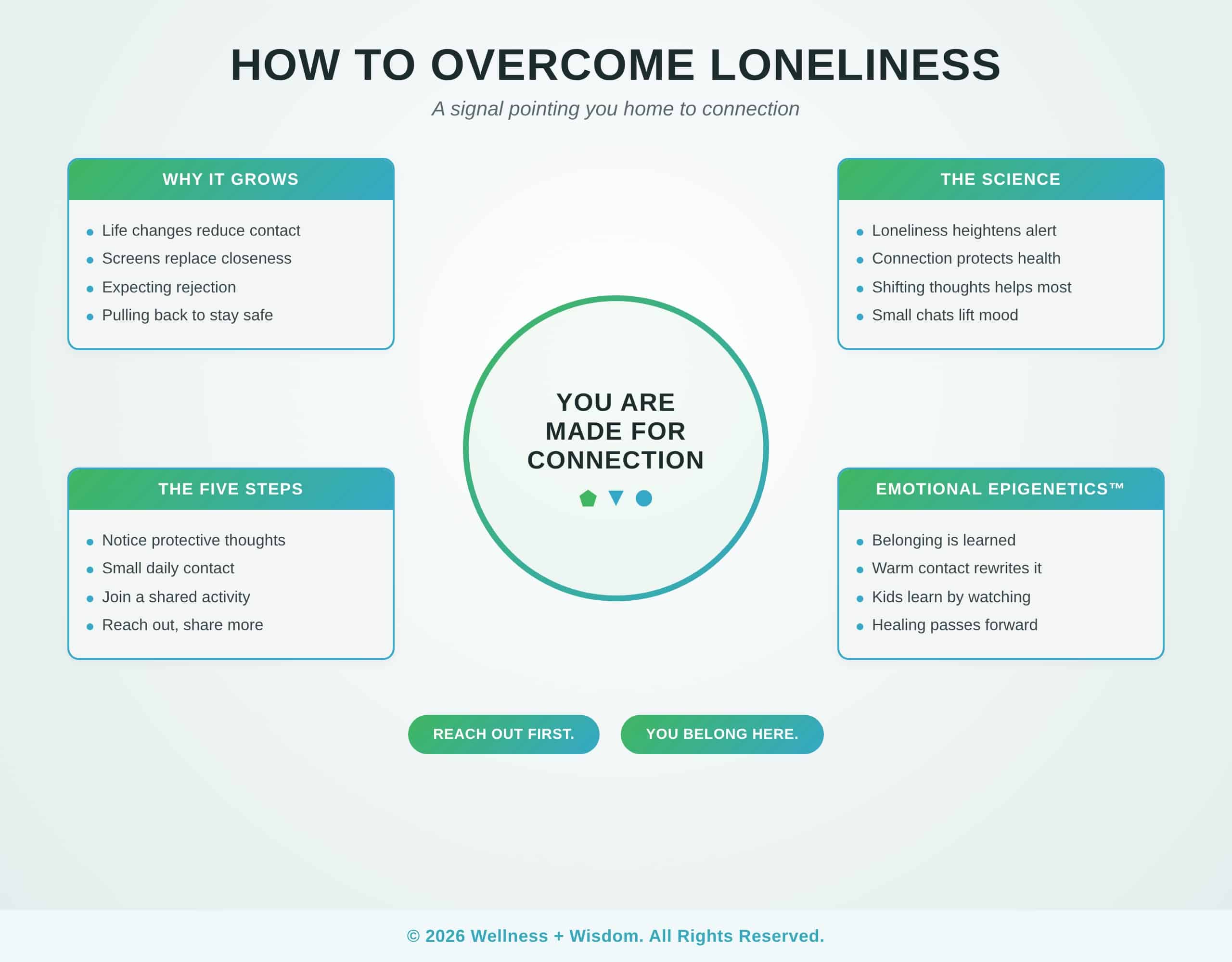
Loneliness grows when the natural rhythms of connection get disrupted and then quietly reinforce themselves through protective thoughts and habits. Moves, breakups, new jobs, becoming a parent, retiring, losing a loved one, or simply a busy season can all reduce the everyday contact that keeps us feeling connected.
Modern life plays a role too. Many of us work remotely, live far from family, and spend more time on screens than in person. Digital connection can be wonderful, but it rarely replaces the warmth of a shared meal, a hug, or an unhurried conversation. Over time, it is easy to feel surrounded by contacts yet starved for closeness.
There is also a quieter layer. When we feel lonely for a while, our neural system can shift into a more self protective state. We start scanning for signs of rejection, expecting people to be uninterested, and holding back to avoid getting hurt. Those protective thoughts make reaching out feel risky, which leads to more isolation, which deepens the loneliness. Seeing this cycle clearly is freeing, because it means loneliness is not a verdict on your worth. It is a pattern, and patterns can change. If you notice yourself expecting rejection, the practices in how to stop taking things personally can help.
The Gift of Reconnection
Reconnection gives you warmth, support, laughter, resilience, and a deep sense of belonging that makes every part of life richer. When you feel connected, challenges feel lighter, joys feel bigger, and your whole system can finally relax.
Think about how different life feels when you know someone has your back. A hard day becomes manageable when you can call a friend. Good news becomes a celebration when someone shares it with you. Ordinary moments, a walk, a meal, a cup of coffee, become meaningful when they are shared. Connection turns surviving into living, and it reminds you that you were never meant to carry everything alone.
Your body benefits too. When you feel safe and connected, your neural system can shift out of its protective alert state and into rest and repair. Sleep often improves. Stress softens. Your mind feels clearer. And here is the part I love most. Reconnection often helps you reconnect with yourself as well. When other people see and appreciate you, it becomes easier to see and appreciate yourself. That inner sense of belonging is explored beautifully in how to reconnect with yourself.
The Science of Loneliness
The science of loneliness shows that it acts like a biological signal that can heighten our sensitivity to social threat, that it is linked with higher health risks, that the most effective interventions help people shift protective thinking patterns, and that even small everyday interactions lift our mood and sense of belonging. Understanding this gives you a clear path forward.
Start with what loneliness does inside us. In a major review published in Annals of Behavioral Medicine, Louise Hawkley and John Cacioppo explained that loneliness tends to put people on alert for social threats, making them more likely to notice rejection and expect negative outcomes. This hypervigilance is protective in theory, but in daily life it can make people withdraw, which keeps loneliness going. Their work also linked loneliness to poorer sleep and other health effects.
The health stakes are real. A meta analysis led by Julianne Holt Lunstad in Perspectives on Psychological Science found that loneliness, social isolation, and living alone were each associated with a meaningfully higher risk of mortality. Connection is not a luxury. It is a genuine pillar of health, right alongside sleep, movement, and nourishment.
The encouraging part is what helps. A meta analysis led by Christopher Masi in Personality and Social Psychology Review compared many different loneliness interventions and found that the most effective approaches were those that addressed the protective thinking patterns described above, helping people notice and gently challenge their expectations of rejection. And research by Gillian Sandstrom and Elizabeth Dunn in Personality and Social Psychology Bulletin found that people felt happier and more connected on days when they had more interactions with weak ties, like classmates, neighbors, or familiar faces at a cafe. Small moments of contact matter more than we think, and they are available to almost everyone, almost every day.
How to Overcome Loneliness
You learn how to overcome loneliness by noticing protective thoughts, creating small daily moments of contact, joining shared activities, reaching out to people you already know, and gradually sharing more of yourself. These five steps work together to rebuild connection from the inside and the outside. Here is how I practice and teach them.
1. Notice Protective Thoughts
Pay attention to the stories your mind tells about other people. “They probably do not want to hear from me.” “Everyone already has their friends.” “I will just be a bother.” When you notice one of these thoughts, gently ask, “Is this definitely true? What else might be true?” This simple practice, supported by the research above, loosens the grip of the protective patterns that keep loneliness going.
2. Create Small Daily Moments of Contact
Smile at a neighbor. Chat with the barista. Ask a coworker how their weekend was. Say thank you and mean it. These brief interactions may seem small, but research shows they lift your mood and sense of belonging. They also warm up your social muscles, making bigger connections feel more natural over time.
3. Join a Shared Activity
Find something you enjoy that brings you into regular contact with the same people: a class, a walking group, a volunteer project, a faith community, or a book club. Shared activities give conversation a natural starting point and allow relationships to grow gradually through repeated contact. The full process of building new friendships is explored in how to make friends as an adult.
4. Reach Out to People You Already Know
Think of someone you used to be close to or someone you have always wanted to know better. Send them a simple message. “I was thinking of you today. How are you?” Most people are delighted to hear from an old friend, even after a long gap. Reconnecting with existing relationships is often the fastest way to ease loneliness, because the foundation is already there.
5. Share a Little More of Yourself
Loneliness often persists when our connections stay on the surface. As trust grows, share a little more of what is really going on for you, your hopes, your worries, your daily life. Deeper sharing invites deeper connection. It takes courage, and it is beautifully explored in how to be vulnerable.
It can also help to look for ways to give, not only to receive. Volunteering, mentoring, helping a neighbor, or checking in on someone who might be lonely themselves can create connection in a way that feels natural and meaningful. When you focus on offering care, the pressure to impress or be liked fades, and connection grows around a shared purpose. Many people find that the quickest way out of loneliness is to become the kind of presence they wish they had, because kindness tends to come back around, often in unexpected and beautiful ways.
Start with one step this week. You do not have to fix loneliness all at once. Every small act of reaching out matters. And if you would love a warm, values aligned community to belong to, the Liberated Life Tribe is a beautiful place to start.
Being Alone Versus Feeling Lonely
Being alone and feeling lonely are not the same thing. Being alone is a physical state, while loneliness is an emotional one. You can be alone and feel peaceful and content, and you can be surrounded by people and feel deeply lonely.
Solitude, when chosen, can be a beautiful and restorative experience. Time alone allows you to reflect, rest, create, pray, and reconnect with yourself. Many people need regular solitude to feel balanced. The key difference is that healthy solitude feels nourishing, while loneliness feels painful. Solitude is something you choose. Loneliness is something that happens when your need for connection is not being met.
Understanding this difference is freeing. It means the goal is not to fill every moment with people. It is to make sure you have meaningful connection when you need it, while also honoring your need for quiet. When you feel at home within yourself, solitude stops feeling like loneliness and starts feeling like peace. That inner home is beautifully explored in coming home to yourself. And when you also have people to turn to, you get the best of both: the peace of solitude and the warmth of connection.
How to Overcome Loneliness With Emotional Epigenetics™
Emotional Epigenetics™ shows that the way you experience and respond to loneliness was shaped by the emotional patterns you grew up with, and that you can consciously rewrite those patterns through new experiences of safe connection. Your relationship with belonging is learned, and what is learned can grow.
Think about how connection worked in your early life. Did you feel welcomed and included? Were your feelings noticed and cared for? Or did you often feel on the outside, unseen, or responsible for managing other people's emotions? If belonging felt uncertain when you were young, your neural system may have learned to expect disconnection and to protect itself by holding back. That pattern can quietly shape your adult relationships, making it harder to reach out even when you long for closeness.
The beautiful truth is that every time you reach toward someone and are met with warmth, you create a new emotional experience in your body. Repeated over time, these experiences reshape your expectations. You begin to trust that people can be safe, that you are wanted, and that connection is available. If you are a parent, this healing is especially powerful, because children learn belonging by watching how you connect. That is how one generation's healing becomes the next generation's normal, which is explored in secure attachment for adults. To go deeper with identity level change, explore our L.I.F.E. Method™ programs.
Celebrating Every Connection
Celebrating every connection, no matter how small, helps your brain and body learn that reaching out is safe and rewarding. When you notice and appreciate moments of warmth, you strengthen the patterns that lead to more connection.
Take a moment at the end of each day to notice any connection you experienced. A friendly exchange with a neighbor. A message from a friend. A laugh with a coworker. A meaningful conversation. Name it and let yourself feel the warmth of it. These small celebrations help counter the protective habit of focusing only on disconnection.
You can also celebrate your own courage. Every time you send a message, accept an invitation, or start a conversation, you are taking a brave step toward the life you want. Honor that. And when people show up for you, thank them. Appreciation deepens relationships and makes people feel valued, which is beautifully explored in how to celebrate the people you love. There is also a whole practice around noticing these moments in celebrating small wins.
Connection Is a Lifelong Practice
Connection is a lifelong practice, because life keeps changing and our social worlds change with it. Friends move, children grow up, careers shift, and loved ones pass on. Each transition can bring a season of loneliness, and each one is also an invitation to build new connections that fit who you are becoming.
Be gentle with the timeline. Friendships and a sense of belonging take time to grow, often many weeks or months of repeated contact. It is completely normal for early efforts to feel awkward or for some invitations to go unanswered. That is not rejection of who you are. It is simply part of how connection develops. Keep showing up, keep reaching out, and trust that each small step is building something real, even when you cannot see it yet.
It helps to treat connection the way you treat your physical health: something to tend regularly rather than only when something feels wrong. Schedule time with friends. Keep recurring plans. Check in with people you care about. Join communities that share your values. These habits create a steady foundation of belonging that carries you through life's transitions.
This is also where the Wellness Pentagon™ becomes helpful. Connection supports every dimension of wellbeing, and every dimension supports connection. When you sleep well, move your body, care for your emotions, and nurture your Connection to Creator and God, you have more energy and openness to give to relationships. Many people find that spiritual community, prayer, and a sense of being held by something larger ease loneliness in a profound way. You will hear many guests share how they found belonging across our latest episodes.
When Loneliness Feels Heavy
If loneliness feels heavy right now, you are in very good company, and it is completely understandable. Learning how to overcome loneliness does not mean the feeling will disappear overnight. It means you will gently rebuild connection, a little at a time, at a pace that honors where you are.
When loneliness feels overwhelming, start with the smallest possible step. Send one message. Step outside and say hello to one person. Call a family member just to hear their voice. Sit in a cafe or library among other people. These small actions remind your body that connection is possible. Gentle practices that calm your neural system, like slow breathing with BREATHE™, can also make reaching out feel less daunting. Supportive tools like a journal for noticing protective thoughts can help, and you can find a few we trust in our wellness tools store.
It is also important to know that loneliness that lasts a long time, or that comes with persistent sadness, hopelessness, or difficulty functioning, deserves real care. A qualified therapist or counselor can offer compassionate support, and many communities offer support groups where you can connect with others who understand. There is real strength in asking for help, which is explored in how to ask for help. Wherever you are, be patient and kind with yourself, and trust that learning how to overcome loneliness is something you can absolutely grow, one warm connection at a time.
Ready to go deeper? Join the Liberated Life Tribe and receive your 10 day Self Liberation Blueprint at liberatedlife.com. It is free, it is guided, and it connects you with a community of people who know what it means to grow together.
Frequently Asked Questions
What is the fastest way to overcome loneliness?
Start with small moments of contact, like chatting with a neighbor or messaging an old friend, and notice protective thoughts that tell you people are not interested. Research shows that interventions addressing these thought patterns are among the most effective, and even brief everyday interactions lift mood and belonging.
Why do I feel lonely even when I am around people?
Loneliness is about the quality of connection, not the number of people around you. You can feel lonely in a crowd if you do not feel seen or understood. Deepening a few relationships through honest sharing often eases this kind of loneliness more than adding more acquaintances.
Is loneliness bad for your health?
Research suggests it can be. A large meta analysis found that loneliness and social isolation were associated with a meaningfully higher risk of mortality. Loneliness has also been linked with poorer sleep and heightened stress. Building connection is a genuine investment in your health.
What is the difference between being alone and being lonely?
Being alone is a physical state, while loneliness is an emotional one. Chosen solitude can feel peaceful and restorative. Loneliness feels painful because your need for connection is not being met. You can enjoy solitude and still need meaningful connection.
How do I reconnect with old friends?
Send a simple, warm message such as “I was thinking of you today. How are you?” Most people are happy to hear from an old friend, even after a long gap. Suggest a specific plan, like a call or coffee, to turn the message into real time together.
When should I get help for loneliness?
If loneliness lasts a long time or comes with persistent sadness, hopelessness, or difficulty functioning, reach out to a qualified therapist or counselor. Support groups can also help. Asking for help is a sign of strength, and connection can grow again.
Studies and External Resources
The science in this article rests on peer reviewed research. These are the sources referenced throughout.
- Hawkley LC, Cacioppo JT. (2010). Loneliness matters: a theoretical and empirical review of consequences and mechanisms. Annals of Behavioral Medicine. PubMed: 20652462
- Holt Lunstad J, et al. (2015). Loneliness and social isolation as risk factors for mortality: a meta analytic review. Perspectives on Psychological Science. PubMed: 25910392
- Masi CM, et al. (2011). A meta analysis of interventions to reduce loneliness. Personality and Social Psychology Review. PubMed: 20716644
- Sandstrom GM, Dunn EW. (2014). Social Interactions and Well Being: The Surprising Power of Weak Ties. Personality and Social Psychology Bulletin. PubMed: 24769739
About Josh Trent
Josh Trent is an Identity Transformation Architect and the award winning host of the Wellness + Wisdom Podcast, with over 15 million downloads since 2015. He is the creator of the L.I.F.E. Method™ Identity Transformation System and steward of the Emotional Epigenetics™ and BREATHE: Breath + Wellness™ systems of self mastery, impacting over 1,000 students worldwide. Join the Liberated Life Tribe and receive your 10 day Self Liberation Blueprint at liberatedlife.com. Josh lives in Austin, Texas with his wife Carrie, daughter Nayah, and son Novah. Peace and power.
Disclosure: We may earn a commission from certain links on this site when you make a purchase, at no extra cost to you. These commissions help support Wellness + Wisdom and do not affect the products or resources we choose to recommend. Full disclosure .