
By Josh Trent | Wellness + Wisdom Podcast Host & Identity Transformation Architect
“The feelings you refuse to feel do not disappear. They wait in the body until you are ready to meet them. Learning to feel your feelings is learning that every emotion, felt fully, becomes a doorway back to yourself.”
Josh Trent
Learning how to feel your feelings is honestly one of the most freeing shifts you can ever make, because so much of our suffering comes not from our emotions but from the effort of avoiding them. So many of us learned to push feelings down, to stay busy or numb, and to fear that if we truly felt our emotions they might overwhelm us. This gentle inner work gently reverses all of that, teaching you that emotions felt fully can move through you and set you free. This freeing work is beautifully supported by BREATHE™.
Here is the joy forward truth at the center of it all. Feeling your feelings does not mean drowning in them, it means allowing your emotions to move through you fully so they can pass rather than staying stuck in your body. When you truly feel your feelings, you free the energy that avoidance consumes and come home to a richer, more alive experience of your whole life. When you learn how to feel your feelings, you finally come home to the full aliveness that only comes from feeling. Let us explore exactly how.
Table of Contents
- What Feeling Your Feelings Really Means
- Why We Avoid Our Feelings
- The Hidden Cost of Buried Emotions
- The Science of Feeling Fully
- How to Feel Your Feelings
- Feeling Versus Drowning
- Feeling Your Feelings and BREATHE
- Celebrating Every Feeling Felt
- Feeling Fully Is a Lifelong Practice
- When Your Feelings Feel Too Big
- Frequently Asked Questions
- Studies and External Resources
- About Josh Trent
What Feeling Your Feelings Really Means
Feeling your feelings means allowing your emotions to move through you fully rather than pushing them down, so they can pass instead of staying stuck in your body. It is not about being overwhelmed at all, but rather about letting each feeling be felt and then gently released. Feeling your feelings is truly coming home to the full and alive experience of being human.
This runs much deeper than simply naming an emotion, because feeling your feelings is about changing your whole relationship with your inner world. Rather than fearing your emotions and rushing to numb or fix them, you gently learn to let them move through you, trusting that a felt feeling is a feeling that can finally pass. It is truly a real shift from avoiding your emotions toward allowing them.
Feeling your feelings also gently restores a deep sense of aliveness and freedom, since a life spent avoiding emotion tends to feel numb, heavy, and quietly disconnected from itself. When you learn to feel fully, you come home to the whole range of your aliveness, feeling far more present, free, and genuinely yourself. Feeling your feelings in this way is a cornerstone of real emotional intelligence, and it is a theme we return to often and explore in real depth on the Wellness + Wisdom Podcast.
Why We Avoid Our Feelings
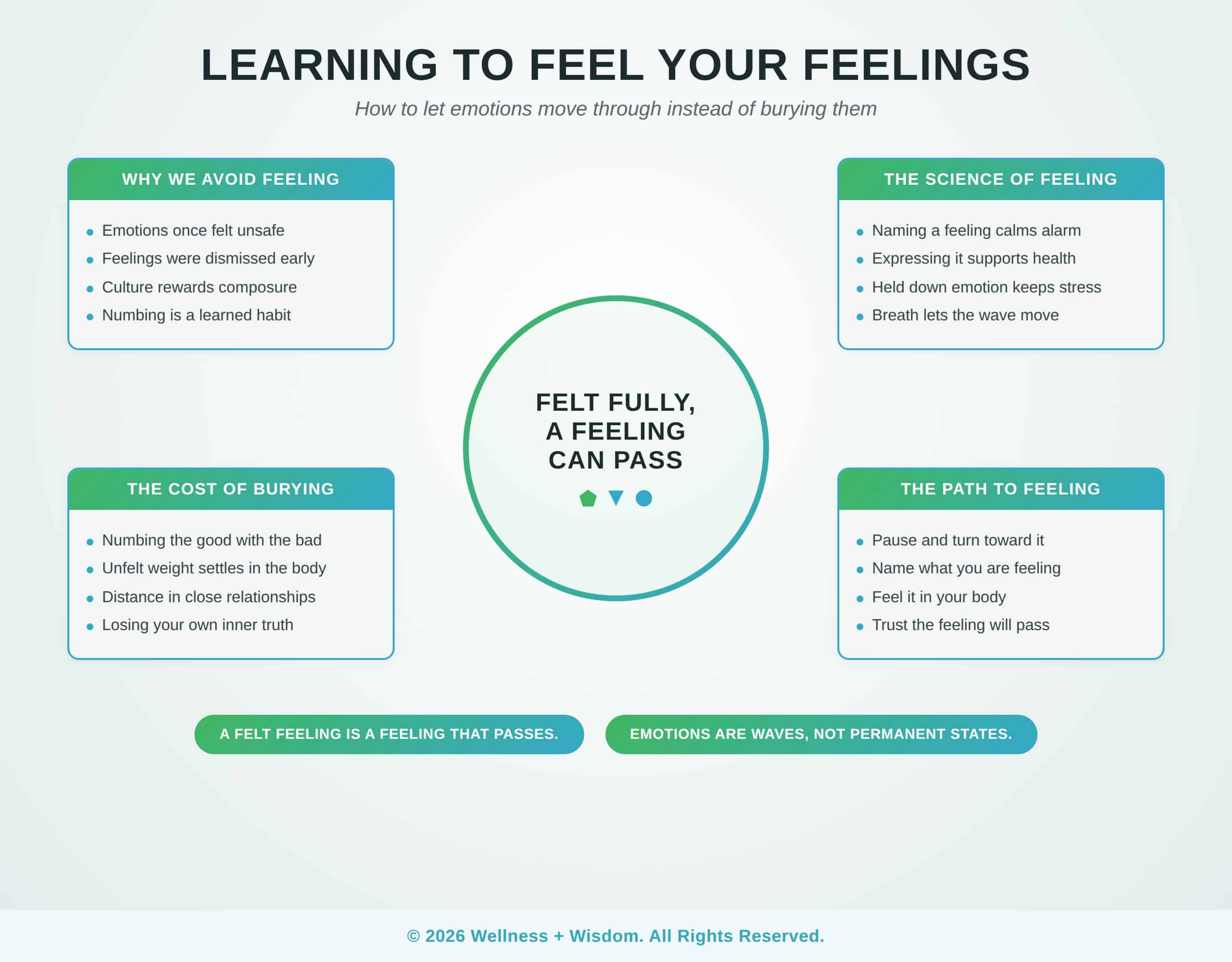
We avoid our feelings because somewhere along the way we learned that emotions were dangerous, too much, or not safe to express, so we pushed them down to protect ourselves. When we grew up in homes where feelings were dismissed or punished, we learned to numb, distract, or brace against our emotions instead of feeling them. This avoidance is a learned protection, not a personal flaw.
On top of all this, a culture that prizes constant productivity and composure can quietly teach us that feelings are inconvenient, that we should push through rather than pause to feel. So we keep numbing and distracting, mistaking avoidance for strength and quietly burying emotions that only grow heavier in the dark. Understanding that avoiding your feelings was simply a way your mind learned to keep you safe, often for very understandable reasons, replaces self judgment with real compassion, which is where lasting change begins, much like the gentle work of learning to practice self compassion.
Seeing clearly why we avoid our feelings is genuinely freeing, because it means your avoidance is not a weakness but a learned protection that can be gently softened over time. The numbing was simply learned, often in seasons when feeling felt unsafe, and like any learned habit, it can genuinely change. You can honor the part of you that avoids emotion in order to keep you safe while gently teaching it that your feelings can be felt and survived, which is deeply connected to neural system regulation.
The Hidden Cost of Buried Emotions
Recognizing the hidden cost of buried emotions helps motivate the shift toward feeling fully, because avoiding your feelings quietly takes far more from you than you realize. What feels like staying strong and composed often quietly leaves you numb, heavy, and disconnected from your own aliveness. Seeing this clearly makes feeling your feelings feel not just nice but genuinely essential.
Buried emotions quietly cost us our aliveness over time, since a heart that numbs the hard feelings also numbs the good ones. When we push our emotions down, we flatten our whole inner world and lose the vividness and color of being fully alive. This ongoing, quiet numbness is one of the heaviest costs of avoiding our feelings.
It also quietly costs us our health, since emotions we refuse to feel do not disappear but often settle into the body as tension, fatigue, and stress. When feelings stay buried, they keep our body braced and activated, quietly wearing on our wellbeing over time. Buried emotions can also quietly cost us our relationships, since a heart closed to its own feelings struggles to be truly open and present with others. When we cannot feel our own emotions, we often cannot fully receive the emotions of the people we love either, and a quiet distance grows in even our closest bonds.
Perhaps most importantly of all, buried emotions cost you the steady aliveness of a heart that feels fully and lives freely. They quietly cost you your own truth, since the feelings you refuse to feel are often the very ones carrying the messages you most need to hear about your life, your boundaries, and your deepest longings. Recognizing clearly that avoidance is costing you the very aliveness and freedom you long for is genuinely motivating, because it helps you choose feeling instead, supporting the kind of open, present living that lets you truly thrive, which deepens your whole spiritual wellness.
The Science of Feeling Fully
The science of emotion offers real support for learning how to feel your feelings. Research by Matthew Lieberman and colleagues, published in Psychological Science, found that putting feelings into words reduces activity in the brain's alarm center. When you gently name and feel an emotion rather than avoiding it, you help calm the very circuits that keep you braced, making it far easier to let the feeling move through, which draws on real emotional intelligence.
Expressing what you feel helps too. Research by James Pennebaker, published in the Journal of Consulting and Clinical Psychology, found that putting emotional experiences into words supported measurable improvements in wellbeing. When you allow yourself to feel and express your emotions rather than burying them, you support both your mind and your body, which is deeply connected to neural system regulation.
The stress of avoidance is real as well. Bruce McEwen described in the New England Journal of Medicine how chronic stress produces allostatic load, the cumulative wear on a body kept braced. Emotions we constantly hold down keep this stress response activated, quietly asking the body to carry what the heart will not feel, and over time that unfelt weight settles into our tissues and our health. Feeling them fully gives your whole system the release and recovery it genuinely needs, which is why breathwork is such a faithful companion to a feeling heart.
How to Feel Your Feelings
Learning how to feel your feelings is a gentle, gradual practice of allowing your emotions to move through you, again and again, whenever a feeling rises. It grows with steady practice over time, and every time you allow a feeling, feeling your feelings grows a little easier. Here are practices that help.
1. Pause and Turn Toward the Feeling
Gently pause when an emotion rises and turn toward it rather than away, since feelings need our attention to be felt and released. Pausing and turning toward the feeling is truly the first step to feeling fully, which pairs beautifully with learning to come back to the present.
2. Name What You Are Feeling
Gently put words to the emotion moving through you, since naming a feeling calms the brain and helps you feel it more clearly. Naming what you are feeling gently opens the door to feeling it, which supports learning to express your emotions.
3. Feel It in Your Body
Gently notice where the feeling lives in your body, the tightness, the heaviness, the warmth, since emotions are felt in the body as much as the mind. Feeling it in your body helps the emotion truly move through, which supports learning to sit with difficult emotions.
4. Breathe and Let It Move
Use slow, conscious breath to stay present with the feeling and let it rise and fall like a wave, since the breath helps emotions move through rather than stay stuck. Breathing and letting it move is a powerful way to feel fully, which is beautifully supported by breathwork.
5. Trust That the Feeling Will Pass
Remind yourself that every feeling, felt fully, will move through and pass, since emotions are waves rather than permanent states. Trusting that the feeling will pass helps you stay present with it, which supports learning to trust the process.
Begin with whatever single practice feels most accessible to you and be patient and kind with yourself, since unlearning a lifetime of avoiding emotion genuinely takes time. Every single time you allow a feeling makes the very next time a little easier. When you want community and support for this journey, the Liberated Life Tribe is here for you.
Feeling Versus Drowning
One of the most important distinctions in this work is the difference between feeling your feelings and drowning in them, because feeling fully does not mean being swept away. Feeling means allowing an emotion to move through you while staying present, while drowning means being lost in it without any ground, and understanding this one difference is key to real freedom.
Drowning in an emotion means losing yourself in it completely, with no anchor and no sense that it will pass, which only deepens the overwhelm. Feeling your feelings is something completely different, it lets the emotion move through while you stay grounded and present, trusting it will rise and fall. And where drowning leaves you swept away, feeling leaves you steady and free.
The key difference here is that feeling keeps you present while drowning loses you completely. You can let an emotion be fully felt, stay anchored in your breath and body, and trust that the wave will pass, rather than being swept away by it. This gentle understanding truly frees you to feel fully without fear of being overwhelmed, which is a beautiful part of your whole journey of learning to express your emotions and grow.
Feeling Your Feelings and BREATHE
Feeling your feelings is beautifully supported by BREATHE™, our own breathwork system for regulating the neural system and staying present with emotion. The breath is a truly powerful ally for feeling, because it gives you an anchor that lets you stay present with a feeling long enough for it to move through you.
When a strong emotion rises, your breath often grows shallow and quick as your body braces against the feeling, keeping it stuck rather than letting it flow. Slowing and deepening your breath gently reverses all of this, calming your body, softening the bracing, and giving the feeling the safety it needs to move through and pass. In this beautiful way, the breath becomes an anchor that lets you feel fully without being swept away.
This is exactly why we hold breathwork as such a genuinely powerful ally for feeling your feelings. Rather than avoiding an emotion or drowning in it, you can breathe your way into staying present with it, using the body to let the feeling flow. Each slow, conscious breath then becomes a small act of allowing, a gentle welcoming of the emotion that wants to move through you, deepening your whole L.I.F.E. Method™ journey.
Celebrating Every Feeling Felt
The joyful heart of all this work is celebrating every feeling felt, honoring each single time you allow an emotion to move through you rather than dwelling on the times you numbed or avoided. When you begin to truly celebrate each feeling you allow rather than judging the avoidance, feeling your feelings grows a little easier each time.
Celebrating every feeling felt means gently honoring each moment you turn toward an emotion and let it move through you, each time you choose feeling over numbing. Each single feeling felt is genuinely worth celebrating, and honoring it reinforces your growing capacity to feel, which is a beautiful part of learning to celebrate yourself.
And here is the beautiful part. When you feel your feelings and live from more openness, you naturally become far more present, alive, and emotionally available, quietly inspiring the people around you to feel their own emotions too. Your own willingness to feel quietly gives the people around you permission to open to their feelings as well, showing them that emotions felt fully lead to freedom. In this beautiful way, feeling your feelings becomes a gift that ripples far beyond yourself, bringing more aliveness and connection to every single relationship you touch, which is a spirit we cherish in learning to find inner peace.
Feeling Fully Is a Lifelong Practice
Feeling your feelings is not a single change you make just once, but rather a lifelong practice of allowing emotion across all the changing seasons of your life. New feelings will always keep rising, so learning to feel them is far less a fixed destination and more an ongoing practice of gently turning toward emotion again and again. This is truly the most wonderful news of all, because it means the freedom of feeling remains available to you, no matter how long you have avoided it.
This gentle understanding takes the pressure off getting it perfect. You will certainly have times when you numb or avoid again, moments when a feeling seems too big, and seasons when feeling fully feels much harder, and all of that is completely human. What matters most here is the gentle returning, the steady practice of turning back toward your feelings whenever you notice yourself avoiding them.
Understanding feeling fully as a lifelong, ongoing practice also gently keeps it compassionate. Each time you notice you have numbed or braced against a feeling, you have a fresh opportunity to turn toward it and let it move through, and every single feeling allowed deepens your aliveness. Over time, feeling fully becomes far less something you have to work at so consciously and more simply how you naturally meet your emotions.
So approach your own journey here with real patience and warmth toward yourself. There is no finish line at all here, only the ongoing, freeing practice of feeling fully and celebrating the aliveness you reclaim along the way. This steady capacity to feel quietly supports every single dimension of your wellbeing and deepens your whole experience of being alive, growing richer with time, which is closely tied to learning to sit with difficult emotions.
When Your Feelings Feel Too Big
If your feelings feel too big right now, you are in very good company here, and it is completely understandable, especially if you have avoided your emotions for a long time or are carrying deep grief or pain. Learning how to feel your feelings does not mean feeling everything all at once, it means gently turning toward your emotions a little at a time, at a pace that truly honors you.
When your feelings feel too big, it genuinely helps to start with the very smallest allowings, feeling one emotion for one breath, naming one feeling, or noticing one sensation in your body. The smallest allowing matters far more than any grand catharsis here, because it is the quiet, repeated practice of turning toward one feeling at a time that slowly teaches your body it is safe to feel. You do not have to feel everything all at once at all, you simply keep on gently turning toward your emotions, and over time feeling fully grows far more natural. Even just allowing one feeling to move through you for a single breath is a real and meaningful beginning.
It is also genuinely worth remembering that overwhelming emotions, especially those that interfere with your daily life or are rooted in trauma or depression, are best supported by working with a qualified therapist. There is real and genuine strength in seeking help, and a skilled professional can offer truly effective, compassionate tools for feeling safely and healing over time. Wherever you happen to be, be patient and kind with yourself, honor your own pace, and trust that feeling your feelings is truly something you can genuinely learn, one feeling at a time.
Frequently Asked Questions
What does it mean to feel your feelings?
Feeling your feelings means allowing your emotions to move through you fully rather than pushing them down, so they can pass instead of staying stuck in your body. It is not about being overwhelmed, but about letting each feeling be felt and then released, coming home to the full experience of being human.
Why do we avoid our feelings?
Because somewhere along the way we learned that emotions were dangerous, too much, or not safe to express, so we numbed or braced against them to protect ourselves. Understanding that avoidance is a learned protection, rather than a flaw, opens the way to gently softening it and turning toward your feelings over time.
How do I feel my feelings?
Pause and turn toward the feeling, name what you are feeling, feel it in your body, breathe and let it move, and trust that the feeling will pass. Start with whatever feels most accessible and be patient, since unlearning a lifetime of avoiding emotion takes time and gentle practice.
What is the difference between feeling and drowning?
Drowning means losing yourself in an emotion with no anchor, which deepens the overwhelm. Feeling means letting the emotion move through you while you stay grounded and present. Where drowning leaves you swept away, feeling leaves you steady and free, trusting the wave will rise and pass.
Is there science behind feeling your feelings?
Yes. Research shows naming an emotion calms the brain's alarm center, expressing feelings supports wellbeing, and emotions we hold down keep the body braced and stressed. Learning to feel fully genuinely supports your aliveness, health, and whole sense of freedom and presence.
What if my feelings feel too big right now?
That is understandable, especially after avoiding emotion for a long time or while carrying deep grief. You do not have to feel it all at once. Start with one feeling for one breath. Overwhelming emotions, especially those that interfere with daily life or are rooted in trauma, are best supported by a qualified therapist.
Studies and External Resources
The science in this article rests on peer reviewed research. These are the sources referenced throughout.
- Lieberman MD, et al. (2007). Putting Feelings Into Words: Affect Labeling Disrupts Amygdala Activity in Response to Affective Stimuli. Psychological Science. PubMed: 17576282
- Pennebaker JW, Kiecolt-Glaser JK, Glaser R. (1988). Disclosure of traumas and immune function: health implications for psychotherapy. Journal of Consulting and Clinical Psychology. PubMed: 3372832
- McEwen BS. (1998). Protective and damaging effects of stress mediators. New England Journal of Medicine. PubMed: 9428819
About Josh Trent
Josh Trent is an Identity Transformation Architect and the award winning host of the Wellness + Wisdom Podcast, with over 15 million downloads since 2015. He is the creator of the L.I.F.E. Method™ Identity Transformation System and steward of the Emotional Epigenetics™ and BREATHE: Breath + Wellness™ systems of self mastery, impacting over 1,000 students worldwide. Join the Liberated Life Tribe and receive your 10 day Self Liberation Blueprint at liberatedlife.com. Josh lives in Austin, Texas with his wife Carrie, daughter Nayah, and son Novah. Peace and power.
Disclosure: We may earn a commission from certain links on this site when you make a purchase, at no extra cost to you. These commissions help support Wellness + Wisdom and do not affect the products or resources we choose to recommend. Full disclosure .