
By Josh Trent | Wellness + Wisdom Podcast Host & Identity Transformation Architect
“The voice that tears you down was never truly yours. It was borrowed from somewhere, learned in some hard season. Learning to stop being so hard on yourself is learning to speak to yourself the way love would.”
Josh Trent
Learning how to stop being so hard on yourself is honestly one of the most freeing shifts you can ever make, because so much of our suffering comes not from our mistakes but from the harsh way we punish ourselves for them. So many of us carry a relentless inner critic that judges every misstep, magnifies every flaw, and quietly robs us of peace no matter how much we achieve. This gentle inner work gently reverses all of that, teaching you to meet yourself with the same kindness you would offer someone you love. This freeing work is beautifully supported by Emotional Epigenetics™.
Here is the joy forward truth at the center of it all. Stopping being so hard on yourself does not mean lowering your standards, it means replacing harsh self punishment with the kind, honest encouragement that actually helps you grow. When you truly stop being so hard on yourself, you free the energy that self criticism consumes and come home to a steady self compassion that carries you further than any critic ever could. When you learn how to stop being so hard on yourself, you finally come home to a kindness that has been waiting within you all along. Let us explore exactly how.
Table of Contents
- What Stopping Being So Hard on Yourself Really Means
- Why We Are So Hard on Ourselves
- The Hidden Cost of a Harsh Inner Critic
- The Science of Self Compassion
- How to Stop Being So Hard on Yourself
- Self Compassion Versus Self Indulgence
- Self Criticism and Emotional Epigenetics
- Celebrating Every Gentle Return
- Self Kindness Is a Lifelong Practice
- When the Inner Critic Feels Too Loud
- Frequently Asked Questions
- Studies and External Resources
- About Josh Trent
What Stopping Being So Hard on Yourself Really Means
Stopping being so hard on yourself means replacing the harsh inner critic with real self compassion, so you can meet your mistakes and flaws with kindness rather than punishment. It is not about excusing yourself, but about encouraging yourself the way love would. Stopping being so hard on yourself is coming home to the gentle voice that helps you grow.
This runs much deeper than simply thinking positive, because stopping being so hard on yourself is about changing your whole relationship with yourself. Rather than driving yourself forward through criticism and fear, you gently learn to support yourself through kindness and honest encouragement, which turns out to help you far more. It is truly a real shift from harsh self punishment toward warm self support.
Stopping being so hard on yourself also gently restores a deep sense of peace and worth, since a relentless inner critic tends to leave us anxious, exhausted, and quietly convinced we are never enough. When you learn to speak to yourself with kindness, you come home to a steady sense of worth that harshness could never give, feeling far more peaceful, resilient, and genuinely alive. Stopping being so hard on yourself in this way is a cornerstone of real self compassion, and it is a theme we return to often and explore in real depth on the Wellness + Wisdom Podcast.
Why We Are So Hard on Ourselves
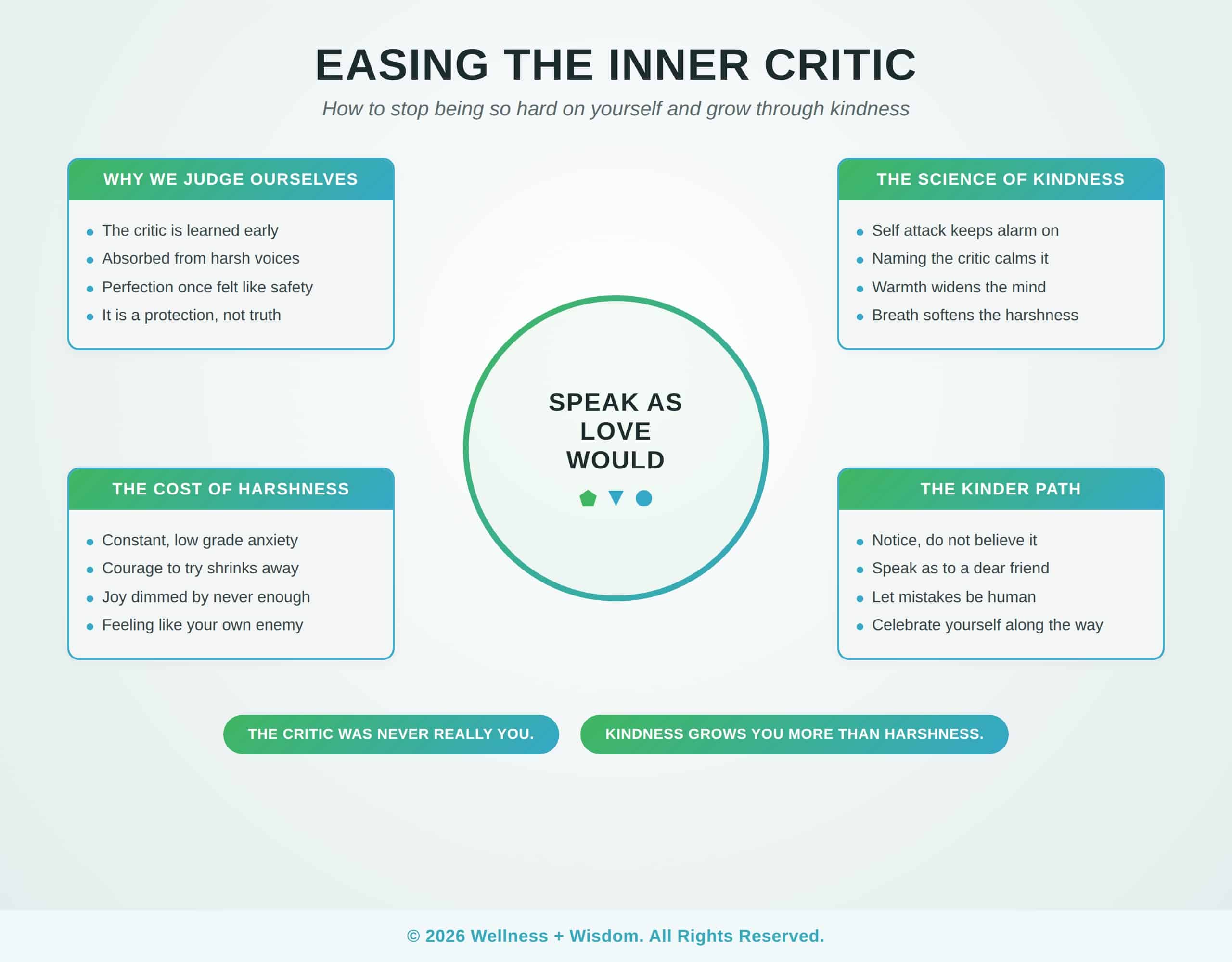
We are so hard on ourselves because the harsh inner voice was often learned early, absorbed from critical voices around us or from seasons when we believed we had to be perfect to be safe or loved. When we grew up with criticism or high expectations, we internalize that voice and turn it on ourselves, mistaking harshness for motivation. This inner critic is a learned protection, not a personal truth.
On top of all this, a culture that praises relentless self improvement can quietly teach us that being hard on ourselves is the only way to grow, even when the harshness only wounds us. So we keep punishing ourselves for every flaw, mistaking self criticism for high standards and slowly eroding our own worth. Understanding that your inner critic was simply learned, often in seasons when it felt like the only way to stay safe or accepted, replaces self judgment with real compassion, which is where lasting change begins, much like the gentle work of learning to forgive yourself.
Seeing clearly why we are so hard on ourselves is genuinely freeing, because it means your inner critic is not the truth about you but a learned voice that can be gently softened over time. The harshness was simply absorbed, often in seasons when perfection felt like safety, and like any learned voice, it can genuinely change. You can honor the part of you that criticizes in order to keep you safe while gently teaching it that kindness helps you far more, which is deeply connected to neural system regulation.
The Hidden Cost of a Harsh Inner Critic
Recognizing the hidden cost of a harsh inner critic helps motivate the shift toward self compassion, because punishing yourself quietly takes far more from you than you realize. What feels like holding yourself to high standards often quietly leaves you anxious, exhausted, and convinced you are never quite enough. Seeing this clearly makes stopping being so hard on yourself feel not just nice but genuinely essential.
A harsh inner critic quietly costs us our peace over time, since a mind constantly judging itself can never fully rest in acceptance. When we live under relentless self criticism, we carry a constant, low level anxiety that slowly drains us and keeps genuine peace out of reach. This ongoing, quiet self attack is one of the heaviest costs of a harsh inner critic.
It also quietly costs us our courage, since a heart afraid of its own harsh judgment hesitates to try, create, and risk. When self criticism fills our inner world, we shrink back from the very things that would help us grow, terrified of failing our own impossible standards. A harsh inner critic can also quietly cost us our joy, since it is hard to feel real happiness while a voice inside keeps telling us we are not enough.
Perhaps most importantly of all, a harsh inner critic costs you the steady peace of a heart that knows it is worthy just as it is. It costs your relationship with yourself, since it is hard to feel at home while a voice inside treats you as an enemy. Recognizing clearly that harshness is costing you the very peace and confidence you long for is genuinely motivating, because it helps you choose kindness instead, supporting the kind of gentle, courageous living that lets you truly thrive, which deepens your whole spiritual wellness.
The Science of Self Compassion
The science of stress offers real support for learning how to stop being so hard on yourself. Bruce McEwen described in the New England Journal of Medicine how chronic stress produces allostatic load, the cumulative wear on a body whose alarm rarely rests. A mind under constant self criticism keeps this stress response almost always activated, while meeting yourself with kindness gives your whole system the calm and safety it genuinely needs, supporting real neural system regulation.
Naming the critic helps too. Research by Matthew Lieberman and colleagues, published in Psychological Science, found that putting feelings into words reduces activity in the brain's alarm center. When you gently name the harsh voice rather than believing it, you help calm the very circuits that fuel the self attack, making it far easier to return to kindness, which draws on real emotional intelligence.
There is an uplifting dimension too. Barbara Fredrickson's research, published in American Psychologist, shows that positive emotions like warmth and kindness broaden our awareness and build lasting inner resources, while harsh self criticism narrows our focus and shrinks our world. When you learn to cultivate self compassion rather than self attack, you widen your capacity for peace, courage, and growth, which is why breathwork is such a faithful companion to a kind inner voice.
How to Stop Being So Hard on Yourself
Learning how to stop being so hard on yourself is a gentle, gradual practice of catching the critic and choosing kindness, again and again, whenever the harsh voice rises. It grows with steady practice over time, and every time you choose kindness, stopping being so hard on yourself grows a little easier. Here are practices that help.
1. Notice the Critic Without Believing It
Gently notice when the harsh inner voice speaks, and remind yourself that it is a learned voice, not the truth about who you are. Noticing the critic without believing it is truly the first step to freedom, which pairs beautifully with learning to calm an anxious mind.
2. Speak to Yourself as You Would a Friend
Gently offer yourself the same kindness and understanding you would give a dear friend who was struggling, since you deserve that same compassion. Speaking to yourself as you would a friend gently softens the critic, which supports learning to practice self compassion.
3. Let Your Mistakes Be Human
Gently allow yourself to make mistakes without punishment, remembering that being human means being imperfect and still worthy. Letting your mistakes be human frees you from impossible standards, which supports learning to forgive yourself.
4. Breathe and Soften When the Critic Rises
Use slow, conscious breath to calm your body and soften the harshness whenever the inner critic grows loud. Breathing and softening when the critic rises returns you to kindness, which is beautifully supported by breathwork.
5. Celebrate Yourself Along the Way
Gently honor your efforts and small wins rather than only noticing your flaws, since celebrating yourself rebuilds the worth the critic tore down. Celebrating yourself along the way nourishes real self kindness, which supports learning to celebrate yourself.
Begin with whatever single practice feels most accessible to you and be patient and kind with yourself, since unlearning a lifetime of harsh self criticism genuinely takes time. Every single time you choose kindness makes the very next time a little easier. When you want community and support for this journey, the Liberated Life Tribe is here for you.
Self Compassion Versus Self Indulgence
One of the most important distinctions in this work is the difference between self compassion and self indulgence, because being kind to yourself does not mean letting yourself off the hook. Self compassion means supporting yourself with honest kindness, while self indulgence means avoiding growth through excuses, and understanding this one difference is key to real change.
Self indulgence avoids responsibility and dodges the hard truths that help us grow, leaving us stuck rather than free. Self compassion is something completely different, it holds you accountable with kindness, encouraging real growth without the cruelty of the critic. And where self criticism motivates through fear and shame, self compassion motivates through warmth and honest support.
The key difference here is that self compassion encourages growth while self criticism only wounds it. You can hold yourself to real standards, learn honestly from your mistakes, and still speak to yourself with kindness, trusting that warmth helps you grow far more than harshness ever could. This gentle understanding truly frees you to grow through kindness rather than cruelty, which is a beautiful part of your whole journey of learning to build self confidence.
Self Criticism and Emotional Epigenetics
Stopping being so hard on yourself is beautifully supported by Emotional Epigenetics™, our own understanding of how the emotional patterns we inherit and practice can shape the way our biology expresses itself over time. The harsh inner critic is often an inherited pattern, absorbed from the voices and wounds of those who came before us.
When you keep repeating harsh self criticism, you reinforce an old inherited pattern that keeps your body in stress and your heart in judgment. When you practice self compassion instead, you gently begin to rewrite that pattern, training your body and heart toward safety, warmth, and worth over time. In this beautiful way, choosing kindness becomes a practice that reaches all the way into your biology and even into the patterns you pass on.
This is exactly why we hold self compassion as such a genuinely powerful practice for healing. Rather than accepting the inherited critic as your truth, you actively practice kindness, and the kindness you practice becomes the new pattern you live from and pass forward. Each gentle word to yourself then becomes a small act of healing, a quiet rewriting of an old inherited story, deepening your whole connection to the Wellness Pentagon™ vision of whole person wellbeing.
Celebrating Every Gentle Return
The joyful heart of all this work is celebrating every gentle return, honoring each single time you choose kindness over harshness rather than dwelling on the times the critic won. When you begin to truly celebrate each small return to kindness rather than judging the harshness, stopping being so hard on yourself grows a little easier each time.
Celebrating every gentle return means gently savoring each moment you speak to yourself with warmth, each time you soften the critic and choose compassion instead. Each single return to kindness is genuinely worth celebrating, and honoring it reinforces your growing self compassion, which is a beautiful part of learning to celebrate yourself.
And here is the beautiful part. When you stop being so hard on yourself and live from more kindness, you naturally become far more warm, patient, and compassionate, quietly inspiring the people around you to ease their own harshness too. Your own self kindness quietly gives the people around you permission to be gentle with themselves as well, showing them that they too are worthy just as they are. In this beautiful way, stopping being so hard on yourself becomes a gift that ripples far beyond yourself, bringing more warmth and kindness to every single relationship you touch, which is a spirit we cherish in learning to find inner peace.
Self Kindness Is a Lifelong Practice
Stopping being so hard on yourself is not a single change you make just once, but rather a lifelong practice of choosing kindness across all the changing seasons of your life. The inner critic may naturally return in stressful or vulnerable times, so easing it is far less a fixed destination and more an ongoing practice of gently returning to kindness again and again. This is truly the most wonderful news of all, because it means self compassion remains available to you, no matter how loud the critic once was.
This gentle understanding takes the pressure off getting it perfect. You will certainly have times when the critic takes over again, moments when harshness returns, and seasons when kindness feels much harder, and all of that is completely human. What matters most here is the gentle returning, the steady practice of coming back to kindness whenever the harsh voice rises.
Understanding self kindness as a lifelong, ongoing practice also gently keeps it compassionate. Each time you notice the critic has taken hold again, you have a fresh opportunity to return to kindness, and every single return deepens your self compassion. Over time, kindness becomes far less something you have to work at so consciously and more simply how you naturally speak to yourself.
So approach your own journey here with real patience and warmth toward yourself. There is no finish line at all here, only the ongoing, freeing practice of returning to kindness and celebrating the compassion you reclaim along the way. This steady self kindness quietly supports every single dimension of your wellbeing and deepens your whole experience of being alive, growing richer with time, which is closely tied to learning to build self confidence.
When the Inner Critic Feels Too Loud
If the inner critic feels too loud right now, you are in very good company here, and it is completely understandable, especially if you have carried harsh self criticism for a long time or grew up with critical voices around you. Learning how to stop being so hard on yourself does not mean silencing the critic perfectly overnight, it means gently returning to kindness a little at a time, at a pace that truly honors you.
When the critic feels too loud, it genuinely helps to start with the very smallest kindnesses, offering yourself one gentle word, one soft breath, or one moment of understanding instead of judgment. You do not have to silence the harshness all at once at all, you simply keep on gently returning to kindness, and over time self compassion grows far more natural. Even just one kind word to yourself in the middle of harsh judgment is a real and meaningful beginning.
It is also genuinely worth remembering that a relentless, punishing inner critic, especially one that interferes with your daily life or is rooted in trauma or depression, is best supported by working with a qualified therapist. There is real and genuine strength in seeking help, and a skilled professional can offer truly effective, compassionate tools for easing the critic and building lasting self kindness. Wherever you happen to be, be patient and kind with yourself, honor your own pace, and trust that stopping being so hard on yourself is truly something you can genuinely cultivate, one kind word at a time.
Frequently Asked Questions
What does it mean to stop being so hard on yourself?
Stopping being so hard on yourself means replacing the harsh inner critic with real self compassion, so you can meet your mistakes and flaws with kindness rather than punishment. It is not about excusing yourself, but about encouraging yourself the way love would and coming home to the gentle voice that helps you grow.
Why are we so hard on ourselves?
Because the harsh inner voice was often learned early, absorbed from critical voices around us or from seasons when we believed we had to be perfect to be safe or loved. Understanding that the inner critic is a learned protection, rather than the truth about you, opens the way to gently softening it over time.
How do I stop being so hard on myself?
Notice the critic without believing it, speak to yourself as you would a friend, let your mistakes be human, breathe and soften when the critic rises, and celebrate yourself along the way. Start with whatever feels most accessible and be patient, since unlearning a lifetime of harsh self criticism takes time and gentle practice.
What is the difference between self compassion and self indulgence?
Self indulgence avoids responsibility and dodges hard truths, leaving you stuck. Self compassion holds you accountable with kindness, encouraging real growth without cruelty. Where self criticism motivates through fear and shame, self compassion motivates through warmth and honest support that actually helps you grow.
Is there science behind self compassion?
Yes. Research shows chronic self criticism keeps the stress response activated and wears on the body, naming the harsh voice calms the brain's alarm center, and cultivating kindness broadens awareness while harshness narrows it. Learning self compassion genuinely supports your peace, courage, and wellbeing.
What if my inner critic feels too loud right now?
That is understandable, especially after carrying harsh self criticism for a long time or growing up with critical voices. You do not have to silence it all at once. Start with one kind word. A relentless, punishing inner critic, especially one that interferes with daily life or is rooted in trauma, is best supported by a qualified therapist.
Studies and External Resources
The science in this article rests on peer reviewed research. These are the sources referenced throughout.
- McEwen BS. (1998). Protective and damaging effects of stress mediators. New England Journal of Medicine. PubMed: 9428819
- Lieberman MD, et al. (2007). Putting Feelings Into Words: Affect Labeling Disrupts Amygdala Activity in Response to Affective Stimuli. Psychological Science. PubMed: 17576282
- Fredrickson BL. (2001). The role of positive emotions in positive psychology. The broaden and build theory of positive emotions. American Psychologist. PubMed: 11315248
About Josh Trent
Josh Trent is an Identity Transformation Architect and the award winning host of the Wellness + Wisdom Podcast, with over 15 million downloads since 2015. He is the creator of the L.I.F.E. Method™ Identity Transformation System and steward of the Emotional Epigenetics™ and BREATHE: Breath + Wellness™ systems of self mastery, impacting over 1,000 students worldwide. Join the Liberated Life Tribe and receive your 10 day Self Liberation Blueprint at liberatedlife.com. Josh lives in Austin, Texas with his wife Carrie, daughter Nayah, and son Novah. Peace and power.
Disclosure: We may earn a commission from certain links on this site when you make a purchase, at no extra cost to you. These commissions help support Wellness + Wisdom and do not affect the products or resources we choose to recommend. Full disclosure .