
By Josh Trent | Wellness + Wisdom Podcast Host & Identity Transformation Architect
“A healthy relationship is not two perfect people. It is two honest people who keep choosing to turn toward each other, especially on the hard days.”
Josh Trent
Learning how to build a healthy relationship is one of the most rewarding investments you will ever make, because the quality of your closest relationships shapes the quality of your life. Your partner is the person you wake up next to, the one you share your wins and worries with, and often the first person who sees you at your most tired and most real. When that connection is strong, life feels lighter. Joy is shared, burdens are halved, and home becomes a true place of rest. Here is the good news. Healthy relationships are not a matter of luck or finding the perfect person. They are built, day by day, through small choices that anyone can learn. Carrie and I have been learning these choices for years, and we are still learning. This work fits beautifully inside the L.I.F.E. Method™, which helps you become the kind of partner you would love to have.
Here is the joy forward truth at the center of it all. A healthy relationship is one of the most powerful sources of happiness and health a human being can experience. Every small act of attention, kindness, and repair is a deposit into a shared account that pays dividends for decades. Let us explore exactly how to build it.
Table of Contents
- What a Healthy Relationship Really Is
- Why Healthy Relationships Matter So Much
- The Gift of a Healthy Relationship
- The Science of Healthy Relationships
- How to Build a Healthy Relationship
- Healthy Conflict Versus Harmful Conflict
- How to Build a Healthy Relationship With the L.I.F.E. Method™
- Celebrating Each Other Every Day
- Keeping Your Relationship Healthy for Life
- When Your Relationship Feels Hard
- Frequently Asked Questions
- Studies and External Resources
- About Josh Trent
What a Healthy Relationship Really Is
A healthy relationship is a partnership built on trust, respect, honest communication, and mutual care, where both people feel safe to be themselves and supported to grow. It is not a relationship without conflict. It is a relationship where conflict is handled with care and repair.
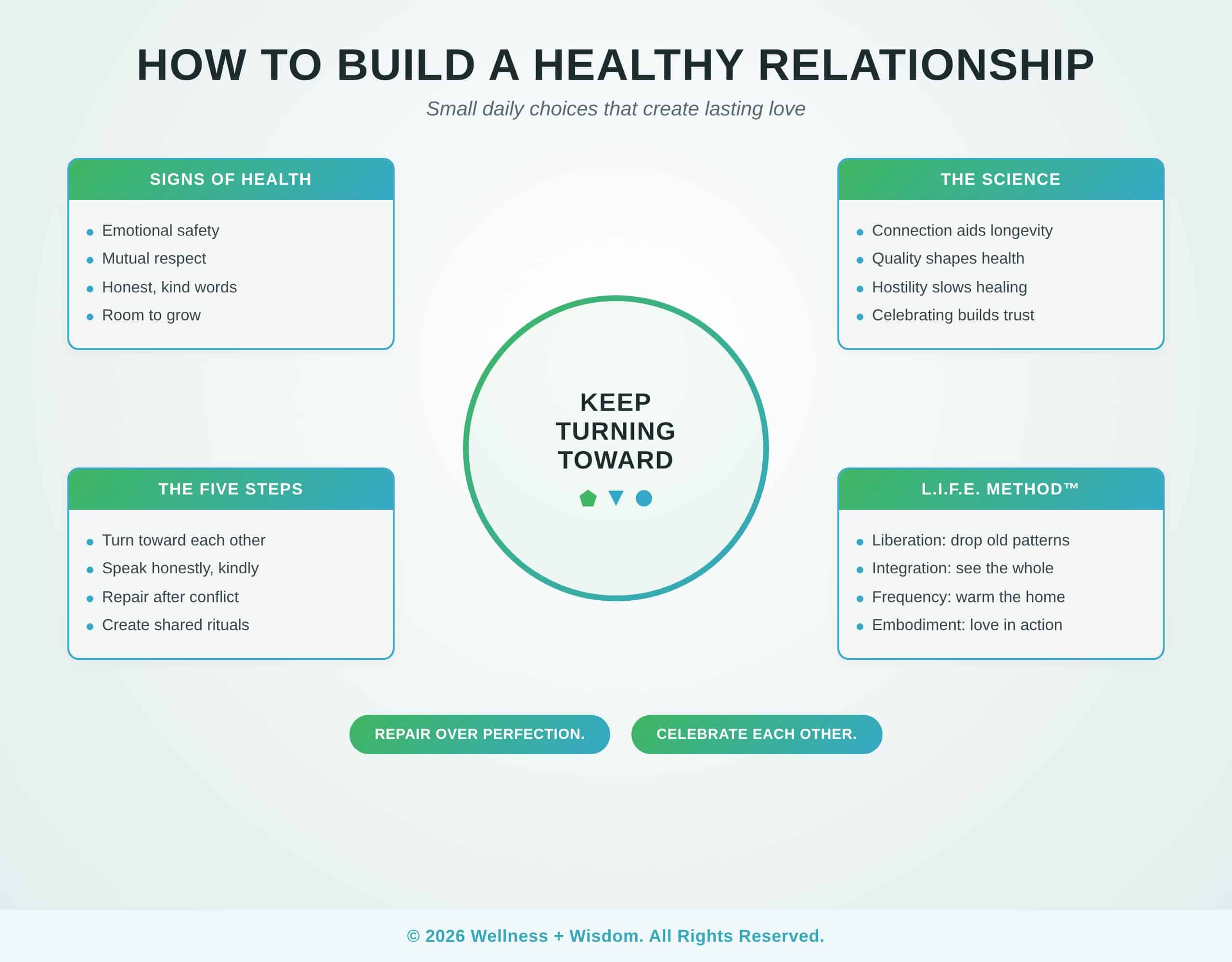
Healthy relationships share some common qualities. Both partners feel emotionally safe, meaning they can share feelings, needs, and fears without being mocked or dismissed. There is mutual respect, including respect for each other's boundaries, time, and individuality. Communication is honest and kind, even when the topic is difficult. Both people contribute to the relationship, and both feel that their efforts are noticed. And there is warmth: affection, laughter, curiosity, and the simple pleasure of being together.
A healthy relationship also leaves room for two whole people. You do not lose yourself in a healthy partnership. Instead, you each keep your own friendships, interests, faith, and goals, while building a shared life together. Your partner supports your growth, and you support theirs. These ideas come up often on the Wellness + Wisdom Podcast, where relationship experts share what truly helps love last.
It can also help to name what a healthy relationship is not. It is not constant happiness, a partner who reads your mind, or a love that requires no effort. It is not one person always giving while the other always takes. And it is not a relationship where you feel you must hide parts of yourself to keep the peace. Healthy love is steady, honest, and mutual. It feels more like a safe harbor than a roller coaster.
Why Healthy Relationships Matter So Much
Healthy relationships matter so much because close connection is one of the strongest predictors of happiness, resilience, and even physical health. Humans are wired for connection, and our closest bonds shape how we experience nearly everything.
When your relationship is healthy, it becomes a secure base. You can take on challenges at work, care for children, and pursue dreams because you know someone has your back. A healthy relationship helps your body and mind feel safe, which supports better sleep, steadier moods, and a calmer neural system. When a relationship is filled with tension, the opposite tends to happen. Stress rises, energy drains, and every other part of life can feel heavier.
Relationships also shape who we become. The way your partner treats you, and the way you treat them, can either reinforce old wounds or help heal them. Many of us carry patterns from childhood about love, conflict, and trust. A healthy relationship offers a chance to practice new patterns and become more secure over time. This is where Emotional Epigenetics™ offers a powerful lens, showing how the emotional patterns we inherit can be transformed through conscious choices.
The Gift of a Healthy Relationship
The gift of a healthy relationship is a life shared with someone who knows you deeply, supports your growth, and makes ordinary days feel meaningful. It is one of the richest sources of joy available to us.
In a healthy relationship, you get to be fully seen and fully loved. That experience is profoundly healing. It tells your heart, again and again, that you are safe and worthy just as you are. Over time, that safety allows you to take healthy risks, be more creative, and show up more fully in every area of life. People in healthy relationships often describe feeling more like themselves, not less.
A healthy relationship also multiplies joy. Good news feels better when it is shared with someone who celebrates with you. Hard seasons feel more bearable when you face them together. And the small rituals of daily life, like morning coffee, evening walks, and inside jokes, become treasured memories. Learning to receive love fully is part of unlocking this gift, because many of us are better at giving love than letting it in.
The Science of Healthy Relationships
The science of healthy relationships shows that strong social bonds are linked with longer life, that marital quality is associated with better physical health, that hostile conflict can measurably affect the body, and that how couples respond to each other's good news predicts relationship satisfaction. Love is not only a feeling. It is a powerful force in health.
Start with the big picture. In a landmark meta analysis published in PLoS Medicine, Julianne Holt Lunstad and colleagues analyzed data from 148 studies including more than 300,000 people. They found that people with stronger social relationships had about a 50 percent greater likelihood of survival over the study periods compared with those with weaker social connections. Connection matters for how long we live.
Relationship quality matters too, not just relationship status. A meta analysis by Theodore Robles and colleagues published in Psychological Bulletin found that higher marital quality was associated with better health outcomes, including lower risk of mortality and better cardiovascular health. The way partners treat each other day by day appears to shape health over the long run.
Conflict affects the body as well. In a study published in Archives of General Psychiatry, Janice Kiecolt Glaser and colleagues found that couples who showed more hostile behavior during a conflict discussion healed more slowly from small experimental wounds than couples with less hostile interactions. And research by Shelly Gable and colleagues in the Journal of Personality and Social Psychology found that responding to a partner's good news with active, enthusiastic support was linked with greater relationship satisfaction and trust. How you fight matters, and so does how you celebrate.
How to Build a Healthy Relationship
You learn how to build a healthy relationship by turning toward each other, communicating honestly and kindly, repairing after conflict, creating shared rituals, and celebrating each other often. These five practices strengthen trust and connection over time. Here is how Carrie and I practice them.
1. Turn Toward Each Other
Throughout the day, partners make small bids for connection. A comment about something funny, a request for help, a touch on the shoulder, a sigh after a long day. Turning toward these bids, by responding with attention and warmth, builds trust in tiny increments. Put down your phone when your partner speaks. Ask a follow up question. Notice how they are really doing. These moments seem small, but they add up to a relationship where both people feel seen. The practices in how to be a better listener can help.
2. Communicate Honestly and Kindly
Healthy communication blends honesty with kindness. Share your feelings and needs using “I” statements, like “I feel overwhelmed when the house is messy, and I would love some help tonight,” instead of blame. Listen to understand, not to win. Ask, “What do you need from me right now?” Honest, gentle communication keeps small issues from growing into big ones. The skill of speaking your truth with love is essential here.
3. Repair After Conflict
Every couple argues. What matters most is repair. When a conversation gets heated, take a break to calm down, then come back. Apologize for your part, without excuses. Acknowledge your partner's feelings. Repair might sound like, “I am sorry I raised my voice. You matter to me, and I want to understand what you were feeling.” Couples who repair well build a deep sense of safety, because they know that conflict will not break their bond. The ideas in how to handle conflict go deeper.
4. Create Shared Rituals
Rituals give a relationship rhythm and meaning. A weekly date night, a morning coffee together, a nightly check in, a Sunday walk, or praying together before bed. Rituals create predictable moments of connection that protect your relationship from the busyness of life. They do not need to be elaborate. Consistency matters more than grandeur.
5. Celebrate Each Other Often
Notice what your partner does well and say it out loud. Celebrate their wins with genuine enthusiasm. Thank them for the small things, like making dinner or handling a hard phone call. As the research shows, responding warmly to good news strengthens trust and satisfaction. Appreciation is the fuel of a healthy relationship. The ideas in how to celebrate the people you love are a joyful guide.
Start with one or two of these practices this week. Small, consistent actions create big changes over time. And if you would love support as you grow, the Liberated Life Tribe is a warm place to begin.
Here is a simple daily rhythm that brings these practices together. In the morning, share one hope and one worry for the day, so you can support each other. During the day, send a quick message that says you are thinking of them. In the evening, put devices away for twenty minutes and ask, “What was the best part of your day, and what was the hardest?” Before sleep, say one thing you appreciate about your partner. This rhythm takes less than thirty minutes, yet it can transform how connected you feel. If you have been wondering how to build a healthy relationship when life feels too busy, this is a wonderful place to start.
Physical affection matters too. A long hug, holding hands on a walk, or sitting close on the couch all signal safety and closeness. Touch helps the body relax and reminds both partners that they are on the same team. Many couples drift away from affection when life gets busy. Bringing it back, even in small ways, can quickly warm a relationship.
Healthy Conflict Versus Harmful Conflict
Healthy conflict and harmful conflict are very different. Healthy conflict focuses on the problem, respects both people, and ends with repair. Harmful conflict attacks the person, involves contempt or stonewalling, and leaves wounds that do not heal. Every couple disagrees. The goal is to disagree in a way that brings you closer rather than pushing you apart.
Healthy conflict sounds like, “I felt hurt when you made plans without asking me. Can we talk about how to decide things together?” It stays focused on one issue, uses calm language, and includes listening. Harmful conflict sounds like, “You never think about me. You are so selfish.” It generalizes, criticizes character, and often brings up old grievances. Contempt, like eye rolling, sarcasm, and mockery, is especially corrosive, because it communicates disrespect.
If your conflicts tend to be harmful, that does not mean your relationship is doomed. It means you have an opportunity to learn new skills. Start by noticing when you feel flooded and taking a break. Practice softer ways of starting hard conversations. Make repair a habit. Over time, these changes can transform how you and your partner handle disagreements. If trust has been damaged, the ideas in how to rebuild trust after betrayal may help.
Timing matters as well. Hard conversations go better when both people are rested, fed, and calm. Avoid starting a serious discussion late at night or in the middle of a stressful moment. Instead, ask, “Is now a good time to talk about something that matters to me?” This simple courtesy shows respect and sets the stage for a more productive conversation. It also gives both partners a chance to come in with open hearts rather than defenses already raised.
How to Build a Healthy Relationship With the L.I.F.E. Method™
The L.I.F.E. Method™ offers a meaningful framework for relationships, because each of its four pillars, Liberation, Integration, Frequency, and Embodiment, helps you become a more present and loving partner. A healthy relationship starts with two people who are each doing their own inner work.
Liberation is about releasing old patterns that hurt your relationship, like people pleasing, defensiveness, or fear of vulnerability. When you let go of these patterns, you make room for real intimacy. Integration is about weaving together your past experiences, your values, and your partner's perspective into a shared understanding. It helps you see your partner as a whole person rather than through the lens of old wounds.
Frequency is about the emotional energy you bring into your home. Gratitude, laughter, prayer, and kindness raise the emotional tone of a relationship and make connection easier. Embodiment is about living your love in everyday actions: how you greet each other, how you touch, how you show up when your partner needs you. When both partners practice these four pillars, the relationship becomes a place of growth and joy. To learn more about how this framework came to life, visit my story.
Your own inner work is one of the greatest gifts you can bring to your partner. When you understand your triggers, heal old wounds, and learn to regulate your emotions, you show up with more patience and presence. Many relationship struggles are really two personal histories meeting each other. When each partner takes responsibility for their own healing, the relationship becomes a place where both can grow. The ideas in how to be vulnerable are a beautiful place to begin.
Celebrating Each Other Every Day
Celebrating each other every day keeps a relationship warm, joyful, and resilient. Appreciation reminds your partner that they matter, and it trains your own mind to notice the good in them.
Look for small moments to celebrate. Thank your partner for making coffee. Compliment how they handled a tough situation with the kids. Celebrate a promotion, a finished project, or a personal breakthrough with real enthusiasm. Leave a note in their bag. Send a text in the middle of the day saying you are thinking of them. These small gestures say, “I see you, and I am grateful for you.”
Celebration also includes celebrating your relationship itself. Mark anniversaries, remember meaningful moments, and reflect together on how far you have come. There is a whole practice around noticing these moments in celebrating small wins, and it brings so much joy to a partnership.
Keeping Your Relationship Healthy for Life
Keeping your relationship healthy for life means continuing to invest in connection through every season, from the early days to raising children to growing older together. Healthy relationships are not built once. They are tended, like a garden.
Life will bring changes: new jobs, moves, children, health challenges, and loss. Each season brings new stresses and new opportunities to grow closer. Couples who stay healthy over decades tend to keep learning about each other, adapt to change together, and protect time for connection even when life is busy. Regular check ins, like a weekly conversation about how you are both doing, can help you stay aligned.
This is also where the Wellness Pentagon™ becomes helpful. A relationship thrives when both partners care for their physical, mental, emotional, spiritual, and financial wellbeing, including a shared Connection to Creator and God for couples who walk in faith together. When each person is well, the relationship has a stronger foundation. You will find many couples and experts sharing their wisdom across our latest episodes.
When Your Relationship Feels Hard
If your relationship feels hard right now, you are not alone, and it is completely understandable. Every relationship goes through difficult seasons. Learning how to build a healthy relationship includes learning how to navigate these seasons with patience, honesty, and care for both yourself and your partner.
When things feel hard, start with what you can control: your own words, actions, and inner work. Practice the five steps above, even if your partner is not ready to change yet. Often, one person's shift creates a ripple that invites the other to soften. Supportive resources like couples journals, books, and conversation card decks can help you reconnect, and you can find a few tools we trust in our wellness tools store.
It is also important to know when to seek outside help. A skilled couples therapist can help you break painful patterns and rebuild connection. And if a relationship involves abuse, control, or threats to your safety, please reach out to a trusted professional or local support service right away. Your safety matters most. Wherever you are, trust that growth is possible. If you want to start with your own heart, the practices in how to love yourself are a gentle next step.
Ready to go deeper? Join the Liberated Life Tribe and receive your 10 day Self Liberation Blueprint at liberatedlife.com. It is free, it is guided, and each day offers a gentle practice to help you become the partner you would love to have.
Frequently Asked Questions
What are the signs of a healthy relationship?
Signs include feeling emotionally safe, mutual respect, honest and kind communication, trust, shared responsibility, room for each person's individuality, and regular warmth and affection. Conflicts happen but are handled with care and followed by repair.
What is the most important part of a healthy relationship?
Many experts point to trust and emotional safety as the foundation. When both partners feel safe to be honest and know the other will respond with care, everything else, from communication to intimacy, becomes easier to build.
How can couples communicate better?
Use “I” statements to share feelings and needs, listen to understand rather than to win, take breaks when emotions run high, and come back to repair. Regular check ins about how you are both doing can prevent small issues from growing.
Is it normal for healthy couples to argue?
Yes. Every couple disagrees. What matters is how you argue. Healthy conflict focuses on the problem, avoids contempt and personal attacks, and ends with repair. Research suggests hostile conflict can even affect the body, so learning to fight kindly matters.
How do you keep a relationship strong over time?
Keep turning toward each other in small moments, protect shared rituals like date nights, celebrate each other's wins, keep learning about each other, and adapt together as life changes. Healthy relationships are tended daily, not built once.
When should a couple seek counseling?
Consider counseling if the same painful conflicts keep repeating, trust has been damaged, you feel disconnected for a long time, or you want support through a major life change. If there is abuse or a safety concern, reach out to a professional right away.
Studies and External Resources
The science in this article rests on peer reviewed research. These are the sources referenced throughout.
- Holt Lunstad J, Smith TB, Layton JB. (2010). Social relationships and mortality risk: a meta analytic review. PLoS Medicine. PubMed: 20668659
- Robles TF, Slatcher RB, Trombello JM, McGinn MM. (2014). Marital quality and health: a meta analytic review. Psychological Bulletin. PubMed: 23527470
- Kiecolt Glaser JK, et al. (2005). Hostile marital interactions, proinflammatory cytokine production, and wound healing. Archives of General Psychiatry. PubMed: 16330726
- Gable SL, Reis HT, Impett EA, Asher ER. (2004). What Do You Do When Things Go Right? The Intrapersonal and Interpersonal Benefits of Sharing Positive Events. Journal of Personality and Social Psychology. View the study via DOI
About Josh Trent
Josh Trent is an Identity Transformation Architect and the award winning host of the Wellness + Wisdom Podcast, with over 15 million downloads since 2015. He is the creator of the L.I.F.E. Method™ Identity Transformation System and steward of the Emotional Epigenetics™ and BREATHE: Breath + Wellness™ systems of self mastery, impacting over 1,000 students worldwide. Join the Liberated Life Tribe and receive your 10 day Self Liberation Blueprint at liberatedlife.com. Josh lives in Austin, Texas with his wife Carrie, daughter Nayah, and son Novah. Peace and power.
Disclosure: We may earn a commission from certain links on this site when you make a purchase, at no extra cost to you. These commissions help support Wellness + Wisdom and do not affect the products or resources we choose to recommend. Full disclosure .