

By Josh Trent | Wellness + Wisdom Podcast Host & Identity Transformation Architect
“A spiritual practice is not something you add to a busy life. It is the quiet center that holds the whole life together. Start small, return often, and let the connection grow.”
Josh Trent
Learning how to build a spiritual practice may be one of the most meaningful steps you ever take toward a life of peace, purpose, and joy. In a world that moves fast and rarely pauses, a spiritual practice gives you a place to return to, a daily rhythm of connection with Creator and God, with your own heart, and with what truly matters. It does not have to be complicated or time consuming. A few quiet minutes each morning, a moment of gratitude before meals, a walk in nature with an open heart, these simple acts can transform how you experience your days. In my own life, spiritual practice has been the anchor that holds everything else steady. It is one of the five dimensions of the Wellness Pentagon™, and in many ways it is the one that ties the others together.
Here is the joy forward truth at the center of it all. You do not need to be perfect, experienced, or certain to begin. You only need willingness and a little consistency. Your spiritual practice can grow with you, deepening over months and years into a wellspring of peace you can draw from in every season of life. Let us explore exactly how to begin.
Table of Contents
- What a Spiritual Practice Really Is
- Why a Spiritual Practice Matters
- The Gift of a Daily Spiritual Rhythm
- The Science of Spirituality and Wellbeing
- How to Build a Spiritual Practice
- Spiritual Practice Versus Spiritual Performance
- How to Build a Spiritual Practice With the Wellness Pentagon™
- Celebrating Moments of Connection
- Letting Your Practice Grow Over Time
- When Your Practice Feels Dry
- Frequently Asked Questions
- Studies and External Resources
- About Josh Trent
What a Spiritual Practice Really Is
A spiritual practice is a regular, intentional activity that nurtures your Connection to Creator and God, deepens your inner life, and helps you live with greater peace, purpose, and love. It is less about the specific form and more about the heart you bring to it.
Spiritual practices take many forms. Prayer is one of the oldest and most universal. Meditation, contemplative reading of scripture or sacred texts, journaling, gratitude, worship, fasting, silence, time in nature, acts of service, and breathwork can all be spiritual practices. What makes something spiritual is not the activity itself but the intention behind it: turning your attention toward God, toward truth, and toward love.
A spiritual practice is also personal. What nourishes one person may feel empty to another. Some people find deep connection in quiet morning prayer. Others feel closest to God while hiking, singing, or serving others. Part of building a practice is discovering what helps you feel connected and returning to it regularly. These themes come up often on the Wellness + Wisdom Podcast, where guests from many traditions share how faith and practice shape their lives.
It may help to think of a spiritual practice like tending a garden. You do not plant a seed and expect a full harvest the next morning. You water it, protect it, and give it light, day after day. Some days you see visible growth. Other days, the roots are deepening quietly beneath the surface. Your spiritual life works the same way. Each small act of prayer, gratitude, or stillness is a drop of water, and over time, something beautiful grows.
Why a Spiritual Practice Matters
A spiritual practice matters because it gives your life a steady center, a source of meaning, comfort, and guidance that remains constant even when circumstances change. It helps you navigate challenges with perspective and face joys with gratitude.
Modern life pulls our attention in countless directions. Notifications, deadlines, and responsibilities can leave little room for reflection. Without a regular way to pause and reconnect, it is easy to feel scattered, anxious, or disconnected from what matters most. A spiritual practice creates intentional space to slow down, listen, and remember who you are and what you are here for.
Spiritual practice also shapes how you show up in the rest of your life. When you begin your day grounded in prayer, gratitude, or stillness, you often carry that peace into your relationships, your work, and your decisions. You become more patient, more compassionate, and more aware of the blessings around you. If you want to explore this dimension of wellness more deeply, spiritual wellness and reclaiming your inner signal is a beautiful companion read.
The Gift of a Daily Spiritual Rhythm
The gift of a daily spiritual rhythm is a deep sense of peace, meaning, and belonging that grows stronger over time and supports you through every season of life. Many people describe their spiritual practice as the most important part of their day.
When you return to a spiritual practice each day, something quietly shifts. You become more aware of grace in ordinary moments. Gratitude comes more easily. Worries lose some of their grip, because you remember that you are not carrying everything alone. Over time, your practice becomes a source of strength you can lean on when life feels uncertain.
A daily rhythm also brings clarity. In moments of stillness and prayer, many people find guidance for decisions, insight into their relationships, and a clearer sense of purpose. The noise settles, and you can hear your heart and God's leading more clearly. This is why spiritual practice pairs so naturally with the work of reconnecting with your purpose. Connection and purpose grow together.
The Science of Spirituality and Wellbeing
The science of spirituality and wellbeing shows that religious and spiritual involvement is associated with better mental and physical health, that regular attendance at religious services is linked with longer life and greater flourishing, and that contemplative practices like meditation are associated with changes in the brain. Spiritual practice nourishes the whole person.
Start with the big picture. In a comprehensive review published in ISRN Psychiatry, Harold Koenig of Duke University examined decades of research on religion, spirituality, and health. He found that religious and spiritual involvement was associated with better mental health, including more hope, optimism, meaning, and purpose, and lower rates of depression and anxiety in many studies, along with links to better physical health outcomes.
Community practice appears especially meaningful. In a large study published in JAMA Internal Medicine, Shanshan Li and colleagues followed nearly 75,000 women in the Nurses' Health Study and found that those who attended religious services more than once a week had a lower risk of death over the study period compared with those who never attended. Building on this, a study led by Ying Chen in the International Journal of Epidemiology found that regular service attendance was associated with better health and wellbeing outcomes later in life, including greater life satisfaction and a stronger sense of purpose.
Contemplative practice also shows up in the brain. In a study published in NeuroReport, Sara Lazar and colleagues found that experienced meditators had greater cortical thickness in brain regions related to attention and awareness of internal sensations compared with non meditators. While these studies show associations rather than proof of cause, together they paint a hopeful picture: spiritual practice supports the mind, body, and heart.
How to Build a Spiritual Practice
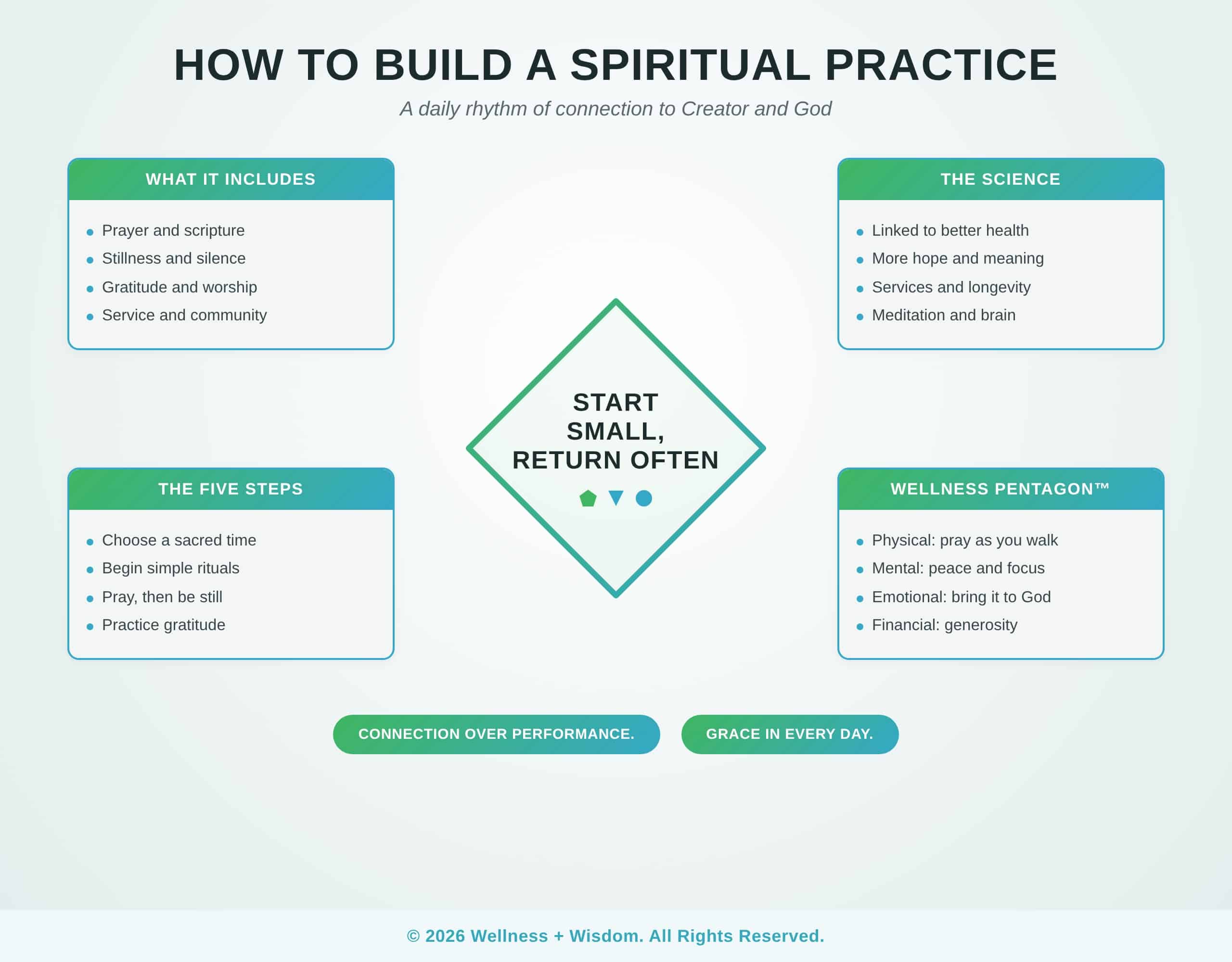
You learn how to build a spiritual practice by choosing a sacred time, starting with simple rituals, making room for prayer and stillness, practicing gratitude, and connecting with community. These five steps help you create a daily rhythm of connection that grows deeper over time. Here is how I practice and teach them.
1. Choose a Sacred Time
Pick a consistent time each day for your practice. For many people, the early morning works best, before the day's demands begin. Others prefer evening, as a way to reflect and release the day. Consistency matters more than length. Even five minutes at the same time each day helps your practice become a natural part of your rhythm. The ideas in building a morning routine can help you anchor it.
2. Start With Simple Rituals
Keep your practice simple at first. You might light a candle, read a short passage of scripture or a devotional, say a prayer, and sit in silence for a few minutes. Simple rituals signal to your mind and heart that this time is set apart. Over time, you can add or adjust elements as your practice grows. Starting small makes it easier to stay consistent.
3. Make Room for Prayer and Stillness
Prayer is a conversation with God, and stillness is the space where you listen. Share what is on your heart honestly, including gratitude, worries, hopes, and questions. Then pause and simply be present. You might use a slow breath to settle your body. Many people find that the quiet moments after prayer are where they feel God's presence most clearly. The practices in how to practice mindfulness can help you cultivate stillness.
4. Practice Gratitude
Gratitude opens the heart and reminds you of the blessings already present in your life. Each day, name three things you are grateful for, either in prayer or in a journal. Thank God for both big and small gifts. Over time, gratitude becomes a lens through which you see the world, and joy grows naturally. The ideas in how to practice gratitude go deeper here.
5. Connect With Community
Spiritual life flourishes in community. Consider joining a church, faith community, small group, or prayer circle where you can worship, learn, and grow alongside others. Community offers encouragement, accountability, and the joy of shared faith. As the research suggests, regular communal practice may be especially nourishing for both body and soul.
Start with one or two of these steps, and let your practice grow naturally. There is no perfect way to do this. What matters is showing up with an open heart. And if you would love a supportive community on your journey, the Liberated Life Tribe is a warm place to begin.
Here is a simple fifteen minute morning practice you can try this week. Begin with two minutes of slow breathing to settle your body. Spend five minutes reading a short passage of scripture or a devotional, letting one phrase stand out. Spend five minutes in honest prayer, sharing what is on your heart. Then sit in silence for two minutes, simply resting in God's presence. Close by naming three things you are grateful for. That is it. Simple, repeatable, and deeply nourishing.
You can also weave small spiritual moments throughout your day. Pause for a breath of prayer before a meeting. Give thanks before meals. Say a short blessing over your children at bedtime. Notice beauty during a walk and offer a quiet word of thanks. These moments keep you connected between your longer practice times and turn ordinary days into sacred ones. Breath can be a wonderful anchor for these pauses, and the practices in how to practice breathwork pair beautifully with prayer.
Spiritual Practice Versus Spiritual Performance
Spiritual practice and spiritual performance look similar on the outside but feel very different on the inside. Spiritual practice is about genuine connection with God and inner transformation. Spiritual performance is about looking spiritual, meeting expectations, or checking boxes. The first nourishes the soul. The second can leave you feeling empty.
Many people fall into performance without realizing it. They pray because they feel they should, attend services out of obligation, or compare their spiritual life to others. Over time, this can make spirituality feel like a burden rather than a source of life. If your practice feels heavy or hollow, it may be a sign that it has drifted from connection toward performance.
The invitation is to return to the heart of it. Ask yourself, what helps me feel truly connected to God? What practices bring me peace, honesty, and love? Let go of what feels forced and lean into what feels alive. Spiritual practice is not about impressing anyone, including yourself. It is about relationship. If you want to explore how stillness supports this kind of authentic connection, the ideas in meditation and DNA offer a fascinating look at the science of contemplative life.
A good test is how you feel after your practice. Genuine connection usually leaves you a little lighter, more honest, and more loving, even when the time felt quiet. If you walk away feeling anxious or judged, gently adjust until it feels like coming home again.
How to Build a Spiritual Practice With the Wellness Pentagon™
The Wellness Pentagon™ offers a helpful framework for spiritual practice, because it shows how your spiritual life connects with and supports every other dimension of wellbeing: physical, mental, emotional, and financial. When your spiritual foundation is strong, the rest of your life tends to feel more grounded.
Inside the Wellness Pentagon™, the spiritual dimension is defined as Connection to Creator and God. It is the dimension that gives meaning to the others. Your physical health becomes a way of honoring the body you have been given. Your mental and emotional health are supported by the peace and perspective that faith provides. Even your financial life can be shaped by spiritual values like generosity, stewardship, and trust.
You can weave spiritual practice into each dimension in simple ways. Pray or give thanks during a walk to connect the physical and spiritual. Use breathwork as a doorway to stillness before prayer. Journal about your emotions and bring them honestly to God. Practice generosity as an expression of faith. When spirituality touches every part of life, it becomes less of a separate activity and more of a way of living. To go deeper with identity level change, explore our L.I.F.E. Method™ programs.
Your family can share in this too. Simple rituals like praying together before dinner, reading a short devotional at bedtime, or attending services as a family can root children in faith from an early age. When kids see their parents practicing with sincerity and joy, they learn that spiritual life is a natural, beautiful part of everyday living. Our children often teach us as much as we teach them, reminding us of the wonder and trust at the heart of faith.
Celebrating Moments of Connection
Celebrating moments of connection helps your spiritual practice feel alive and joyful rather than dutiful. When you notice and give thanks for the ways God shows up in your life, your faith grows stronger and your practice feels more meaningful.
Look for moments of grace. A prayer that felt deeply answered. A sense of peace that came over you during a hard day. A conversation that felt guided. A sunrise that took your breath away. Write these moments down in a journal or share them with someone in your faith community. Over time, you will build a record of God's faithfulness that encourages you in harder seasons.
Celebrate your consistency too. The week you showed up for your practice every morning. The first time stillness felt peaceful instead of restless. These small wins matter. There is a whole practice around noticing these moments in celebrating small wins, and it brings joy to the spiritual journey.
Letting Your Practice Grow Over Time
Letting your practice grow over time means allowing it to evolve as you do, deepening, changing form, and meeting you in new ways through different seasons of life. A spiritual practice is a living relationship, not a fixed routine.
In some seasons, your practice may be rich and expansive, with long times of prayer, study, and worship. In other seasons, like when you have young children or are going through a demanding time at work, it may be shorter and simpler. Both are valid. What matters is staying connected. A single heartfelt prayer in a busy day can be just as meaningful as an hour of quiet reflection.
As your practice matures, you may feel drawn to explore new forms, like a silent retreat, a new devotional, fasting, or serving in your community. Follow those invitations with curiosity. Your spiritual life is meant to grow. You will find many guests sharing how their faith deepened over time across our latest episodes.
When Your Practice Feels Dry
If your practice feels dry right now, you are in very good company, and it is completely understandable. Learning how to build a spiritual practice includes walking through seasons when prayer feels quiet and connection feels distant. People of faith across centuries have written about these dry seasons. They are a normal part of the spiritual journey, not a sign that something is wrong.
When your practice feels dry, keep showing up gently. Faithfulness in quiet seasons often prepares the ground for renewed connection. Try changing your routine, like praying outdoors, reading a different passage, or listening to worship music. Talk with a trusted friend, mentor, or pastor about what you are experiencing. Supportive tools like a prayer journal or a devotional can help, and you can find a few resources we trust in our wellness tools store.
It is also important to care for your whole self. Sometimes spiritual dryness is connected to exhaustion, stress, or emotional struggles. Rest, connection, and, when needed, support from a qualified counselor can all help. If you are experiencing persistent sadness or hopelessness, please reach out to a qualified mental health professional. There is real strength in asking for help. Wherever you are, trust that God is near, even in the quiet. If you want to cultivate deeper peace in this season, the practices in how to find inner peace are a gentle next step.
Ready to go deeper? Join the Liberated Life Tribe and receive your 10 day Self Liberation Blueprint at liberatedlife.com. It is free, it is guided, and each day offers a gentle practice to help you deepen your connection with yourself, with others, and with Creator and God.
Frequently Asked Questions
How do I start a spiritual practice as a beginner?
Start small and simple. Choose a consistent time each day, perhaps the morning, and spend five to ten minutes in prayer, reading a short passage, and sitting in stillness. Add gratitude by naming three blessings. Consistency matters more than length.
How long should a daily spiritual practice be?
There is no required length. Even five minutes each day can be meaningful. Many people start with five to fifteen minutes and naturally extend their time as the practice becomes a cherished part of their routine.
What are examples of spiritual practices?
Common spiritual practices include prayer, meditation, reading scripture or devotionals, journaling, gratitude, worship, fasting, silence, time in nature, acts of service, and attending services with a faith community. Choose what helps you feel connected to God.
Is there science behind spiritual practice and health?
Yes. Reviews of decades of research link religious and spiritual involvement with better mental health and other positive outcomes. Large studies have associated regular religious service attendance with longer life and greater wellbeing. These are associations, not proof of cause.
What should I do when prayer feels empty?
Dry seasons are a normal part of spiritual life. Keep showing up gently, try a new form of practice, and talk with a trusted mentor or faith community. Caring for your rest and emotional health can also help renew your sense of connection.
Do I need a faith community to have a spiritual practice?
You can practice on your own, but community adds encouragement, accountability, and shared joy. Research suggests regular communal practice is associated with better health and wellbeing, so many people find that a faith community strengthens their personal practice.
Studies and External Resources
The science in this article rests on peer reviewed research. These are the sources referenced throughout.
- Koenig HG. (2012). Religion, spirituality, and health: the research and clinical implications. ISRN Psychiatry. PubMed: 23762764
- Li S, Stampfer MJ, Williams DR, VanderWeele TJ. (2016). Association of Religious Service Attendance With Mortality Among Women. JAMA Internal Medicine. PubMed: 27183175
- Chen Y, Kim ES, VanderWeele TJ. (2021). Religious service attendance and subsequent health and well being throughout adulthood: evidence from three prospective cohorts. International Journal of Epidemiology. PubMed: 32793951
- Lazar SW, et al. (2005). Meditation experience is associated with increased cortical thickness. NeuroReport. PubMed: 16272874
About Josh Trent
Josh Trent is an Identity Transformation Architect and the award winning host of the Wellness + Wisdom Podcast, with over 15 million downloads since 2015. He is the creator of the L.I.F.E. Method™ Identity Transformation System and steward of the Emotional Epigenetics™ and BREATHE: Breath + Wellness™ systems of self mastery, impacting over 1,000 students worldwide. Join the Liberated Life Tribe and receive your 10 day Self Liberation Blueprint at liberatedlife.com. Josh lives in Austin, Texas with his wife Carrie, daughter Nayah, and son Novah. Peace and power.
Disclosure: We may earn a commission from certain links on this site when you make a purchase, at no extra cost to you. These commissions help support Wellness + Wisdom and do not affect the products or resources we choose to recommend. Full disclosure .