
By Josh Trent | Wellness + Wisdom Podcast Host & Identity Transformation Architect
“Our children do not need perfect parents. They need parents who are willing to feel, to name what they feel, and to stay close through every emotion. That is how emotional wisdom is passed down.”
Josh Trent
Learning how to raise emotionally intelligent kids is one of the greatest gifts you can give your children, because emotional intelligence shapes nearly every part of their lives: their friendships, their learning, their resilience, and their future relationships. As a dad to Nayah and Novah, I think about this every single day. Children are not born knowing how to understand and manage big feelings. They learn it from us, one tantrum, one tear, and one hug at a time. The beautiful news is that you do not need a degree in psychology to do this well. You need presence, patience, and a willingness to grow alongside your children. This work connects deeply to Emotional Epigenetics™, which shows how the emotional patterns we live become the patterns our children learn.
Here is the joy forward truth at the center of it all. Every emotional moment with your child is an opportunity for connection. The meltdown in the grocery store, the tears at bedtime, the frustration over homework, these are not interruptions to parenting. They are the heart of it. Let us explore exactly how to turn everyday moments into lifelong emotional wisdom.
Table of Contents
- What Emotional Intelligence in Kids Really Is
- Why Emotional Intelligence Matters for Children
- The Gift of an Emotionally Intelligent Childhood
- The Science of Emotional Intelligence in Children
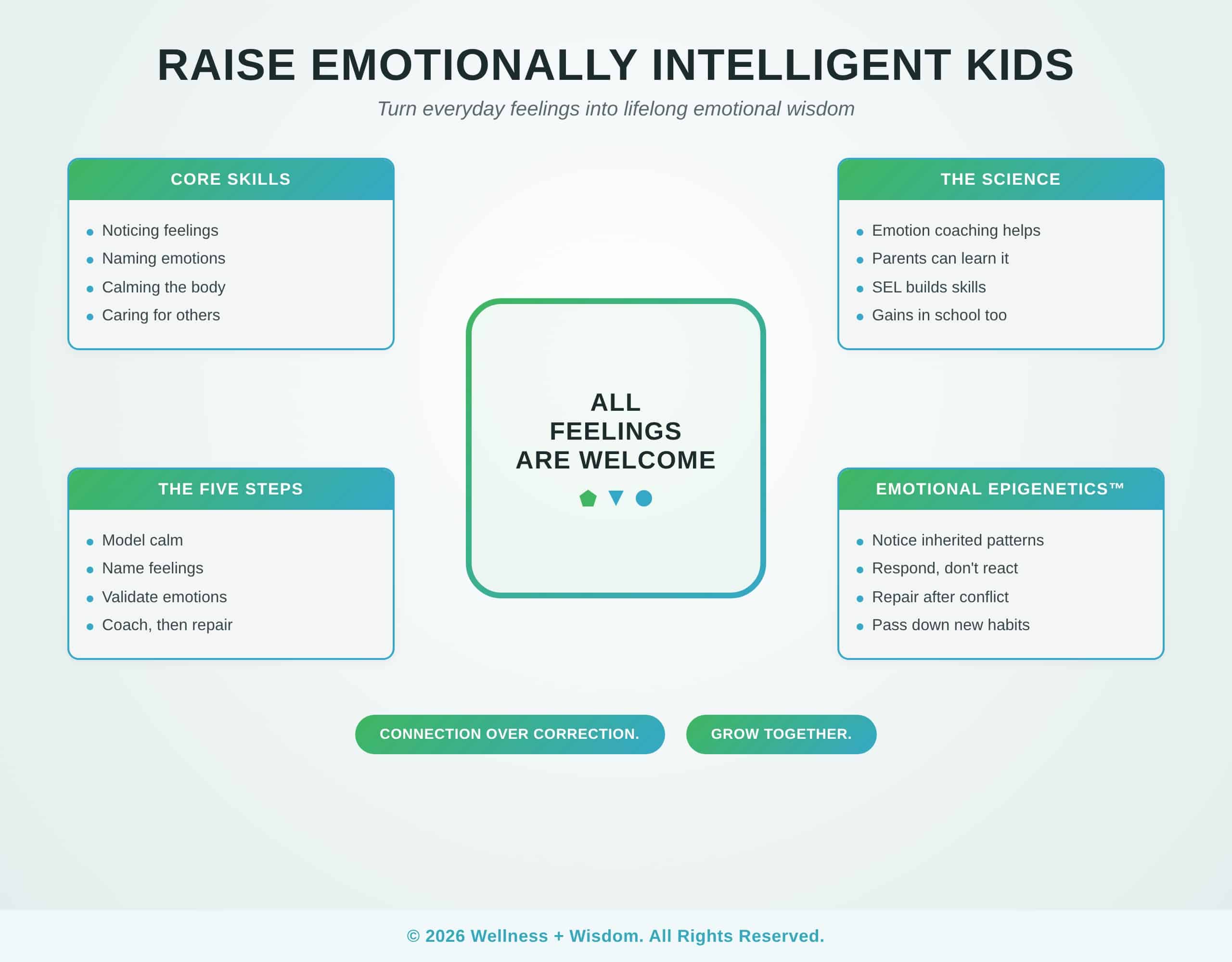
- How to Raise Emotionally Intelligent Kids
- Emotion Coaching Versus Emotion Dismissing
- How to Raise Emotionally Intelligent Kids With Emotional Epigenetics™
- Celebrating Emotional Growth Together
- Emotional Intelligence at Every Age
- When Parenting Feels Hard
- Frequently Asked Questions
- Studies and External Resources
- About Josh Trent
What Emotional Intelligence in Kids Really Is
Emotional intelligence in kids is the ability to recognize, understand, express, and manage their own emotions, and to notice and respond with care to the emotions of others. It is a set of skills that children develop over time, with the guidance and example of the adults around them.
Emotional intelligence includes several connected abilities. Self awareness is noticing what you feel. Emotional vocabulary is having words to name those feelings. Self regulation is calming yourself when emotions run high. Empathy is understanding how someone else feels. And social skills involve using all of this to build healthy relationships, solve problems, and work through conflict. Children grow each of these skills gradually, at their own pace.
Emotional intelligence is not about raising children who are always happy or never upset. It is about raising children who know that all feelings are welcome, who can understand what their feelings are telling them, and who can choose healthy ways to respond. A child who can say, “I am frustrated because my tower fell, and I need a minute,” is showing real emotional intelligence. These themes come up often on the Wellness + Wisdom Podcast, where parenting experts share what truly helps children thrive.
One helpful way to think about emotional intelligence is as an inner toolkit. Each time your child learns a new feeling word, a new way to calm down, or a new way to understand a friend, a tool is added. At first, children need you to hand them the right tool in the moment. Over time, they learn to reach for it on their own. Your job is not to fix every feeling. It is to help them fill and use that toolkit with growing confidence.
Why Emotional Intelligence Matters for Children
Emotional intelligence matters for children because it supports their wellbeing, learning, relationships, and resilience throughout life. Children who understand and manage their emotions tend to navigate challenges with more confidence and connect more easily with others.
When children can name and regulate their feelings, they are better able to focus, learn, and solve problems. They tend to get along better with peers, handle disappointment more gracefully, and recover from setbacks more quickly. Emotional skills also lay the groundwork for healthy adult relationships, both romantic and professional. In many ways, emotional intelligence is a foundation that supports every other area of growth.
Emotional intelligence also helps children feel safe in their own inner world. Big feelings can be scary for young children. When a parent helps them understand what is happening and how to cope, the child learns that emotions are manageable and that they are not alone. That sense of safety becomes a deep source of resilience. If you want to explore this further, raising emotionally resilient children is a natural companion to this article.
The Gift of an Emotionally Intelligent Childhood
The gift of an emotionally intelligent childhood is a child who grows into an adult with a strong inner compass, healthy relationships, and the ability to meet life's challenges with resilience and compassion. It is a gift that keeps giving across generations.
Children who learn emotional skills early often carry them for life. They know how to calm themselves when stressed, how to communicate their needs clearly, and how to show empathy to others. They are better equipped to form healthy friendships and partnerships, to navigate conflict, and to bounce back from disappointment. These are the skills that make life richer and more joyful.
And here is the part I find most beautiful. When you raise emotionally intelligent children, you often grow your own emotional intelligence too. Parenting invites us to look at our own patterns, heal old wounds, and become the calm, connected presence our children need. In that way, raising emotionally intelligent kids becomes a path of healing for the whole family. This is the heart of conscious parenting, which invites parents to grow alongside their children.
The Science of Emotional Intelligence in Children
The science of emotional intelligence in children shows that how parents respond to emotions shapes how children learn to handle them, that parents can learn emotion coaching skills that improve children's behavior, and that social and emotional learning programs improve children's skills, behavior, and academic performance. Emotional intelligence is teachable, and parents play a central role.
Start with the foundational research. In a study published in the Journal of Family Psychology, John Gottman, Lynn Katz, and Carole Hooven studied how parents think about and respond to emotions, which they called parental meta emotion philosophy. They found that parents who were aware of their own and their children's emotions, and who coached children through feelings, had children who showed better emotional regulation and social outcomes. This approach became known as emotion coaching.
Emotion coaching can be learned. In a randomized controlled trial published in the Journal of Child Psychology and Psychiatry, Sophie Havighurst and colleagues tested a parenting program called Tuning in to Kids, which teaches parents emotion coaching skills. Parents who took part became more emotionally responsive and less dismissive, and their children showed improvements in emotional knowledge and fewer behavior problems.
The benefits extend to schools too. In a meta analysis of more than 200 programs published in Child Development, Joseph Durlak and colleagues found that school based social and emotional learning programs improved students' social and emotional skills, attitudes, and behavior, and were also associated with an 11 percentile point gain in academic achievement. Emotional skills support learning, not just wellbeing.
How to Raise Emotionally Intelligent Kids
You learn how to raise emotionally intelligent kids by modeling calm, naming feelings, validating emotions, coaching solutions, and repairing after conflict. These five steps turn everyday moments into opportunities for emotional growth. Here is how Carrie and I practice them at home.
1. Model Calm
Children learn more from what we do than what we say. When you stay calm during their big feelings, you show them what regulation looks like. Take a slow breath before responding. Lower your voice. Get down to their level. Your calm becomes their anchor. This does not mean you never feel frustrated. It means you show them how to handle frustration with care. The breathing practices in breathwork for your neural system can help you stay grounded.
2. Name Feelings
Help your child build an emotional vocabulary by naming feelings in the moment. “You look really disappointed that we have to leave the park.” “It sounds like you felt left out.” Naming feelings helps children understand their inner world and often helps calm big emotions. Expand their vocabulary beyond happy, sad, and mad to words like frustrated, worried, proud, and lonely.
3. Validate Emotions
Let your child know that all feelings are welcome, even when certain behaviors are not. “It is okay to feel angry. It is not okay to hit.” Validation helps children feel understood, which makes them more open to guidance. When children feel heard, their emotions often soften naturally. Avoid phrases like “You are fine” or “Stop crying,” which can teach children that their feelings are wrong.
4. Coach Solutions
Once your child feels heard and calmer, help them think through what to do next. “What could you do when you feel this frustrated?” “How could we solve this together?” This step teaches problem solving and self regulation. Over time, children begin to use these strategies on their own. Simple tools like a calm down corner, deep breaths, or a hug can become part of their toolkit.
5. Repair After Conflict
No parent gets it right every time. When you lose your patience, come back and repair. “I am sorry I yelled earlier. I was feeling overwhelmed, and I want to handle it better next time.” Repair teaches children that relationships can survive hard moments and that taking responsibility is a sign of strength. It may be one of the most powerful lessons in emotional intelligence you can teach. The ideas in breaking the parenting cycle go deeper on this.
Start with one or two of these steps, and be patient with yourself and your children. Emotional skills grow over years, not days. Every small moment of connection counts. And if you would love support on your own growth journey as a parent, the Liberated Life Tribe is a warm place to begin.
Here is what this can look like in a real moment. Your child bursts into tears because a friend would not share a toy at the playground. Instead of saying “It is no big deal,” you kneel down and say, “You really wanted a turn, and it felt unfair when she said no.” You pause and let them cry for a moment. Then you ask, “What could we do now?” Maybe they decide to ask again later, or find another game. In less than two minutes, your child has practiced naming a feeling, being comforted, and solving a problem.
Daily rituals make these skills feel natural. At dinner, each person can share a high and a low from their day. At bedtime, you might ask, “What was one feeling you had today?” In the car, you can talk about a character in a favorite show and how they might have felt. These simple conversations build emotional vocabulary and show your children that feelings are a normal, welcome part of family life.
Emotion Coaching Versus Emotion Dismissing
Emotion coaching and emotion dismissing are two very different ways parents respond to children's feelings. Emotion coaching treats emotions as opportunities for connection and teaching. Emotion dismissing treats emotions as problems to be fixed quickly or ignored. Research suggests that emotion coaching supports healthier emotional development.
Emotion dismissing is usually well intentioned. Parents may want to protect their child from pain, avoid a scene, or simply move on with the day. They might say, “Do not be sad, it is just a toy,” or distract the child immediately. While this may stop the tears in the short term, it can teach children that their feelings are unimportant or unwelcome, which makes it harder for them to learn to manage those feelings.
Emotion coaching takes a bit more time in the moment, but it pays off over the long run. An emotion coaching parent notices the feeling, sees it as a chance to connect, helps the child name it, validates it, and then guides them toward a solution. Many of us were raised with more dismissing than coaching, so this may feel unfamiliar at first. That is completely okay. Every time you choose coaching, you are building a new pattern for your family. If you want to grow your own emotional skills alongside your children, explore emotional intelligence for adults.
How to Raise Emotionally Intelligent Kids With Emotional Epigenetics™
Emotional Epigenetics™ offers a powerful lens for parenting, because it shows how the emotional patterns we live, often inherited from our own parents, shape the emotional world our children grow up in. When we become aware of these patterns, we can choose which ones to pass down and which ones to transform.
Many parents notice themselves reacting to their children the way their own parents reacted to them, even when they promised themselves they would do it differently. That is not a failure. It is a sign of how deeply emotional patterns are learned. Emotional Epigenetics™ invites you to notice these moments with curiosity rather than shame. Ask yourself, where did I learn this response? Does it serve my child? What would I like to do instead?
When you heal your own emotional patterns, you give your children a different starting point. You show them that feelings are safe, that conflict can be repaired, and that love stays steady through every emotion. This is generational healing in action. To go deeper with identity level change, explore our L.I.F.E. Method™ programs, which help parents transform the patterns they carry.
Your marriage or co parenting relationship matters here too. Children learn a great deal by watching how the adults in their lives handle disagreement. When they see parents disagree respectfully, listen to each other, and make up after conflict, they learn that strong relationships can hold hard feelings. Carrie and I try to let our kids see us repair, not just argue. If you want to strengthen this part of family life, the ideas in how to handle conflict can help.
Celebrating Emotional Growth Together
Celebrating emotional growth together helps children feel proud of their progress and motivated to keep building emotional skills. When you notice and appreciate the moments your child handles feelings well, you reinforce those skills in a joyful way.
Look for small wins. The time your child uses words instead of hitting. The moment they take a deep breath when frustrated. The day they comfort a friend who is sad. Name these moments specifically. “I noticed you took a big breath when your sister knocked over your blocks. That was really strong of you.” Specific praise helps children understand exactly what they did well.
Celebrate your own growth as a parent too. The time you stayed calm during a meltdown. The moment you repaired after losing your patience. These wins matter just as much. There is a whole practice around noticing these moments in celebrating small wins, and it brings so much joy to family life.
Emotional Intelligence at Every Age
Emotional intelligence looks different at every age, and meeting children where they are developmentally helps them grow skills at a pace that fits. Toddlers, school age children, and teenagers each need slightly different support.
With toddlers and preschoolers, focus on naming feelings, staying calm during big emotions, and offering comfort. Simple books about feelings and playful games like making faces for different emotions can help. With school age children, you can talk more about why feelings happen, practice problem solving together, and discuss how others might feel in different situations. With teenagers, listen more than you talk, respect their growing independence, and stay available for connection, even when they seem to pull away.
No matter the age, the foundation stays the same: presence, validation, and steady love. This is also where the Wellness Pentagon™ becomes helpful, as a reminder that children thrive when their physical, mental, emotional, spiritual, and relational needs are all cared for, including a sense of Connection to Creator and God. You will find many parents and experts sharing their wisdom across our latest episodes.
When Parenting Feels Hard
If parenting feels hard right now, you are in very good company, and it is completely understandable. Learning how to raise emotionally intelligent kids asks a lot of us, especially when we are tired, stressed, or still healing our own emotional patterns. Be patient and gentle with yourself as you grow, one moment at a time.
When parenting feels hard, start by caring for yourself. You cannot pour from an empty cup. Protect your sleep where you can, take short breaks, and lean on your partner, family, or friends for support. A calmer parent is better able to coach a child through big feelings. Simple tools like feelings charts, books about emotions, or a family journal can help, and you can find a few resources we trust in our wellness tools store.
It is also important to know when to seek extra support. If your child's emotions or behavior consistently make daily life very difficult, or if you notice signs of anxiety, persistent sadness, or developmental concerns, reach out to your pediatrician or a qualified child mental health professional. There is real strength in asking for help. Wherever you are, trust that every moment of connection matters. If you want to bring more presence into family life, the practices in how to be more patient are a gentle next step.
Ready to go deeper? Join the Liberated Life Tribe and receive your 10 day Self Liberation Blueprint at liberatedlife.com. It is free, it is guided, and each day offers a gentle practice to help you grow your own emotional wisdom so you can pass it on to your children.
Frequently Asked Questions
What is emotion coaching?
Emotion coaching is a parenting approach where you notice your child's emotions, see them as chances to connect, help your child name the feeling, validate it, and guide them toward solutions. Research by John Gottman and colleagues linked emotion coaching with better emotional regulation in children.
At what age should I start teaching emotional intelligence?
You can start from infancy by responding warmly to your baby's cues. With toddlers, begin naming feelings and staying calm during big emotions. Emotional skills grow throughout childhood and adolescence, so it is never too early or too late to begin.
How do I handle my child's tantrums with emotional intelligence?
Stay calm, get down to your child's level, and name the feeling you see. Keep everyone safe, and offer comfort without giving in to unsafe demands. Once your child is calmer, talk about what happened and what they could do next time.
What if I was not raised with emotional intelligence?
Many parents were not, and that is completely okay. Emotional skills can be learned at any age. Research shows parents can learn emotion coaching, and as you grow your own skills, you naturally pass them to your children. Be patient and kind with yourself.
Do social emotional learning programs really work?
Research suggests they do. A large meta analysis of more than 200 school based programs found improvements in social and emotional skills, behavior, and attitudes, along with gains in academic achievement. Home and school support work best together.
How can I help my child build empathy?
Talk about how others might feel in different situations, read stories together and discuss the characters' emotions, and model kindness in your own words and actions. When your child shows empathy, name it and celebrate it specifically.
Studies and External Resources
The science in this article rests on peer reviewed research. These are the sources referenced throughout.
- Gottman JM, Katz LF, Hooven C. (1996). Parental meta emotion philosophy and the emotional life of families: Theoretical models and preliminary data. Journal of Family Psychology. View the study via DOI
- Havighurst SS, et al. (2010). Tuning in to Kids: improving emotion socialization practices in parents of preschool children. Journal of Child Psychology and Psychiatry. PubMed: 20735794
- Durlak JA, et al. (2011). The impact of enhancing students' social and emotional learning: a meta analysis of school based universal interventions. Child Development. PubMed: 21291449
About Josh Trent
Josh Trent is an Identity Transformation Architect and the award winning host of the Wellness + Wisdom Podcast, with over 15 million downloads since 2015. He is the creator of the L.I.F.E. Method™ Identity Transformation System and steward of the Emotional Epigenetics™ and BREATHE: Breath + Wellness™ systems of self mastery, impacting over 1,000 students worldwide. Join the Liberated Life Tribe and receive your 10 day Self Liberation Blueprint at liberatedlife.com. Josh lives in Austin, Texas with his wife Carrie, daughter Nayah, and son Novah. Peace and power.
Disclosure: We may earn a commission from certain links on this site when you make a purchase, at no extra cost to you. These commissions help support Wellness + Wisdom and do not affect the products or resources we choose to recommend. Full disclosure .