
By Josh Trent | Wellness + Wisdom Podcast Host & Identity Transformation Architect
“Focus is not about forcing your mind to stay still. It is about giving your attention a home worth returning to. Learning how to improve focus is learning to choose where your life energy goes.”
Josh Trent
Learning how to improve focus is one of the most valuable skills you can build in a world designed to scatter your attention. Notifications, endless tabs, constant messages, and a never ending to do list compete for every minute of your day. Many people end their workday feeling busy but unfulfilled, sensing that they were everywhere at once and nowhere fully. Focus is not a gift that some people are born with and others lack. It is a skill and a state that you can strengthen through the way you design your day, care for your body, and train your mind. One of the simplest doorways into focus is your breath, which is why this work pairs so beautifully with BREATHE™.
Here is the joy forward truth at the center of it all. Focus is not just about productivity. It is about presence. When your attention is steady, you do better work, yes, but you also enjoy conversations more, notice beauty more, and feel calmer inside. When you learn how to improve focus, you give yourself the gift of being fully where you are. Let us explore exactly how.
Table of Contents
- What Focus Really Is
- Why Focus Feels So Hard Today
- The Gift of a Focused Mind
- The Science of Focus
- How to Improve Focus
- Deep Focus Versus Constant Multitasking
- How to Improve Focus With BREATHE™
- Celebrating Focused Moments
- Focus Is a Lifelong Practice
- When Focus Feels Impossible
- Frequently Asked Questions
- Studies and External Resources
- About Josh Trent
What Focus Really Is
Focus is the ability to direct and sustain your attention on one thing while gently setting aside distractions. It includes choosing what to pay attention to, staying with it, and returning to it when your mind wanders. Focus is less like a laser that never moves and more like a muscle that strengthens with practice.
There are different kinds of focus. Deep focus is the sustained concentration you need for complex work, creative projects, or meaningful conversations. Light focus is enough for routine tasks like answering simple emails. Both have their place. The challenge in modern life is that we spend most of our time in fragmented, shallow attention, jumping from one thing to the next without ever settling into deep focus.
It is also important to know that a wandering mind is normal. Even the most focused people experience distraction. What makes them different is not that their minds never wander, but that they notice more quickly and return more easily. That skill of returning is at the heart of focus, and it is something anyone can develop. It is also a theme that comes up often on the Wellness + Wisdom Podcast, because attention shapes every part of a well lived life.
Why Focus Feels So Hard Today
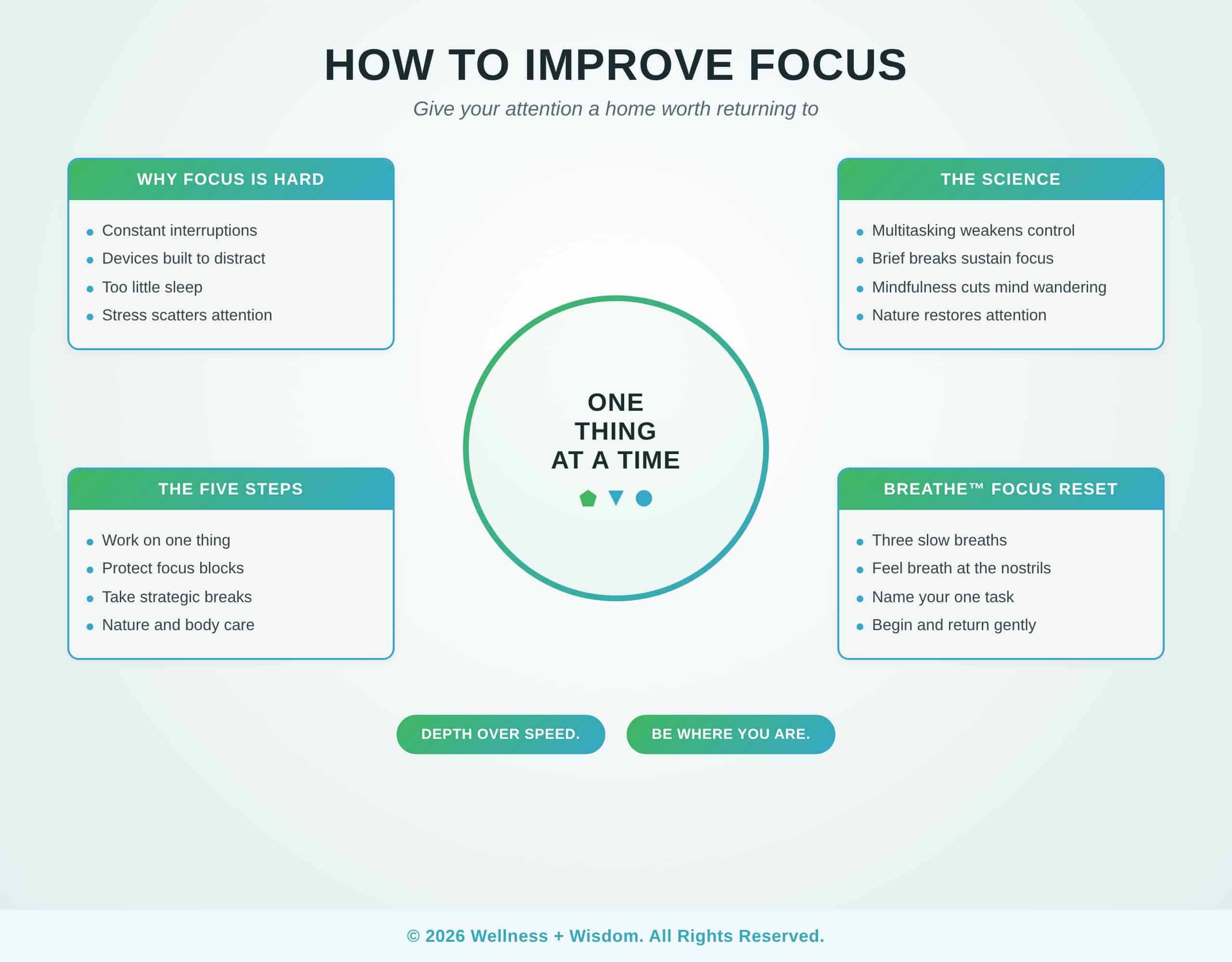
Focus feels hard today because our environments are full of interruptions, our devices are designed to capture attention, and many of us are running on too little sleep and too much stress. Each of these pulls our attention apart before we have a chance to settle.
Think about how many times your attention gets interrupted in a typical hour. A notification buzzes. An email arrives. A coworker asks a quick question. You remember something you forgot to do. Each interruption may only take a moment, but returning to deep focus afterward takes much longer. Over a day, these fragments add up to hours of lost concentration and a deep sense of mental fatigue. The habits that help you reduce screen time can make a big difference here.
Your body matters too. Poor sleep, dehydration, long stretches of sitting, and chronic stress all make focus harder. When your neural system is stuck on high alert, your attention naturally jumps around, scanning for problems. And when your mind is full of unprocessed worries, it keeps pulling your focus back toward them. If mental noise is a big part of your day, the practices in how to quiet the noise in your mind are a beautiful companion.
The Gift of a Focused Mind
A focused mind gives you better work, deeper relationships, more creativity, less stress, and the satisfaction of finishing what matters. When your attention is steady, you accomplish more in less time and feel calmer while doing it.
Think about the times you were fully absorbed in something you cared about. Maybe you were writing, building, learning, or having a heartfelt conversation. Time seemed to disappear, and you came away energized rather than drained. That state of absorbed focus is one of the most satisfying experiences a human being can have. It is where your best work and your deepest joy often live.
Focus also transforms your relationships. When you give someone your full attention, without glancing at your phone or thinking about your next task, they feel truly seen. That kind of presence is rare and deeply valued. It is the same quality explored in how to be present. And here is the part I love most. A focused mind is often a calmer mind. When you stop jumping between dozens of things, your neural system can settle, and life starts to feel less frantic and more intentional.
The Science of Focus
The science of focus shows that heavy multitasking is linked with weaker control over attention, that brief breaks help sustain focus over long tasks, that mindfulness training can improve working memory and reduce mind wandering, and that time in nature restores the kind of attention that concentration depends on. Focus can be strengthened through simple, research backed habits.
Start with multitasking. In a study published in the Proceedings of the National Academy of Sciences, Eyal Ophir, Clifford Nass, and Anthony Wagner found that people who regularly used many forms of media at once performed worse on tests of attention control and were more easily distracted by irrelevant information than people who multitasked less. Constantly splitting attention appears to make focusing on one thing harder, which is a powerful reason to give single tasking a real try.
Breaks matter, but in a specific way. Research by Atsunori Ariga and Alejandro Lleras, published in Cognition, found that people who took brief mental breaks during a long, demanding task maintained their performance, while people who worked without breaks saw their performance decline over time. Short, intentional pauses appear to help the mind stay engaged with a goal.
Training and nature help too. A study by Michael Mrazek and colleagues in Psychological Science found that just two weeks of mindfulness training improved working memory capacity and reading comprehension scores on a standardized test, while reducing mind wandering. And research by Marc Berman, John Jonides, and Stephen Kaplan, also in Psychological Science, found that a walk in a natural setting improved performance on attention tasks more than a walk in an urban environment. Your focus responds to how you train it and where you spend your time, which means every day offers a fresh chance to strengthen it through small, simple choices.
How to Improve Focus
You learn how to improve focus by working on one thing at a time, protecting focus blocks from interruptions, taking strategic breaks, spending time in nature, and caring for your body. These five steps help you build steady, sustainable attention. Here is how I practice and teach them.
1. Work on One Thing at a Time
Choose a single task and give it your full attention. Close other tabs, put away unrelated materials, and resist the urge to check messages mid task. Single tasking feels slower at first, but it usually produces better work in less time, with far less mental fatigue. When you finish, move on to the next thing with the same full attention.
2. Protect Focus Blocks
Schedule specific blocks of time, perhaps sixty to ninety minutes, for your most important work. During these blocks, silence notifications, put your phone in another room, and let others know you are unavailable. Treat these blocks like important meetings with yourself. Over time, protected focus blocks become the most productive and satisfying parts of your entire day.
3. Take Strategic Breaks
Between focus blocks, take short breaks that genuinely rest your mind. Stand up, stretch, walk, look out the window, or take a few slow breaths. Avoid filling breaks with scrolling, which tends to fragment attention further. As the research shows, brief breaks help you sustain focus over longer periods.
4. Spend Time in Nature
Whenever you can, take a walk outside, eat lunch in a park, or simply look at trees and sky. Nature restores the kind of attention that concentration depends on. Even a short walk among greenery can leave you feeling deeply refreshed and far more able to focus. Many people find their clearest thinking happens on walks outdoors.
5. Care for Your Body
Focus depends on a well cared for body. Protect your sleep, drink enough water, move regularly, and eat nourishing foods. When your body is rested and fueled, your mind has far more capacity for sustained attention. The practices in how to sleep better are one of the most powerful focus tools you can use.
It also helps to match your hardest work to your best energy. Most people have a natural window when their mind feels sharpest, often in the morning, sometimes later in the day. Notice when yours is, and protect it for the work that needs your deepest attention. Save routine tasks like email, errands, and quick calls for the times when your energy naturally dips. Working with your rhythm rather than against it makes focus feel far less like a fight. A clear, calm start to the day supports this beautifully, which is explored in how to create a morning routine.
Another simple tool is a distraction list. Keep a notepad beside you during focus blocks. When an unrelated thought pops up, like a call you need to make or something you want to look up, write it down and return to your task. Your mind relaxes because it knows the thought is captured, and you can deal with it later without losing your momentum now.
Start with one of these steps this week. Small changes in how you structure your day can lead to big improvements in focus. And if you would love to grow alongside people building more intentional lives, the Liberated Life Tribe is a warm community to join.
Deep Focus Versus Constant Multitasking
Deep focus means giving your full attention to one meaningful task, while constant multitasking means rapidly switching between several things. Multitasking can feel productive, but it usually leads to more mistakes, slower progress, and greater mental fatigue.
When you switch between tasks, your brain has to reorient each time, reloading the context of what you were doing. That switching cost is small in a single moment but adds up quickly. Many people who multitask all day feel exhausted yet struggle to point to what they actually finished. The constant switching also keeps the neural system in a mildly stressed state, which makes calm, clear thinking harder.
Deep focus is different. It allows your mind to settle into a task, build momentum, and do its best thinking. Ideas connect. Problems resolve. Quality rises. Deep focus is also more satisfying, because you finish things and feel the reward of real progress. Learning to choose depth over constant switching is one of the most powerful changes you can make, and it often begins with quieting the habit of overthinking, explored in how to stop overthinking.
How to Improve Focus With BREATHE™
BREATHE™ offers a simple and powerful way to improve focus, because your breath directly influences the state of your neural system, and a calm system focuses far more easily than a stressed one. A few intentional breaths can help you shift from scattered to centered in less than a minute.
Inside BREATHE™, I teach a short focus reset to use at the start of every focus block. First, sit comfortably and take three slow breaths, letting your exhale be longer than your inhale. Second, bring your attention to the feeling of the breath at your nostrils for five more breaths. Third, silently name the one task you are about to do, and begin. This simple ritual signals to your body and mind that it is time to settle in.
Practiced regularly, breath based focus training strengthens your ability to notice when your mind has wandered and gently bring it back, which is the core skill of focus itself. Many people find that their focus improves noticeably within a couple of weeks of consistent practice. For a simple daily structure, box breathing is a wonderful place to start, and the techniques in how to practice breathwork offer even more options. To go deeper with breath and identity, explore our L.I.F.E. Method™ programs.
Celebrating Focused Moments
Celebrating focused moments helps reinforce the habits that make focus possible. Your brain learns through reward, so when you notice and appreciate a period of deep focus, you strengthen your motivation to create more of them.
At the end of each focus block, take a moment to notice what you accomplished and how it felt. Maybe you finished a draft, solved a tricky problem, or simply stayed with one task for an hour without checking your phone. That is worth celebrating. A quiet “well done” or a check mark on your list can make the experience more rewarding.
Sharing your wins can multiply their effect. Tell a partner, friend, or colleague about the focused morning you had or the project you finally finished. Speaking it out loud helps you notice the progress and often inspires others to protect their own focus too. Focus is contagious in the best way, and a household or team that values deep attention makes it easier for everyone to thrive.
You can also celebrate the small moments of returning. Every time you notice your mind has drifted and gently bring it back, you are strengthening your focus. Treat these moments as victories, not failures. Over time, you will notice that returning becomes faster and easier. There is a whole practice around noticing these moments in celebrating small wins.
Focus Is a Lifelong Practice
Focus is a lifelong practice, because the demands on your attention will keep changing throughout your life. New technologies, new responsibilities, and new seasons will each bring their own challenges. The habits you build now will help you meet them with greater ease.
Your environment can quietly support or sabotage your attention. A cluttered desk, a noisy room, or a chair that leaves you uncomfortable all pull small amounts of attention away from your work. Try creating a dedicated space for focused work, even if it is just a cleared corner of a table with good light and a glass of water. Some people find gentle background sound helpful, while others prefer silence. Experiment to find what helps you settle in. Over time, simply sitting down in your focus space can become a cue that tells your mind it is time to concentrate.
Some days, focus will come easily. Other days, especially when you are tired, stressed, or going through a big life change, it will feel scattered. That is completely normal. On those days, simplify. Choose one important thing, shorten your focus blocks, and be kind to yourself. Focus grows over time, not in a straight line.
This is also where the Wellness Pentagon™ becomes helpful. Focus is supported by every dimension of wellbeing. Physical health through sleep and movement, mental health through rest and stimulation, emotional health through processing feelings, financial health through reduced money worries, and spiritual health through stillness and a sense of Connection to Creator and God. Many people find that prayer or meditation is one of the deepest forms of focus training there is. You will find many guests sharing their focus practices across our latest episodes.
When Focus Feels Impossible
If focus feels impossible right now, you are in very good company, and it is completely understandable. Learning how to improve focus does not mean you will suddenly concentrate perfectly. It means you will gently build your capacity for attention, a little at a time, at a pace that honors where you are.
When focus feels out of reach, start with the smallest possible step. Set a timer for ten minutes and work on one thing. Put your phone in another room for just one hour. Take a short walk outside before a task. Drink a glass of water and take three slow breaths. These small steps build momentum and prove to yourself that focus is possible. Supportive tools like a simple timer, noise reducing headphones, or a breath training device can help, and you can find a few we trust in our wellness tools store.
It is also worth knowing that persistent difficulty focusing, especially when it affects your work, relationships, or daily life, can sometimes be connected to attention differences, sleep disorders, anxiety, depression, or other health concerns. A qualified health professional can help you understand what is going on and offer effective support. There is real strength in asking for help. Wherever you are, be patient and kind with yourself, and trust that learning how to improve focus is something you can absolutely grow, one focused moment at a time. If stress is scattering your attention, the practices in how to manage stress are a gentle next step.
Ready to go deeper? Join the Liberated Life Tribe and receive your 10 day Self Liberation Blueprint at liberatedlife.com. It is free, it is guided, and each day offers a simple practice that helps you build a calmer, more focused mind.
Frequently Asked Questions
How can I improve my focus quickly?
Put your phone in another room, close extra tabs, and choose one task to work on for a set time, like thirty minutes. Take three slow breaths before you begin. Reducing interruptions and giving your full attention to a single task often improves focus right away.
Does multitasking hurt focus?
Research suggests it can. A study found that people who regularly multitasked with media performed worse on attention control tests and were more easily distracted. Switching between tasks adds mental strain, while working on one thing at a time supports deeper focus.
Do breaks really help concentration?
Yes. Research found that people who took brief mental breaks during a long task maintained their performance, while those without breaks declined over time. Short breaks that truly rest the mind, like stretching or a short walk, work better than scrolling.
Can mindfulness improve focus?
Yes. A study found that two weeks of mindfulness training improved working memory, reduced mind wandering, and raised reading comprehension scores on a standardized test. Regular breath focused practice strengthens the skill of noticing distraction and returning.
Does nature help you focus?
Research suggests it does. A study found that a walk in a natural setting improved performance on attention tasks more than a walk in an urban area. Time outdoors among trees and greenery can help restore the attention that concentration depends on.
When should I see a professional about focus problems?
If difficulty focusing is persistent and affects your work, relationships, or daily life, talk with a qualified health professional. Attention differences, sleep disorders, anxiety, and depression can all affect focus, and effective support is available.
Studies and External Resources
The science in this article rests on peer reviewed research. These are the sources referenced throughout.
- Ophir E, Nass C, Wagner AD. (2009). Cognitive control in media multitaskers. Proceedings of the National Academy of Sciences. PubMed: 19706386
- Ariga A, Lleras A. (2011). Brief and rare mental breaks keep you focused: deactivation and reactivation of task goals preempt vigilance decrements. Cognition. PubMed: 21211793
- Mrazek MD, et al. (2013). Mindfulness training improves working memory capacity and GRE performance while reducing mind wandering. Psychological Science. PubMed: 23538911
- Berman MG, Jonides J, Kaplan S. (2008). The cognitive benefits of interacting with nature. Psychological Science. PubMed: 19121124
About Josh Trent
Josh Trent is an Identity Transformation Architect and the award winning host of the Wellness + Wisdom Podcast, with over 15 million downloads since 2015. He is the creator of the L.I.F.E. Method™ Identity Transformation System and steward of the Emotional Epigenetics™ and BREATHE: Breath + Wellness™ systems of self mastery, impacting over 1,000 students worldwide. Join the Liberated Life Tribe and receive your 10 day Self Liberation Blueprint at liberatedlife.com. Josh lives in Austin, Texas with his wife Carrie, daughter Nayah, and son Novah. Peace and power.
Disclosure: We may earn a commission from certain links on this site when you make a purchase, at no extra cost to you. These commissions help support Wellness + Wisdom and do not affect the products or resources we choose to recommend. Full disclosure .