
By Josh Trent | Wellness + Wisdom Podcast Host & Identity Transformation Architect
“You are not your thoughts. You are the one who notices them. Learning how to stop negative thinking is learning to step back, see clearly, and choose the thoughts that help you grow.”
Josh Trent
Learning how to stop negative thinking is one of the most liberating shifts you can make, because the thoughts you repeat shape how you feel, what you believe is possible, and the choices you make every day. Most of us have an inner voice that leans toward worry, criticism, and worst case scenarios. It tells us we are not enough, that things will go wrong, that other people are judging us. That voice is not the truth. It is a habit of mind, often learned early and repeated so many times that it feels like reality. The beautiful news is that habits of mind can be changed. That inside out transformation is the heart of the L.I.F.E. Method™.
Here is the joy forward truth at the center of it all. You do not have to force yourself to think positively all the time or pretend everything is perfect. You simply need to learn how to notice your thoughts, question the ones that are not serving you, and gently guide your mind toward something more helpful and true. When you learn how to stop negative thinking, you free up enormous energy for creativity, connection, and joy. Let us explore exactly how.
Table of Contents
- What Negative Thinking Really Is
- Why the Mind Leans Negative
- The Gift of a Clearer Mind
- The Science of Thought Patterns
- How to Stop Negative Thinking
- Realistic Thinking Versus Forced Positivity
- How to Stop Negative Thinking With the L.I.F.E. Method™
- Celebrating Mental Shifts
- A Clearer Mind Is a Lifelong Practice
- When Negative Thoughts Feel Overwhelming
- Frequently Asked Questions
- Studies and External Resources
- About Josh Trent
What Negative Thinking Really Is
Negative thinking is a habitual pattern of focusing on what is wrong, expecting the worst, or judging yourself and others harshly, often in ways that are not fully accurate or helpful. Everyone has negative thoughts sometimes. They become a problem when they repeat constantly, color how you see everything, and keep you stuck.
Negative thinking takes many familiar forms. Catastrophizing turns a small setback into a disaster. All or nothing thinking sees things as either perfect or a failure. Mind reading assumes we know what others think of us, usually something bad. Overgeneralizing turns one mistake into “I always mess up.” Harsh self criticism treats every imperfection as proof that we are not good enough. These patterns feel automatic, but they are learned, and they can be unlearned.
It is important to remember that not every difficult thought is a problem. Sometimes thinking about what could go wrong helps you prepare. Sometimes noticing a problem helps you solve it. The goal is not to eliminate every uncomfortable thought. It is to recognize unhelpful patterns and shift toward thinking that is more balanced, accurate, and kind. This journey from automatic reaction to conscious choice is a theme we explore often on the Wellness + Wisdom Podcast.
Why the Mind Leans Negative
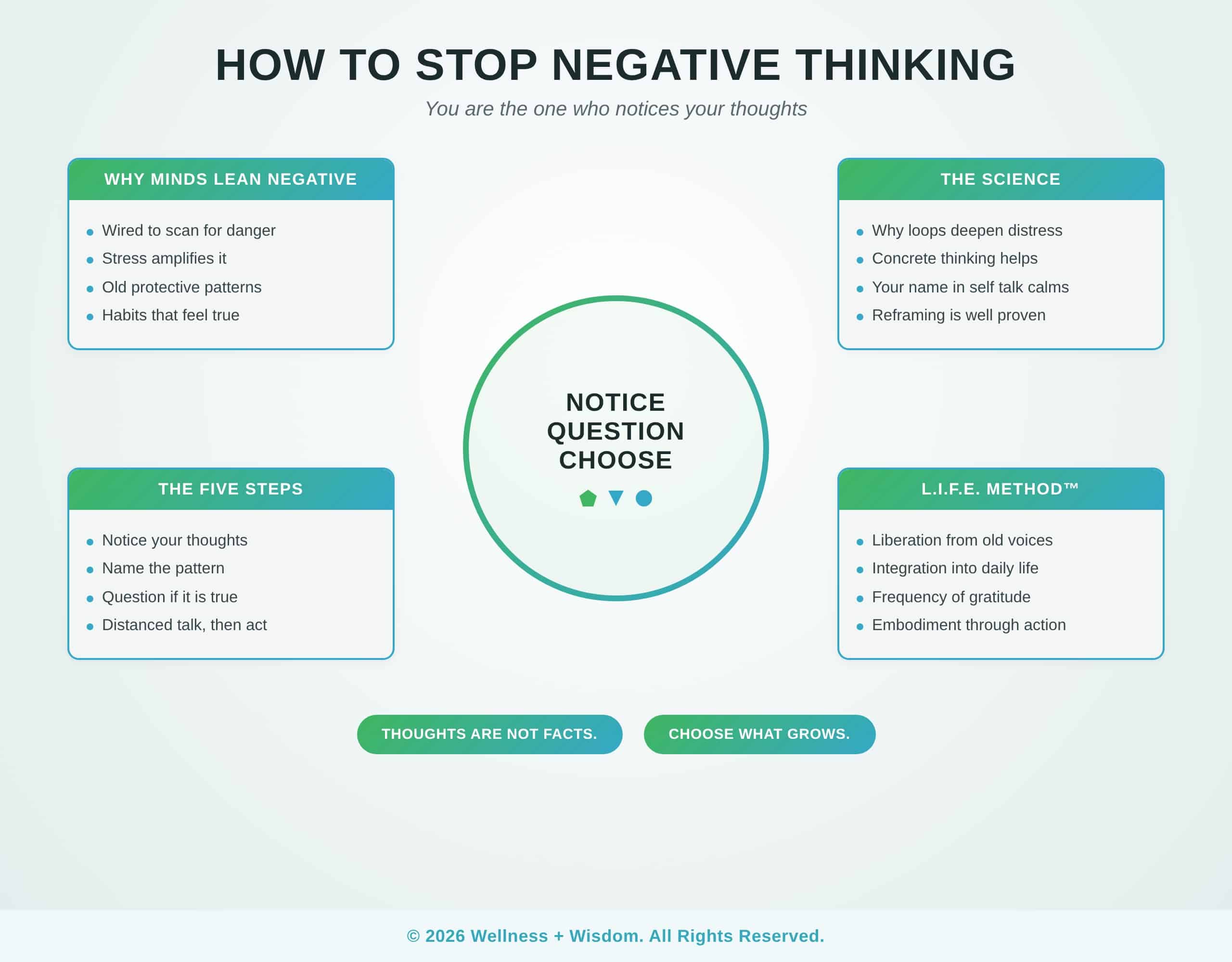
The mind leans negative because the human brain evolved to scan for danger, and noticing threats was more important for survival than noticing pleasant things. Our ancestors who paid close attention to possible dangers were more likely to survive. That protective tendency is still with us today, even when the threats we face are emails and deadlines rather than predators.
Stress amplifies this tendency. When you are tired, overwhelmed, or anxious, your brain becomes even more alert to problems and more likely to interpret situations negatively. That is why negative thoughts often feel louder late at night, after a hard day, or during difficult seasons of life. If this sounds familiar, the practices in how to calm an anxious mind can help.
Many of our negative thought patterns also began in childhood. If we grew up with criticism, high pressure, or unpredictability, we may have learned to expect the worst as a way to protect ourselves from disappointment. Over time, those protective thoughts became automatic. They are not character flaws. They are old survival strategies that once made sense. This connects deeply to the work of rewriting inherited limiting beliefs. Seeing this clearly replaces self judgment with compassion, which is where real change begins.
The Gift of a Clearer Mind
A clearer mind gives you more peace, better decisions, stronger relationships, and far more energy for the things you love. When negative thoughts lose their grip, you can see your life and yourself with more accuracy and compassion.
Think about how much energy negative thinking consumes. Replaying mistakes, worrying about the future, imagining what others think. These mental loops drain you, often without you even noticing. When you learn to step out of them, that energy becomes available for creativity, connection, and action. Many people describe feeling lighter, as if a weight they did not know they were carrying has been lifted.
A clearer mind also improves your relationships. When you stop assuming the worst about people, you become more open, generous, and curious. Conversations go better. Conflicts soften. You give others the benefit of the doubt, and they often return the favor. And here is the part I love most. When negative thinking quiets down, joy has room to grow. You start noticing the good things that were always there, the small kindnesses, the beauty, the progress you have made. That shift is beautifully supported by the practices in how to cultivate daily gratitude.
The Science of Thought Patterns
The science of thought patterns shows that abstract, repetitive dwelling on problems tends to deepen distress while concrete, specific thinking is more helpful, that talking to yourself from a distanced perspective reduces anxiety and improves performance, and that structured approaches to changing thoughts are strongly supported by research. Your thinking can genuinely be retrained.
Start with the difference between helpful and unhelpful thinking. In a major review published in Psychological Bulletin, Edward Watkins found that repetitive thinking is not always harmful. Abstract, evaluative thinking, like repeatedly asking “Why does this always happen to me?”, tends to deepen distress. More concrete, specific thinking, like asking “What exactly happened, and what is one step I can take?”, tends to be more constructive and helpful. The way you think about problems matters as much as what you think about.
Next, consider how you talk to yourself. In research published in the Journal of Personality and Social Psychology, Ethan Kross and colleagues found that when people used their own name or the word “you” in their self talk, rather than “I,” before a stressful task like giving a speech, they felt less anxious and ashamed, performed better, and saw the task more as a challenge than a threat. A small shift in language created psychological distance, which made difficult thoughts easier to manage.
Finally, consider the broader evidence. In a review of more than 250 meta analyses published in Cognitive Therapy and Research, Stefan Hofmann and colleagues found strong support for cognitive behavioral approaches, which teach people to notice and reframe unhelpful thoughts, across a range of challenges including anxiety and stress. Learning to work with your thoughts is one of the most well supported tools in modern psychology.
How to Stop Negative Thinking
You learn how to stop negative thinking by noticing your thoughts, naming the pattern, questioning whether the thought is true, using distanced self talk, and shifting from abstract worry to concrete action. These five steps help you step out of automatic loops and choose more helpful ways of thinking. Here is how I practice and teach them.
1. Notice Your Thoughts
The first step is simply noticing when a negative thought appears. Many of our thoughts run so automatically that we do not realize we are having them. Try pausing a few times a day to ask, “What am I thinking right now?” Writing your thoughts down can make them easier to see. Awareness alone creates a little space between you and the thought, which is the beginning of freedom. This is closely connected to the practices in how to practice mindfulness.
2. Name the Pattern
Once you notice a thought, see if you can name the pattern it follows. “That is catastrophizing.” “That is mind reading.” “That is all or nothing thinking.” Naming the pattern helps you see the thought as a habit of mind rather than a fact. It also makes the thought feel less personal and less powerful.
3. Question Whether It Is True
Ask yourself a few gentle questions. “Is this definitely true? What is the evidence for and against it? What would I tell a friend who had this thought? What is a more balanced way to see this?” You are not trying to force yourself to think positively. You are looking for a view that is more accurate and fair. Often, the truth is far kinder than the negative thought suggested.
4. Use Distanced Self Talk
When a negative thought feels strong, try talking to yourself using your own name or “you.” “Josh, you have handled hard things before. You can handle this too.” As the research shows, this simple shift creates psychological distance and makes it easier to respond with calm and wisdom. It is a practice that also helps quiet your inner critic.
5. Shift From Worry to Concrete Action
When you find yourself stuck in “why” questions, shift to “what” and “how” questions. Instead of “Why do I always fail?”, ask “What specifically went wrong, and what is one small thing I can do next?” Concrete thinking moves you out of the loop and into action, which often brings immediate relief. This is the same principle that helps people stop overthinking.
It can also help to set aside a specific time for worry. Choose fifteen minutes each day, perhaps in the late afternoon, as your dedicated worry time. When a negative thought shows up at other times, jot it down and tell yourself, “I will think about this later.” When your worry time arrives, look at the list and work through each item with the questions above. Many people find that by the time worry time comes, half the items no longer feel important. This practice contains negative thinking rather than letting it spill across your whole day, and it teaches your mind that you are in charge of when and how you think about difficult things.
Start with one of these steps today. Practice it gently and consistently. Your mind has been running its old patterns for a long time, so give yourself patience as it learns new ones. And if you would love support from a community walking the same path, the Liberated Life Tribe is a warm place to grow.
Realistic Thinking Versus Forced Positivity
Realistic thinking means seeing situations accurately and fairly, including both the challenges and the possibilities, while forced positivity means pretending everything is fine even when it is not. The goal of changing negative thinking is not to replace it with fake cheerfulness. It is to see more clearly.
Forced positivity can actually backfire. When we tell ourselves “Everything is great!” while feeling deeply worried, part of us knows it is not true. The gap between what we say and what we feel can create more tension, not less. It can also make us feel like we are failing at being positive, which adds another layer of self criticism.
Realistic thinking is different. It acknowledges difficulty while also recognizing strengths, resources, and possibilities. It sounds like, “This is a hard situation, and I have gotten through hard things before. Here is what I can do next.” It holds both truth and hope at the same time. This balanced approach is more believable, more sustainable, and far more helpful than either negativity or forced positivity. It also leaves room to honor your feelings, which is explored beautifully in how to feel your feelings.
How to Stop Negative Thinking With the L.I.F.E. Method™
The L.I.F.E. Method™ offers a complete framework for transforming negative thinking through four pillars: Liberation, Integration, Frequency, and Embodiment. Each pillar addresses a different layer of how thoughts shape our lives, and together they help new ways of thinking take root.
Liberation means freeing yourself from old stories and beliefs that drive negative thinking. Many of our harshest thoughts echo things we heard or absorbed long ago. Recognizing these inherited voices and gently releasing them creates space for new, more truthful beliefs.
Integration means weaving new thinking habits into your daily life. Short check ins, a few minutes of journaling, or a reframing practice after difficult moments help new patterns become part of your routine rather than occasional exercises.
Frequency is about the emotional energy that fuels your thoughts. When you cultivate gratitude, compassion, and joy, your mind naturally becomes more balanced. Negative thinking thrives in stress and depletion, while helpful thinking flourishes in a calmer, more nourished state.
Embodiment means bringing your new way of thinking into your body and actions. Thoughts are reinforced by what we do. Taking small, positive actions in line with your new beliefs, and noticing how your body feels as you do, helps those beliefs settle deeply. This connection between mind and body is explored in the biology of belief.
Celebrating Mental Shifts
Celebrating every mental shift helps reinforce new patterns of thinking. Your brain learns through reward, so when you notice and appreciate a moment when you caught a negative thought and chose a more helpful one, you make that shift easier next time.
Pay attention to the small wins. Maybe you caught yourself catastrophizing and paused. Maybe you questioned a harsh thought and found a kinder perspective. Maybe you shifted from worry to action. These moments matter. Take a breath and acknowledge them: “I noticed that, and I chose differently.” Over time, these small victories add up to a genuinely different relationship with your mind.
Keeping a simple journal of these shifts can be powerful. At the end of each day, write down one negative thought you noticed and the more balanced thought you replaced it with. Over weeks, you will see clear evidence of your growth. There is a whole practice around this in celebrating small wins, and it pairs beautifully with this work.
A Clearer Mind Is a Lifelong Practice
Building a clearer mind is a lifelong practice, because new challenges will keep triggering old patterns from time to time. Negative thoughts will never disappear completely, and they do not need to. What changes is how quickly you notice them, how gently you respond, and how much power you give them.
Pay attention to what you feed your mind as well. The news you consume, the social media you scroll, the conversations you have, and the people you spend time with all influence your thoughts. Constant exposure to alarming headlines or critical voices can quietly strengthen negative patterns. Choosing uplifting books, meaningful conversations, inspiring podcasts, and time in nature gives your mind healthier material to work with. You do not need to ignore reality, but you can be intentional about the inputs that shape your inner world, as explored in reclaiming your inner signal in the age of distraction, a gentle and practical guide to protecting your attention.
Some seasons will feel lighter, and your mind will feel calm and balanced. Other seasons, during stress, loss, or major change, negative thinking may return with more intensity. That is completely normal. When it happens, return to your practices with patience. Notice, name, question, and redirect. Each return strengthens your ability to recover.
This is also where the Wellness Pentagon™ becomes helpful. Negative thinking is often louder when other parts of life are depleted. Poor sleep, lack of movement, isolation, financial stress, and spiritual disconnection all make the mind more vulnerable to negativity. Caring for every dimension of your wellbeing, including your Connection to Creator and God, gives your mind a steadier foundation. Many people find that prayer, gratitude, and stillness are powerful antidotes to repetitive negative thoughts. You will find many guests sharing how they transformed their inner dialogue across our latest episodes.
When Negative Thoughts Feel Overwhelming
If negative thoughts feel overwhelming right now, you are in very good company, and it is completely understandable. Learning how to stop negative thinking does not mean every thought will suddenly become positive. It means you will gently build new patterns, a little at a time, at a pace that honors where you are.
When negative thoughts feel relentless, start with the smallest possible step. One slow breath. One thought written down and questioned. One sentence of kind self talk. Getting outside, moving your body, or talking with someone you trust can also interrupt negative loops. Gentle practices that calm your neural system, like slow breathing with BREATHE™, can quiet the mind too. Supportive tools like a thought journal or a breath training device can help, and you can find a few we trust in our wellness tools store.
It is also important to know that persistent negative thinking, especially when combined with ongoing sadness, hopelessness, anxiety, or difficulty functioning, can be a sign of depression or an anxiety condition that deserves professional care. A qualified therapist, particularly one trained in cognitive behavioral approaches, can offer effective, compassionate support. There is real strength in asking for help. Wherever you are, be patient and kind with yourself, and trust that learning how to stop negative thinking is something you can absolutely grow, one thought at a time. If your mind feels especially noisy, the practices in how to quiet the noise in your mind are a gentle next step.
Ready to go deeper? Join the Liberated Life Tribe and receive your 10 day Self Liberation Blueprint at liberatedlife.com. It is free, it is guided, and each day offers a simple practice that helps you build a clearer, kinder mind.
Frequently Asked Questions
How can I stop negative thoughts quickly?
Notice the thought, name the pattern, and ask whether it is definitely true. Try speaking to yourself using your own name or “you,” which research shows reduces anxiety. Then shift to one concrete next step. A few slow breaths can also calm your body and make thoughts easier to manage.
Why does my mind always go to the worst case scenario?
The human brain evolved to scan for danger, so it naturally leans toward noticing threats. Stress, fatigue, and past experiences can strengthen this tendency. Recognizing catastrophizing as a learned pattern rather than a prediction helps you respond with more balance.
Is positive thinking the answer to negative thinking?
Not exactly. Forced positivity can backfire if it does not feel true. The goal is realistic, balanced thinking that acknowledges challenges while also recognizing strengths and possibilities. This approach is more believable and more helpful over time.
What is rumination?
Rumination is repeatedly dwelling on problems, mistakes, or negative feelings, often by asking abstract questions like “Why does this always happen?” Research shows this kind of thinking tends to deepen distress, while concrete thinking about specific next steps is more helpful.
Does talking to yourself in the third person really help?
Research suggests it can. Studies by Ethan Kross found that using your own name or “you” in self talk before a stressful task reduced anxiety and shame and improved performance. The shift creates psychological distance, making difficult thoughts easier to handle.
When should I get help for negative thinking?
If negative thoughts are persistent and come with ongoing sadness, hopelessness, anxiety, or difficulty functioning, reach out to a qualified therapist. Cognitive behavioral approaches have strong research support. Asking for help is a sign of strength.
Studies and External Resources
The science in this article rests on peer reviewed research. These are the sources referenced throughout.
- Watkins ER. (2008). Constructive and unconstructive repetitive thought. Psychological Bulletin. PubMed: 18298268
- Kross E, et al. (2014). Self talk as a regulatory mechanism: how you do it matters. Journal of Personality and Social Psychology. PubMed: 24467424
- Hofmann SG, et al. (2012). The Efficacy of Cognitive Behavioral Therapy: A Review of Meta analyses. Cognitive Therapy and Research. PubMed: 23459093
About Josh Trent
Josh Trent is an Identity Transformation Architect and the award winning host of the Wellness + Wisdom Podcast, with over 15 million downloads since 2015. He is the creator of the L.I.F.E. Method™ Identity Transformation System and steward of the Emotional Epigenetics™ and BREATHE: Breath + Wellness™ systems of self mastery, impacting over 1,000 students worldwide. Join the Liberated Life Tribe and receive your 10 day Self Liberation Blueprint at liberatedlife.com. Josh lives in Austin, Texas with his wife Carrie, daughter Nayah, and son Novah. Peace and power.
Disclosure: We may earn a commission from certain links on this site when you make a purchase, at no extra cost to you. These commissions help support Wellness + Wisdom and do not affect the products or resources we choose to recommend. Full disclosure .