By Josh Trent | Wellness + Wisdom Podcast Host & Identity Transformation Architect
“Generosity is not about how much you have. It is about how open your hand is. The more freely we give, the more alive we feel.”
Josh Trent
Learning how to practice generosity is one of the most joyful ways to transform your relationship with money, with people, and with life itself. In a culture that often tells us happiness comes from getting more, generosity offers a beautiful surprise: real joy often comes from giving. A meal for a neighbor, a gift to a cause you believe in, an hour of your time for a friend in need, a word of encouragement to a stranger. These acts ripple outward, lifting others and lifting us too. Generosity is not reserved for the wealthy. It is a way of living that anyone can practice, starting today, with whatever they have. It is also a beautiful expression of the financial dimension of the Wellness Pentagon™, where money becomes a tool for meaning rather than a source of fear.
Here is the joy forward truth at the center of it all. Generosity is one of the most reliable paths to happiness that science has found. When you give, your brain lights up with reward, your sense of purpose grows, and your relationships deepen. Let us explore exactly how to make generosity a natural part of your life.
Table of Contents
- What Generosity Really Is
- Why Generosity Matters
- The Gift That Comes Back to the Giver
- The Science of Generosity
- How to Practice Generosity
- Generosity Versus Overgiving
- How to Practice Generosity With the Wellness Pentagon™
- Celebrating the Joy of Giving
- Building a Generous Life Over Time
- When Giving Feels Hard
- Frequently Asked Questions
- Studies and External Resources
- About Josh Trent
What Generosity Really Is
Generosity is the willingness to freely share your time, money, attention, skills, and kindness with others, without expecting anything in return. It is an attitude of openness that shows up in both big gifts and small everyday acts.
Generosity takes many forms. Financial generosity includes donating to causes, supporting your church or community, helping a friend in need, or giving thoughtful gifts. Time generosity means volunteering, showing up for someone who is struggling, or simply giving your full attention in conversation. Generosity of spirit includes offering encouragement, assuming the best about others, forgiving quickly, and celebrating other people's success. Each form matters, and each brings its own kind of joy.
Generosity is also a mindset. It flows from a sense of sufficiency rather than scarcity, a belief that there is enough to share. That mindset does not depend on how much money you have. Some of the most generous people in the world have very little, and some wealthy people struggle to give. Generosity grows from the heart. These themes come up often on the Wellness + Wisdom Podcast, where guests share how giving changed their lives.
It helps to remember that generosity is a practice, not a personality trait. Some people seem naturally generous, but most of us grow into generosity through small, repeated choices. Every time you share, you strengthen the habit. Learning how to practice generosity is less about one grand gesture and more about building a daily rhythm of openness. Over time, giving stops feeling like a sacrifice and starts feeling like a natural expression of who you are.
Why Generosity Matters
Generosity matters because it strengthens communities, deepens relationships, gives life meaning, and consistently boosts the happiness of the giver. It is one of the few things that benefits everyone involved.
When you give, you create connection. A gift, a helping hand, or a kind word builds trust and goodwill between people. Communities with more generosity tend to be more resilient, because people support one another in hard times. Families where generosity is modeled raise children who care about others. And on a personal level, generosity shifts your focus away from your own worries and toward the needs and joys of others, which can be a powerful antidote to anxiety and loneliness.
Generosity also transforms your relationship with money. Many people carry a sense of scarcity around finances, a fear that there will never be enough. Practicing generosity, even in small amounts, can loosen that fear and replace it with a sense of abundance and purpose. Money becomes something you steward with intention rather than something that controls you. If money stress is weighing on you, the ideas in how to improve your money mindset are a helpful companion.
The Gift That Comes Back to the Giver
The gift that comes back to the giver is joy, meaning, and connection, often in greater measure than what was given. Generosity has a remarkable way of enriching the person who practices it.
Many people describe a warm glow after giving, a feeling of happiness and lightness that lingers. That feeling is real, and it is supported by research. Giving also builds a sense of purpose. When you know your time or money is making a difference in someone's life, your own life feels more meaningful. That sense of meaning can be especially powerful in seasons when work or other areas of life feel unfulfilling.
Generosity also strengthens relationships. People feel closer to those who are generous with them, and givers often feel closer to those they help. Over time, a generous life becomes a connected life, full of mutual care and support. The ideas in how to celebrate the people you love show how small acts of generosity toward those closest to us can deepen every relationship.
The Science of Generosity
The science of generosity shows that spending money on others can increase happiness more than spending on yourself, that this effect appears across many cultures, that giving activates reward regions in the brain, and that even the intention to be generous is linked with greater happiness. Giving is good for the giver.
Start with the classic study. In research published in Science, Elizabeth Dunn, Lara Aknin, and Michael Norton found that people who spent money on others reported greater happiness than those who spent the same amount on themselves. In one experiment, participants received an envelope of money and were randomly assigned to spend it on themselves or on someone else. Those who spent it on others reported feeling happier by the end of the day.
This effect appears to be widespread. In a study published in the Journal of Personality and Social Psychology, Lara Aknin and colleagues analyzed data from more than 130 countries and found that prosocial spending, meaning spending money on others or donating to charity, was associated with greater wellbeing in rich and poor countries alike. They described the emotional reward of giving as a possible psychological universal.
Brain research adds another layer. In a study published in Science, William Harbaugh and colleagues found that both voluntary giving and even mandatory, tax like transfers to a charity activated reward related regions of the brain, with voluntary giving showing a stronger response. And in a study published in Nature Communications, Soyoung Park and colleagues found that people who simply committed to being generous made more generous choices and reported greater happiness, with brain activity linking generosity to happiness. Generosity feels good, and science helps explain why.
How to Practice Generosity
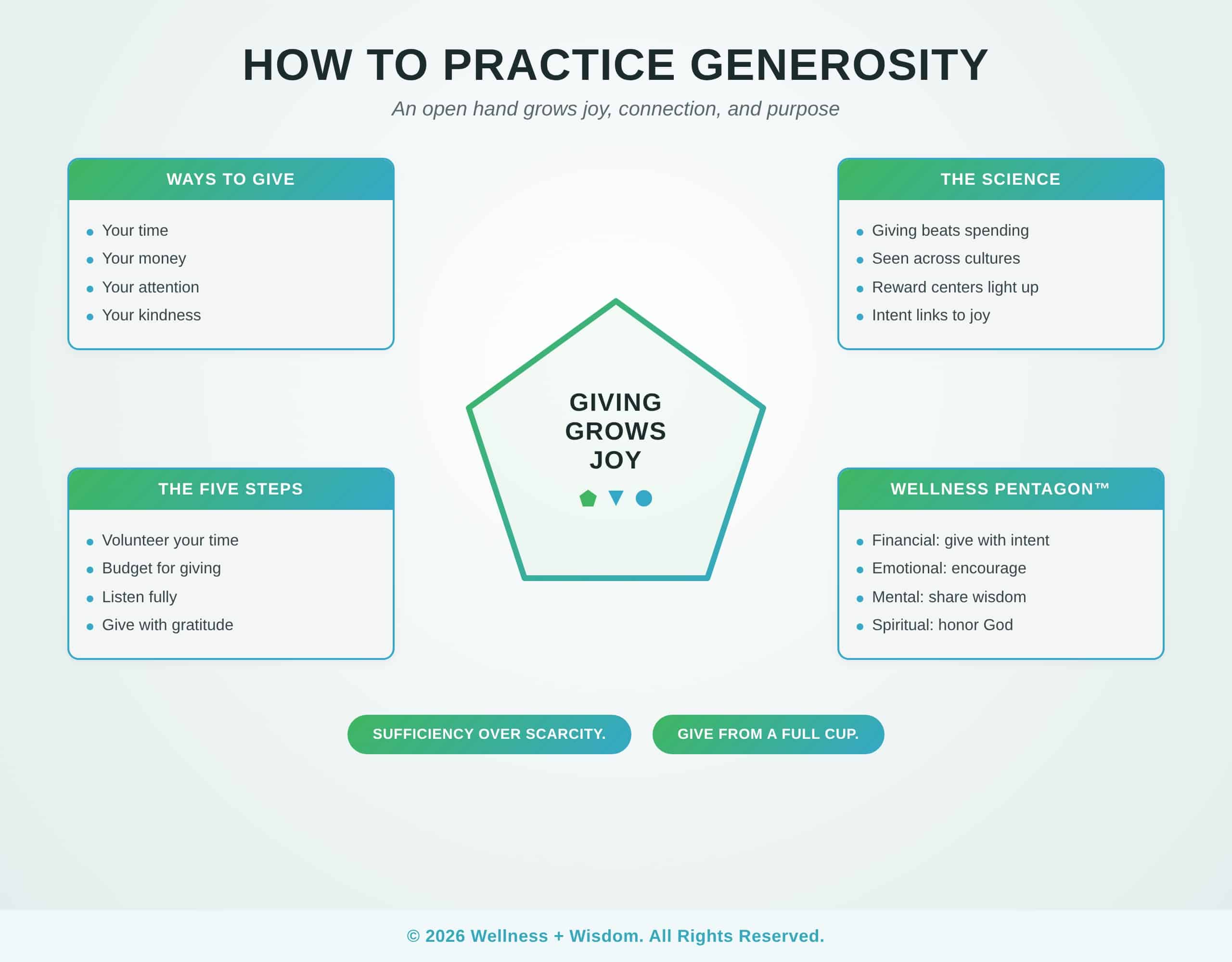
You learn how to practice generosity by giving your time, setting aside money to give, offering your full attention, practicing everyday kindness, and giving with gratitude rather than obligation. These five practices make generosity a natural and joyful part of life. Here is how I practice and teach them.
1. Give Your Time
Time is one of the most precious gifts you can offer. Volunteer at a local organization, mentor someone younger in your field, help a neighbor with a project, or visit someone who is lonely. Even an hour a month can make a real difference. Giving time often creates the deepest connections, because it involves showing up in person. If you have been feeling isolated yourself, serving others is also a beautiful way to connect, as explored in how to overcome loneliness.
2. Set Aside Money to Give
Make financial generosity intentional by building it into your budget. Many people choose a percentage of their income to give, whether through tithing, donations to causes they care about, or a fund for helping friends and family in need. Start with an amount that feels comfortable and grow it over time. Having a giving fund ready makes it easy and joyful to respond when a need arises. The ideas in money and wellness can help you build a healthy financial foundation for giving.
3. Offer Your Full Attention
In a distracted world, undivided attention is a rare and generous gift. When someone is talking to you, put your phone away, make eye contact, and truly listen. Ask questions. Remember details and follow up later. People feel deeply valued when they are fully heard. The practices in how to be a better listener can help.
4. Practice Everyday Kindness
Generosity lives in small moments too. Hold the door, let someone go ahead of you in line, pay for a stranger's coffee, leave a generous tip, write a thank you note, or send an encouraging text. These everyday acts take little time or money but brighten someone's day and train your heart toward giving.
5. Give With Gratitude
Give from a place of gratitude rather than guilt or obligation. Before you give, pause and reflect on what you have received: the people, opportunities, and blessings in your life. When giving flows from gratitude, it feels joyful and free. The ideas in how to practice gratitude are a natural partner to generosity.
Start with one or two of these practices this week. Generosity grows like a muscle, becoming stronger and more natural with use. And if you would love a supportive community on your journey, the Liberated Life Tribe is a warm place to begin.
If you are wondering how to practice generosity in a busy week, try a simple seven day challenge. On day one, send a heartfelt thank you message. On day two, buy coffee or lunch for a coworker. On day three, give an hour to someone who needs help. On day four, donate to a cause you care about. On day five, offer your full, undistracted attention in every conversation. On day six, leave an encouraging note for a family member. On day seven, reflect in your journal on how the week felt. Many people are surprised by how much joy a single week of intentional giving brings.
Generosity can also be woven into your finances in practical ways. Set up an automatic monthly donation so giving happens without needing to remember. Keep a small amount of cash or a gift card on hand for spontaneous kindness. Review your giving once a year, alongside your budget, to see where your money is going and whether it reflects your values. Small systems like these make generosity effortless and consistent. If you want to explore the deeper connection between money and wellbeing, financial wellness and stress offers a helpful perspective.
Generosity Versus Overgiving
Generosity and overgiving can look similar, but they come from very different places. Generosity flows freely from a sense of sufficiency and joy. Overgiving comes from fear, guilt, or a need for approval, and it often leads to resentment and exhaustion. Healthy generosity includes boundaries.
Overgiving might look like saying yes to every request even when you are depleted, giving money you cannot afford to give, or helping others while neglecting your own needs. It is often driven by people pleasing or a belief that your worth depends on what you do for others. Over time, overgiving drains your energy and finances and can even damage relationships, because it is not truly free.
True generosity is sustainable. It respects your own limits and needs, and it is offered freely, without strings attached. A good test is how you feel after giving. Generosity usually leaves you feeling lighter and more joyful. Overgiving leaves you feeling drained, anxious, or resentful. If you recognize patterns of overgiving, the ideas in how to stop people pleasing and how to set healthy boundaries can help you give from a healthier place.
Receiving well is part of generosity too. Many generous people struggle to accept help, compliments, or gifts. Yet when you receive graciously, you give others the joy of giving. A simple “thank you, that means a lot to me” honors the giver and keeps the circle of generosity flowing. Practice letting people bless you, just as you love to bless them. The ideas in how to receive love explore this beautifully.
How to Practice Generosity With the Wellness Pentagon™
The Wellness Pentagon™ offers a meaningful framework for generosity, because giving touches every dimension of wellbeing: physical, mental, emotional, spiritual, and financial. When you practice generosity across all five, it becomes a way of life rather than an occasional act.
In the financial dimension, generosity means stewarding money with intention, setting aside a portion to give, and seeing money as a tool for good. In the emotional dimension, it means sharing encouragement, patience, and forgiveness. In the mental dimension, it means sharing knowledge, wisdom, and skills to help others grow. In the physical dimension, it can mean helping with practical tasks, cooking for someone, or volunteering hands on.
In the spiritual dimension, generosity is often an expression of faith and gratitude. Many traditions teach that everything we have is a gift, and that giving is a way of honoring our Connection to Creator and God. When generosity flows from that place, it becomes an act of worship and trust. If you want to deepen this dimension, the ideas in how to build a spiritual practice are a beautiful companion. To go deeper with identity level change, explore our L.I.F.E. Method™ programs.
Generosity also shapes the next generation. Children learn how to practice generosity by watching the adults around them. When Nayah and Novah see Carrie and me give, whether it is time, money, or kindness, they learn that giving is a normal and joyful part of family life. Involve your children in choosing a cause, let them help prepare a meal for a neighbor, or invite them to donate a portion of their allowance. These experiences plant seeds of generosity that can grow for a lifetime.
Celebrating the Joy of Giving
Celebrating the joy of giving helps generosity become a lasting habit. When you notice and savor the good feelings that come from giving, you reinforce the behavior and make it more likely you will give again.
After you give, take a moment to notice how you feel. Do you feel warmer, lighter, more connected? Write it down in a journal. Share stories of generosity with your family, especially your children, so they learn that giving is a joyful part of life. Celebrate the impact of your giving, too, by learning how your donations or volunteer time made a difference.
You can also celebrate generosity in others. Notice when friends, family, or colleagues give generously, and thank them. Generosity is contagious, and celebrating it helps spread it. There is a whole practice around noticing these moments in celebrating small wins, and the joy of giving is one of the best things to celebrate.
Building a Generous Life Over Time
Building a generous life over time means letting giving grow with you, from small daily acts to larger commitments, as your capacity and sense of purpose expand. A generous life is built gradually, one open handed choice at a time.
Many people start small, with a few acts of kindness each week or a modest monthly donation. Over time, as giving becomes a habit and they experience its joy, they naturally look for ways to give more. Some increase their giving percentage each year. Others find a cause they are passionate about and commit to it deeply. Some families create giving traditions, like choosing a charity together each holiday season or serving a meal at a shelter.
A generous life also tends to be a joyful life. As you give, you may find your own worries shrinking, your gratitude growing, and your relationships deepening. Generosity becomes not just something you do, but part of who you are. The ideas in how to cultivate joy explore how these practices build a happier life. You will find many guests sharing their own stories of giving across our latest episodes.
Generosity can also shape your work. Share credit freely with teammates, mentor newer colleagues, and offer help without being asked. Workplaces where people give generously tend to build trust, creativity, and loyalty. When generosity becomes part of how you work, your career often becomes more meaningful and more joyful, too.
When Giving Feels Hard
If giving feels hard right now, you are not alone, and it is completely understandable. Financial pressure, exhaustion, or past experiences of being taken advantage of can all make generosity feel difficult. Learning how to practice generosity includes honoring where you are and starting with what feels possible.
If money is tight, remember that generosity is not only financial. You can give time, attention, encouragement, and kindness, all of which are deeply valuable. If you are exhausted, generosity toward yourself, through rest and care, may be the most important gift right now. You cannot pour from an empty cup. Simple supportive tools, like a giving journal or a gratitude practice, can help you reconnect with the joy of giving, and you can find a few we trust in our wellness tools store.
If you are facing serious financial stress, it is wise to focus on stabilizing your own situation first. That might include creating a budget, reducing debt, or speaking with a qualified financial advisor. Taking care of your foundation is not selfish. It is what makes long term generosity possible. If financial stress is weighing on you, the practices in how to manage financial stress are a gentle next step.
Ready to go deeper? Join the Liberated Life Tribe and receive your 10 day Self Liberation Blueprint at liberatedlife.com. It is free, it is guided, and each day offers a gentle practice to help you live with more openness, gratitude, and joy.
Frequently Asked Questions
Does giving really make you happier?
Research suggests it does. Studies have found that spending money on others boosts happiness more than spending on yourself, and that this link between giving and wellbeing appears across many countries and cultures.
How can I be generous if I do not have much money?
Generosity is not only financial. You can give your time, attention, skills, encouragement, and kindness. Small acts, like listening fully, helping a neighbor, or writing a thank you note, are generous and meaningful.
How much money should I give away?
There is no single right amount. Many people choose a percentage of income, such as tithing ten percent, while others start smaller and grow over time. Give an amount that feels joyful and sustainable for your situation.
What is the difference between generosity and people pleasing?
Generosity is offered freely from a sense of sufficiency and joy. People pleasing comes from fear, guilt, or a need for approval and often leads to resentment and exhaustion. Healthy generosity includes boundaries.
How can I teach my children to be generous?
Model generosity in your own life, involve your children in giving decisions, volunteer together, and talk about how giving feels. Celebrate their generous acts specifically so they connect giving with joy.
Why does giving feel good in the brain?
Brain imaging research has found that giving activates reward related regions of the brain. Studies also link the intention to be generous with greater happiness, suggesting our brains are wired to find giving rewarding.
Studies and External Resources
The science in this article rests on peer reviewed research. These are the sources referenced throughout.
- Dunn EW, Aknin LB, Norton MI. (2008). Spending money on others promotes happiness. Science. PubMed: 18356530
- Aknin LB, et al. (2013). Prosocial spending and well being: cross cultural evidence for a psychological universal. Journal of Personality and Social Psychology. PubMed: 23421360
- Harbaugh WT, Mayr U, Burghart DR. (2007). Neural responses to taxation and voluntary giving reveal motives for charitable donations. Science. PubMed: 17569866
- Park SQ, et al. (2017). A neural link between generosity and happiness. Nature Communications. PubMed: 28696410
About Josh Trent
Josh Trent is an Identity Transformation Architect and the award winning host of the Wellness + Wisdom Podcast, with over 15 million downloads since 2015. He is the creator of the L.I.F.E. Method™ Identity Transformation System and steward of the Emotional Epigenetics™ and BREATHE: Breath + Wellness™ systems of self mastery, impacting over 1,000 students worldwide. Join the Liberated Life Tribe and receive your 10 day Self Liberation Blueprint at liberatedlife.com. Josh lives in Austin, Texas with his wife Carrie, daughter Nayah, and son Novah. Peace and power.
Disclosure: We may earn a commission from certain links on this site when you make a purchase, at no extra cost to you. These commissions help support Wellness + Wisdom and do not affect the products or resources we choose to recommend. Full disclosure .