
By Josh Trent | Wellness + Wisdom Podcast Host & Identity Transformation Architect
“Music is medicine you can carry in your pocket. One song can change your breath, your mood, and the direction of your whole day.”
Josh Trent
Learning how to use music for stress relief is one of the most enjoyable wellness practices you will ever adopt. Think about the last time a song gave you chills, made you want to dance in the kitchen, or helped you breathe easier after a long day. Music moves us in ways few other things can. It shifts our emotions in seconds, brings back memories, connects us with other people, and can help the body move from tension toward calm. And unlike many wellness tools, music is free, always available, and genuinely fun. In my own life, music is part of how I reset between podcast recordings, wind down at night, and fill our home with joy. It also pairs beautifully with breathwork, which is why this article connects so naturally to BREATHE™.
Here is the joy forward truth at the center of it all. You already have a powerful stress relief tool in your pocket. With a little intention, the music you love can become a daily ritual that calms your neural system and lifts your spirit. Let us explore what the science says and exactly how to begin.
Table of Contents
- What Music Does for Stress
- Why Music Moves Us So Deeply
- The Gift of a Musical Life
- The Science of Music and Stress
- How to Use Music for Stress Relief
- Active Listening Versus Background Noise
- How to Use Music for Stress Relief With BREATHE™
- Celebrating Music in Everyday Life
- Building a Daily Music Ritual
- When Stress Feels Bigger Than a Song
- Frequently Asked Questions
- Studies and External Resources
- About Josh Trent
What Music Does for Stress
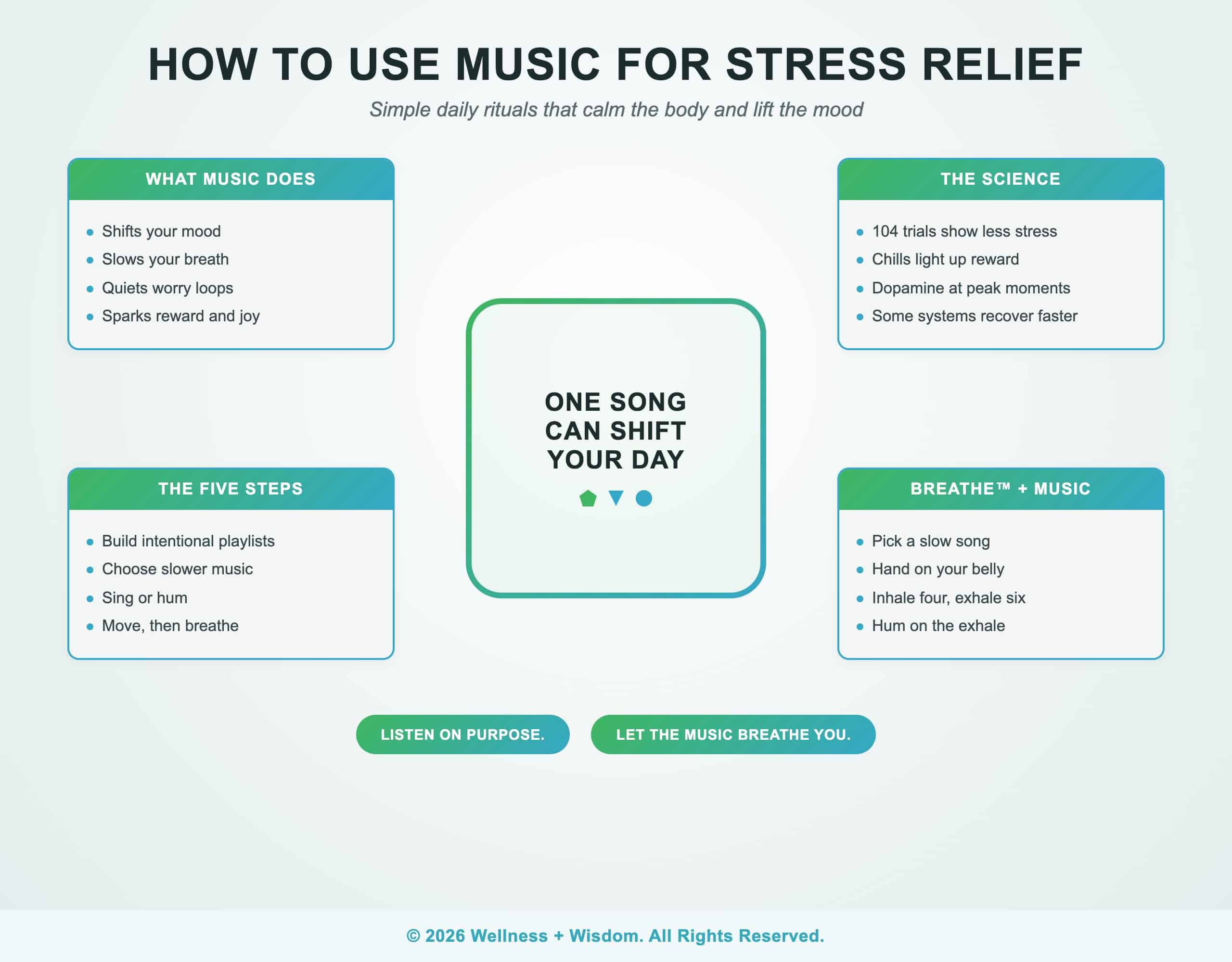
Music can reduce stress by shifting your emotional state, influencing physical signals like heart rate and breathing, redirecting your attention away from worry, and activating reward pathways in the brain. It works on the body and the mind at the same time.
When you listen to slow, calming music, your breathing may naturally slow down to match the rhythm, and your body can begin to relax. When you listen to uplifting music, your mood can rise and your energy can return. Music also gives your mind something pleasant to focus on, which can interrupt the loop of anxious thoughts. And when you sing, hum, or play an instrument, you add the benefits of active engagement and, often, slower and deeper breathing.
Music is also deeply personal. The song that calms one person may irritate another. Part of using music well is discovering what works for your own body and mind. These themes come up often on the Wellness + Wisdom Podcast, where guests share the simple daily practices that help them feel grounded and alive.
It also helps to know that music does not have to be slow or quiet to help with stress. Sometimes the most effective stress relief is an upbeat song that gets you moving, laughing, or singing at the top of your lungs. Movement and joy release tension too. The key is matching the music to what your body needs in the moment: calm when you are wound up, energy when you are drained, and comfort when you are sad.
Why Music Moves Us So Deeply
Music moves us so deeply because it engages many brain systems at once, including those involved in emotion, memory, movement, and reward. A favorite song can light up parts of the brain linked to pleasure and motivation, which is why it can feel so good.
Music is also woven into our memories and relationships. A song can transport you back to a summer road trip, your wedding day, or your grandmother's kitchen in an instant. Those associations carry emotional weight, which is why certain songs can comfort us so quickly. Music connects us to who we are and where we come from.
Across every culture in history, people have used music to celebrate, mourn, worship, work, and heal. Lullabies calm babies. Work songs lighten labor. Hymns and worship music bring people together in faith. This deep human history suggests that music is not just entertainment. It is one of the oldest tools we have for regulating emotion and building connection. If you are curious about the healing power of sound more broadly, the ideas in sound frequency healing offer another perspective.
Your musical memories can be a resource too. Think about songs from times in your life when you felt safe, happy, and loved. Those songs can carry those feelings forward. Building a playlist of comfort songs from your own history gives you a quick way to reconnect with those emotions when stress rises. Many people find that music from their teenage years or early adulthood has an especially strong emotional pull.
The Gift of a Musical Life
The gift of a musical life is more joy, more calm, and more connection, woven into ordinary days. When music becomes an intentional part of your routine, it can lift your mood, soften stress, and help you feel more like yourself.
A musical life does not require talent or training. It simply means noticing how music affects you and using it on purpose. A calm playlist on the morning commute. A dance party with the kids after dinner. Singing in the shower. Worship music on Sunday. A favorite album during a long walk. These moments add up to a life with more beauty and less tension.
Music also brings people together. Singing in a choir, playing in a band, going to concerts, or simply sharing songs with friends creates powerful bonds. Shared music can make us feel part of something bigger than ourselves. If you have been feeling disconnected, music can be a joyful bridge back to others, as explored in how to make friends as an adult.
The Science of Music and Stress
The science of music and stress shows that music interventions reduce both physiological and psychological stress, that intensely pleasurable music activates the brain's reward regions and releases dopamine, and that listening to music can help some stress systems recover faster. Music is a real and measurable tool for wellbeing.
Start with the big picture. In two meta analyses published in Health Psychology Review, Martina de Witte and colleagues analyzed 104 randomized controlled trials with more than 9,600 participants. They found that music interventions had a significant effect on reducing stress, both in physiological measures like heart rate, blood pressure, and hormone levels, and in psychological measures like anxiety and restlessness. Music works on body and mind together.
Pleasure is part of the story. In a study published in the Proceedings of the National Academy of Sciences, Anne Blood and Robert Zatorre found that when people listened to music that gave them chills, brain regions involved in reward and emotion became more active. Building on this, Valorie Salimpoor and colleagues, writing in Nature Neuroscience, found that listening to intensely pleasurable music released dopamine in the brain's reward system, both while anticipating a favorite moment in a song and when that moment arrived.
The stress response itself can shift too. In a study published in PLoS One, Myriam Thoma and colleagues gave healthy women relaxing music, the sound of rippling water, or silence before a standardized stress test. Those who heard relaxing music returned to baseline faster on one autonomic stress marker after the test, although other measures, like cortisol, did not follow the same pattern. The honest picture is that music helps, and its effects vary across different stress systems and situations.
How to Use Music for Stress Relief
You learn how to use music for stress relief by creating intentional playlists, choosing slower music to calm down, singing or humming, moving to music, and pairing music with slow breathing. These five practices turn music into a reliable daily tool. Here is how I practice and teach them.
1. Create Intentional Playlists
Build a few playlists for different needs. A calm playlist for winding down. An uplifting playlist for low energy days. A focus playlist for work. A comfort playlist for hard moments. When stress hits, you will not have to search. You can simply press play. Choose songs that you personally find soothing or energizing, since the research suggests personal preference matters.
2. Choose Slower Music to Calm Down
When you want to relax, try music with a slower tempo, gentle melodies, and fewer sudden changes. Many people find instrumental music, soft acoustic songs, or classical pieces especially calming. Notice how your breathing and heart rate respond. Over time, you will learn which songs help your body settle. The practices in how to calm an anxious mind pair well with a calm playlist.
3. Sing or Hum
Singing and humming are wonderful stress relievers. They naturally lengthen your exhale, which helps calm the body. They also engage you actively, which pulls your attention away from worry. Sing in the car, hum while cooking, or join a choir. You do not need to sound good. You only need to enjoy it.
4. Move to Music
Put on an upbeat song and move. Dance in the living room, take a brisk walk with headphones, or stretch to a gentle playlist. Movement helps release tension stored in the body, and music makes movement more enjoyable. Even one song's worth of dancing can shift your mood. The ideas in how to boost your energy naturally go deeper on movement and energy.
5. Pair Music With Slow Breathing
Choose a slow, calming song and breathe along with it. Inhale gently for a few counts and exhale a little longer. Let the music set the pace. Pairing music with breath can deepen relaxation and make breathwork feel easier and more enjoyable. You will find more on this in the BREATHE™ section below.
Start with one or two of these practices this week. Notice what helps you most and build from there. If you would love a supportive community on your wellness journey, the Liberated Life Tribe is a warm place to begin.
Here is a simple daily rhythm if you are wondering how to use music for stress relief on a busy schedule. In the morning, play one uplifting song while you get ready. Midday, take a five minute music break with a calming song and a few slow breaths. After work, play a transition song in the car or on your walk home to mark the end of the workday. In the evening, put on a soft playlist as you wind down. Four small moments, a few minutes each, can change the emotional tone of your entire day.
Active Listening Versus Background Noise
Active listening and background noise are very different experiences. Active listening means giving music your full attention, noticing how it makes you feel, and letting it move you. Background noise means music plays while your mind is elsewhere. Both have their place, but active listening tends to bring deeper stress relief.
Many of us have music on all day without really hearing it. It fills the silence while we work, scroll, or drive. That can be pleasant, but it often does not provide the same calming benefit as intentional listening. When you stop and truly listen, closing your eyes, noticing the instruments, feeling the rhythm, and letting emotions rise, music becomes a form of mindfulness. The practices in how to come back to the present pair beautifully with active listening.
Try setting aside a few minutes each day for active listening. Choose one song. Sit or lie down comfortably. Close your eyes and listen as if you are hearing it for the first time. Notice where you feel the music in your body. When your mind wanders, gently bring it back to the sound. This simple practice can feel like a mini vacation for your mind.
Nature sounds are another option worth exploring. In the same study by Thoma and colleagues, the sound of rippling water was also tested, and many people find birdsong, rain, or ocean waves deeply calming. If music with melodies feels too stimulating at times, nature sounds can offer a gentle alternative. You might even combine the two by listening to soft instrumental music outdoors on a walk.
Playing an instrument offers its own unique benefits. Learning to play, even simply, engages your attention fully and can bring a deep sense of flow and accomplishment. If you played an instrument as a child, consider picking it up again. If you never have, it is never too late to begin. A ukulele, a hand drum, or a simple keyboard can become a joyful daily practice that melts stress away.
How to Use Music for Stress Relief With BREATHE™
BREATHE™ and music make a powerful partnership, because both directly influence your neural system. Music can set a calming rhythm, and slow breathing can deepen the relaxation response. Together, they can help your body shift from stress toward calm more easily than either alone.
Inside BREATHE™, I teach a simple music and breath practice. Choose a slow, calming song, ideally one without lyrics. Sit or lie down comfortably and place one hand on your belly. Breathe in gently through your nose for about four counts, letting your belly rise. Exhale slowly through your mouth for about six counts. Let the rhythm of the music guide your pace. Continue for the length of the song. By the end, many people notice their shoulders have dropped, their jaw has softened, and their mind feels quieter.
Humming is another beautiful bridge between music and breath. Try humming a slow tune on a long exhale. The gentle vibration and extended exhale can feel deeply soothing. For more techniques, explore how to practice breathwork or the simple structure of box breathing. To go deeper with identity level change, explore our L.I.F.E. Method™ programs.
A quick note on volume and timing. Keep calming music at a comfortable, moderate volume, since very loud music can add stimulation rather than ease it. And if you use music to help you sleep, consider a timer so it fades out once you drift off. Small adjustments like these help music support your body rather than overwhelm it.
Celebrating Music in Everyday Life
Celebrating music in everyday life helps you remember how much joy it can bring and makes it easier to use music intentionally. When you notice and savor musical moments, you reinforce music as a natural part of your wellbeing routine.
Celebrate the songs that lift you. Share a favorite song with a friend. Have a family dance party. Go to a live concert. Sing happy birthday with gusto. Notice how music makes ordinary moments feel special. These celebrations remind you that wellness can be joyful, not just disciplined.
You can also celebrate your progress. The first week you used your calm playlist instead of scrolling when stressed. The night you fell asleep more easily after a music and breath practice. The moment you noticed a song shift your mood from heavy to hopeful. There is a whole practice around noticing these moments in celebrating small wins, and music makes celebrating easy.
Building a Daily Music Ritual
Building a daily music ritual means choosing specific times and ways to use music intentionally, so it becomes a reliable part of how you care for yourself. Rituals turn good intentions into lasting habits.
Many people anchor music to existing routines. Music during the morning coffee. A calming song before an important meeting. A worship playlist on the drive to church. A wind down playlist as part of the bedtime routine. Over time, your body begins to associate certain songs with calm or energy, making them even more effective. If evenings are a challenge, pairing soft music with the ideas in how to sleep better can help.
This is also where the Wellness Pentagon™ becomes helpful. Music touches every dimension of wellbeing: physical through movement and breath, mental through focus, emotional through mood, spiritual through worship and Connection to Creator and God, and even relational through shared experiences. You will find many guests sharing how music shapes their wellbeing across our latest episodes.
Families can build music rituals together too. Sing in the car, play music while cooking dinner, or let each family member choose a song for a weekend dance party. Children who grow up with music as a joyful, calming part of daily life learn early that they have tools to shift their own mood. That is a gift that lasts a lifetime.
When Stress Feels Bigger Than a Song
If stress feels bigger than a song right now, you are not alone, and it is completely understandable. Music is a wonderful tool, but it is one tool among many. Music works best alongside other supportive practices like sleep, movement, connection, and, when needed, professional care.
When stress feels overwhelming, start small. Put on one calming song and breathe slowly through it. Reach out to someone you trust. Step outside for fresh air. Then consider the bigger picture: what is causing the stress, and what support do you need? Supportive tools like quality headphones or a breath training device can make daily practice easier, and you can find a few we trust in our wellness tools store.
Also be mindful of what music does for you. Sometimes sad or intense music can deepen a low mood rather than lift it. If you notice that, gently switch to something calmer or more uplifting. And if stress, anxiety, or low mood are persistent or interfere with daily life, please reach out to a qualified health professional. There is real strength in asking for help. If you want a broader foundation for handling stress, the practices in how to manage stress are a gentle next step.
Ready to go deeper? Join the Liberated Life Tribe and receive your 10 day Self Liberation Blueprint at liberatedlife.com. It is free, it is guided, and each day offers a gentle practice to help you calm your body, lift your spirit, and live with more joy.
Frequently Asked Questions
What type of music is best for stress relief?
Many people find slower music with gentle melodies, like instrumental, acoustic, or classical pieces, especially calming. Personal preference matters a lot, so choose music you genuinely enjoy and notice how your body responds.
Does music really reduce stress?
Research suggests it does. Two meta analyses covering 104 randomized controlled trials found that music interventions significantly reduced both physiological stress, like heart rate and hormone levels, and psychological stress, like anxiety.
Why does music make me feel good?
Brain research has found that intensely pleasurable music activates reward regions of the brain and releases dopamine, both when anticipating a favorite moment in a song and when it arrives. That is part of why music can feel so uplifting.
How long should I listen to music to feel calmer?
Even a single song of focused listening paired with slow breathing can help. Many people use a few minutes several times a day, such as morning, midday, after work, and before bed, to build a calmer baseline.
Can singing help with stress?
Yes. Singing and humming naturally lengthen your exhale, which can help calm the body, and they engage your attention in a joyful way. You do not need to sound good to benefit.
Can music help me sleep?
Many people find that soft, slow music helps them unwind before bed. Try a calming playlist as part of a consistent wind down routine, and pair it with slow breathing for deeper relaxation.
Studies and External Resources
The science in this article rests on peer reviewed research. These are the sources referenced throughout.
- de Witte M, et al. (2020). Effects of music interventions on stress related outcomes: a systematic review and two meta analyses. Health Psychology Review. PubMed: 31167611
- Blood AJ, Zatorre RJ. (2001). Intensely pleasurable responses to music correlate with activity in brain regions implicated in reward and emotion. Proceedings of the National Academy of Sciences. PubMed: 11573015
- Salimpoor VN, et al. (2011). Anatomically distinct dopamine release during anticipation and experience of peak emotion to music. Nature Neuroscience. PubMed: 21217764
- Thoma MV, et al. (2013). The effect of music on the human stress response. PLoS One. PubMed: 23940541
About Josh Trent
Josh Trent is an Identity Transformation Architect and the award winning host of the Wellness + Wisdom Podcast, with over 15 million downloads since 2015. He is the creator of the L.I.F.E. Method™ Identity Transformation System and steward of the Emotional Epigenetics™ and BREATHE: Breath + Wellness™ systems of self mastery, impacting over 1,000 students worldwide. Join the Liberated Life Tribe and receive your 10 day Self Liberation Blueprint at liberatedlife.com. Josh lives in Austin, Texas with his wife Carrie, daughter Nayah, and son Novah. Peace and power.
Disclosure: We may earn a commission from certain links on this site when you make a purchase, at no extra cost to you. These commissions help support Wellness + Wisdom and do not affect the products or resources we choose to recommend. Full disclosure .