
By Josh Trent | Wellness + Wisdom Podcast Host & Identity Transformation Architect
“Your mind is a brilliant storyteller, but not every story is true. Breathe, come back to this moment, and ask what is actually happening right now.”
Josh Trent
Learning how to stop catastrophizing can free you from one of the most exhausting habits of the human mind. Catastrophizing is when your thoughts race to the worst possible outcome. A late text becomes a car accident. A small mistake at work becomes losing your job. A strange ache becomes a terrible illness. In seconds, your mind writes an entire disaster movie, and your body reacts as if it is already happening. If this sounds familiar, you are far from alone. Catastrophizing is a very common thinking pattern, and the beautiful news is that it can be changed. One of the fastest ways to interrupt it is through your breath, which is why this work pairs so well with BREATHE™.
Here is the joy forward truth at the center of it all. Most of the disasters your mind imagines never happen. With a few simple tools, you can calm your body, question your thoughts, and return to the present moment, where life is usually far more manageable than your fears suggest. Let us explore exactly how.
Table of Contents
- What Catastrophizing Really Is
- Why Your Mind Catastrophizes
- The Gift of a Calmer Mind
- The Science of Catastrophic Thinking
- How to Stop Catastrophizing
- Planning Versus Catastrophizing
- How to Stop Catastrophizing With BREATHE™
- Celebrating Each Calm Moment
- Building a Calmer Mind Over Time
- When Fear Feels Overwhelming
- Frequently Asked Questions
- Studies and External Resources
- About Josh Trent
What Catastrophizing Really Is
Catastrophizing is a thinking pattern in which the mind jumps to the worst possible outcome, treats that outcome as likely, and assumes you will not be able to cope with it. Psychologists describe it as a cognitive distortion, a habitual way of thinking that does not match reality.
Catastrophizing often has a few parts. First, there is magnification: a small problem feels huge. Second, there is a leap to the worst case: the mind skips over all the likely, ordinary outcomes and lands on disaster. Third, there is helplessness: the belief that if the worst happens, you will not be able to handle it. Together, these create a powerful wave of fear that feels completely real in the moment.
Catastrophizing can show up in many areas of life: health, relationships, work, money, and parenting. It often starts with a “what if” question. What if they are angry with me? What if I fail? What if something happens to my child? These questions are natural, but catastrophizing answers them with the worst possible story, again and again. These patterns come up often on the Wellness + Wisdom Podcast, where guests share how they learned to quiet anxious thinking.
Catastrophizing is also different from simply feeling worried. Worry is a normal human experience, and a little concern can help us prepare. Catastrophizing goes further. It takes a worry and amplifies it into a disaster, then treats that disaster as if it is already happening. The emotional intensity is out of proportion to the actual situation. Recognizing this difference is an important first step, because it helps you see that the problem is not the situation itself but the story your mind is telling about it.
Why Your Mind Catastrophizes
Your mind catastrophizes because it is trying to protect you. The brain evolved to scan for danger and prepare for threats, and sometimes that protective system becomes overactive, treating unlikely possibilities as urgent dangers.
For our ancestors, assuming the rustle in the grass was a predator could be lifesaving. Today, that same protective instinct often fires in response to emails, social media, and everyday uncertainty. Your brain cannot always tell the difference between a real threat and an imagined one, so it sounds the alarm either way. Your heart races, your breathing quickens, and your body prepares for danger that may never come.
Past experiences also shape catastrophizing. If you grew up in an unpredictable environment, or lived through painful events, your neural system may have learned to stay on high alert. Many people also absorb anxious thinking patterns from family members. This is where Emotional Epigenetics™ offers helpful insight into how emotional patterns pass through generations. Understanding where catastrophizing comes from helps you meet it with compassion rather than frustration, and that is the first step in learning how to stop catastrophizing.
The Gift of a Calmer Mind
The gift of a calmer mind is more energy, clearer thinking, deeper presence with the people you love, and the freedom to enjoy your life rather than bracing for disaster. When catastrophizing loosens its grip, life feels lighter.
Catastrophizing is exhausting. It drains energy, disrupts sleep, and steals joy from good moments. When you learn to interrupt it, you get that energy back. You can enjoy a day at the beach without imagining a storm. You can wait for test results without living through every terrible outcome in advance. You can be present with your kids instead of lost in worry.
A calmer mind also helps you handle real challenges better. When you are not overwhelmed by imagined disasters, you can think clearly, make good decisions, and respond with wisdom. You discover that you are far more capable than your fears suggest. The practices in how to quiet the noise in your mind are a beautiful companion on this path.
The Science of Catastrophic Thinking
The science of catastrophic thinking shows that catastrophizing appears across many forms of anxiety and emotional distress, that most worries do not come true, and that cognitive behavioral approaches, which teach people to examine and reshape their thoughts, are well supported by research. Catastrophizing is common and very changeable.
Start with what catastrophizing is. In a review published in Cognitive Therapy and Research, Jennifer Gellatly and Aaron Beck described catastrophic thinking as a transdiagnostic process, meaning it shows up across many different conditions, including anxiety, depression, and chronic pain. Because it is so common, learning to work with it can help in many areas of life.
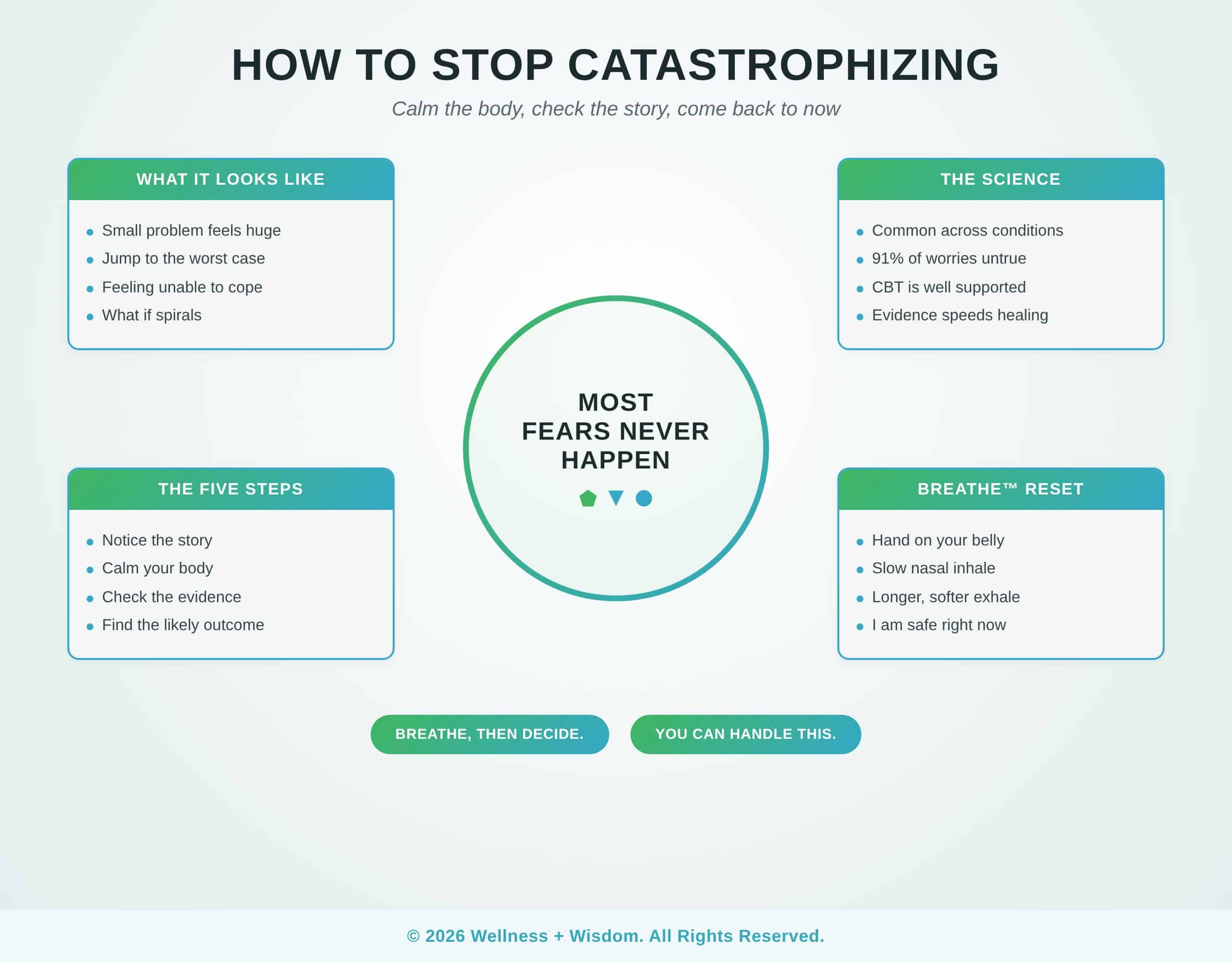
The most encouraging finding may be this one. In a study published in Behavior Therapy, Lucas LaFreniere and Michelle Newman asked people with generalized anxiety disorder to write down their worries and then track whether they came true over the following weeks. They found that 91.4 percent of worry predictions did not come true. For many participants, none of their worries came true. And people who saw more evidence that their worries were untrue showed greater improvement in symptoms. Checking your fears against reality is powerful medicine.
Effective help exists. In a review of meta analyses published in Cognitive Therapy and Research, Stefan Hofmann and colleagues found strong support for cognitive behavioral therapy, an approach that helps people identify and reshape distorted thoughts like catastrophizing, particularly for anxiety disorders. The skills in this article draw on the same principles.
How to Stop Catastrophizing
You learn how to stop catastrophizing by noticing the story, calming your body with slow breathing, checking the evidence, finding the most likely outcome, and trusting your ability to cope. These five steps interrupt the worst case spiral and bring you back to reality. Here is how I practice and teach them.
1. Notice the Story
The first step is awareness. When you feel fear rising, pause and notice what your mind is telling you. Name it: “I am catastrophizing.” Or, “My mind is writing a disaster story.” Naming the pattern creates a little distance between you and the thought. You are not the thought. You are the one noticing it.
2. Calm Your Body
Catastrophizing ramps up your body's stress response, and a stressed body makes anxious thoughts feel more true. Slow your breathing to calm things down. Inhale gently through your nose for about four seconds, then exhale slowly for about six. Repeat five times. A long, slow exhale helps signal safety to your neural system. The practices in box breathing are another excellent option.
3. Check the Evidence
Once you feel a little calmer, examine the thought. Ask: What evidence do I have that this will happen? What evidence do I have that it will not? Has something like this happened before, and how did it turn out? As the research shows, most worries do not come true. Writing your answers down can make this step even more powerful.
4. Find the Most Likely Outcome
Your mind has already imagined the worst case. Now imagine the best case. Then ask, what is the most likely outcome? Usually, the most likely outcome is somewhere in the middle and far less frightening than the catastrophe. This simple exercise helps your brain see the full range of possibilities instead of fixating on one terrible one.
5. Trust Your Ability to Cope
Ask yourself, “If something difficult does happen, how would I handle it?” Think of past challenges you have survived and the strengths, people, and resources that helped you. Remind yourself, “Even if this is hard, I can handle it, and I will not be alone.” This builds confidence that you can meet whatever comes. The ideas in how to make peace with uncertainty go deeper here.
Start with one or two of these steps the next time you notice catastrophizing. With practice, they become faster and more natural. If you would love a supportive community as you grow, the Liberated Life Tribe is a warm place to begin.
Here is what these steps can look like in a real moment. Imagine your teenager is an hour late and not answering their phone. Your mind immediately jumps to a car accident. First, you notice the story: “I am catastrophizing.” Second, you take five slow breaths with long exhales. Third, you check the evidence: they have been late before, and their phone often dies. Fourth, you find the most likely outcome: they lost track of time with friends, and their phone battery is dead. Fifth, you remind yourself that if something difficult has happened, you will handle it, and you have people to call. Then you take one helpful action, like texting a friend's parent. Often, the reply comes within minutes, and the whole story dissolves into an ordinary evening. In a few minutes, you have moved from panic to calm, clear action.
Writing can be especially helpful when you are learning how to stop catastrophizing. Try a simple three column practice. In the first column, write the catastrophic thought. In the second, write the evidence for and against it. In the third, write a more balanced thought, like “My boss wants to meet, which probably means a routine check in. Even if there is a problem, I can handle it.” Seeing your thoughts on paper makes them easier to examine and often reveals how unlikely the worst case really is.
It also helps to limit the inputs that feed catastrophic thinking. Constant news alerts, doom filled social media feeds, and late night internet searches about symptoms can all fuel worst case thinking. Set boundaries around these inputs, especially before bed. Try a simple rule like no news or symptom searches after dinner, and notice how much calmer your evenings and your sleep become. Give your mind a chance to rest in calmer information and real connection.
Planning Versus Catastrophizing
Planning and catastrophizing both involve thinking about the future, but they lead to very different places. Planning looks at realistic possibilities and leads to helpful action. Catastrophizing fixates on the worst case and leads to fear and paralysis. One prepares you. The other drains you.
Healthy planning sounds like, “There is a chance of rain, so I will pack an umbrella.” Catastrophizing sounds like, “It might storm, the flight will be canceled, I will miss the wedding, and everyone will be disappointed in me.” Planning stays grounded in what is likely and what you can do about it. Catastrophizing spirals into unlikely disasters and leaves you feeling helpless.
A useful question to ask is, “Is this thought helping me take a useful action right now?” If yes, make a plan and take the step. If no, it may be catastrophizing, and it is time to breathe, check the evidence, and come back to the present. If your mind tends to loop, the practices in how to stop overthinking can help you break the cycle.
Catastrophizing can also affect relationships. When you assume the worst about a partner's silence or a friend's short reply, you may react defensively before you know what is really going on. Before responding, try asking a simple, curious question like, “Hey, is everything okay?” Most of the time, the explanation is ordinary, and asking saves you and the people you love a lot of unnecessary pain.
How to Stop Catastrophizing With BREATHE™
BREATHE™ offers one of the fastest ways to interrupt catastrophizing, because your breath directly influences your neural system. When you slow your breathing, you send a signal of safety to your body, which makes it easier for your mind to calm down and think clearly.
Inside BREATHE™, I teach a simple practice for catastrophic moments. First, pause and place one hand on your belly. Second, breathe in slowly through your nose, feeling your belly rise. Third, exhale slowly through your mouth, letting the breath be longer than the inhale. Repeat for one to two minutes. As you breathe, gently say to yourself, “I am safe in this moment.” Once your body softens, move to the steps of checking the evidence and finding the most likely outcome.
Practicing breathwork daily, not just in moments of fear, builds a calmer baseline over time. A few minutes of slow breathing each morning and evening can make your neural system less reactive throughout the day. For more techniques, explore how to practice breathwork. To go deeper with identity level change, explore our L.I.F.E. Method™ programs.
If you are a parent, you can also help your children learn these skills early. When your child says, “What if everyone laughs at me?” you can gently ask, “What is the most likely thing that will happen?” and “If something hard happens, what could you do?” Teaching kids how to stop catastrophizing gives them a lifelong tool for meeting uncertainty with courage.
Celebrating Each Calm Moment
Celebrating each calm moment helps your brain learn that you can handle uncertainty, which makes catastrophizing less automatic over time. Your brain learns through reward, so noticing progress strengthens new habits.
Look for small wins. The first time you caught yourself catastrophizing and named it. The moment you took five slow breaths instead of spiraling. The day a worry did not come true and you noticed it. Write these moments down. Some people keep a worry log, writing down their fears and later recording what actually happened. Over time, this log becomes powerful evidence that most fears do not come true, just like the research found.
Celebrate your courage too. Facing uncertainty without catastrophizing takes strength. Every time you choose calm, you are rewiring old patterns. There is a whole practice around noticing these moments in celebrating small wins, and it helps keep you motivated.
Self compassion is a key part of this work. When you notice yourself catastrophizing, avoid adding a layer of judgment like “Why am I always like this?” Instead, try, “Of course my mind went there. It is trying to protect me. I can choose a calmer response now.” Kindness toward yourself calms the neural system and makes it easier to shift. The practices in how to practice self compassion are a wonderful support. Over time, you will find yourself catching the pattern sooner and returning to calm more quickly, which is exactly what progress looks like.
Building a Calmer Mind Over Time
Building a calmer mind over time involves daily habits that support your neural system, so catastrophizing has less fuel to begin with. When your body and mind are well cared for, anxious thoughts tend to be less frequent and less intense.
Sleep, movement, nourishing food, time in nature, and limiting news and social media all support a calmer baseline. Daily practices like breathwork, prayer, meditation, and gratitude train your mind to rest in the present. Connection with people you trust also matters: sharing worries out loud often shrinks them. Over weeks and months, these habits add up to a more peaceful inner life. The practices in how to manage stress are a helpful foundation.
This is also where the Wellness Pentagon™ becomes helpful. Caring for your physical, mental, emotional, spiritual, and financial wellbeing, including your Connection to Creator and God, builds resilience that makes catastrophic thinking less likely to take over. Many people find that faith offers a deep sense of trust that softens fear. You will find many guests sharing how they quieted anxious thinking across our latest episodes.
When Fear Feels Overwhelming
If fear feels overwhelming right now, you are not alone, and it is completely understandable. Learning how to stop catastrophizing takes practice, and some seasons of life bring more uncertainty and stress than others. Be patient and gentle with yourself as you build these skills.
When fear feels big, return to the basics: breathe slowly, put your feet on the ground, and notice five things you can see around you. These grounding steps bring you back to the present moment. Then reach out to someone you trust and share what is on your mind. Supportive tools like a worry journal or a breath training device can help, and you can find a few we trust in our wellness tools store.
It is also important to know when to seek professional support. If catastrophizing and worry are frequent, intense, or interfering with your sleep, work, or relationships, or if you experience panic attacks or thoughts of self harm, please reach out to a qualified mental health professional right away. Cognitive behavioral therapy and other approaches can be very effective. There is real strength in asking for help. If anxious thoughts are your daily companion, the practices in how to calm an anxious mind are a gentle next step.
Ready to go deeper? Join the Liberated Life Tribe and receive your 10 day Self Liberation Blueprint at liberatedlife.com. It is free, it is guided, and each day offers a gentle practice to help you calm your mind and come back to the joy of the present moment.
Frequently Asked Questions
What is catastrophizing?
Catastrophizing is a thinking pattern where your mind jumps to the worst possible outcome, treats it as likely, and assumes you will not be able to cope. It is a common cognitive distortion that can fuel anxiety and stress.
Why do I always think the worst?
Your brain is wired to scan for danger, and sometimes that protective system becomes overactive. Past experiences, stress, and learned patterns from family can make catastrophizing more automatic. The good news is that it can be changed with practice.
How can I stop catastrophizing quickly?
Name the pattern, then slow your breathing with a long exhale for one to two minutes. Once calmer, check the evidence for your fear, imagine the most likely outcome, and remind yourself of your ability to cope.
Do most worries come true?
No. In one study of people with generalized anxiety disorder, 91.4 percent of worry predictions did not come true, and seeing that evidence was linked with greater improvement in symptoms.
Is catastrophizing a sign of anxiety?
Catastrophizing is common in anxiety, but it also appears in depression, chronic pain, and everyday stress. If it is frequent and interferes with daily life, a qualified mental health professional can help.
Can therapy help with catastrophizing?
Yes. Cognitive behavioral therapy helps people identify and reshape distorted thoughts like catastrophizing, and research strongly supports it, particularly for anxiety disorders.
Studies and External Resources
The science in this article rests on peer reviewed research. These are the sources referenced throughout.
- Gellatly R, Beck AT. (2016). Catastrophic Thinking: A Transdiagnostic Process Across Psychiatric Disorders. Cognitive Therapy and Research. View the study via DOI
- LaFreniere LS, Newman MG. (2020). Exposing Worry's Deceit: Percentage of Untrue Worries in Generalized Anxiety Disorder Treatment. Behavior Therapy. PubMed: 32402257
- Hofmann SG, et al. (2012). The Efficacy of Cognitive Behavioral Therapy: A Review of Meta analyses. Cognitive Therapy and Research. PubMed: 23459093
About Josh Trent
Josh Trent is an Identity Transformation Architect and the award winning host of the Wellness + Wisdom Podcast, with over 15 million downloads since 2015. He is the creator of the L.I.F.E. Method™ Identity Transformation System and steward of the Emotional Epigenetics™ and BREATHE: Breath + Wellness™ systems of self mastery, impacting over 1,000 students worldwide. Join the Liberated Life Tribe and receive your 10 day Self Liberation Blueprint at liberatedlife.com. Josh lives in Austin, Texas with his wife Carrie, daughter Nayah, and son Novah. Peace and power.
Disclosure: We may earn a commission from certain links on this site when you make a purchase, at no extra cost to you. These commissions help support Wellness + Wisdom and do not affect the products or resources we choose to recommend. Full disclosure .