

By Josh Trent | Wellness + Wisdom Podcast Host & Identity Transformation Architect
“Our kids do not remember the perfect birthday parties. They remember the moments we put the phone down, looked them in the eyes, and were fully there.”
Josh Trent
Learning how to connect with your kids is one of the most meaningful things you will ever do, and the beautiful news is that it happens mostly in small, ordinary moments. A bedtime story. A silly dance in the kitchen. Ten minutes of undivided attention after school. A walk where you mostly listen. These moments may seem simple, but to a child, they say, “You matter. I see you. I love being with you.” As a dad to Nayah and Novah, I have learned that my kids do not need me to be perfect. They need me to be present. In a world full of screens, schedules, and stress, presence has become one of the most powerful gifts a parent can give. This is the heart of conscious parenting, which invites us to show up with awareness and love.
Here is the joy forward truth at the center of it all. Connection with your kids is not about having more time. It is about how you use the time you already have. A few intentional minutes a day can transform your relationship and fill your home with more joy. Let us explore exactly how.
Table of Contents
- What Connection With Your Kids Really Means
- Why Connection Matters So Much
- The Gift of a Connected Family
- The Science of Parent and Child Connection
- How to Connect With Your Kids
- Presence Versus Proximity
- How to Connect With Your Kids Through Conscious Parenting
- Celebrating Your Kids Every Day
- Connecting at Every Age
- When Connection Feels Hard
- Frequently Asked Questions
- Studies and External Resources
- About Josh Trent
What Connection With Your Kids Really Means
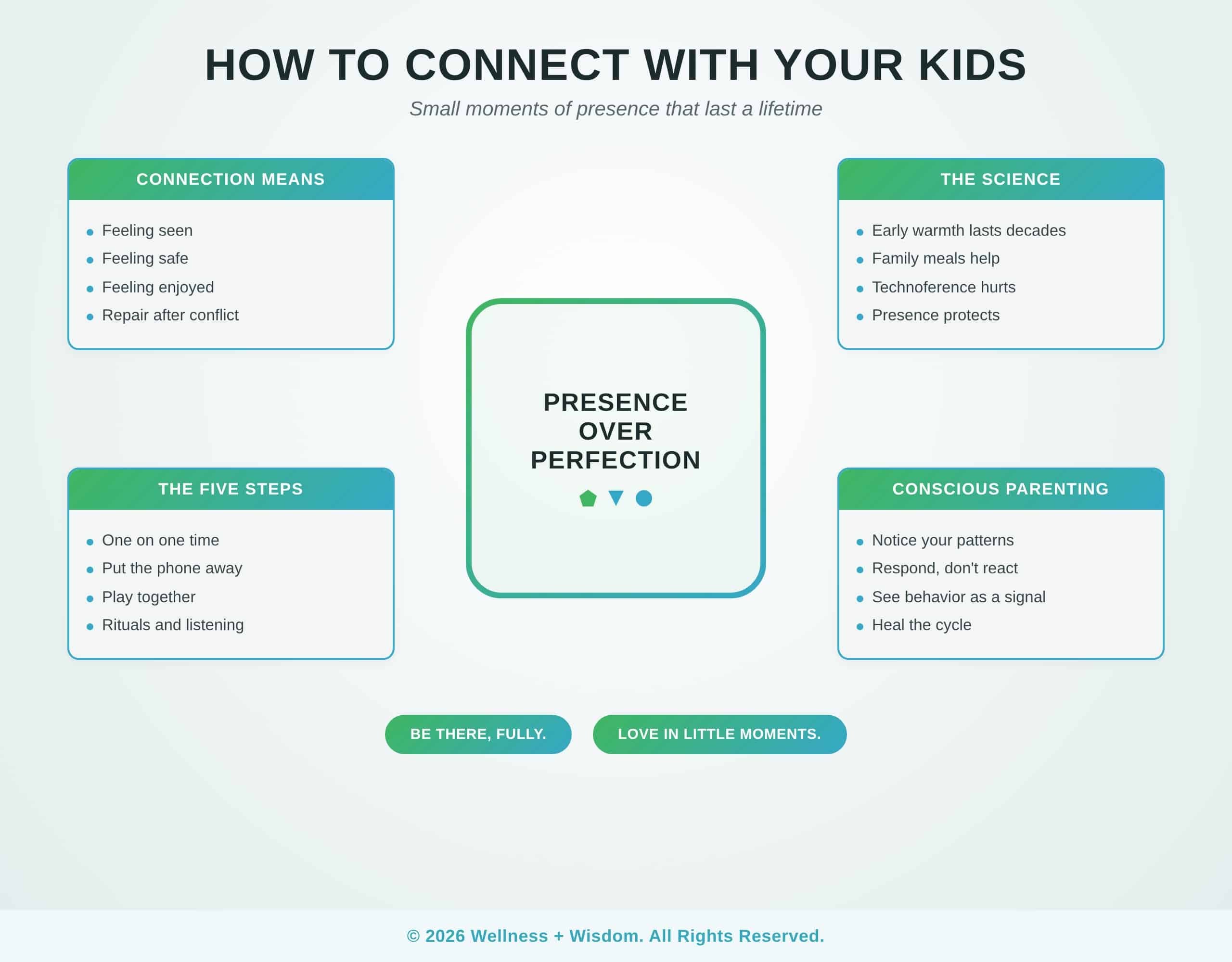
Connection with your kids means a relationship where your children feel seen, safe, understood, and enjoyed by you. It is built through warmth, attention, responsiveness, and shared experiences, and it gives children a secure base from which to explore the world.
Connection is not the same as entertaining your kids or giving them everything they want. It is about attunement, noticing what your child feels and needs, and responding with care. It is about delight, letting your kids see that you genuinely enjoy them. And it is about repair, coming back together after conflict so your child knows the relationship is strong enough to handle hard moments.
Connected children tend to feel more secure, cooperate more willingly, and come to their parents when they are struggling. That last part matters more and more as kids grow older. The connection you build when they are small becomes the bridge they walk across when they are teenagers facing big decisions. These themes come up often on the Wellness + Wisdom Podcast, where parenting experts share what truly helps families thrive.
It also helps to remember that connection is a two way street that you, as the parent, lead. Children cannot build connection on their own. They depend on us to notice them, invite them in, and keep the door open even when they push us away. That can feel like a lot of responsibility, but it is also a beautiful invitation. Every day brings dozens of small opportunities to turn toward your child, and each one counts.
Why Connection Matters So Much
Connection matters so much because a warm, responsive relationship with a parent is one of the strongest foundations for a child's emotional health, social skills, and resilience. Children learn who they are and how relationships work through their bond with you.
When children feel connected, their brains and bodies feel safe. That safety allows them to learn, play, explore, and handle stress. Connected children are often better at managing emotions, because they have learned through countless small moments that big feelings can be soothed. They tend to have healthier friendships, because they have experienced what a caring relationship feels like.
Connection also makes parenting easier. Children who feel close to their parents are generally more willing to cooperate, listen, and follow family values, because they want to protect the relationship. Many behavior challenges ease when connection grows. Instead of more rules, many children simply need more of us. If you want to build your child's emotional skills alongside connection, the ideas in how to raise emotionally intelligent kids are a natural companion.
The Gift of a Connected Family
The gift of a connected family is a home filled with warmth, laughter, trust, and the deep security of knowing you belong. That gift shapes children for a lifetime and brings parents some of their greatest joy.
In a connected family, children grow up knowing they are loved for who they are, not just what they do. That knowledge becomes a foundation for self worth that carries them through school, friendships, setbacks, and eventually their own adult relationships. Many adults who struggle with self worth can trace it back to feeling unseen as children. Connection now is an investment in your child's future wellbeing.
Connection is a gift to parents too. Some of the sweetest moments of life happen in the simple rhythms of family: laughing at dinner, reading under a blanket, hearing your child tell you something they have never told anyone else. These moments fill the heart in a way nothing else can. And they remind us why the hard parts of parenting are worth it. Learning to celebrate the people you love starts right at home.
The Science of Parent and Child Connection
The science of parent and child connection shows that sensitive, responsive parenting in early childhood predicts social and academic competence decades later, that frequent shared family meals are linked with healthier eating patterns in children, and that parent distraction with technology is associated with more child behavior problems. Connection shapes children's lives in lasting ways.
Start with the long view. In a study published in Child Development, Kenneth Raby and colleagues used data from the Minnesota Longitudinal Study of Risk and Adaptation, which followed participants from birth into adulthood. They found that maternal sensitivity during the first three years of life predicted social skills and academic achievement not only through adolescence but all the way to age 32. The warmth and responsiveness of early relationships appear to echo across decades.
Everyday rituals matter too. In a meta analysis published in Pediatrics, Amber Hammons and Barbara Fiese examined 17 studies involving more than 180,000 children and adolescents. They found that children and teens who shared family meals three or more times per week were more likely to have healthy weight and healthy eating patterns than those who shared fewer meals. The family table is a powerful place for connection.
Technology plays a role as well. In a study published in Child Development, Brandon McDaniel and Jenny Radesky surveyed families with young children and found that parents' problematic technology use was linked with more technology based interruptions in parent and child interactions, which they called technoference. Greater technoference was in turn associated with more child behavior problems. Putting the phone down is not a small thing. It is a powerful act of connection.
How to Connect With Your Kids
You learn how to connect with your kids by creating special one on one time, putting the phone away, playing together, building family rituals, and listening with curiosity. These five practices fit into busy lives and build a deep, lasting bond. Here is how Carrie and I practice them at home.
1. Create Special One on One Time
Set aside ten to fifteen minutes a day, or a longer block each week, for focused time with each child. Let them choose the activity. Give them your full attention: no phone, no multitasking, no correcting. Just enjoy being together. Even short, consistent one on one time can make children feel deeply valued. Some families call it “special time” and give it a regular slot on the calendar.
2. Put the Phone Away
When your child is talking to you, or during meals, bedtime, and car rides, put your phone out of sight. Kids notice when they are competing with a screen. As the research shows, technology interruptions are linked with more behavior problems. Create phone free zones and times in your home. The practices in how to reduce screen time can help the whole family.
3. Play Together
Play is the language of childhood. Get on the floor with your little ones, build forts, play board games, kick a ball outside, or have a dance party. Let your kids lead and let yourself be silly. Laughter and play release tension and build closeness faster than almost anything else. With older kids, play might look like video games, cooking together, or shooting hoops.
4. Build Family Rituals
Rituals give families rhythm and belonging. Share meals together as often as you can. Create a bedtime ritual with a story, a prayer, or a “best part of your day” question. Plan a weekly family night, a Saturday pancake breakfast, or a Sunday walk. As the research suggests, shared family meals are linked with healthier patterns in children. Consistency matters more than perfection.
5. Listen With Curiosity
When your child shares something, listen to understand, not to fix or lecture. Ask open questions like, “What was that like for you?” or “Tell me more.” Reflect what you hear: “It sounds like you felt left out.” Children who feel heard are more likely to keep talking to you, especially as they grow older. The practices in how to be a better listener are a great resource.
Start with one or two of these practices this week. Small, consistent moments build connection over time. And if you would love support on your own growth journey as a parent, the Liberated Life Tribe is a warm place to begin.
Here is a simple daily rhythm that weaves these practices into a busy life. In the morning, greet each child with eye contact, a hug, and a warm word before the rush begins. After school, ask one open question and really listen to the answer. At dinner, put phones in another room and share the best and hardest parts of the day. At bedtime, read together, pray together, or simply lie beside your child for a few quiet minutes. These moments take very little time, yet they add up to a childhood filled with connection.
Physical affection matters too, especially for younger children. Hugs, snuggles, holding hands, and a gentle hand on the back all communicate safety and love without words. With older kids, respect their comfort level, but do not stop offering. A quick hug before school or a high five after a game can mean more than you know.
And do not underestimate the power of saying “yes” to your child's invitations. When your daughter asks you to watch her cartwheel for the tenth time, or your son wants to tell you every detail about his favorite game, those are bids for connection. You will not be able to say yes to every one, but saying yes more often than not tells your child that their world matters to you. If you have been wondering how to connect with your kids when time feels short, start right here.
Presence Versus Proximity
Presence and proximity are not the same thing. Proximity means being in the same room as your kids. Presence means being emotionally and mentally available to them. You can spend all day near your children without truly connecting, and you can connect deeply in just a few minutes of full presence.
Many parents spend lots of time near their kids but feel disconnected because their attention is elsewhere: on work, on phones, on worries, or on the never ending to do list. Children feel the difference. When a parent is physically there but mentally elsewhere, kids may act out, cling, or withdraw, all ways of seeking connection. Presence is what fills their emotional cup.
The good news is that presence is a skill you can grow. Start by noticing when your mind wanders during time with your kids. Take a breath, look at your child, and come back to the moment. Even a few minutes of full presence each day can make a big difference. The practices in how to be present can help you strengthen this muscle.
One gentle check is to notice your child's eyes when you are together. Are they looking at you, or at the back of a phone? Are you looking at them? Eye contact is one of the simplest signals of presence, and children light up when they feel truly seen. Even thirty seconds of warm, undistracted eye contact can shift the emotional tone of an interaction.
How to Connect With Your Kids Through Conscious Parenting
Conscious parenting offers a powerful approach to connection, because it invites parents to become aware of their own emotional patterns, respond rather than react, and see each child as a unique person to be understood rather than controlled. Connection grows naturally from this awareness.
Many of our reactions as parents come from how we were raised. If you grew up with a lot of yelling, criticism, or distance, you may notice those patterns showing up with your own kids, even when you promised yourself you would do it differently. Conscious parenting asks you to notice these moments with curiosity rather than shame. This is where Emotional Epigenetics™ offers insight into how emotional patterns pass from generation to generation.
When you heal your own patterns, you can show up for your kids with more calm, patience, and connection. You respond to their big feelings with empathy instead of frustration. You repair after conflict. You see their behavior as communication. This is generational healing in action. If you want to explore this more deeply, the ideas in breaking the parenting cycle are a beautiful next step. To go deeper with identity level change, explore our L.I.F.E. Method™ programs.
Connection also means letting your kids see you as a real person. Share stories from your own childhood, including times you struggled or made mistakes. Tell them about your day, what you are learning, and what you love. When children know their parents as whole people, they feel closer to them and learn that it is safe to be imperfect.
Celebrating Your Kids Every Day
Celebrating your kids every day helps them feel seen, valued, and loved for who they are. It also trains your own attention toward the good, which makes parenting more joyful.
Celebrate the small things. A kind word to a sibling. A brave try at something new. A drawing, a joke, a question. Be specific: “I noticed how patient you were with your little brother today. That was really kind.” Specific appreciation tells children that you are paying attention. Celebrate who they are, too, not just what they do: their curiosity, humor, creativity, and heart.
You can also build celebration into family rituals. Share “high points” at dinner. Keep a family gratitude jar. Mark milestones with simple traditions. There is a whole practice around noticing these moments in celebrating small wins, and it brings so much joy to family life.
Siblings deserve attention here too. When you have more than one child, each one needs to feel uniquely seen. Rotating one on one time, noticing each child's individual interests, and avoiding comparisons all help every child feel special in their own way. Connection is not divided among children. It grows with each relationship you nurture.
Connecting at Every Age
Connecting at every age means adapting how you show up as your children grow, while keeping the foundation of warmth, presence, and listening the same. What connects you to a toddler looks different from what connects you to a teenager.
With babies and toddlers, connection lives in eye contact, cuddles, responsive care, and playful back and forth. With young children, it shows up in play, stories, routines, and plenty of physical affection. With school age kids, it grows through shared activities, conversations about their interests, and showing up for their games and performances. With teenagers, connection often happens side by side rather than face to face: in the car, while cooking, or on late night walks. Be available, listen more than you talk, and respect their growing independence.
Across every age, the Wellness Pentagon™ reminds us that children thrive when their physical, mental, emotional, spiritual, and relational needs are cared for, including a sense of Connection to Creator and God for families of faith. You will find many parents and experts sharing their wisdom across our latest episodes.
When Connection Feels Hard
If connection with your kids feels hard right now, you are not alone, and it is completely understandable. Busy schedules, work stress, sibling conflict, big emotions, and teenage distance can all make connection feel out of reach. Learning how to connect with your kids is a journey, and every family has seasons that feel harder than others.
When connection feels hard, start small. One phone free dinner. Ten minutes of play. One bedtime conversation. These small moments can open the door to more. If you have had a lot of conflict, focus on repair and on simply enjoying your child without an agenda. Supportive tools like family conversation cards and connection games can help, and you can find a few we trust in our wellness tools store.
Take care of yourself too. You cannot pour from an empty cup. Rest, support from your partner or friends, and your own healing all make it easier to connect. If you notice persistent struggles in your child, such as ongoing sadness, anxiety, withdrawal, or behavior concerns, reach out to your pediatrician or a qualified child mental health professional. There is real strength in asking for help. If patience is wearing thin, the practices in how to be more patient are a gentle next step.
Ready to go deeper? Join the Liberated Life Tribe and receive your 10 day Self Liberation Blueprint at liberatedlife.com. It is free, it is guided, and each day offers a gentle practice to help you heal your own patterns so you can connect more deeply with the people you love most.
Frequently Asked Questions
How much quality time do kids need?
There is no magic number, but even ten to fifteen minutes a day of focused, phone free one on one time can make children feel deeply valued. Consistency and full attention matter more than the total number of hours.
How can busy parents connect with their kids?
Use moments you already have: meals, car rides, bedtime, and walks. Put the phone away during these times, ask open questions, and listen. Small, consistent moments of presence build strong connection even in busy seasons.
How do I connect with my teenager?
Teens often open up side by side rather than face to face, like in the car or while cooking. Be available, listen more than you talk, avoid lecturing, show interest in their world, and respect their growing independence.
Does phone use affect my child?
Research suggests it can. One study found that parent distraction with technology, called technoference, was associated with more child behavior problems. Creating phone free times and zones helps protect connection.
Why are family meals important?
Family meals create a regular rhythm of connection and conversation. A meta analysis found that children who shared family meals three or more times a week were more likely to have healthy weight and healthy eating patterns.
What if I lose my temper with my kids?
Every parent does sometimes. What matters most is repair. Come back, apologize sincerely, acknowledge your child's feelings, and share what you will try next time. Repair teaches children that relationships can survive hard moments.
Studies and External Resources
The science in this article rests on peer reviewed research. These are the sources referenced throughout.
- Raby KL, Roisman GI, Fraley RC, Simpson JA. (2015). The enduring predictive significance of early maternal sensitivity: social and academic competence through age 32 years. Child Development. PubMed: 25521785
- Hammons AJ, Fiese BH. (2011). Is frequency of shared family meals related to the nutritional health of children and adolescents? Pediatrics. PubMed: 21536618
- McDaniel BT, Radesky JS. (2018). Technoference: Parent Distraction With Technology and Associations With Child Behavior Problems. Child Development. PubMed: 28493400
About Josh Trent
Josh Trent is an Identity Transformation Architect and the award winning host of the Wellness + Wisdom Podcast, with over 15 million downloads since 2015. He is the creator of the L.I.F.E. Method™ Identity Transformation System and steward of the Emotional Epigenetics™ and BREATHE: Breath + Wellness™ systems of self mastery, impacting over 1,000 students worldwide. Join the Liberated Life Tribe and receive your 10 day Self Liberation Blueprint at liberatedlife.com. Josh lives in Austin, Texas with his wife Carrie, daughter Nayah, and son Novah. Peace and power.
Disclosure: We may earn a commission from certain links on this site when you make a purchase, at no extra cost to you. These commissions help support Wellness + Wisdom and do not affect the products or resources we choose to recommend. Full disclosure .