
By Josh Trent | Wellness + Wisdom Podcast Host & Identity Transformation Architect
“Empathy is not about having the right words. It is about being willing to sit beside someone in their world, without rushing to fix it, until they feel less alone.”
Josh Trent
Learning how to practice empathy is one of the most powerful ways to deepen every relationship in your life. Empathy is what makes a friend feel understood, a partner feel cherished, a child feel safe, and a coworker feel valued. It turns arguments into conversations and distance into closeness. And here is the beautiful news: empathy is not a fixed trait you either have or do not have. It is a skill, and like any skill, it grows with practice. Every time you pause to truly listen, imagine someone else's experience, or respond with care, you strengthen your capacity for connection. Much of how we respond to others was shaped early in life, which is why this work connects so naturally with Emotional Epigenetics™.
Here is the joy forward truth at the center of it all. Empathy does not drain you when it is practiced well. It fills your relationships with trust, warmth, and meaning, and it makes your own life richer too. Let us explore what the science says and exactly how to build this skill.
Table of Contents
- What Empathy Really Is
- Why Empathy Matters
- The Gift of Feeling Understood
- The Science of Empathy
- How to Practice Empathy
- Empathy Versus Sympathy
- How to Practice Empathy With Emotional Epigenetics™
- Celebrating Moments of Connection
- Empathy at Home, at Work, and in Conflict
- When Empathy Feels Hard
- Frequently Asked Questions
- Studies and External Resources
- About Josh Trent
What Empathy Really Is
Empathy is the ability to understand and share another person's feelings and perspective, and to respond with care. It combines three parts: noticing what someone feels, imagining their experience from their point of view, and caring enough to respond in a way that helps.
Psychologists often describe several kinds of empathy. Cognitive empathy, sometimes called perspective taking, is understanding what someone else is thinking and feeling. Emotional empathy is feeling some of what they feel, like sensing a friend's sadness in your own chest. Compassionate empathy, often called empathic concern, is the caring motivation to help. Healthy empathy weaves all three together, so you understand, feel, and act with kindness.
Empathy is not the same as agreeing with someone or taking on their problems as your own. You can deeply understand a person's feelings while still holding your own perspective and boundaries. In fact, the most sustainable empathy comes from a grounded place, where you can be present with someone else's emotions without losing yourself. These themes come up often on the Wellness + Wisdom Podcast, where guests share how empathy transformed their relationships.
It also helps to remember that empathy is a practice, not a personality trait. Some people seem naturally attuned, but research suggests empathy can grow with intention and training. Learning how to practice empathy is less about becoming a different person and more about building small habits of attention and care.
Why Empathy Matters
Empathy matters because it is the foundation of trust, closeness, and cooperation in every relationship. When people feel understood, they relax, open up, and connect. When they feel misunderstood, they defend, withdraw, or argue.
In families, empathy helps children feel safe and helps partners feel cherished. In friendships, it turns casual acquaintances into lifelong bonds. At work, it builds teams where people feel valued and can do their best. In communities, it helps people with different backgrounds and beliefs see each other as human beings. Empathy is the glue that holds relationships together.
Empathy also transforms conflict. When you take the time to understand someone's perspective before responding, arguments often soften. People feel heard, and solutions become easier to find. Many conflicts are less about the problem itself and more about feeling unheard. If conflict is a challenge in your life, the ideas in how to handle conflict pair beautifully with empathy.
The Gift of Feeling Understood
The gift of feeling understood is one of the deepest gifts one human being can give another. When someone truly gets you, your whole body relaxes. You feel safe, valued, and less alone.
Think about a time when someone listened to you without judging, interrupting, or rushing to fix. Maybe it was a friend during a hard season, a teacher who saw your potential, or a partner who understood your fears. That experience likely stayed with you. Feeling understood builds trust and self worth, and it often helps us find our own answers more clearly.
When you offer empathy to others, you give them that same gift. And something beautiful happens in return. Empathy deepens your own relationships, expands your perspective, and fills your life with more meaning and connection. The practices in how to be vulnerable show how empathy and openness grow together.
The Science of Empathy
The science of empathy shows that empathy is shaped by motivation, meaning we can choose to approach it, that empathy levels in young adults declined in recent decades, and that empathy can be trained and improved. Empathy is a skill we can grow.
Start with how empathy works. In a review published in Psychological Bulletin, Jamil Zaki of Stanford University described empathy as a motivated process. People are drawn toward empathy when they expect positive feelings, connection, or social approval, and they tend to avoid it when they expect suffering or cost. That means empathy is not purely automatic. It is shaped by our choices about where to place our attention and how to interpret what we see.
Context matters too. In a meta analysis published in Personality and Social Psychology Review, Sara Konrath and colleagues examined decades of data on American college students and found declines in perspective taking and empathic concern over time, most pronounced in samples from after 2000. Whatever the causes, the finding is a reminder that empathy is not guaranteed. It needs to be nurtured.
The encouraging part is that empathy can be trained. In a randomized controlled trial published in the Journal of General Internal Medicine, Helen Riess and colleagues gave resident physicians a brief training grounded in the neurobiology of empathy. Patients, who did not know which doctors had been trained, rated the trained physicians as more empathic afterward. The trained doctors also became better at reading facial expressions of emotion. If busy physicians can grow their empathy, so can all of us.
How to Practice Empathy
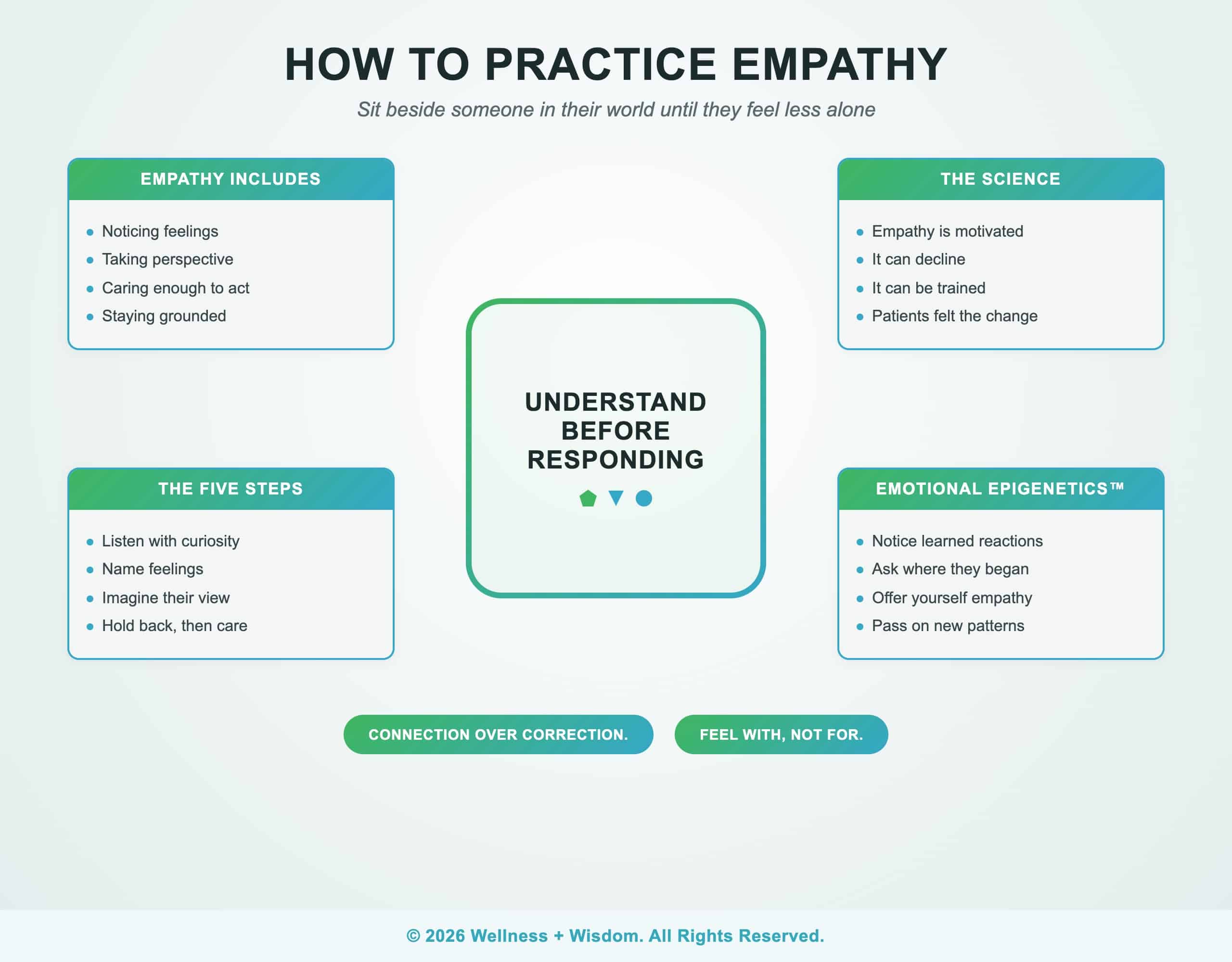
You learn how to practice empathy by listening with curiosity, naming feelings, imagining another perspective, holding back on fixing, and offering caring action. These five practices turn empathy from a good intention into a daily habit. Here is how I practice and teach them.
1. Listen With Curiosity
Empathy begins with listening. When someone talks to you, put your phone away, make eye contact, and focus fully on them. Listen to understand, not to respond. Ask open questions like, “What was that like for you?” or “Tell me more.” Curiosity tells the other person that their experience matters. The practices in how to be a better listener go deeper here.
2. Name Feelings
Gently reflect what you hear. “It sounds like you felt really overlooked.” “That must have been so frustrating.” Naming feelings shows the other person that you are tuned in, and it often helps them feel calmer and more understood. If you are not sure, ask: “Am I getting that right?” Being willing to check shows respect.
3. Imagine Another Perspective
Before you respond, take a moment to imagine the situation from the other person's point of view. What might they be worried about? What pressures might they be carrying? What history might shape their reaction? Perspective taking does not mean you have to agree. It means you seek to understand. This one habit can transform conflicts and deepen bonds.
4. Hold Back on Fixing
Many of us rush to solve problems when someone shares a struggle. While our intentions are good, fixing too quickly can make people feel unheard. Try asking, “Do you want ideas, or do you just need me to listen right now?” Often, simply being present is the most helpful thing you can do. The ideas in how to sit with difficult emotions can help you stay present.
5. Offer Caring Action
Empathy becomes complete when it leads to care. That might mean a hug, a meal, a follow up text, a practical favor, or simply showing up. Ask, “What would be most helpful right now?” Then do what you can. Caring action turns understanding into connection.
Start with one or two of these practices this week. Small moments of empathy add up quickly. And if you would love a supportive community as you grow, the Liberated Life Tribe is a warm place to begin.
Here is a simple daily practice if you are wondering how to practice empathy in a busy life. Choose one conversation each day to give your full attention. During that conversation, ask at least one open question, reflect one feeling, and resist the urge to fix. Afterward, take a moment to notice how the conversation felt for both of you. This small habit, repeated daily, can transform your relationships within weeks.
Body language matters as much as words. Turn toward the person speaking, relax your shoulders, and let your face reflect what you are hearing. Nod, lean in, and keep your arms open. Research on empathy training highlights how much of empathy is communicated through nonverbal cues like eye contact, facial expression, and tone of voice. Even a gentle hand on the shoulder, when welcome, can say “I am with you” more powerfully than any sentence.
Your tone of voice carries empathy too. A soft, warm, unhurried tone tells someone it is safe to keep sharing. A rushed or distracted tone can shut a conversation down before it begins. Notice how you sound when someone brings you something hard, and practice slowing down. These small shifts are a big part of how to practice empathy in a way people can actually feel.
Empathy can also be practiced in your imagination. Before a difficult conversation, take a few minutes to picture the other person's day, their worries, and their hopes. What might they need from this conversation? What might they be afraid of? This mental rehearsal softens defensiveness and prepares you to meet them with curiosity rather than judgment.
Reading fiction and listening to people's stories are wonderful ways to grow empathy too. When you step into the lives of characters or hear the real experiences of people different from you, your capacity for perspective taking expands. Choose books, podcasts, and conversations that introduce you to new perspectives, and notice how your understanding of others grows over time.
Empathy Versus Sympathy
Empathy and sympathy are related but different. Sympathy is feeling sorry for someone from the outside. Empathy is stepping into their experience and feeling with them. Sympathy can create distance. Empathy creates connection.
Sympathy might sound like, “Oh, that is too bad,” or “At least it was not worse.” These responses are well meaning, but they can leave people feeling more alone, because they do not truly meet the person where they are. Empathy sounds more like, “That sounds really hard. I am so glad you told me.” Empathy acknowledges the feeling without minimizing it or rushing past it.
Empathy also differs from taking on someone else's emotions completely. Sometimes people feel so much of another person's pain that they become overwhelmed. That kind of empathic distress can lead to burnout. Healthy empathy includes a grounded sense of self, so you can be present with someone's feelings while still caring for your own wellbeing. If you tend to absorb other people's emotions, the ideas in how to release what is not yours may help.
Boundaries make empathy sustainable. You can care deeply while still protecting your time, energy, and emotional health. In fact, people with healthy boundaries often have more empathy to give, because they are not running on empty. The practices in how to set boundaries with love are a beautiful companion.
How to Practice Empathy With Emotional Epigenetics™
Emotional Epigenetics™ offers a powerful lens for empathy, because the way we respond to others' emotions is often learned in childhood. When you become aware of these inherited patterns, you can choose to respond with more empathy, both toward others and toward yourself.
If you grew up in a home where feelings were dismissed, you may find it hard to sit with other people's emotions without trying to fix or minimize them. If you grew up where conflict was scary, you may withdraw when others are upset. These responses are not character flaws. They are learned patterns, and they can be transformed. Emotional Epigenetics™ invites you to notice these patterns with curiosity: Where did I learn to respond this way? What would I like to do instead?
Empathy for yourself is part of this healing. When you understand why you react the way you do, you can offer yourself compassion instead of criticism. That self empathy makes it easier to extend empathy to others. And when you practice empathy with your children, you help them grow up with a different emotional inheritance. If you are a parent, the ideas in how to raise emotionally intelligent kids are a natural next step. To go deeper with identity level change, explore our L.I.F.E. Method™ programs.
Learning how to practice empathy with yourself first can make everything else easier. When you notice a hard feeling, pause and name it gently: “I feel anxious right now, and that makes sense.” Then ask what you need. This self empathy calms your body and builds the inner steadiness that allows you to show up for others. The practices in how to practice self compassion are a beautiful support here.
Celebrating Moments of Connection
Celebrating moments of connection helps empathy become a lasting habit, because your brain learns through reward. When you notice how good it feels to truly understand someone, and to be understood, you naturally want to do it more.
Look for the small wins. The conversation where your partner opened up because you listened. The moment a coworker thanked you for understanding their stress. The time your child calmed down because you named their feelings. These moments are worth noticing and savoring. Write them down or share them with someone you trust.
Celebrate empathy in others too. When someone listens to you well, thank them. When your kids show empathy to a sibling or friend, name it specifically. Celebration spreads empathy through families and communities. There is a whole practice around noticing these moments in celebrating small wins, and moments of connection are some of the best to celebrate.
Empathy at Home, at Work, and in Conflict
Empathy at home, at work, and in conflict looks a little different in each setting, but it always starts with the same choice: seeking to understand before seeking to be understood. When you bring that choice into every area of life, relationships grow stronger and more resilient.
At home, empathy might look like noticing when your partner is tired and offering help, listening to your teenager without lecturing, or asking your child how they feel before correcting behavior. At work, it might mean considering the pressures your colleagues face, giving feedback with care, and recognizing effort as well as results. These small acts build trust and make home and work feel safer and more supportive. If you want to grow in your closest relationship, the ideas in how to build a healthy relationship go deeper.
In conflict, empathy is especially powerful. Before you share your side, try summarizing the other person's perspective: “So it sounds like you felt dismissed when I changed the plans without asking. Is that right?” When people feel heard, they become much more open to hearing you. Empathy does not mean giving in. It means creating the conditions for a real solution. This is also where the Wellness Pentagon™ becomes helpful, reminding us that emotional, spiritual, and relational wellbeing are all connected, including a shared Connection to Creator and God for families of faith. You will find many guests sharing how empathy healed their relationships across our latest episodes.
Empathy can even extend to people we disagree with. When we take the time to understand why someone holds a different view, we often discover shared values beneath the surface. This does not mean abandoning our beliefs. It means treating others with the dignity and curiosity we would want for ourselves.
Leaders and teams benefit greatly from empathy as well. When managers take time to understand their people's challenges, trust grows and people feel safe to share ideas and concerns. A simple question like “What is making your work harder right now?” can open doors that no performance review ever could.
When Empathy Feels Hard
If empathy feels hard right now, you are not alone, and it is completely understandable. Stress, exhaustion, hurt, or old wounds can all make it difficult to be present with other people's feelings. Learning how to practice empathy includes being gentle with yourself in these seasons.
When empathy feels hard, start by caring for yourself. Rest, nourishment, and time to process your own feelings make it easier to show up for others. Then choose small steps, like one fully present conversation a day. Supportive tools like conversation card decks or a reflection journal can help, and you can find a few we trust in our wellness tools store.
It is also important to know that empathy does not require you to stay in harmful situations. If someone is repeatedly hurtful or abusive, you can understand their pain while still protecting yourself with firm boundaries or distance. And if you are struggling with persistent emotional exhaustion or burnout from caring for others, please reach out to a qualified health professional. There is real strength in asking for help. If you are caring for others and feeling depleted, the ideas in how to recover from burnout are a gentle next step.
Ready to go deeper? Join the Liberated Life Tribe and receive your 10 day Self Liberation Blueprint at liberatedlife.com. It is free, it is guided, and each day offers a gentle practice to help you connect more deeply with yourself and the people you love.
Frequently Asked Questions
What is empathy?
Empathy is the ability to understand and share another person's feelings and perspective, and to respond with care. It combines noticing what someone feels, imagining their experience from their point of view, and caring enough to help.
Can empathy be learned?
Yes. Research suggests empathy is shaped by motivation and can be trained. In one randomized trial, physicians who received brief empathy training were rated as more empathic by their patients afterward.
What is the difference between empathy and sympathy?
Sympathy is feeling sorry for someone from the outside. Empathy is stepping into their experience and feeling with them. Empathy tends to create connection, while sympathy can sometimes create distance.
How can I be more empathetic in relationships?
Listen with curiosity, reflect the feelings you hear, imagine your partner's perspective, ask whether they want ideas or just support, and follow up with caring action. Small daily moments of empathy build deep trust.
How do I practice empathy without getting overwhelmed?
Stay grounded in your own sense of self, set healthy boundaries, and care for your own wellbeing. Healthy empathy means being present with someone's feelings without taking them on completely.
How can I teach my children empathy?
Model empathy in how you respond to their feelings, name emotions together, talk about how others might feel, and celebrate their empathic acts specifically. Children learn empathy most by experiencing it.
Studies and External Resources
The science in this article rests on peer reviewed research. These are the sources referenced throughout.
- Zaki J. (2014). Empathy: a motivated account. Psychological Bulletin. PubMed: 25347133
- Konrath SH, O'Brien EH, Hsing C. (2011). Changes in dispositional empathy in American college students over time: a meta analysis. Personality and Social Psychology Review. PubMed: 20688954
- Riess H, et al. (2012). Empathy training for resident physicians: a randomized controlled trial of a neuroscience informed curriculum. Journal of General Internal Medicine. PubMed: 22549298
About Josh Trent
Josh Trent is an Identity Transformation Architect and the award winning host of the Wellness + Wisdom Podcast, with over 15 million downloads since 2015. He is the creator of the L.I.F.E. Method™ Identity Transformation System and steward of the Emotional Epigenetics™ and BREATHE: Breath + Wellness™ systems of self mastery, impacting over 1,000 students worldwide. Join the Liberated Life Tribe and receive your 10 day Self Liberation Blueprint at liberatedlife.com. Josh lives in Austin, Texas with his wife Carrie, daughter Nayah, and son Novah. Peace and power.
Disclosure: We may earn a commission from certain links on this site when you make a purchase, at no extra cost to you. These commissions help support Wellness + Wisdom and do not affect the products or resources we choose to recommend. Full disclosure .