
By Josh Trent | Wellness + Wisdom Podcast Host & Identity Transformation Architect
“Hope is not a wish. It is a decision to keep walking toward the light with a plan in your hand and faith in your heart.”
Josh Trent
Learning how to be more hopeful is one of the most powerful skills you can build for your mind, your body, and your future. Hope is what gets you out of bed on a hard morning. It is what helps a family keep going through a tough season, what helps an athlete push through the final mile, and what helps a dreamer keep building when nobody else can see it yet. Here is the beautiful part. Hope is not a personality trait that some people are simply born with. Researchers describe it as a way of thinking, built from clear goals, workable pathways, and the willpower to walk them. That means hope can be learned, practiced, and strengthened at any age. In my own life, hope has been the bridge between who I was and who I was becoming, and it sits at the very heart of the L.I.F.E. Method™.
Here is the joy forward truth at the center of it all. Your future is not fixed. Every day you get to choose where you point your attention, what you work toward, and who you become. Hope is the fuel for that choice. Let us explore what the science says and exactly how to grow more hope in your daily life.
Table of Contents
- What Hope Really Is
- Why Hope Matters
- The Gift of a Hopeful Mind
- The Science of Hope
- How to Be More Hopeful
- Hope Versus Wishful Thinking
- How to Be More Hopeful With the L.I.F.E. Method™
- Celebrating Signs of Progress
- Hope in Families, Work, and Faith
- When Hope Feels Far Away
- Frequently Asked Questions
- Studies and External Resources
- About Josh Trent
What Hope Really Is
Hope is the belief that you can reach meaningful goals, combined with the ability to find pathways toward them and the motivation to keep moving along those pathways. In the research world, it is often described as two parts working together: agency, the “I can do this” willpower, and pathways, the “here is how” way power.
Psychologist C. R. Snyder spent decades studying hope, and his model is beautifully practical. Hope starts with a goal, something you genuinely want. Then it needs pathways, the routes you can take to get there, including backup routes when the first one is blocked. Finally, it needs agency, the inner energy and belief that keeps you moving. When all three are present, hope becomes a living force in your life rather than a vague feeling.
This view of hope is deeply empowering. It means hope is not something that happens to you. It is something you build. You can choose clearer goals. You can brainstorm more pathways. You can strengthen your willpower through small wins. These themes come up often on the Wellness + Wisdom Podcast, where guests share how hope carried them through seasons that seemed impossible.
Hope also has a spiritual dimension for many people. Faith in God, trust that life is unfolding for a purpose, and belief that tomorrow can be better than today are all part of a hopeful heart. Learning how to be more hopeful often means weaving together practical planning and deep trust.
Why Hope Matters
Hope matters because it shapes how we think, feel, and act about the future. Hopeful people tend to set meaningful goals, cope better with setbacks, and keep moving forward when life gets hard. Hope turns obstacles into problems to solve rather than walls that stop us.
Without hope, even small challenges can feel overwhelming. With hope, big challenges become manageable steps. Hope helps you see possibilities where you once saw dead ends. It gives you the energy to try again after a disappointment and the creativity to find a new route when the old one closes. Hope is not about ignoring problems. It is about believing that problems can be worked through.
Hope also spreads. When you carry hope, the people around you feel it. Children borrow hope from their parents. Teams borrow hope from their leaders. Friends borrow hope from each other. In a world where many people feel uncertain about the future, a hopeful person can be a light for an entire family or community. If worry about tomorrow tends to crowd out hope, the ideas in how to stop worrying about the future pair beautifully with this work.
The Gift of a Hopeful Mind
The gift of a hopeful mind is freedom. Hope frees you from the belief that today's circumstances define tomorrow's possibilities. It opens your eyes to new options, new relationships, and new versions of yourself.
Hopeful people often describe a sense of lightness. They still face hard things, but they carry them differently. Instead of thinking, “This will never change,” they think, “This is hard, and I can find a way through.” That single shift in thinking changes how the body feels, how decisions get made, and how relationships unfold. Hope invites you to lean forward into life instead of bracing against it.
A hopeful mind is also a creative mind. When you believe a better future is possible, your brain starts looking for ways to build it. You notice opportunities you would have missed. You ask better questions. You connect with people who can help. Hope and meaning are close companions, as explored in how to find meaning in hard times.
The Science of Hope
The science of hope shows that hope can be measured as a combination of willpower and pathways thinking, that hopeful teenagers grow into healthier and happier adults, and that even a single focused session can increase hope and progress toward goals. Hope is both measurable and teachable.
Start with how hope is measured. In research published in the Journal of Personality and Social Psychology, C. R. Snyder and colleagues developed the Hope Scale, defining hope as a sense of successful agency, which is goal directed determination, and pathways, which is planning ways to meet goals. Their studies found that hope scores helped predict goal related activities and coping strategies beyond other self report measures. This work gave researchers a clear way to study hope and how it shapes daily life.
Hope appears to matter for the long run. In an outcome wide study published in Social Science and Medicine, Katelyn Long, Tyler VanderWeele, and colleagues at Harvard's Human Flourishing Program followed more than 11,000 adolescents for about twelve years. Teens who had more hope for the future went on to show better outcomes in adulthood across several areas, including higher self rated health, fewer depressive symptoms, lower perceived stress, greater happiness, less physical inactivity, and more volunteering and voting. Hope in youth was linked with a brighter adult life.
The encouraging part is that hope can grow quickly. In a study published in the Journal of Happiness Studies, David Feldman and Diane Dreher tested a single ninety minute hope session with college students, comparing it to progressive muscle relaxation and to no intervention. Students in the hope session showed larger increases in hope, life purpose, and vocational calling right afterward. One month later, they also reported greater progress on a personal goal they had chosen. A little focused practice can make a real difference.
How to Be More Hopeful
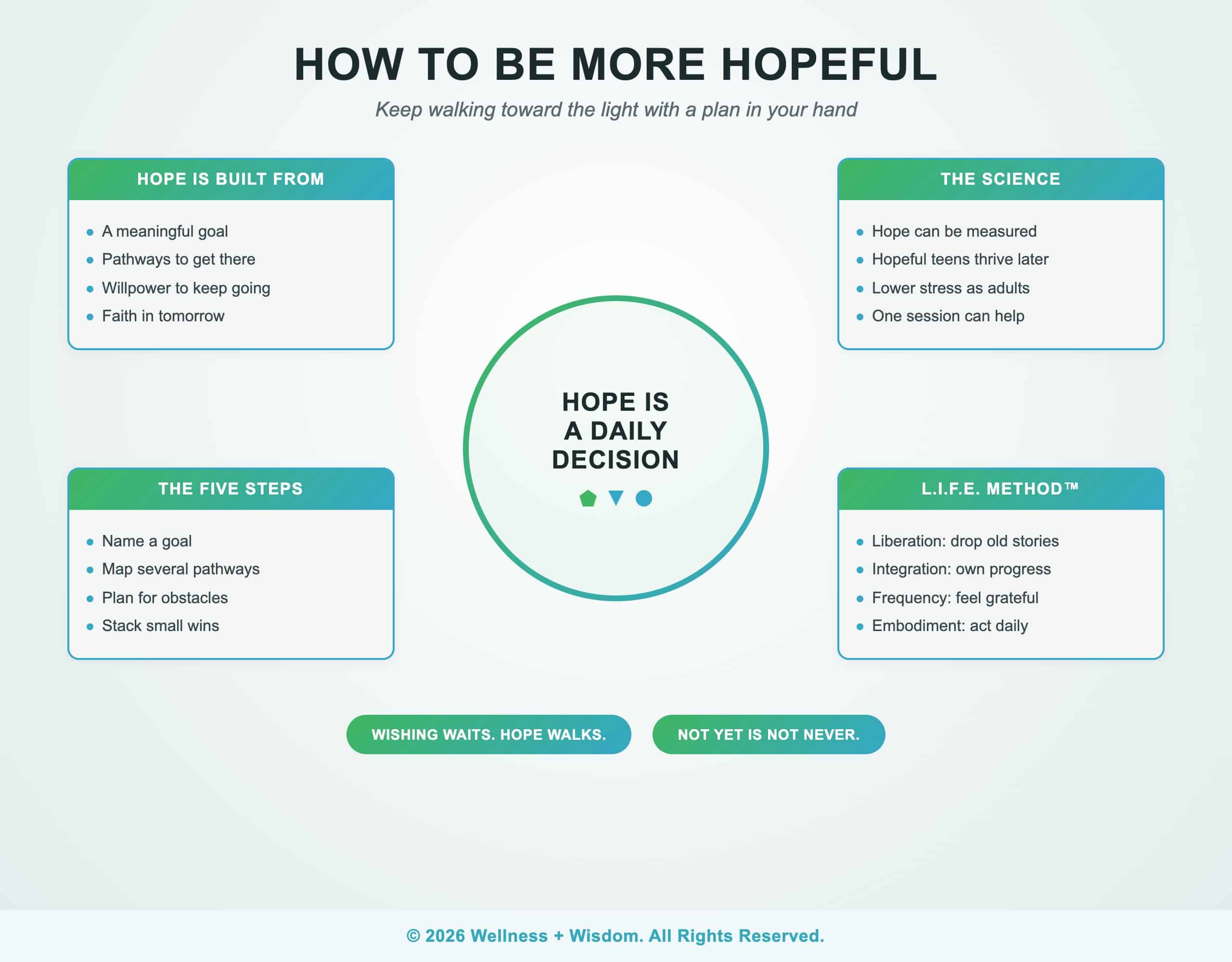
You learn how to be more hopeful by naming a meaningful goal, mapping several pathways, planning for obstacles, fueling your willpower with small wins, and borrowing hope from people who believe in you. These five practices turn hope from a feeling into a skill. Here is how I practice and teach them.
1. Name a Meaningful Goal
Hope needs a target. Choose one goal that genuinely matters to you, something you want rather than something you think you should want. Make it specific enough to picture. “Feel better” becomes “Walk outside for twenty minutes five days a week.” “Fix my finances” becomes “Save a small amount every Friday.” Clear, meaningful goals give hope something to grab onto. If you are not sure what matters most, the ideas in how to reconnect with your purpose can help.
2. Map Several Pathways
Once you have a goal, brainstorm at least three ways to reach it. Write them down. If your goal is to move more, your pathways might be a morning walk, a lunchtime stretch, or a weekend hike with a friend. Having more than one path matters, because the first one will not always work. Hopeful people are not those who never hit roadblocks. They are the ones who already have a detour in mind.
3. Plan for Obstacles
Ask yourself, “What is most likely to get in my way?” Then decide in advance what you will do when it shows up. “If it rains, I will walk at the mall.” “If I feel tired after work, I will do ten minutes instead of thirty.” Planning for obstacles keeps setbacks from turning into stopping points. The practices in how to build emotional resilience go deeper here.
4. Fuel Your Willpower With Small Wins
Agency grows through evidence. Each time you take a small step toward your goal, your brain gathers proof that you can do this. Break big goals into tiny actions you can complete today. Check them off. Notice them. Over time, these small wins add up to a deep sense of “I can.” If motivation is running low, the ideas in how to find motivation are a wonderful support.
5. Borrow Hope From Others
When your own hope runs low, lean on people who believe in you. Talk with a friend who sees your potential. Read stories of people who overcame similar challenges. Join a community that is moving in the same direction. Hope is contagious, and sometimes the fastest way to find it is to sit near someone who already has it. The Liberated Life Tribe is a warm place to borrow hope and share your own.
Start with one or two of these practices this week. Hope grows the moment you begin to act on it.
Here is a simple daily rhythm if you are wondering how to be more hopeful on a busy schedule. In the morning, write down one goal for the day and one small step you will take toward it. At midday, check in: Is there an obstacle showing up, and what is your detour? In the evening, write down one thing that went right and one sign of progress, however small. Before bed, say a short prayer or intention for tomorrow. These tiny habits train your mind to look forward with expectation instead of dread.
Your words shape your hope too. Notice how you talk about the future. “This will never work” closes doors. “I have not found the way yet” keeps them open. Adding the word “yet” to your sentences is one of the simplest hope practices there is. Try it today: “I am not where I want to be yet.” “I do not know how yet.” Small changes in language can create big changes in how possible the future feels.
Imagination is another powerful hope tool. Take a few minutes to picture your life one year from now if things go well. Where are you? Who is with you? How do you feel? Write it down in detail. Researchers who study hope often use this kind of future visualization, because a clear picture of a good future makes the pathways easier to see. Return to this picture whenever you need a lift.
Your body plays a role as well. Hope is harder to access when you are exhausted, hungry, or stuck indoors for days. Simple care like sleep, sunlight, movement, and nourishing food gives your mind the energy it needs to look forward. Many people find that a short walk outside, especially somewhere beautiful, brings hope back faster than any amount of thinking. Moments of wonder help too, which is why the practices in how to experience awe are such a natural companion to hope.
Hope Versus Wishful Thinking
Hope and wishful thinking can look similar, but they are very different. Wishful thinking is wanting a good outcome without a plan or action. Hope is wanting a good outcome and actively working toward it, with pathways and willpower. Wishing waits. Hope walks.
Wishful thinking sounds like, “I hope things just get better somehow.” Real hope sounds like, “I want things to get better, here is what I am going to try, and here is what I will do if that does not work.” Wishful thinking can leave people feeling passive and disappointed. Hope gives people a sense of participation in their own lives.
Hope is also different from forced positivity. You do not have to pretend everything is fine to be hopeful. In fact, real hope makes room for honest feelings. You can feel sad, scared, or frustrated and still hold hope that things can improve. Hope says, “This is hard, and I believe there is a way forward.” If negative thought loops make that difficult, the ideas in how to stop negative thinking can help you find steadier ground.
Hope also lives comfortably with uncertainty. You do not need to know exactly how things will turn out to feel hopeful. You only need to believe that you can keep taking meaningful steps. The practices in how to make peace with uncertainty are a beautiful companion to this kind of grounded hope.
How to Be More Hopeful With the L.I.F.E. Method™
The L.I.F.E. Method™ offers a meaningful framework for hope, because each of its four pillars, Liberation, Integration, Frequency, and Embodiment, helps you release hopeless stories and build a future rooted in who you are becoming.
Liberation is about releasing the old beliefs that keep hope small, like “Good things do not happen to people like me” or “I always mess things up.” Many of these beliefs were absorbed early in life, which is where Emotional Epigenetics™ offers insight. When you see where a hopeless story came from, you can choose a new one. Integration is about weaving your progress into your identity. Each step you take becomes evidence that you are someone who moves toward what matters.
Frequency is about the emotional energy you carry. Hope naturally raises your frequency, bringing expectation, warmth, and courage. Gratitude raises it too, because noticing what is already good makes it easier to believe more good is coming. Embodiment is about living your hope through daily action: the walk, the phone call, the application, the prayer. When you move through these four pillars, hope stops being something you wait for and becomes something you practice. To learn more about how this framework came to life, visit my story.
Gratitude deserves a special mention here. Hope looks forward, and gratitude looks at what is already good. Together they create a powerful rhythm. Each evening, write down three things you are grateful for and one thing you are looking forward to. This simple practice trains your mind to see goodness behind you and possibility ahead of you. The ideas in how to cultivate daily gratitude go deeper.
Remember that hope is a skill you strengthen with repetition. Some days it will feel natural and other days it will take effort. Both are normal. Learning how to be more hopeful is less about feeling hopeful all the time and more about returning to your goals, your pathways, and your faith again and again.
Celebrating Signs of Progress
Celebrating signs of progress keeps hope alive, because your brain learns through reward. When you notice and honor each step forward, you build the agency that makes the next step easier.
Look for small signs of movement. The day you walked even though you did not feel like it. The conversation that went better than expected. The savings account that grew a little. The morning you woke up feeling lighter. These moments are evidence that change is happening. Write them down in a hope journal and read them back when progress feels slow.
Share your progress with someone who cares about you. Telling a friend or family member about your wins makes them more real and invites encouragement. There is a whole practice around noticing these moments in celebrating small wins, and every small win is a seed of hope.
Hope in Families, Work, and Faith
Hope in families, work, and faith grows when we practice it together. Shared goals, shared encouragement, and shared trust in God create environments where hope can flourish for everyone.
In families, hope can be modeled and taught. Talk with your children about their dreams and help them map out small steps. When they face setbacks, ask, “What is another way you could try?” That question teaches pathways thinking. Share your own goals and progress too, so kids see hope in action. Carrie and I love dreaming with Nayah and Novah about what they want to create, and watching their eyes light up reminds us how natural hope is when it is nurtured.
At work, hope fuels creativity and resilience. Teams with hopeful leaders tend to set clear goals, celebrate progress, and recover faster from setbacks. You can bring hope to your workplace by naming a shared goal, brainstorming multiple ways forward, and recognizing each step of progress. A hopeful attitude often becomes the culture of an entire team.
In faith, hope runs deep. For many people, trust in God is the anchor that holds when everything else feels uncertain. Prayer, scripture, worship, and community remind us that we are not alone and that our story is still being written. This is also where the Wellness Pentagon™ becomes helpful, reminding us that our physical, mental, emotional, financial, and spiritual lives are connected, including our Connection to Creator and God. If you want to deepen this dimension, the ideas in how to build a spiritual practice are a beautiful next step. You will find many guests sharing how hope and faith carried them through across our latest episodes.
Trusting the bigger picture can be a powerful source of hope as well. Sometimes doors close so better ones can open. Sometimes delays protect us or prepare us. Holding your plans with open hands, while still taking steady action, is one of the most peaceful ways to live. The ideas in how to trust the process explore this beautifully.
When Hope Feels Far Away
If hope feels far away right now, you are not alone, and it is completely understandable. Loss, illness, financial strain, and long seasons of struggle can all drain hope. Learning how to be more hopeful in these moments starts with being gentle with yourself and taking the smallest possible step.
When hope feels distant, shrink your focus. Instead of trying to feel hopeful about your whole future, look for hope in the next hour. Can you drink a glass of water, step outside, or call one person? Small actions create small sparks, and small sparks can grow. If your mind tends to jump to worst case scenarios, the ideas in how to stop catastrophizing can help you return to the present. Supportive tools like a hope journal or a daily devotional can help too, and you can find a few we trust in our wellness tools store.
Sometimes a lasting loss of hope is connected to depression or deep exhaustion. If you notice persistent hopelessness, loss of interest in things you once loved, or thoughts that life is not worth living, please reach out to a qualified health professional or a crisis line right away. There is real strength in asking for help, and the ideas in how to ask for help can make that first step a little easier. Wherever you are, trust that hope can return.
Ready to go deeper? Join the Liberated Life Tribe and receive your 10 day Self Liberation Blueprint at liberatedlife.com. It is free, it is guided, and each day offers a gentle practice to help you set meaningful goals, find new pathways, and step into the future you want to create.
Frequently Asked Questions
What is hope?
Hope is the belief that you can reach meaningful goals, combined with the ability to find pathways toward them and the motivation to keep going. Researchers often describe it as willpower, the sense that you can do it, plus way power, the ability to plan routes forward.
Can you learn to be more hopeful?
Yes. Hope is shaped by how you set goals, plan pathways, and build motivation. In one study, a single ninety minute session increased hope, life purpose, and progress on personal goals among college students.
What are the benefits of hope?
A long term study of more than 11,000 adolescents found that those with more hope went on to have better self rated health, fewer depressive symptoms, lower stress, greater happiness, and more volunteering as adults.
What is the difference between hope and optimism?
Optimism is a general expectation that good things will happen. Hope adds a sense of personal agency and planning, the belief that you can help create good outcomes and the ability to find ways to get there.
How can I feel hopeful when life is hard?
Shrink your focus to the next small step, lean on people who believe in you, notice small signs of progress, care for your body, and lean on your faith. If hopelessness persists, please reach out to a qualified health professional.
How can I help my children be more hopeful?
Talk with them about their dreams, help them break goals into small steps, ask “What is another way you could try?” when they hit setbacks, and share your own goals and progress so they see hope in action.
Studies and External Resources
The science in this article rests on peer reviewed research. These are the sources referenced throughout.
- Snyder CR, et al. (1991). The will and the ways: development and validation of an individual differences measure of hope. Journal of Personality and Social Psychology. PubMed: 2037968
- Long KNG, Wilkinson R, Cowden RG, Chen Y, VanderWeele TJ. (2024). Hope in adolescence and subsequent health and well being in adulthood: an outcome wide longitudinal study. Social Science and Medicine. PubMed: 38493683
- Feldman DB, Dreher DE. (2012). Can hope be changed in 90 minutes? Testing the efficacy of a single session goal pursuit intervention for college students. Journal of Happiness Studies. View the study via DOI
About Josh Trent
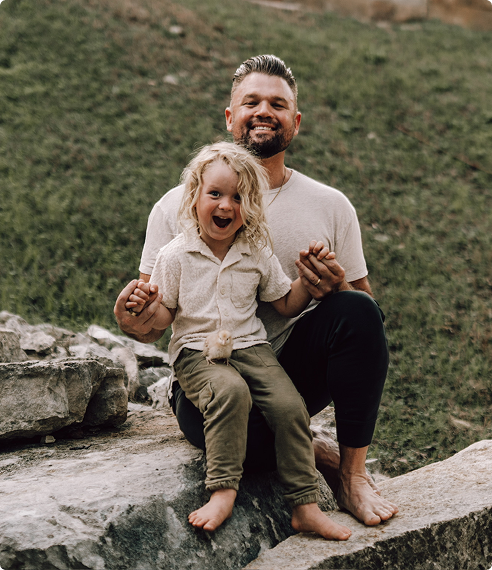
Josh Trent is an Identity Transformation Architect and the award winning host of the Wellness + Wisdom Podcast, with over 15 million downloads since 2015. He is the creator of the L.I.F.E. Method™ Identity Transformation System and steward of the Emotional Epigenetics™ and BREATHE: Breath + Wellness™ systems of self mastery, impacting over 1,000 students worldwide. Join the Liberated Life Tribe and receive your 10 day Self Liberation Blueprint at liberatedlife.com. Josh lives in Austin, Texas with his wife Carrie, daughter Nayah, and son Novah. Peace and power.
Disclosure: We may earn a commission from certain links on this site when you make a purchase, at no extra cost to you. These commissions help support Wellness + Wisdom and do not affect the products or resources we choose to recommend. Full disclosure .