
By Josh Trent | Wellness + Wisdom Podcast Host & Identity Transformation Architect
“Your children do not only inherit your eyes and your laugh. They can inherit the chemistry of what you survived. And that means they can also inherit the chemistry of how you heal.”
Josh Trent
Cortisol intergenerational transmission is one of the most important and least understood truths in human biology. The stress your parents and grandparents carried did not simply end with them. Through a hormone called cortisol and the epigenetic marks it leaves behind, the imprint of what your ancestors endured can shape how your own body responds to the world, and how your children's bodies will too. This is the frontier of Emotional Epigenetics™, and it changes how we think about healing.
Here is the joy forward truth I want you to hold from the first sentence. If stress can travel down the generations, so can safety. If a wound can be inherited, so can the repair. The very mechanism that carried the burden forward is the same mechanism that can carry liberation forward. You are not the end of a sad story. You can be the beginning of a new one, and your neural system is where that new story starts.
Table of Contents
- What Cortisol Intergenerational Transmission Actually Means
- Cortisol: The Messenger That Carries the Load
- The Holocaust Study and FKBP5 Methylation
- The Cherry Blossom Study: Fear That Skips a Generation
- The Womb as the First Environment
- Cortisol and Offspring: How the Signal Passes
- What Inherited Stress Feels Like From the Inside
- Why This Is Not a Life Sentence
- How to Break the Cycle for Your Children
- Healing Is Also Inheritable
- Frequently Asked Questions
- Studies and External Resources
- About Josh Trent
What Cortisol Intergenerational Transmission Actually Means
Cortisol intergenerational transmission means that the stress chemistry of one generation can influence the biology of the next. It is not a metaphor and it is not mysticism. It is a measurable pattern in which the way a parent's body regulates stress, governed largely by the hormone cortisol, leaves epigenetic marks that shape how their children's bodies regulate stress in turn.
For most of modern history, we assumed inheritance was simple. You got your DNA sequence from your parents, and that was the end of the conversation. What we now understand is that there is a second layer of inheritance riding on top of the genes, a layer of chemical tags that tell genes when to switch on and off. Stress is one of the most powerful forces shaping that layer, and cortisol is the hormone at the center of it. This is the same principle we explore in inherited trauma and bioenergetic memory.
What makes this so profound is where it locates responsibility and possibility. The patterns you carry are not your fault. You did not choose the chemistry you were handed. And yet the healing is available to you, which means it is also your responsibility, in the most empowering sense of that word. It is not your fault, but it is your opportunity.
Cortisol: The Messenger That Carries the Load
To understand cortisol intergenerational patterns, you first have to understand cortisol itself. Cortisol is your primary stress hormone, released by the adrenal glands when your brain perceives a demand or a threat. In healthy amounts and healthy rhythms, it is essential. It wakes you up, mobilizes energy, and sharpens your response to challenge.
The trouble begins when cortisol regulation gets disrupted, either by chronic stress in your own life or by an inherited pattern that set your baseline before you were old enough to remember. As the researcher Bruce McEwen described in the New England Journal of Medicine, chronic stress creates what he called allostatic load, the cumulative wear that builds when stress systems stay switched on. A dysregulated cortisol rhythm is one of the clearest signatures of that load.
What does this dysregulation actually look like from the inside? It can show up as waking at three in the morning with a racing mind, as an afternoon crash that no amount of coffee fixes, or as a body that feels wired and tired at the same time. These are not character flaws or a lack of discipline. They are the felt experience of a cortisol rhythm that has lost its natural shape, often for reasons that began long before your own choices entered the picture.
Here is the key insight for our topic. The system that regulates cortisol, known as the HPA axis, can be calibrated by early experience and even by conditions before birth. A body that develops in an environment of high stress may set its cortisol thermostat differently, running hotter or, in some cases, blunting the response entirely. That calibration then becomes a kind of inheritance, a starting point passed from parent to child. Learn how to recalibrate yours in our guide to box breathing.
The Holocaust Study and FKBP5 Methylation
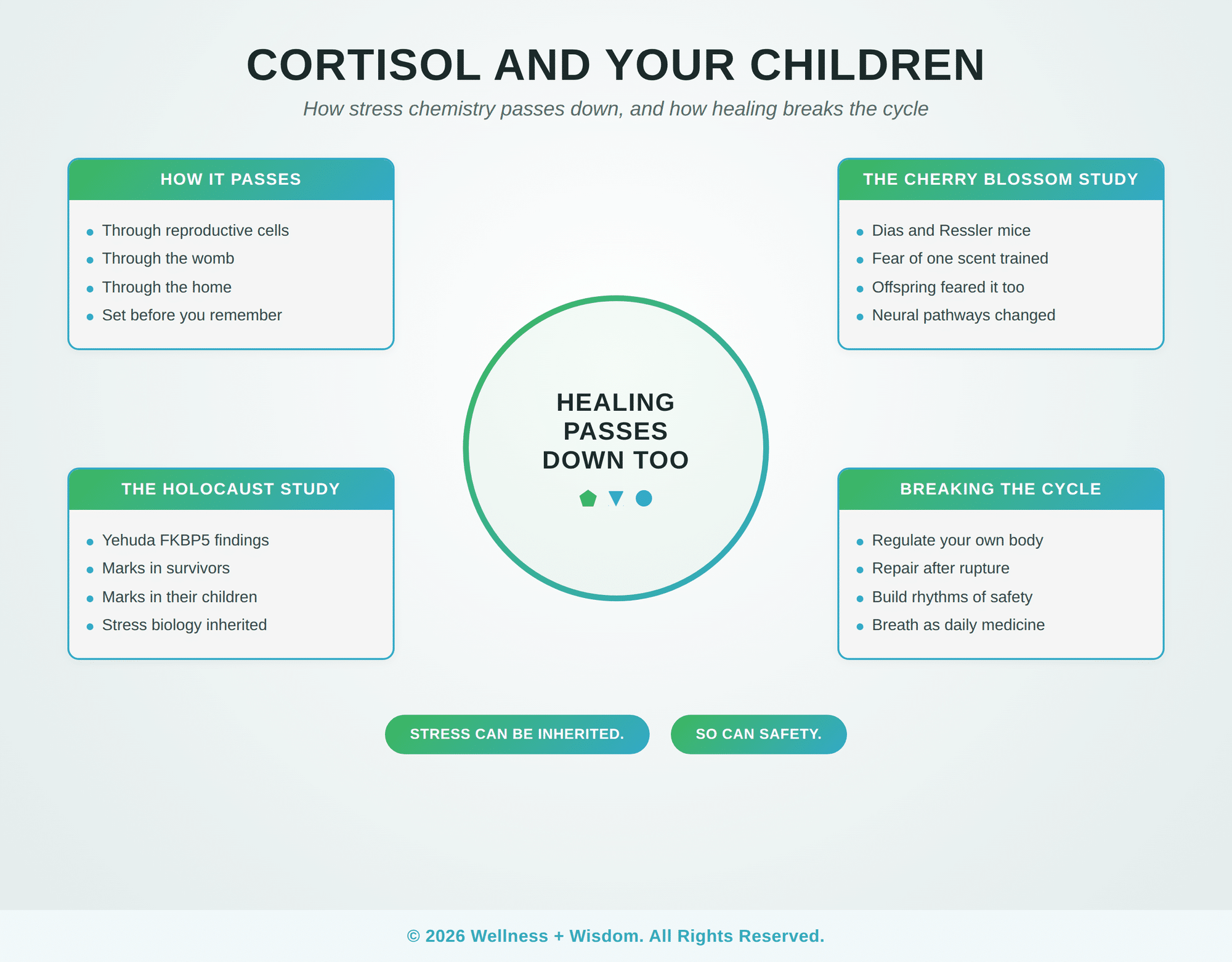
The most striking evidence for cortisol intergenerational effects comes from a study by Rachel Yehuda and her colleagues, published in Biological Psychiatry. They studied Holocaust survivors and their adult children, looking at a gene called FKBP5, which plays a central role in how the body regulates cortisol and the stress response.
What they found was remarkable. The researchers observed changes in FKBP5 methylation, the epigenetic tagging of that gene, in both the survivors and their offspring. In other words, the biological signature of extreme stress appeared not only in the people who lived through the trauma, but in their children, who did not. The pattern of these marks in the offspring was distinct, suggesting a genuine intergenerational effect rather than a coincidence.
Sit with what that means. The most catastrophic stress imaginable left a measurable mark on the stress biology of the next generation. This is the hard science behind what wisdom traditions and families have sensed for centuries, that pain can echo forward through a lineage. It is the empirical backbone of breaking generational patterns.
I want to be careful and honest here, because good science requires humility. This is a young and complex field, and researchers are still working out the precise mechanisms and the full picture. But the direction of the evidence is clear and it is serious. Stress leaves epigenetic marks, and some of those marks appear in the next generation.
The Cherry Blossom Study: Fear That Skips a Generation
If the Holocaust research shows the pattern in humans, an elegant animal study shows the mechanism with startling clarity. Kerry Ressler and Brian Dias, publishing in Nature Neuroscience, trained male mice to fear a specific smell, the scent of cherry blossom, by pairing it with a mild stressor. Then they looked at the offspring, and even the grand offspring, of those mice.
The result changed the field. The children and grandchildren of the trained mice showed heightened sensitivity to that same cherry blossom scent, despite never having encountered it or the stressor themselves. The inherited fear even corresponded to physical changes in the structure of their scent detecting neural pathways. A specific learned association had traveled down the generations through the biology of the reproductive cells.
This is why the conversation about cortisol intergenerational transmission is not just theory. In a controlled setting, researchers watched an experience in one generation shape the neural structure and behavior of the next. The body remembers, and it can pass the memory forward. The full story of how fear becomes hypervigilance is one we explore in our work on the neural system.
The Womb as the First Environment
Long before a child takes a first breath, their stress system is already being shaped, and cortisol is one of the primary sculptors. The womb is not a sealed vault. It is a rich informational environment, and a mother's stress chemistry is part of the information the developing baby receives.
When a pregnant mother experiences sustained stress, elevated cortisol can influence how the baby's own stress system develops. The developing body, in a sense, reads the chemical signals of the world it is about to enter and calibrates accordingly. If the signals suggest the world is dangerous, the baby's stress system may be set to a more reactive baseline, prepared for a hard environment before it has even arrived.
This is not about blaming mothers, and I want to be emphatic about that. A mother's stress is very often the product of her own inheritance and her own circumstances, and no mother chooses to pass on a burden. Understanding this pathway is not about guilt. It is about compassion, and about widening the circle of support around mothers so that their bodies, and their babies' bodies, can settle into safety.
It also points to something deeply hopeful. If the prenatal environment matters, then supporting the wellbeing of expecting parents is one of the most powerful forms of preventive healing we have. Calm, connection, and regulation for a mother are not luxuries. They are direct gifts to the next generation's biology. This is a core reason we treat conscious parenting as something that begins long before a child is born, and why the whole Wellness Pentagon™ matters so much for families.
Cortisol and Offspring: How the Signal Passes
How does cortisol and offspring biology actually connect? There are several pathways, and researchers are mapping them with growing precision. The signal can pass through changes in the reproductive cells themselves, carrying epigenetic marks into the next generation. It can pass through the environment of the womb, where a mother's cortisol levels shape the developing baby's stress system. And it can pass after birth, through the emotional atmosphere a child grows up in, which teaches the young neural system what to expect from the world.
Notice something important about that list. Some of these pathways are set before you were born, but others are shaped by the daily experience of a childhood home. That is enormously hopeful, because it means a regulated, safe, loving environment is not just nice. It is a biological intervention. The calm you cultivate in your home is literally shaping your child's stress chemistry.
This is where the science of cortisol intergenerational patterns meets the practice of conscious parenting. You do not have to be a perfect parent. Perfection was never the goal and never the mechanism. What matters is that a child's body gets enough repeated experiences of safety, repair, and connection to set a healthier baseline than the one you may have received.
What Inherited Stress Feels Like From the Inside
For all the talk of genes and methylation, cortisol intergenerational patterns are not abstract. They show up in ordinary life, in ways most people never connect to their lineage. If you have ever felt a level of anxiety that seemed out of proportion to your actual circumstances, or a bracing for danger that never fully switches off even when life is calm, you may be feeling the echo of a stress baseline that was set before you had any say in it.
Inherited stress can feel like a body that struggles to rest even when it is safe. It can feel like a startle response that fires too easily, a mind that scans for threat out of habit, or a quiet certainty that you must stay on guard. It can look like difficulty trusting that good things will last, or a tendency to brace for the other shoe to drop. None of this means something is wrong with you. It means your neural system learned a lesson, possibly generations ago, that the world requires vigilance.
I have sat with hundreds of people who carried this and assumed it was simply their personality. Anxious. High strung. Unable to relax. When they learned that their baseline may have been calibrated by inherited stress chemistry, something shifted. The shame lifted, because you cannot be blamed for a thermostat setting you never chose. And once the shame lifts, the real work becomes possible, which is gently teaching the body a new setting through breath, safety, and repair.
This is why I never frame this work as fixing what is wrong with you. There is nothing wrong with a body that learned to survive. The invitation is simply to update the lesson, to give your neural system enough new evidence of safety that it can finally exhale. That updating is not only possible. It becomes the most natural thing in the world once you know how to offer it.
Why This Is Not a Life Sentence
It would be easy to read all of this and feel doomed, as if your biology were fixed by events you never chose. That reading is both inaccurate and, frankly, the opposite of what the science supports. The defining feature of epigenetic marks is that they are changeable. Unlike your DNA sequence, which is fixed, these tags respond to how you live, and they can shift across a lifetime.
The same Dias and Ressler line of research that showed inherited fear also pointed toward reversal, demonstrating that the effects of these learned associations could be diminished through specific interventions. And a growing body of work on meditation, breathwork, and lifestyle shows measurable changes in the epigenetic landscape of people who commit to these practices. The marks that stress writes, calm can begin to rewrite.
This is the entire premise of the L.I.F.E. Method™ and the reason I have devoted my life to this work. Your inheritance is a starting point, not a destiny. The story your body is telling can be edited, and you are the one holding the pen. Explore how this connects to identity in our piece on identity transformation.
How to Break the Cycle for Your Children
Understanding cortisol intergenerational transmission is only powerful if it changes what you do. Here is how you begin to break the cycle, not with perfection, but with practice. These five practices are the practical core of reversing cortisol intergenerational patterns in your own home, and none of them require money, equipment, or anything beyond your willingness to show up for your body again and again.
1. Regulate Your Own Neural System First
Children co regulate with the adults around them. Their stress systems calibrate to yours. The single most powerful gift you can give your child's biology is your own regulated presence. Breath, rest, and repair are not selfish. They are the foundation of the safe atmosphere your child's body learns from.
2. Repair After Rupture
You will lose your patience. Every parent does. What matters is not the absence of rupture but the presence of repair. When you reconnect after a hard moment, you teach your child's neural system that safety returns, that conflict is survivable, and that love is stable. Repair is the antidote to inherited fear.
3. Name and Feel Your Own Inheritance
You cannot heal what you will not feel. Turning toward your own inherited patterns, with support, is how you stop passing them on unconsciously. This is deep work, and it is worth every ounce of courage it takes. Our work on inherited limiting beliefs is a doorway in.
4. Build Rhythms of Safety
The stress system loves predictability. Consistent rhythms of sleep, meals, connection, and rest send a steady signal of safety to a developing body. These rhythms are not rigid rules. They are a biological love language that tells your child the world can be counted on.
5. Use the Breath as Medicine
Breathwork is the fastest way to shift a stress state in real time, for you and, as they grow, for your children. Teaching a child to take a long slow exhale is teaching them to regulate their own cortisol. This is why breath is central to the BREATHE™ program and to everything we teach.
Start with the first one. Your own regulation is the root from which all the others grow. When you are ready to go deeper with a community doing this work together, the Liberated Life Tribe and the Wellness + Wisdom Podcast are here to walk with you. Explore more through our Wellness Pentagon and the full L.I.F.E. Method.
Healing Is Also Inheritable
If there is one idea I want you to carry out of this article, it is this. Cortisol intergenerational transmission runs in both directions. The same biology that can pass a burden forward can pass a blessing forward. When you regulate your body, turn toward your inherited patterns, and build a life of genuine safety, you are not only healing yourself. You are changing the environment and, over time, the chemistry that your children and their children will inherit.
Think about the weight of that, and then think about the lightness of it. Every long exhale you take, every moment of repair after a hard day, every night of real rest is a small deposit into a healthier lineage. You will never see most of the returns. They will unfold in people you may never meet, in a great grandchild who simply finds it a little easier to feel safe in the world. That is a legacy worth building with your whole heart.
This is the heart of why we say that healing changes the code for seven generations forward. It is not a slogan. It is the logical conclusion of what the science is showing us. The marks of stress can travel down a family line, and so can the marks of safety, love, and regulation. You get to decide which ones you amplify with the way you live.
So do not carry this knowledge as a burden. Carry it as an invitation. You are standing at a hinge point in your family's story, holding the pen. The L.I.F.E. Method™ exists to help you write the next chapter, and the Liberated Life Tribe exists so that you never have to write it alone.
Frequently Asked Questions
What is cortisol intergenerational transmission?
Cortisol intergenerational transmission is the way stress chemistry from one generation can influence the stress biology of the next. Through cortisol and the epigenetic marks it leaves on genes like FKBP5, a parent's stress regulation can shape how their children's bodies respond to stress, even before those children have their own stressful experiences.
What did the Holocaust study actually find?
Rachel Yehuda and colleagues, publishing in Biological Psychiatry, found changes in FKBP5 methylation, an epigenetic mark on a key stress regulation gene, in both Holocaust survivors and their adult children. The finding suggested that the biological signature of extreme stress appeared in offspring who had not lived through the trauma themselves.
Does this mean my children are doomed to my stress patterns?
No. Epigenetic marks are changeable, which is the most hopeful part of this science. Unlike your fixed DNA sequence, these tags respond to how you live. A regulated, safe, and loving environment is a genuine biological intervention that can help set a healthier stress baseline for your children.
What is FKBP5 methylation?
FKBP5 is a gene that helps regulate the body's stress response and its sensitivity to cortisol. Methylation is a type of epigenetic tag that influences how strongly a gene is expressed. Changes in FKBP5 methylation are associated with altered stress regulation, and they are one of the markers researchers have studied in intergenerational trauma.
How can I break the cycle for my kids?
Begin by regulating your own neural system, because children co regulate with the adults around them. Prioritize repair after conflict, build predictable rhythms of safety, turn toward your own inherited patterns with support, and use breathwork as a shared tool. You do not need to be perfect. You need to provide enough repeated experiences of safety and repair.
How does this connect to Emotional Epigenetics?
Emotional Epigenetics™ is the understanding that emotional patterns, beliefs, and environment shape genetic expression. Cortisol intergenerational transmission is a clear example of this principle in action, showing how stress leaves marks that can pass forward, and how changing the inputs can change the outcome for generations to come.
Studies and External Resources
The science in this article rests on peer reviewed research. These are the sources referenced throughout.
- Yehuda R, et al. (2016). Holocaust Exposure Induced Intergenerational Effects on FKBP5 Methylation. Biological Psychiatry. PubMed: 26410355
- Dias BG, Ressler KJ. (2014). Parental olfactory experience influences behavior and neural structure in subsequent generations. Nature Neuroscience. PubMed: 24292232
- McEwen BS. (1998). Protective and damaging effects of stress mediators. New England Journal of Medicine. PubMed: 9428819
About Josh Trent
Josh Trent is an Identity Transformation Architect and the award winning host of the Wellness + Wisdom Podcast, with over 15 million downloads since 2015. He is the creator of the L.I.F.E. Method™ Identity Transformation System and steward of the Emotional Epigenetics™ and BREATHE: Breath + Wellness™ systems of self mastery, impacting over 1,000 students worldwide. Join the Liberated Life Tribe and receive your 10 day Self Liberation Blueprint at liberatedlife.com. Josh lives in Austin, Texas with his wife Carrie, daughter Nayah, and son Novah.
Disclosure: We may earn a commission from certain links on this site when you make a purchase, at no extra cost to you. These commissions help support Wellness + Wisdom and do not affect the products or resources we choose to recommend. Full disclosure .