By Josh Trent, Identity Transformation Architect and host of the Wellness + Wisdom Podcast
Your body is not asking you to push harder. It is asking you to listen closer.
I have spent two decades with my hands on tools that promise recovery, and most ask you to do the same thing: lie down on something big and grind until it hurts less. That is negotiation by force. Real self myofascial release is precision work, and precision is the difference between a body that opens and a body that braces. Find the exact spot, apply pressure you can breathe into, and your body responds in seconds.
Here is my breakdown of self myofascial release: what it is, what the research supports, why the mechanism is neurological rather than mechanical, and the exact ten minute practice I run daily. I will show you the tools I use too, because the tool matters more than most people admit.
Table of Contents
- What Self Myofascial Release Actually Is
- Why Precision Self Myofascial Release Beats Brute Force
- How Self Myofascial Release Works in Your Neural System
- What the Research Shows
- The RAD Tool Set Built for Precision
- The Ten Minute Daily Self Myofascial Release Method
- Breath Is the Multiplier
- Where This Fits in the Wellness Pentagon
- Self Myofascial Release vs Stretching and Massage
- Five Mistakes That Cancel Your Results
- Frequently Asked Questions
- Studies and External Resources
- Join the Liberated Life Tribe
- About Josh Trent
What Self Myofascial Release Actually Is
Self myofascial release is the practice of applying sustained, targeted pressure to your own soft tissue with a tool so muscle tone drops, range of motion improves, and sensitivity calms down. Myo means muscle. Fascia is the connective web wrapping every muscle, organ, and bone you have. Self means nobody else is doing it for you, which is why it scales into daily life the way a massage appointment never will.
The practical version: take a roller or a ball, find a spot that talks back, settle your weight onto it, and breathe until the signal changes. That is the whole practice. What separates good self myofascial release from wasted time is specificity. Your fascia is not uniform. It carries the imprint of how you actually live: the hip that absorbed ten thousand hours of sitting, the jaw that clenches when the inbox fills, the foot that has never once been given attention.
The old textbooks treated fascia as wrapping material. That model is dead. Fascia is one of the most richly innervated tissues in your body, dense with sensory endings reporting pressure, stretch, and threat back to your brain continuously. You are not kneading dough. You are sending a loud message into a sensory network that has been telling the same story for years, which is why self myofascial release belongs in the same conversation as breathwork and neural system regulation rather than in the equipment aisle.
Why Precision Self Myofascial Release Beats Brute Force
Precision self myofascial release beats brute force because pressure that exceeds your capacity to relax produces guarding, and guarding is the opposite of release. When sensation crosses a threshold your body has one job: protect. Muscles tighten. Breath shortens. The tissue you are trying to open braces harder.
I learned this the hard way. For years I treated recovery like training, so more intensity meant more result. It does not work that way. The tissues that hold the most also hold the most history, and history does not respond to aggression. It responds to attention. When I switched to less pressure, better placement, and actual breathing, my mobility changed faster in three weeks than it had in three years of grinding.
Resolution matters too. A large roller spreads force across a wide surface, so you cannot tell what you are touching. A small, well shaped tool lets you feel the difference between the muscle belly and the attachment, which turns self myofascial release into a conversation with your body instead of a monologue at it.
Three variables you control completely. Placement: one inch changes everything. Pressure: a sensation you can breathe through, not one you survive. Dwell: thirty to ninety seconds of sustained contact is where the change happens.
How Self Myofascial Release Works in Your Neural System
The honest answer is that the name is partly wrong, and knowing why makes you far better at it. A narrative review in Sports Medicine by Behm and Wilke examined what rolling devices actually do and concluded there is insufficient evidence that the primary mechanism is the release of myofascial restrictions at all. The authors went further and called the term self myofascial release misleading as a description of the mechanism.
So what is happening? That same review found rolling activates cutaneous and fascial mechanoreceptors along with interstitial type three and type four afferents, which modulate sympathetic and parasympathetic activation. It also engages global pain modulatory systems and produces reflex driven reductions in muscle tone. Blood flow and fascial hydration shift, which changes stiffness.
Out of the journal and into your living room: sustained pressure floods a dense sensory network with new input. Your brain updates its threat assessment for that region and lowers the protective tone it was holding. Your neural system steps out of guard. Range of motion opens. Sensitivity drops. Nothing was torn. Something was communicated.
Once you understand that, your whole approach to self myofascial release changes. You stop chasing the audible crunch and start creating the conditions that let a neural system stand down: slow breath, unclenched jaw, unhurried mind. People who have lived in chronic hypervigilance often find this liberating, because their tissue is not uniquely stubborn. Their protective system has simply been running longer, which means less pressure and more time. Same principle behind why the body updates through the body.
What the Research Shows
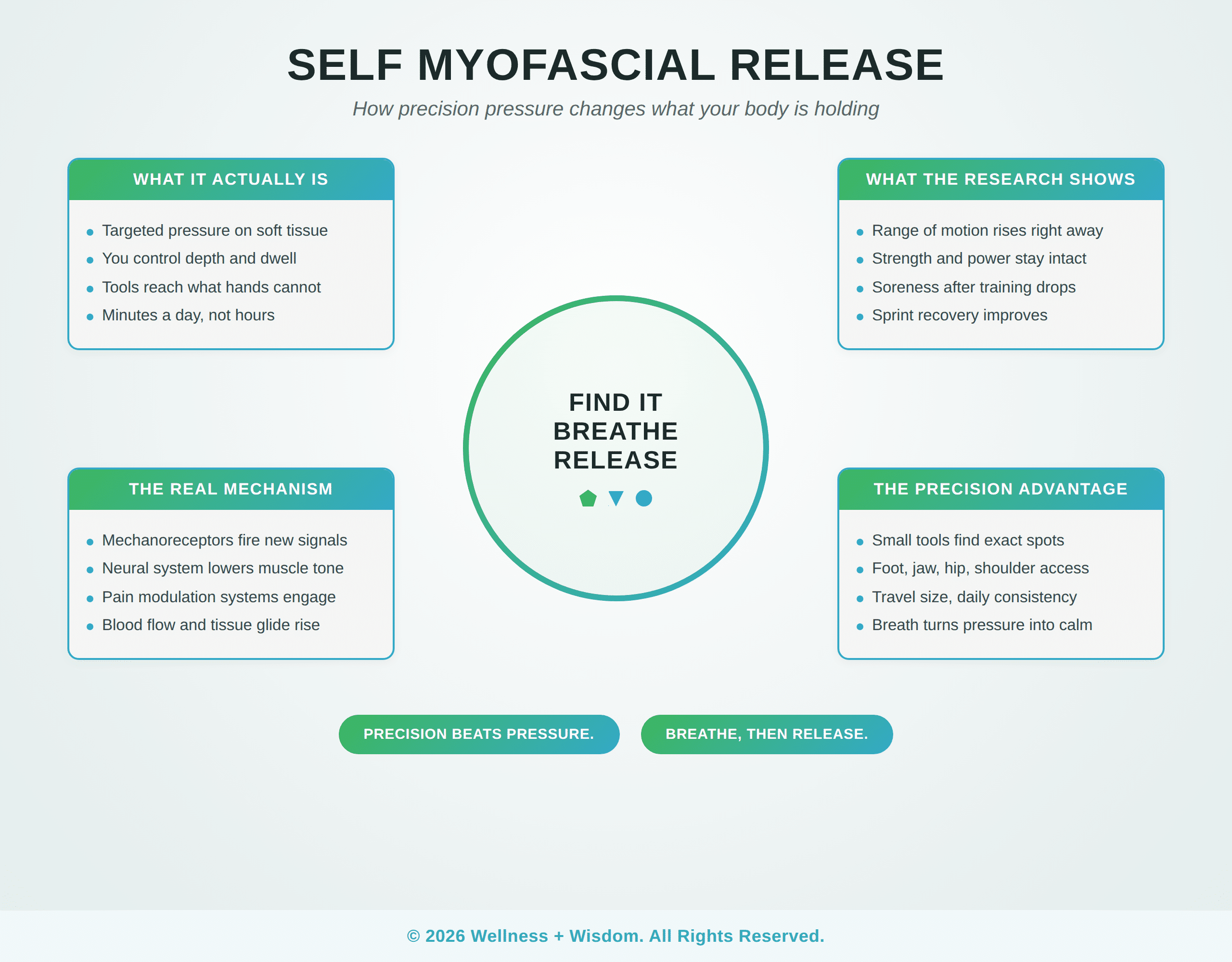
Self myofascial release has a real evidence base for range of motion, soreness, and recovery, and a weaker one for making you stronger or faster on the spot. Honest expectations keep a practice alive past week two.
Range of Motion Improves Immediately, With No Strength Cost
MacDonald and colleagues, in the Journal of Strength and Conditioning Research, had subjects perform two one minute bouts on the quadriceps with a foam roller. Knee range of motion increased significantly by ten degrees at two minutes and eight degrees at ten minutes afterward, with no significant differences in maximum voluntary contraction force or muscle activation. The tissue opened and nothing was given up to get it.
That matters because static stretching before performance has a long history of acutely reducing force output. Cheatham and colleagues reached the same conclusion in a systematic review of fourteen studies in the International Journal of Sports Physical Therapy: short term gains in range of motion with no cost to muscle performance.
Soreness Drops, and the Numbers Stay Honest
Pearcey and colleagues published a controlled study in the Journal of Athletic Training on rolling for delayed onset muscle soreness. Participants did ten sets of ten back squats at sixty percent of their one repetition maximum, then either rolled for twenty minutes immediately and again at twenty four and forty eight hours, or did nothing. Rolling substantially improved quadriceps tenderness with moderate to large effect sizes, plus small to large gains in sprint time, power, and strength endurance. The sample was eight men, and the authors said so plainly.
The wider picture comes from Wiewelhove and colleagues, a meta analysis of twenty one studies in Frontiers in Physiology. Rolling beforehand improved sprint performance by about zero point seven percent and flexibility by about four percent. Rolling afterward reduced the usual decline in sprint performance by about three point one percent and lowered muscle pain perception by about six percent.
Modest numbers, and I will not inflate them. Self myofascial release is a low cost, repeatable practice that reliably makes you move better. Stack it across a year and the compounding is the point, not any single session.
👉 Use code WELLNESS2026 for 20% off at RAD Roller! ❤️
The RAD Tool Set Built for Precision
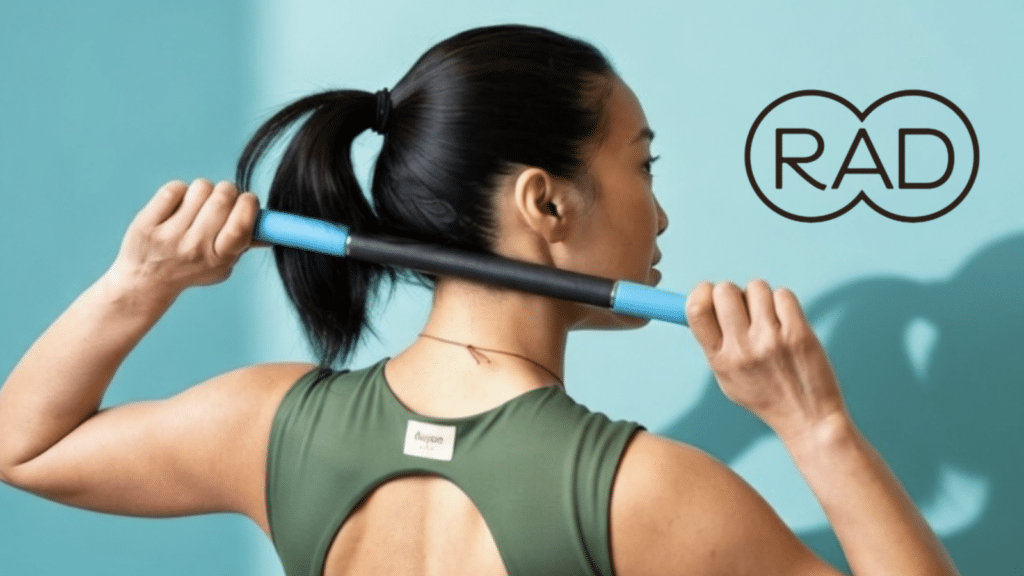
RAD builds the tool set I reach for, and the reason is design intent rather than marketing. The company came out of the medical and manual therapy world, so every piece is shaped for a specific job on a specific part of the body instead of asking one cylinder to do everything.
RAD Roller
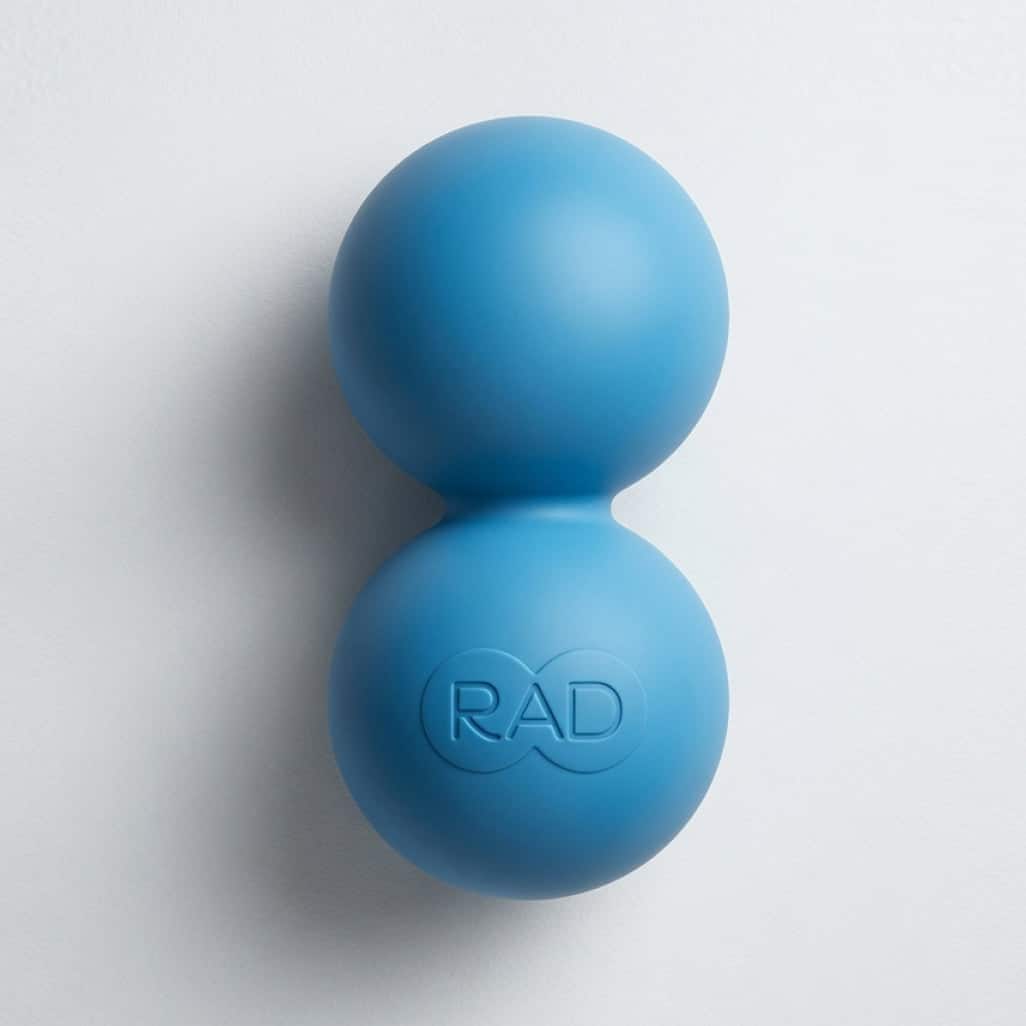
The peanut shaped core tool, two lobes with a channel between them. That channel is the entire point. It runs pressure along either side of your spine without ever loading the vertebrae. For upper back tension, the kind that accumulates from a laptop and a long week, nothing else I own comes close. It fits in a jacket pocket, which means the self myofascial release happens wherever you happen to be.
RAD Rounds
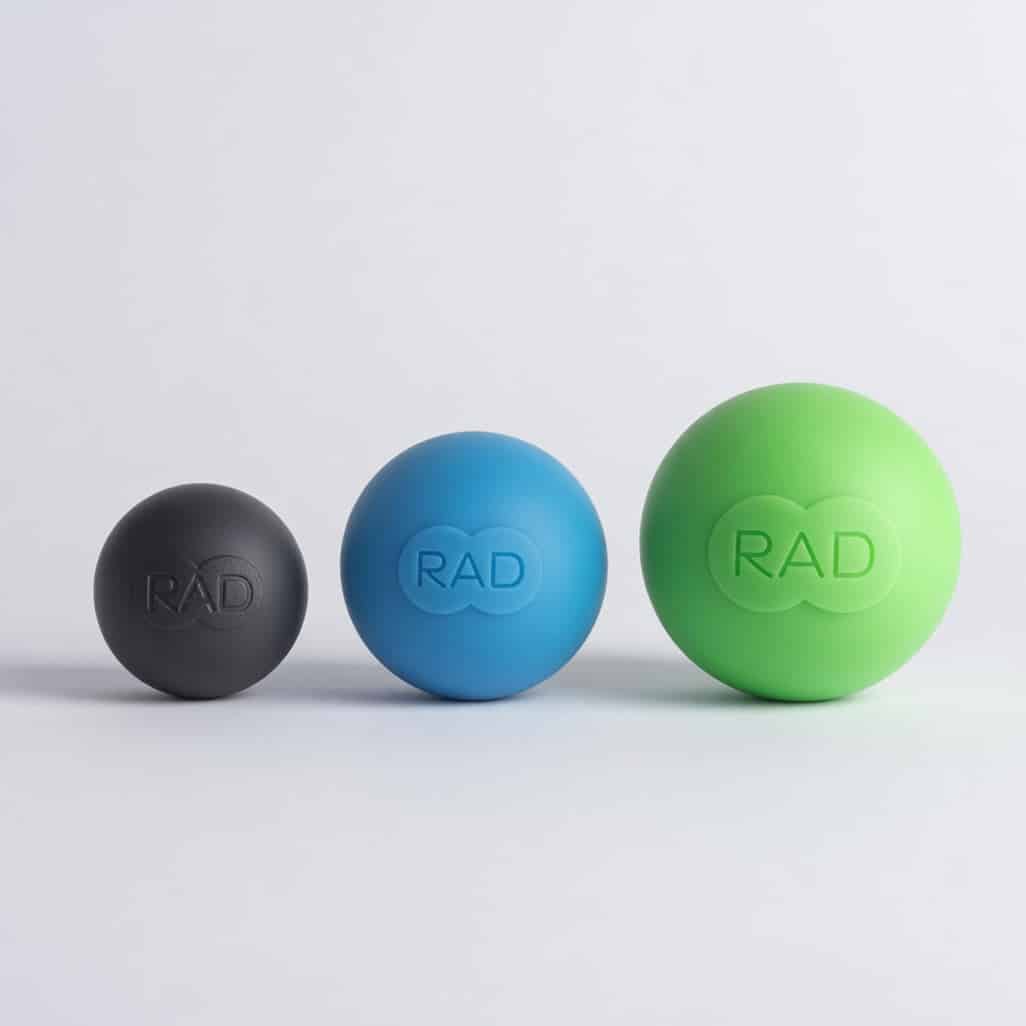
Three balls in different diameters and densities, built for pinpoint work. This is where precision self myofascial release lives. The smallest gets into the arch of a foot, the base of a thumb, the forearm that carries every hour you spend typing. The larger ones handle glutes and shoulders, with focused release and none of the brutality of a lacrosse ball. That sounds minor until you remember the tool you tolerate is the tool you actually use.
RAD Helix
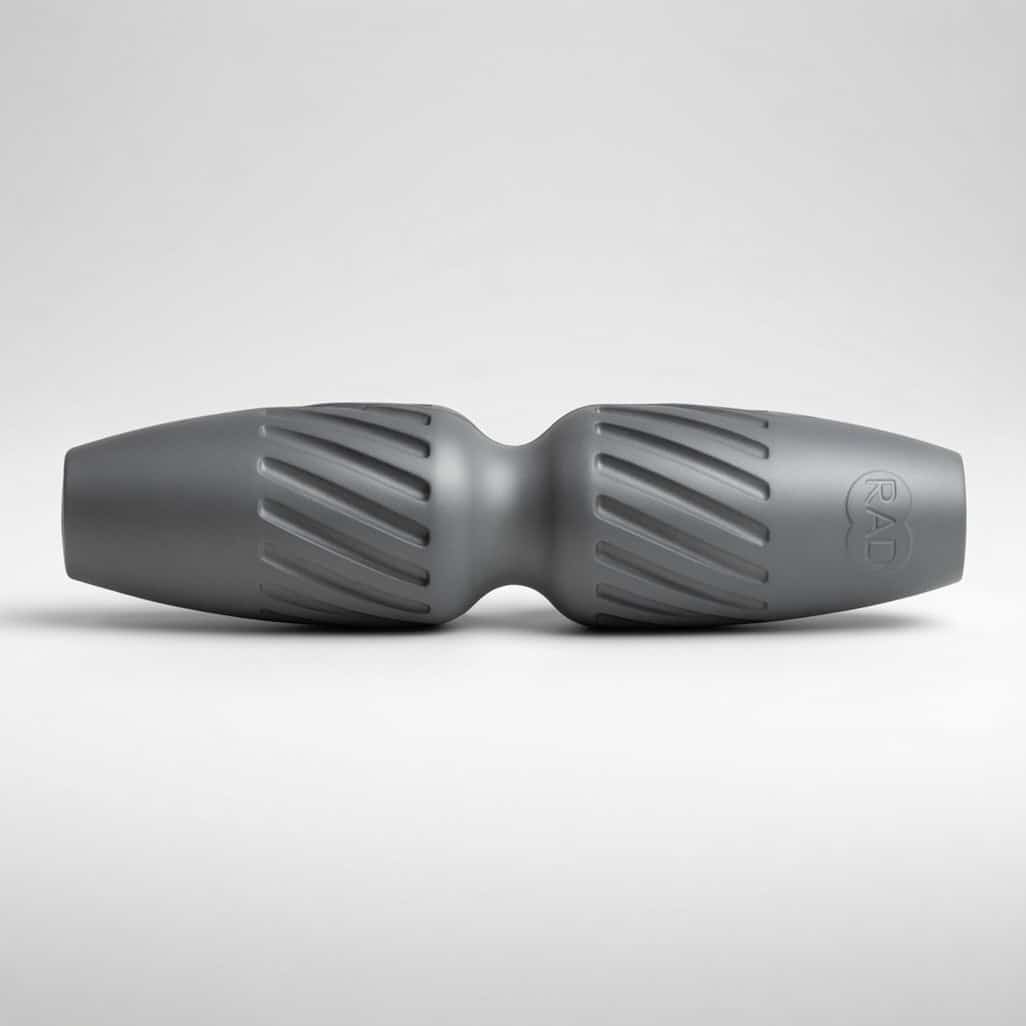
A compact high density foam roller with a spinal recess, so you get the coverage of a traditional roller with a spine sparing design. Twelve and a half inches by three, about a pound, which makes it the piece that travels. Quads, hamstrings, calves, lats, upper back. If you own one larger tool, make it this one.
RAD Rod and RAD Block
The Rod is a steel core massage stick for flushing long muscle groups, and it handles calves and quads standing up. The Block is the piece most people skip and then wish they had bought first. It holds the Roller and the Rounds in recesses so the tool stays exactly where you put it while you load into it hands free, which solves the most frustrating problem in self myofascial release: chasing a ball that slides out the moment you relax.
Which Setup to Start With
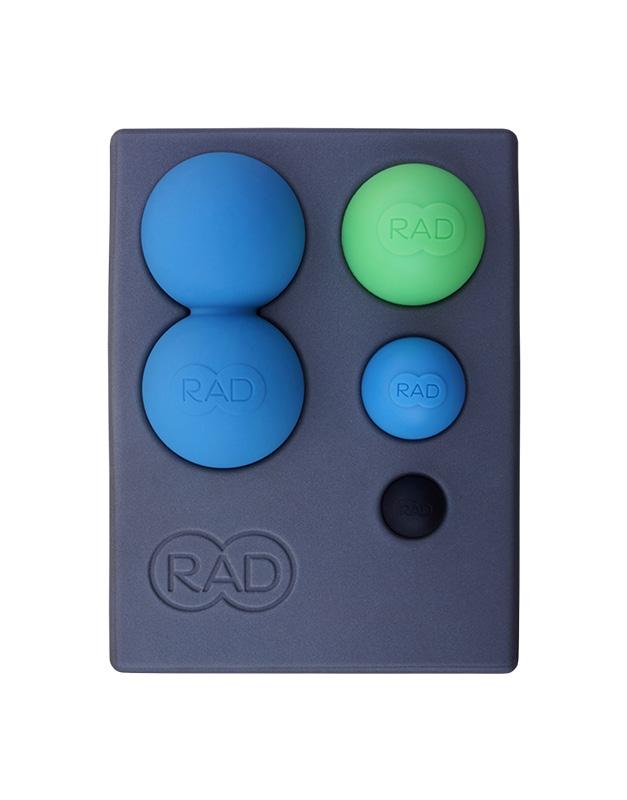
The Point Release Kit pairs the Roller, the Rounds, and the Block, which covers most of the precision self myofascial release you will ever want to do. The All In Kit adds the Helix and the Rod for the complete system. Every tool is rubber based and free of BPA and latex, and RAD runs a mobility app with a large video library so there is no guesswork about placement.
👉 Use code WELLNESS2026 for 20% off at RAD Roller! ❤️
The Ten Minute Daily Self Myofascial Release Method
The best self myofascial release routine is the one that takes ten minutes and happens every day. Five rules govern every round.
One. Breathe or back off. If you cannot take a slow breath in and a longer one out while on the tool, reduce pressure until you can. Breath is how your neural system decides whether this input is safe.
Two. Find, then stay. Explore slowly until you find the spot with a distinct quality, then stop moving. Thirty to ninety seconds beats five minutes of passing over.
Three. Aim for a five or six out of ten. Not a nine. Anything that makes you hold your breath teaches your body the wrong lesson.
Four. Add motion at the joint, not the tool. Once settled, slowly bend and straighten the nearest joint. Much of the range of motion benefit comes from moving tissue under sustained pressure.
Five. Soft tissue only. Never grind on bone, joint lines, or the front of the neck. Sharp or electric means move.
The Sequence
Minutes one and two, feet. Smallest Round under each arch, slow toe curls. Your feet are the first sensory contact your body has with the ground, and one minute per side changes how the rest of the session lands.
Minutes three and four, calves and hamstrings. Helix or Rod. Find the restricted section, park there, then flex and point the ankle. This is where most desk based bodies hold the day.
Minutes five and six, glutes and hips. Larger Round, seated, weight shifted onto one side, slow knee circles. The hips are where sitting accumulates and where a lot of low back complaint originates.
Minutes seven and eight, upper back. RAD Roller either side of the spine, lying back over it, slow overhead reaches. This undoes a screen based day faster than any other self myofascial release I have tried.
Minutes nine and ten, chest and shoulders. Round on the Block, leaning into a wall, small arm circles. Opening the front of the body lets your breath drop deeper than it started.
Ten minutes, every day. This is embodiment, the missing piece between knowing and doing, in physical form. Information about your body does nothing. Ten minutes of contact with it changes everything.
Breath Is the Multiplier
Breath converts self myofascial release from mechanical pressure into neural change, and it is the most skipped variable in the practice. Watch anyone on a roller and you will see a held breath and a set jaw. Under those conditions the body receives pressure plus threat, and it answers threat by holding tighter.
Change the input. On every spot, breathe in through the nose for four and out through the mouth for eight. The extended exhale increases parasympathetic activity, and Behm and Wilke identified that exact modulation as one of the mechanisms by which rolling works. You are not adding a nice extra. You are engaging the pathway.
This is the bridge to everything I teach in BREATHE™ and the L.I.F.E. Method™. Breath is the only system in your body that is both automatic and consciously controllable, which makes it the doorway between the part of you that runs on autopilot and the part that chooses. Put a tool on tight tissue, add conscious breath, and you are running Liberation and Embodiment at once, two of the four pillars of L.I.F.E.™, inside ninety seconds. My guide to how breathwork rewires your neural system in real time covers the physiology, and the latest episodes archive holds hundreds of conversations with the practitioners who taught me most of this.
Where This Fits in the Wellness Pentagon
Self myofascial release lives in the Physical dimension of the Wellness Pentagon™, but its effects run straight through the other four: Financial, Spiritual, Emotional, and Mental. Neglect one side and the others carry the load.
Physically, range of motion improves and soreness drops. Mentally, ten minutes of focused attention on sensation is a working meditation that interrupts the loop hustle culture keeps running. Emotionally, self myofascial release builds interoception, the felt sense of what is happening inside you, which is the raw material for every emotional skill worth having. Spiritually, it is ten minutes of returning to your own body, which is where Connection to Creator and God is experienced rather than thought about.
Every tight place has a history, some mechanical and some emotional, and if you have explored how your body speaks through symptoms you know that line is thinner than it looks. I cover the mind and tissue relationship in psychoneuroimmunology. A massage ball does not resolve your history. But sustained attention on a place guarded for years sometimes opens more than tissue. People cry on rollers. That is a body getting the signal that it is allowed to stop holding.
Self Myofascial Release vs Stretching and Massage
Self myofascial release, static stretching, and professional massage all improve mobility, but they work through different pathways and are not interchangeable.
Versus static stretching. Long holds before performance can acutely reduce force output. Self myofascial release, in the MacDonald study, added ten degrees of knee range of motion with no measurable loss of force. Roll first before training. Afterward they stack well: roll to lower tone, then stretch to use the new range.
Versus professional massage. A skilled therapist will always find things you cannot reach, and nothing replaces that. But a massage happens once a month if you are disciplined, and self myofascial release happens every day. In physiology, frequency wins. Professional work for depth, daily practice for maintenance.
Versus percussion devices. Guns warm tissue quickly, but they do not give you sustained pressure with your body weight behind it and they do not require you to slow down. Slowing down is half the benefit. I use both. If I had to keep one, it would be the tools that make me get on the floor and breathe.
Five Mistakes That Cancel Your Results
Rolling too fast. Quick passes feel productive and do almost nothing. Slow down until it is nearly boring, then stay.
Going too hard. If your breath catches, you have gone past useful into guarding.
Only working where it hurts. The sore spot is often downstream of the restriction. Tight calves show up as foot complaints, locked hips as low back complaints. Work the neighborhood, not just the address.
Skipping the feet and hands. Highest density of sensory nerve endings in your body, and almost nobody touches them. This is the best return in self myofascial release and it is free.
Doing it inconsistently. Twenty minutes once a week loses to five minutes daily, every time. Keep the tools next to where you already sit. Same principle as journaling and cold exposure.
👉 Use code WELLNESS2026 for 20% off at RAD Roller! ❤️
You can find the rest of the tools I use and trust in the Wellness + Wisdom store, including the Neuronic photobiomodulation helmet and the liposomal glutathione I take daily.
Frequently Asked Questions
What is self myofascial release?
Self myofascial release is the practice of applying sustained targeted pressure to your own muscle and fascia with a tool such as a roller or a ball in order to reduce muscle tone, improve joint range of motion, and lower tissue sensitivity. Research shows it works primarily by changing signaling in your neural system rather than by mechanically breaking apart tissue.
How long should I hold pressure on one spot?
Thirty to ninety seconds of sustained contact on a single spot is the effective range. Rolling back and forth quickly feels active but does far less than staying still and breathing. If the sensation has not changed after ninety seconds, move to a nearby spot rather than pushing harder.
Should I do self myofascial release before or after a workout?
Both work and they serve different purposes. Before training, a short session improves range of motion without reducing force output, which the MacDonald study confirmed. After training, longer sessions reduce delayed onset muscle soreness and help protect sprint and power performance over the following forty eight hours, as Pearcey and colleagues found.
Does self myofascial release have to hurt?
No. Aim for a sensation around five or six out of ten, one you can breathe through with a slow full breath. Pressure that exceeds your capacity to relax triggers protective guarding, which increases muscle tone and works against the outcome you want. Gentler and longer consistently beats harder and shorter.
How often should I do self myofascial release?
Daily, for about ten minutes, produces better results than one long weekly session. Frequency is what drives adaptation in your neural system. A short daily practice on feet, calves, hips, upper back, and chest covers the areas that accumulate the most tension in a modern day.
Which RAD tool should a beginner buy first?
Start with the Point Release Kit, which combines the RAD Roller, the RAD Rounds, and the RAD Block. That set covers spine safe upper back work, pinpoint release for feet, hands, hips, and shoulders, and the hands free stability the Block provides. Use code WELLNESS2026 for 20% off at joshtrent.com/radroller.
Studies and External Resources
- Behm DG, Wilke J. Do Self Myofascial Release Devices Release Myofascia? Rolling Mechanisms: A Narrative Review. Sports Medicine, 2019.
- MacDonald GZ, Penney MD, Mullaley ME, et al. An acute bout of self myofascial release increases range of motion without a subsequent decrease in muscle activation or force. Journal of Strength and Conditioning Research, 2013.
- Pearcey GE, Bradbury Squires DJ, Kawamoto JE, et al. Foam rolling for delayed onset muscle soreness and recovery of dynamic performance measures. Journal of Athletic Training, 2015.
- Wiewelhove T, Döweling A, Schneider C, et al. A Meta Analysis of the Effects of Foam Rolling on Performance and Recovery. Frontiers in Physiology, 2019.
- Cheatham SW, Kolber MJ, Cain M, Lee M. The effects of self myofascial release using a foam roll or roller massager on joint range of motion, muscle recovery, and performance: a systematic review. International Journal of Sports Physical Therapy, 2015.
Join the Liberated Life Tribe
Ten minutes of self myofascial release changes how your body feels. What changes how your life feels is doing that work across every dimension, with people doing it alongside you.
Join the Liberated Life Tribe and receive your 10 day Self Liberation Blueprint at liberatedlife.com.
Inside the Liberated Life Tribe you will find the practices, community, and accountability that turn intentions into embodied change. To go deeper, explore the L.I.F.E. Method™, built on Liberation, Integration, Frequency, and Embodiment, and read our mission. If your body is always bracing, start with how to shift from survival mode into creation mode.
Stop the cycle. Step into the joy that is already yours.
Peace + Power
About Josh Trent
Josh Trent is an Identity Transformation Architect and the award winning host of the Wellness + Wisdom Podcast, with over 15 million downloads since 2015. He is the creator of the L.I.F.E. Method™ Identity Transformation System and steward of the Emotional Epigenetics™ and BREATHE: Breath + Wellness™ systems of self mastery, impacting over 1,000 students worldwide. Josh lives in Austin, Texas with his wife Carrie, daughter Nayah, and son Novah.
This article contains affiliate links. If you purchase through them, Wellness + Wisdom may earn a commission at no additional cost to you. We only partner with tools we use and trust. This content is educational and is not medical advice. If you are managing an injury, a circulatory condition, or are pregnant, talk with your physician before beginning a self myofascial release practice.
Disclosure: We may earn a commission from certain links on this site when you make a purchase, at no extra cost to you. These commissions help support Wellness + Wisdom and do not affect the products or resources we choose to recommend. Full disclosure .