
By Josh Trent | Wellness + Wisdom Podcast Host & Identity Transformation Architect
“Your body is not betraying you when it hurts. It is talking to you. Symptoms are the language it uses when whispers went unheard for too long.”
Josh Trent
Body symptoms messages are one of the most overlooked forms of communication in your entire life. That tension in your shoulders, the knot in your stomach before a hard conversation, the fatigue that no amount of coffee touches, the headache that arrives every Sunday evening. We are trained to treat these as annoyances to silence, problems to medicate away as fast as possible. But what if your body is not malfunctioning? What if it is speaking a language you were never taught to hear? Learning to listen is the heart of true holistic health and a central theme of Emotional Epigenetics™.
Here is the joy forward invitation. When you learn to read your body's signals, you stop living at war with yourself. Instead of overriding your body and paying for it later, you partner with it. You catch the message while it is still a whisper, before it has to become a shout. This is not about fear or hypervigilance. It is about a warm, curious friendship with the one companion who has been with you every single day of your life, your own body. That friendship, once rebuilt, becomes a source of guidance you can rely on for the rest of your life.
Table of Contents
- What It Means When Your Body Speaks Through Symptoms
- The Science of the Mind Body Connection
- How Early Experience Becomes Physical
- Common Ways the Body Sends Messages
- Why We Stopped Listening in the First Place
- Body Symptoms Messages and Emotional Epigenetics
- The Body Remembers What the Mind Forgets
- How to Listen to Your Body Symptoms Messages
- Honoring the Message Without Ignoring Real Care
- Frequently Asked Questions
- Studies and External Resources
- About Josh Trent
What It Means When Your Body Speaks Through Symptoms
When your body produces a symptom, it is almost always trying to get your attention about something. A symptom is information, a signal that some system is out of balance and asking for care. Most of us were raised to interpret symptoms only as mechanical failures, like a warning light that means a part is broken. Sometimes that is exactly what it is, and medical care is essential. But very often the body is also communicating about stress, unprocessed emotion, exhaustion, or a life that has drifted out of alignment.
Think about how naturally we already accept this in everyday language. We say a situation makes us sick to our stomach. We say someone is a pain in the neck. We describe heartbreak as a physical ache in the chest. These are not just poetic phrases. They point to a truth our ancestors knew intuitively, that the body and the emotions are not separate departments. They are one integrated system, constantly in conversation.
The problem is that most of us have learned to talk over our bodies. We push through fatigue, ignore hunger and fullness, override the need for rest, and swallow our feelings until they have nowhere to go but into the tissue itself. When the whispers of sensation are ignored long enough, the body raises its voice. That louder voice is what we call a symptom. Understanding this changes your entire relationship with discomfort, and it connects directly to how the body stores experience, a theme we explore in bioenergetic memory.
The Science of the Mind Body Connection
The idea that emotions and the body are linked is no longer fringe. It is well established science, studied under the name psychoneuroimmunology, which examines how psychological states influence the neural, hormonal, and immune systems. One of the foundational studies in this field, by Sheldon Cohen and colleagues in the New England Journal of Medicine, showed that people under higher psychological stress were measurably more likely to develop a cold when exposed to a virus. Stress did not just make people feel worse. It changed how their bodies physically responded.
The mechanism runs largely through the stress response. When your brain perceives a demand or a threat, it activates a cascade of chemistry, including the hormone cortisol, that ripples through every system in your body. In short bursts this is healthy and adaptive. The trouble comes when the stress response never fully switches off. The researcher Bruce McEwen described this in the New England Journal of Medicine as allostatic load, the cumulative wear that builds when stress systems stay activated without recovery. Many chronic symptoms are the felt experience of that accumulated load.
This is why unprocessed emotion so often shows up in the body. An emotion is not only a thought. It is a physiological event, a wave of chemistry and sensation that is meant to move through you. When you consistently block that wave, the energy does not simply vanish. It gets held in the body as tension, constriction, and dysregulation, which over time can express as physical symptoms. Your neural system is the bridge where emotion becomes physiology, which is why regulating it is so central to everything we teach.
How Early Experience Becomes Physical
Some of the most powerful evidence that the body carries our history comes from the landmark Adverse Childhood Experiences study, led by Vincent Felitti and colleagues and published in the American Journal of Preventive Medicine. This large study found a strong relationship between difficult childhood experiences and a wide range of adult physical health conditions, from heart disease to other chronic illnesses. The more adversity a person experienced early in life, the higher their risk of certain physical problems decades later.
Sit with what that means. Experiences that were emotional and relational in nature left a measurable imprint on physical health across a lifetime. The body kept a record. This does not mean anyone is doomed by their past, and it is not about blame. It is about recognizing that the line we draw between emotional experience and physical health is far blurrier than we were taught. What happens to us, and how we do or do not process it, becomes part of our biology.
This is deeply connected to the field of inherited trauma and inherited patterns. The body does not only carry what happened to you. It can carry echoes of what happened to those who came before you. When you understand this, a symptom stops looking like a random malfunction and starts looking like a chapter of a story, one that is finally ready to be read and, gently, rewritten.
Common Ways the Body Sends Messages
Once you start listening, you notice that the body has a rich and consistent vocabulary. While every person is unique and symptoms always deserve proper evaluation, certain patterns show up again and again in the mind body conversation. Here are some of the most common ways the body tends to speak.
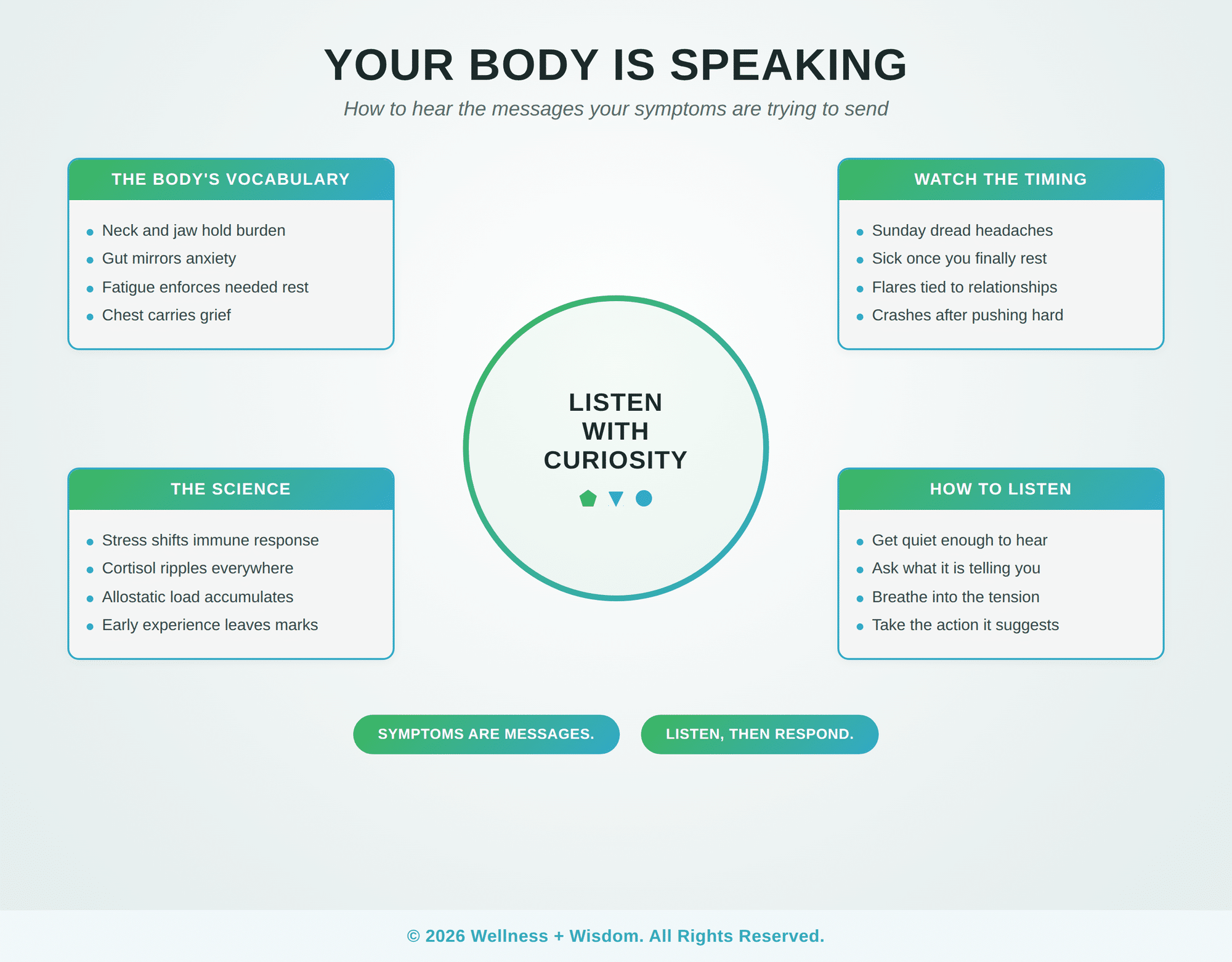
Tension in the neck, shoulders, and jaw often accompanies the feeling of carrying too much, of shouldering burdens or clenching against stress. Digestive upset frequently tracks with anxiety and the feeling of not being able to stomach a situation, which makes sense given the deep connection between the gut and the brain. Chronic fatigue can be the body's way of enforcing a rest that you keep refusing to take voluntarily. Tightness or heaviness in the chest often accompanies grief, anxiety, or a heart that feels unexpressed.
Then there is the timing of symptoms, which is often the loudest message of all. Headaches that arrive every Sunday evening may be speaking about dread of the week ahead. Illness that appears the moment you finally go on vacation may be a body that only feels safe enough to collapse once the pressure lifts. Skin flare ups, tension patterns, and energy crashes that correlate with specific relationships or situations are worth noticing with curiosity. The body is exquisitely honest about what the mind is trying to rationalize away, a truth we return to often on the Wellness + Wisdom Podcast.
Why We Stopped Listening in the First Place
If body symptoms messages are so valuable, why are so many of us so out of practice at hearing them? The disconnection usually begins early. As children, most of us received steady instruction to override our physical and emotional signals. We were told we were fine when we were not, to stop crying when we needed to cry, to sit still when our bodies wanted to move, to clean our plates when we were already full. Each of these small moments taught the same lesson, that the body's signals were less trustworthy than an external authority.
By adulthood, that early training has hardened into a habit of self override. We push through hunger, fatigue, and pain, treating the body as a machine that should perform on demand regardless of what it is telling us. Our culture celebrates this. We admire the person who works while sick, who runs on almost no sleep, who never lets the body slow them down. The quiet cost of that admiration is a generation of people who no longer know how to feel themselves from the inside.
There is also the simple matter of speed. The body speaks in a slow, subtle language of sensation, and modern life moves fast and loud. Between screens, schedules, and constant stimulation, there is rarely enough quiet for the body's whispers to be heard at all. So the signals go unnoticed until they become symptoms loud enough to interrupt the noise. In a real sense, many symptoms are simply the body finally speaking at a volume that our busy lives cannot ignore.
None of this is a cause for shame. It is simply what most of us were taught, and what most of us were never taught. The good news is that the ability to listen inward is not lost, only dormant. It can be relearned at any age, with patience and practice, and rebuilding that skill is one of the most rewarding parts of the journey toward emotional intelligence and whole person wellness.
Body Symptoms Messages and Emotional Epigenetics
Body symptoms messages become even more meaningful when you view them through the lens of Emotional Epigenetics™. This framework holds that your emotional patterns, your beliefs, and your environment converge to shape how your genes express themselves. Your inner emotional climate is not floating in some separate mental realm. It is a biological input, one that influences your physiology at the deepest level.
Seen this way, a persistent symptom can be a signal that an old emotional pattern or inherited belief is still running the show, still shaping your biology in ways that no longer serve you. The chronic tension might be tied to a lifelong pattern of hypervigilance. The exhaustion might be connected to an inherited belief that your worth depends on relentless output. The body is showing you, in physical form, where an unconscious program is still active.
This is genuinely hopeful, because epigenetic expression is not fixed. The same body that learned to hold a pattern can learn to release it. When you change the emotional and lifestyle inputs, through regulation, breath, rest, connection, and inner work, you change the signal your genes are receiving. Over time, the body often responds. This is the premise of the L.I.F.E. Method™, and it is why listening to your body symptoms messages is not passive. It is the first step in a very active process of healing.
The Body Remembers What the Mind Forgets
One of the most important truths in this whole conversation is that the body keeps records the conscious mind does not. Many experiences, especially overwhelming ones, are stored below the level of language and ordinary memory. You may not have a clear mental narrative of an early stress, yet your body can hold the imprint of it for years, expressing it through tension, reactivity, and physical symptoms long after the mind has filed the event away.
This is why insight alone often is not enough to heal a stubborn pattern. You can understand something perfectly with your thinking mind and still feel it gripping your body. That is not a failure of understanding. It is a sign that the pattern lives somewhere words cannot reach directly. To shift it, you have to work with the body itself, through breath, movement, sensation, and safe connection, which speak the language the pattern was encoded in.
This is exactly why practices like breathwork and somatic awareness are so powerful, and why we place them at the center of our work rather than treating them as extras. They give held experience a way to move and complete, so that the body no longer has to keep the score through symptoms. We explore this deeply in our teaching on bioenergetic memory and on breaking generational patterns that live in the body.
When you understand that the body remembers, your symptoms take on a new dignity. They are not random glitches. They are faithful messengers, carrying forward what needs attention until it finally receives it. Meeting them with patience rather than frustration is how you begin to unwind the deeper patterns behind your body symptoms messages, and how you let your biology return to a more settled baseline.
How to Listen to Your Body Symptoms Messages
Listening to your body is a skill, and like any skill it grows with practice. The goal is not to diagnose yourself or to spin anxious stories about every sensation. The goal is to bring warm, patient curiosity to what your body is expressing. Here is how to begin.
1. Get Quiet Enough to Hear
The body speaks softly, and a busy, noisy life drowns it out. Set aside a few minutes of stillness, close your eyes, and simply scan your body from head to toe. Notice where there is tension, heaviness, tightness, or ease. You are not trying to change anything yet. You are just listening, the way you would listen to a friend.
2. Get Curious Instead of Judgmental
When you find a sensation, resist the urge to label it as bad and rush to make it go away. Instead, get curious. Ask the sensation, what are you here to tell me? Then wait. The answer may come as a word, an image, a memory, or simply a deeper feeling. Curiosity opens a door that judgment slams shut.
3. Connect Sensation to Life
Gently notice what is happening in your life around the symptom. When does it appear or intensify? What situations, people, or thoughts accompany it? This is not about forcing a story. It is about noticing honest patterns over time, which is exactly the kind of awareness an emotional inventory builds.
4. Use the Breath to Respond
Breath is the fastest way to send your body a signal of safety and to help held energy move. When you find tension, breathe into it, letting the exhale be long and slow. This tells your neural system that it is safe to soften. Breathwork is a cornerstone of the BREATHE™ program precisely because it speaks the body's language directly.
5. Take the Action the Message Suggests
Ultimately, listening is only complete when you respond. If the message is exhaustion, the response is rest. If it is tension around a relationship, the response might be a boundary or a conversation. If it is grief, the response is to let yourself feel it. Honoring the message is how you teach your body that it no longer has to shout to be heard.
Practiced consistently, this turns your body from an adversary you fight into an ally you trust. When you want support and community for this deeper work, the Liberated Life Tribe and our full L.I.F.E. Method programs are here to guide you.
Honoring the Message Without Ignoring Real Care
Here is a truth I hold firmly, because your wellbeing matters more than any framework. Listening to the emotional meaning of a symptom is never a replacement for proper medical care. It is a complement to it. Some symptoms are urgent physical signals that require a doctor, testing, and treatment, and no amount of breathwork or inner reflection should delay that. Wisdom means holding both truths at once.
The healthiest approach is integrative. When a symptom arises, especially one that is new, severe, persistent, or worrying, get it properly evaluated by a qualified medical professional. That is honoring your body too. At the same time, you can bring curiosity to the emotional and lifestyle patterns around the symptom, so that you address not only the physical expression but the deeper conditions that may be feeding it. The body speaks on many levels at once, and you get to listen on all of them.
This both and approach is the essence of the Wellness Pentagon™, which honors the physical, mental, emotional, spiritual, and financial dimensions as one interconnected whole. Your body deserves excellent physical care and a listening ear for its emotional messages. When you give it both, you move from managing symptoms toward genuine, whole person healing. This is the difference between silencing a warning light and actually tending the engine beneath it. One brings temporary quiet. The other brings lasting change, because it honors your body as the intelligent, communicative system it has always been. Explore more through our latest episodes and wellness tools.
Frequently Asked Questions
What does it mean when your body speaks through symptoms?
It means a symptom is often information, not just a malfunction. Alongside any physical cause, the body frequently communicates about stress, unprocessed emotion, exhaustion, or a life out of alignment. Body symptoms messages are the body raising its voice about something that earlier whispers could not get across, which is why listening with curiosity is so valuable.
Is the mind body connection actually real science?
Yes. The field of psychoneuroimmunology studies how psychological states influence the neural, hormonal, and immune systems. Foundational research, including Cohen's work in the New England Journal of Medicine, showed that higher stress measurably changed how the body responded to a virus. The mind and body operate as one integrated system.
Can childhood experiences really cause physical symptoms in adulthood?
Research strongly supports a connection. The Adverse Childhood Experiences study by Felitti and colleagues found a significant relationship between difficult early experiences and a range of adult physical health conditions. This does not mean anyone is doomed by their past. It means emotional experience and physical health are deeply linked, and healing is possible.
How do I start listening to my body symptoms messages?
Begin by getting quiet enough to hear. Scan your body with curiosity rather than judgment, notice what patterns accompany a sensation in your life, use slow breathing to send signals of safety, and then take the action the message suggests, whether that is rest, a boundary, or letting yourself feel an emotion. Consistency turns your body into a trusted ally.
Should I see a doctor or just work with the emotional meaning?
Both. Listening to the emotional meaning of a symptom never replaces proper medical care. Any symptom that is new, severe, persistent, or worrying should be evaluated by a qualified professional. The healthiest path is integrative, giving your body excellent physical care while also tending the emotional and lifestyle patterns around the symptom.
How does this connect to Emotional Epigenetics?
Emotional Epigenetics™ holds that emotional patterns, beliefs, and environment shape how your genes express themselves. A persistent symptom can signal that an old or inherited pattern is still influencing your biology. Because epigenetic expression can change, listening and shifting the inputs through regulation, breath, and inner work often allows the body to respond over time.
Studies and External Resources
The science in this article rests on peer reviewed research. These are the sources referenced throughout.
- Felitti VJ, et al. (1998). Relationship of Childhood Abuse and Household Dysfunction to Many of the Leading Causes of Death in Adults (The Adverse Childhood Experiences Study). American Journal of Preventive Medicine. PubMed: 9635069
- Cohen S, Tyrrell DA, Smith AP. (1991). Psychological stress and susceptibility to the common cold. New England Journal of Medicine. PubMed: 1713648
- McEwen BS. (1998). Protective and damaging effects of stress mediators. New England Journal of Medicine. PubMed: 9428819
About Josh Trent
Josh Trent is an Identity Transformation Architect and the award winning host of the Wellness + Wisdom Podcast, with over 15 million downloads since 2015. He is the creator of the L.I.F.E. Method™ Identity Transformation System and steward of the Emotional Epigenetics™ and BREATHE: Breath + Wellness™ systems of self mastery, impacting over 1,000 students worldwide. Join the Liberated Life Tribe and receive your 10 day Self Liberation Blueprint at liberatedlife.com. Josh lives in Austin, Texas with his wife Carrie, daughter Nayah, and son Novah.
Disclosure: We may earn a commission from certain links on this site when you make a purchase, at no extra cost to you. These commissions help support Wellness + Wisdom and do not affect the products or resources we choose to recommend. Full disclosure .