By Josh Trent | Wellness + Wisdom Podcast Host & Identity Transformation Architect
“Our kids will not remember every dish on the table. They will remember how it felt to sit together and say out loud what we are grateful for.”
Josh Trent
Thanksgiving gratitude rituals are one of the most meaningful gifts you can give your family this year. The turkey, the pie, and the football are wonderful, but the moments children carry into adulthood are usually the ones that made them feel connected: the hands held around the table, the stories told, the simple practice of naming what we are thankful for. Rituals turn a holiday into a home. They give kids something to look forward to, give adults a chance to slow down, and give everyone a shared language of appreciation. And here is the beautiful part. You do not need anything elaborate. A few intentional minutes, repeated year after year, can shape how your family sees the world. Because the way we practice gratitude is passed down from generation to generation, this work connects deeply with Emotional Epigenetics™ and Conscious Parenting.
Here is the joy forward truth at the center of it all. The rituals you start this Thursday could still be happening at your grandchildren's tables. Let us explore what the science says and exactly how to create gratitude traditions your family will love.
Table of Contents
- What Thanksgiving Gratitude Rituals Are
- Why Family Rituals Matter
- The Gift of a Shared Tradition
- The Science of Gratitude and Family Rituals
- Seven Thanksgiving Gratitude Rituals to Try
- Rituals Versus Routines
- Thanksgiving Gratitude Rituals and Emotional Epigenetics™
- Making Gratitude Fun for Kids of Every Age
- Carrying Gratitude Beyond Thursday
- When the Holidays Feel Complicated
- Frequently Asked Questions
- Studies and External Resources
- About Josh Trent
What Thanksgiving Gratitude Rituals Are
Thanksgiving gratitude rituals are simple, repeated family practices that help everyone pause, notice, and share what they are thankful for. They can be as short as one sentence around the table or as rich as a tradition that unfolds over the whole month of November.
A ritual is different from an activity. An activity happens once. A ritual carries meaning because it is repeated, anticipated, and shared. When your family goes around the table every year and names a blessing, that moment becomes part of your identity. Kids start to say, “This is what we do.” That sense of belonging is one of the most protective gifts a family can offer.
Gratitude rituals can include words, like sharing blessings or writing thank you notes. They can include objects, like a thankful tree, a gratitude jar, or a tablecloth everyone signs each year. They can include actions, like serving others or calling a grandparent. And for many families, they include prayer, giving thanks to God for the year's blessings. These themes come up often on the Wellness + Wisdom Podcast, where guests share the traditions that shaped them.
The best Thanksgiving gratitude rituals fit your family. Some families love loud, joyful sharing. Others prefer quiet reflection. There is no right way, only your way. If you are still building a personal gratitude habit, the ideas in how to practice gratitude are a wonderful foundation.
Why Family Rituals Matter
Family rituals matter because they create belonging, stability, and shared meaning. Research on family routines and rituals has linked them with more competent parenting, better child adjustment, and stronger marriages.
In a fast moving world, rituals act like anchors. They remind children that some things stay steady even when life changes. A child who knows that every Thanksgiving starts with the blessing circle, or ends with a walk together, has something to hold onto. That predictability builds a deep sense of safety.
Rituals also carry values. When your family practices gratitude together, you are teaching kids, without a lecture, that noticing the good is important. You are showing them that appreciation is something we say out loud, not just something we feel. Over time, those small moments add up to a family culture of thankfulness. If you want to strengthen your bond with your kids year round, the ideas in how to connect with your kids pair beautifully with these traditions.
The Gift of a Shared Tradition
The gift of a shared tradition is connection that lasts. When a family practices gratitude together year after year, those moments become memories, and those memories become part of who each person is.
Think back to your own childhood holidays. What do you remember most? For many people, it is not the presents or the exact menu. It is the feeling of being together: the laughter, the stories, the familiar rituals. Shared traditions create a thread that connects generations. A grandmother's blessing becomes a mother's blessing becomes a daughter's blessing.
Gratitude traditions are especially powerful because they combine connection with appreciation. Each year, your family pauses to notice what went right, who showed up, and what blessings arrived. That practice quietly trains everyone to look for the good. It also creates beautiful moments of tenderness, like when a child thanks a parent at the table and everyone feels it. Celebrating these moments is a joy in itself, as explored in celebrating small wins.
The Science of Gratitude and Family Rituals
The science of gratitude and family rituals shows that family rituals are linked with healthier parenting, child adjustment, and marriages, that counting blessings boosts wellbeing in both adults and young adolescents, and that a grateful focus increases positive emotion. Thanksgiving gratitude rituals combine both of these powerful ingredients.
Start with family rituals. In a review of 50 years of research published in the Journal of Family Psychology, Barbara Fiese and colleagues at Syracuse University distinguished routines, the practical things families do, from rituals, the symbolic practices that carry meaning. They found that family routines and rituals were related to parenting competence, child adjustment, and marital satisfaction. The very act of gathering with intention appears to strengthen the family system.
Gratitude itself has strong evidence behind it. In a set of studies published in the Journal of Personality and Social Psychology, Robert Emmons and Michael McCullough randomly assigned people to write about things they were grateful for, daily hassles, or neutral events. The gratitude groups showed higher wellbeing on several measures, with increases in positive emotion being the most consistent finding. A conscious focus on blessings appeared to bring emotional and interpersonal benefits.
Kids benefit too. In a study of 221 early adolescents published in the Journal of School Psychology, Jeffrey Froh, William Sefick, and Emmons randomly assigned classrooms to count blessings, list hassles, or follow a control condition. Students who counted blessings reported more gratitude, more optimism, greater life satisfaction, and less negative emotion. They also reported more satisfaction with their school experience, both right away and three weeks later. Gratitude is a skill kids can learn.
Seven Thanksgiving Gratitude Rituals to Try
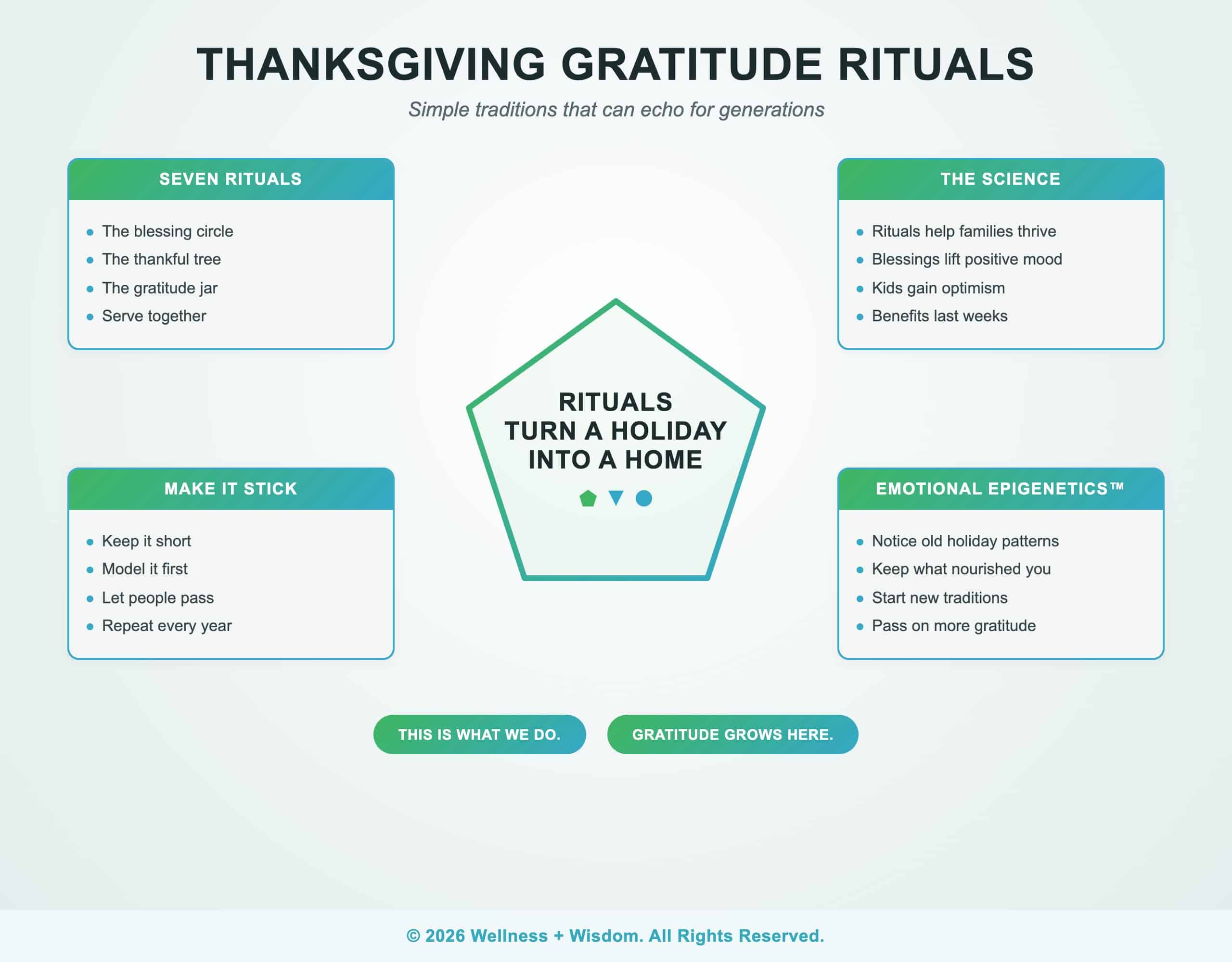
Seven Thanksgiving gratitude rituals that work beautifully for families are the blessing circle, the thankful tree, the gratitude jar, the signed tablecloth, thank you notes, serving together, and the gratitude walk. Pick one or two to start, and let your traditions grow over time. Here is how my family and I approach them.
1. The Blessing Circle
Before the meal, gather around the table, hold hands if you like, and have each person share one thing they are grateful for this year. Encourage specifics: not just “my family,” but “the night Grandpa taught me to fish.” For families of faith, close with a prayer of thanks to God. This is the simplest tradition of all, and often the most powerful.
2. The Thankful Tree
At the start of November, put a few bare branches in a vase or draw a tree on a large sheet of paper. Cut out paper leaves. Each day, everyone writes one thing they are thankful for on a leaf and adds it to the tree. By Thanksgiving, your tree is full. Kids love watching it grow, and it becomes a beautiful centerpiece. If you are starting this week, you can still fill it in just a few days.
3. The Gratitude Jar
Place a jar and some slips of paper near the entrance or on the table. As guests arrive, invite them to write something they are grateful for, or something they appreciate about someone at the gathering. During dessert, take turns reading the notes aloud. Guessing who wrote each one adds laughter and warmth.
4. The Signed Tablecloth
Buy a plain tablecloth and some fabric markers. Each year, everyone writes one sentence of gratitude and signs their name and the year. Over time, the tablecloth becomes a living record of your family's blessings, with kids' handwriting changing year after year. Many families say this becomes their most treasured heirloom.
5. Thank You Notes
Set out cards and pens and invite everyone, especially kids, to write a short thank you note to someone who made a difference this year: a teacher, coach, neighbor, or relative. Mail them on Friday. Research on expressing gratitude shows that recipients feel even better than we expect, so these little notes often mean more than kids realize.
6. Serve Together
Gratitude often grows when we give. Volunteer as a family at a food bank, deliver meals to a neighbor, or invite someone who would otherwise be alone to your table. Serving helps kids see their blessings with new eyes. The ideas in how to practice generosity go deeper here.
7. The Gratitude Walk
After the meal, take a family walk outside. Invite everyone to notice and name things they are grateful for along the way: the crisp air, the colors of the leaves, the people walking beside them. Movement after a big meal feels wonderful, and nature naturally invites wonder and thankfulness. Moments like this pair beautifully with the ideas in how to experience awe.
Start with one or two of these this year. Thanksgiving gratitude rituals do not need to be perfect to be meaningful. And if you would love a supportive community of families on the same journey, the Liberated Life Tribe is a warm place to begin.
A few practical tips help these traditions run smoothly. Keep it short, especially with young kids. Two or three minutes of heartfelt sharing is better than twenty minutes of restless waiting. Model it first by sharing your own gratitude so others know what it can sound like. Let people pass if they are not ready, and invite them again later. And take photos of your thankful tree or tablecloth each year so you can look back on how your family's gratitude has grown.
You can also blend Thanksgiving gratitude rituals with your family's culture and faith. Some families read a favorite scripture or poem of thanks. Others share a family recipe and the story behind it, giving thanks for the ancestors who passed it down. Some light a candle for loved ones who have passed. These personal touches make your rituals uniquely yours.
Rituals Versus Routines
Rituals and routines are both valuable, but they serve different purposes. Routines are about getting things done: who carves the turkey, who sets the table. Rituals are about meaning: why we gather and what we celebrate. Routines keep the day running. Rituals make the day matter.
The research on family life makes this distinction clear. Routines are observable practices that keep families organized. Rituals are symbolic, emotional, and tied to identity. Both support healthy families, but rituals carry a special power to create belonging and connection across generations.
The good news is that any routine can become a ritual with a little intention. Setting the table can become a ritual if each person places a note of thanks at someone else's seat. Clearing the dishes can become a ritual if everyone shares one favorite moment of the day while they work. The most meaningful traditions often grow out of the simplest routines, given a little heart.
Rituals also help families stay present. When everyone knows what is coming, they can relax into the moment instead of worrying about what happens next. If presence is something your family wants more of this season, the ideas in how to be present are a beautiful companion.
Thanksgiving Gratitude Rituals and Emotional Epigenetics™
Thanksgiving gratitude rituals connect deeply with Emotional Epigenetics™, because the emotional patterns we practice in families are passed down from one generation to the next. When you choose gratitude as a family ritual, you are shaping the emotional inheritance your children will carry.
Many of us grew up in homes where holidays were stressful, rushed, or tense. Maybe gratitude was rarely spoken, or maybe it felt forced. Those experiences can leave patterns that show up years later, like dreading family gatherings or feeling awkward expressing appreciation. Emotional Epigenetics™ invites you to notice these inherited patterns with compassion: What did I learn about holidays growing up? What do I want my children to learn instead?
This is where Conscious Parenting comes alive. You get to choose. You can keep the traditions that nourished you and gently let go of the ones that did not. You can start new rituals that reflect the family culture you want to create. Every blessing circle and thankful tree is a vote for a new emotional legacy. We have also explored how gratitude may interact with our biology in gratitude and epigenetics. If you want to go deeper into identity level change, explore our L.I.F.E. Method™ programs.
Gratitude rituals also nourish every part of the Wellness Pentagon™. They bring emotional warmth, mental clarity about what matters, physical connection through shared meals and walks, financial perspective about true abundance, and spiritual depth through prayer and a shared Connection to Creator and God.
Making Gratitude Fun for Kids of Every Age
Making gratitude fun for kids of every age means matching the ritual to their stage. Little ones love hands on activities, school age kids love games, and teenagers appreciate rituals that feel genuine rather than forced.
For toddlers and preschoolers, keep it simple and tactile. Let them draw pictures of things they love for the thankful tree. Ask easy questions like, “What made you happy today?” Help them trace their hand to make a gratitude turkey, writing one blessing on each finger. Young children learn gratitude through repetition and fun.
For school age kids, add a playful twist. Try gratitude bingo with squares like “something that made you laugh” or “a person who helped you.” Turn the gratitude jar into a guessing game. Invite them to interview a grandparent about what they are grateful for. Kids this age love being given a role, like reading the gratitude notes aloud or leading the blessing circle.
For teenagers, sincerity matters most. Teens can spot forced rituals instantly, so keep it real. Invite them to share in their own way, perhaps by writing rather than speaking, or by choosing a song or quote that represents their year. Give them space to pass, and they will often surprise you when they are ready. If you want more tools for raising emotionally aware kids, the ideas in how to raise emotionally intelligent kids are a natural next step.
Food itself can become part of the tradition. Invite each person to bring or make one dish that carries a story, then share why it matters before you eat. A grandmother's stuffing, a dad's cornbread, a new recipe a teenager discovered this year. Giving thanks for the hands that grew, carried, and cooked the food reminds everyone how many people make a single meal possible. Some families also pause before eating to name the farmers, the grocers, and the cooks, a beautiful way to stretch gratitude beyond the people in the room. Others keep a simple family recipe book where each dish has a short note about who made it first and what it means. Over the years, that book becomes a treasure that holds both flavor and memory.
Carrie and I love watching Nayah and Novah fill our thankful tree each year. Their leaves are often the most honest and the most beautiful: thankful for the dog, for pancakes, for a hug when they were sad. Kids remind us that gratitude does not have to be complicated to be true.
Carrying Gratitude Beyond Thursday
Carrying gratitude beyond Thursday means turning your holiday rituals into small daily or weekly habits, so thankfulness becomes part of everyday family life rather than a once a year event.
Keep the gratitude jar out through December and read it again on New Year's Eve. Continue a short blessing circle at Sunday dinners. Ask each child at bedtime, “What was the best part of your day?” Keep a family gratitude journal where everyone adds a line each week. These small habits keep the spirit of Thanksgiving alive all year. The ideas in how to cultivate daily gratitude offer many more ways to do this.
The research suggests that small, repeated gratitude practices make a real difference, for adults and kids alike. You do not need a big production. You need consistency and heart. You will find many guests sharing their own family gratitude traditions across our latest episodes.
When the Holidays Feel Complicated
If the holidays feel complicated for your family, you are not alone, and it is completely understandable. Grief, distance, divorce, financial strain, or tension with relatives can all make Thanksgiving feel heavy. Thanksgiving gratitude rituals can still offer comfort, but they work best when they make room for honest feelings.
If you are missing someone this year, consider adding a ritual of remembrance: light a candle, share a favorite memory, or set out a photo. Gratitude and grief can sit side by side. If gatherings feel stressful, keep rituals short and simple, and give yourself permission to step outside for fresh air. The ideas in keeping the holidays stress free and quitting holiday dread can help. Supportive tools like a family gratitude journal or a set of conversation cards can help too, and you can find a few we trust in our wellness tools store.
If the season brings persistent sadness or overwhelm, please reach out to a qualified health professional. There is real strength in asking for help. Wherever your family is this year, a single honest moment of thanks can be enough.
Ready to go deeper? Join the Liberated Life Tribe and receive your 10 day Self Liberation Blueprint at liberatedlife.com. It is free, it is guided, and each day offers a gentle practice to help you release old patterns and create the family culture you truly want.
Frequently Asked Questions
What are some Thanksgiving gratitude rituals for families?
Popular family rituals include the blessing circle, a thankful tree, a gratitude jar, a signed tablecloth, writing thank you notes, serving others together, and taking a gratitude walk after the meal.
Why are family rituals important?
A review of 50 years of research linked family routines and rituals with parenting competence, child adjustment, and marital satisfaction. Rituals create belonging, stability, and shared meaning.
How do I get kids involved in gratitude at Thanksgiving?
Match the ritual to their age. Little ones love drawing for a thankful tree, school age kids enjoy games like gratitude bingo, and teens appreciate sincere options like writing instead of speaking.
Does practicing gratitude really help kids?
Yes. In a study of 221 early adolescents, counting blessings was linked with more gratitude, optimism, and life satisfaction, and less negative emotion, with benefits for school satisfaction lasting at least three weeks.
What is a thankful tree?
A thankful tree is a branch or drawn tree where family members add paper leaves, each with something they are grateful for. It grows through November and becomes a meaningful Thanksgiving centerpiece.
How can we keep gratitude going after Thanksgiving?
Keep the gratitude jar out, continue a short blessing circle at weekly dinners, ask kids about the best part of their day at bedtime, and keep a family gratitude journal.
Studies and External Resources
The science in this article rests on peer reviewed research. These are the sources referenced throughout.
- Fiese BH, Tomcho TJ, Douglas M, Josephs K, Poltrock S, Baker T. (2002). A review of 50 years of research on naturally occurring family routines and rituals: cause for celebration? Journal of Family Psychology. PubMed: 12561283
- Emmons RA, McCullough ME. (2003). Counting blessings versus burdens: an experimental investigation of gratitude and subjective well being in daily life. Journal of Personality and Social Psychology. PubMed: 12585811
- Froh JJ, Sefick WJ, Emmons RA. (2008). Counting blessings in early adolescents: an experimental study of gratitude and subjective well being. Journal of School Psychology. PubMed: 19083358
About Josh Trent
Josh Trent is an Identity Transformation Architect and the award winning host of the Wellness + Wisdom Podcast, with over 15 million downloads since 2015. He is the creator of the L.I.F.E. Method™ Identity Transformation System and steward of the Emotional Epigenetics™ and BREATHE: Breath + Wellness™ systems of self mastery, impacting over 1,000 students worldwide. Join the Liberated Life Tribe and receive your 10 day Self Liberation Blueprint at liberatedlife.com. Josh lives in Austin, Texas with his wife Carrie, daughter Nayah, and son Novah. Peace and power.
Disclosure: We may earn a commission from certain links on this site when you make a purchase, at no extra cost to you. These commissions help support Wellness + Wisdom and do not affect the products or resources we choose to recommend. Full disclosure .