
By Josh Trent | Wellness + Wisdom Podcast Host & Identity Transformation Architect
“Gratitude you keep to yourself is a gift you never wrapped. Say it out loud, and watch two hearts open at once.”
Josh Trent
Learning how to express gratitude is one of the simplest and most beautiful ways to bring more joy into your relationships, and Thanksgiving week is the perfect time to start. Most of us feel grateful far more often than we say it. We appreciate the friend who showed up when life got hard, the parent who sacrificed more than we will ever know, the partner who quietly carries the load, the teacher who believed in us. Yet those feelings often stay locked inside, waiting for the “right moment” that never quite arrives. Here is the good news. Research shows that expressing gratitude lifts the mood of the person receiving it far more than we expect, and it lifts our own mood too. Gratitude spoken out loud turns a private feeling into a shared connection, and that connection is one of the richest sources of wellbeing in the entire Wellness Pentagon™.
Here is the joy forward truth at the center of it all. You do not need perfect words. You need a willing heart and a few honest sentences. Let us explore what the science says and exactly how to say thank you in ways people will remember long after the turkey is gone.
Table of Contents
- What Expressing Gratitude Really Means
- Why Saying Thank You Matters So Much
- The Gift That Flows Both Ways
- The Science of Expressing Gratitude
- How to Express Gratitude
- Heartfelt Thanks Versus Polite Thanks
- How to Express Gratitude With the Wellness Pentagon™
- Gratitude at the Thanksgiving Table
- Gratitude in Marriage, Parenting, and Work
- When Gratitude Feels Hard to Say
- Frequently Asked Questions
- Studies and External Resources
- About Josh Trent
What Expressing Gratitude Really Means
Expressing gratitude means telling someone, clearly and sincerely, what they did and how it made a difference in your life. It moves gratitude from a quiet feeling inside you into a shared moment between two people.
Feeling grateful and expressing gratitude are related but different. Feeling grateful is an inner experience: the warm recognition that something good came to you through someone else. Expressing gratitude is an outward act: putting that recognition into words or actions the other person can receive. Both matter. But it is the expression that strengthens relationships, because the other person finally gets to know what they mean to you.
Gratitude can be expressed in many ways. A heartfelt letter. A spoken thank you that names something specific. A text out of the blue. A small act of service in return. A toast at the dinner table. A hug that lingers a little longer. These themes come up often on the Wellness + Wisdom Podcast, where guests share the thank yous that changed their lives, both given and received.
If you have already started a private gratitude practice, expressing it is the natural next step. The ideas in how to practice gratitude help you notice the good. Learning how to express gratitude helps you share it.
Why Saying Thank You Matters So Much
Saying thank you matters because it tells people they are seen, valued, and important to you. Gratitude expressed builds trust, deepens bonds, and encourages more of the kindness that made you grateful in the first place.
Think about how it feels when someone thanks you in a specific, heartfelt way. Not a quick “thanks” in passing, but something like, “When you called me after my surgery, I felt so cared for. I will never forget it.” Words like that can stay with a person for years. They remind people that their effort mattered and that they are loved.
Gratitude also changes the one who expresses it. When you put your appreciation into words, you relive the good moment, which strengthens positive emotion. You shift your attention from what is missing to what is present. Over time, expressing gratitude becomes a way of seeing the world, one where you notice and honor the goodness around you. If your relationships could use more warmth, the ideas in how to build a healthy relationship pair beautifully with gratitude.
The Gift That Flows Both Ways
The gift of expressed gratitude flows both ways. The person who hears your thanks feels valued and uplifted, and you feel the joy of giving that gift. Few actions produce so much good for so little cost.
Many people hesitate to express gratitude because they worry it will feel awkward or that the other person already knows how they feel. In reality, most people have no idea how much they mean to us. A sincere thank you often comes as a beautiful surprise. It can repair distance, soften old tension, and open the door to deeper connection.
Gratitude is also a form of generosity. You are giving someone the gift of being seen. That is why gratitude and giving grow together so naturally, as explored in how to practice generosity. When you thank someone well, you often inspire them to pass that kindness forward.
The Science of Expressing Gratitude
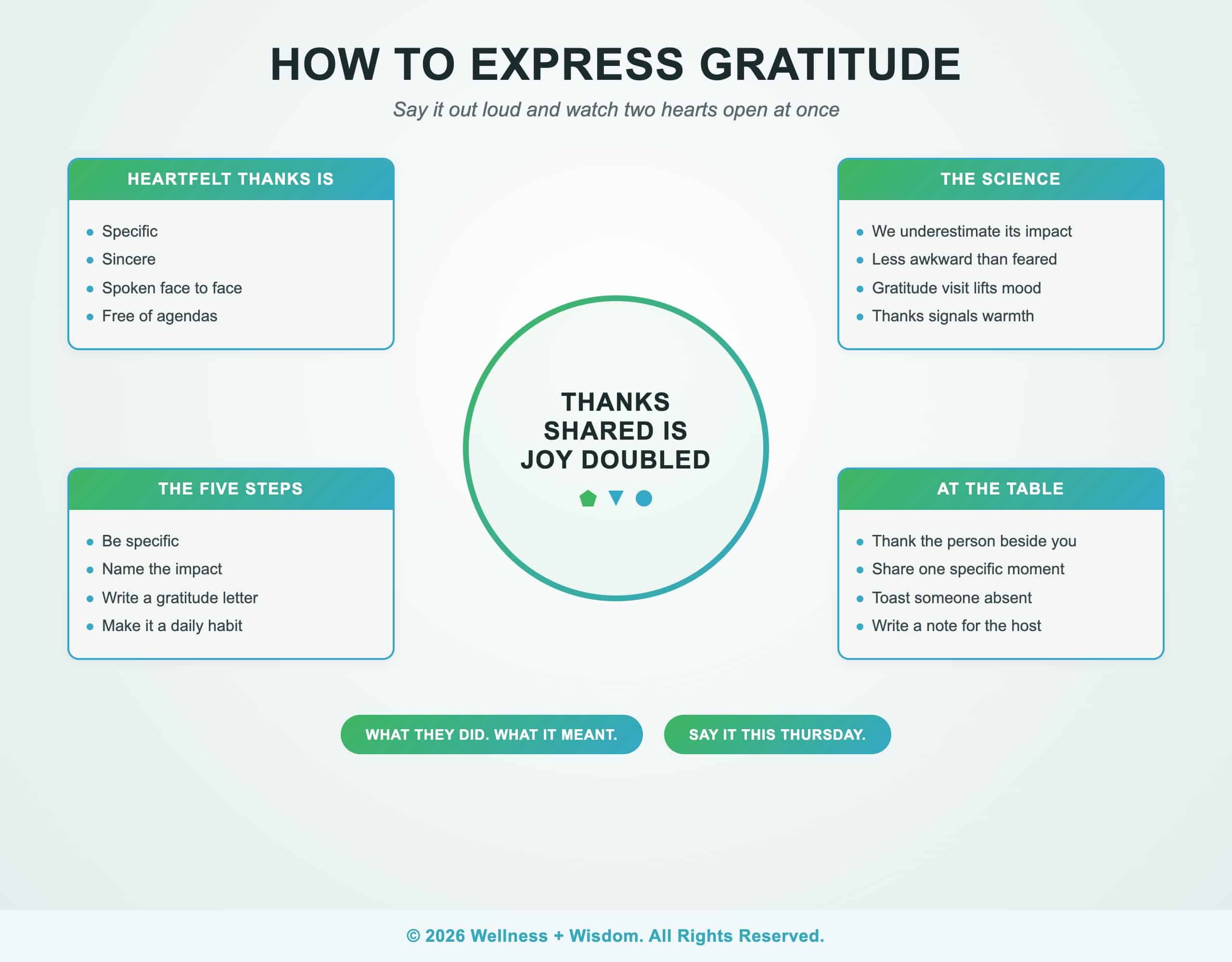
The science of expressing gratitude shows that people consistently underestimate how good their thanks will make others feel, that a single gratitude visit can boost happiness for a month, and that expressing thanks signals warmth that helps new relationships grow. Saying thank you is far more powerful than we think.
Start with what we get wrong. In three experiments published in Psychological Science, Amit Kumar and Nicholas Epley of the University of Chicago asked people to write gratitude letters and predict how the recipients would feel. Then they asked the recipients. Expressers significantly underestimated how surprised and how positive recipients would feel, and overestimated how awkward the moment would be. Those mistaken expectations were linked with people's willingness to express gratitude at all. In other words, the main thing holding us back is a forecast that turns out to be wrong.
The benefits for the giver are real too. In a randomized, placebo controlled online study published in American Psychologist, Martin Seligman and colleagues at the University of Pennsylvania tested several happiness exercises. One of them, the gratitude visit, asked people to write and personally deliver a letter of thanks to someone who had been especially kind to them but had never been properly thanked. Participants who completed the gratitude visit showed large increases in happiness and decreases in depressive symptoms, with benefits lasting about one month.
Gratitude also helps relationships begin. In a study published in Emotion, Lisa Williams and Monica Bartlett found that people who received a note of thanks from a peer they had just met were more likely to share their contact information and continue the relationship. The thank you signaled warmth, friendliness, and thoughtfulness, which made the recipient want to invest in the connection. Gratitude finds, reminds, and binds us to the people who matter.
How to Express Gratitude
You learn how to express gratitude by being specific, naming the impact, writing a gratitude letter, saying it face to face, and making thanks a daily habit. These five practices turn quiet appreciation into connection people can feel. Here is how I practice and teach them.
1. Be Specific
General thanks are nice. Specific thanks are unforgettable. Instead of “Thanks for everything,” try “Thank you for staying late on Tuesday to help me finish that project.” Specific details show the other person that you truly noticed. They also make the moment more vivid for both of you. Before you say thank you, ask yourself, “What exactly did they do?”
2. Name the Impact
After you name what someone did, tell them what it meant. “Because you helped, I got to make it home in time for my daughter's recital.” “When you listened without judging, I finally felt like I could breathe.” Naming the impact connects their action to your life. It is the part of gratitude people remember most. If putting feelings into words is new for you, the ideas in how to express your emotions can help.
3. Write a Gratitude Letter
Choose one person who changed your life for the better and who you have never fully thanked. Write them a letter of about one page. Describe what they did, how it affected you, and where you are now because of it. Then, if you can, deliver it in person and read it aloud. This is the gratitude visit from the research, and it is one of the most powerful happiness practices ever studied. Journaling can be a helpful warmup, as explored in how to start journaling.
4. Say It Face to Face
Texts and cards are wonderful, but there is something special about saying thank you in person. Look the person in the eyes. Slow down. Let your voice and face carry the warmth. If distance makes that impossible, a phone or video call is the next best thing. Your presence makes the gratitude real. The practices in how to be vulnerable can help when this feels a little scary.
5. Make Thanks a Daily Habit
Big gratitude moments are beautiful, but small daily thanks build the foundation. Thank your partner for making coffee. Thank your child for helping clear the table. Thank the cashier by name. Thank a coworker for a quick favor. Each small thank you strengthens the habit of noticing and naming the good. The ideas in how to cultivate daily gratitude go deeper here.
Start with one or two of these practices this week. Thanksgiving is a perfect invitation. And if you would love a supportive community on your journey, the Liberated Life Tribe is a warm place to begin.
Here is a simple rhythm if you are wondering how to express gratitude during a busy holiday week. Monday, send one text thanking someone for something specific from this year. Tuesday, write a short card to a teacher, mentor, or neighbor. Wednesday, call a family member and tell them one memory you are grateful for. Thursday, share a heartfelt thank you at the Thanksgiving table. Friday, write a gratitude letter to someone who shaped your life. By the end of the week, you will have touched five hearts, including your own.
The words do not have to be fancy. A simple formula works beautifully: “Thank you for (what they did). It meant (the impact) to me. I am so grateful for you.” Try it with someone today. You will likely find that the moment feels much better than you expected, exactly as the research predicts.
Actions can express gratitude too. Cook someone their favorite meal. Offer to help with a project they have been putting off. Show up at their event. Write a public note of appreciation on social media or in a team meeting. Gratitude shown through action often speaks just as loudly as words, especially for people who feel loved through acts of service.
Remember to receive gratitude well too. When someone thanks you, resist the urge to brush it off with “Oh, it was nothing.” Instead, smile and say, “Thank you for telling me. That means a lot.” Receiving gratitude graciously completes the circle and makes it easier for others to keep expressing it.
Heartfelt Thanks Versus Polite Thanks
Heartfelt thanks and polite thanks both have their place, but they land very differently. Polite thanks is a social courtesy. Heartfelt thanks is a genuine recognition of someone's impact on your life. Polite thanks keeps things smooth. Heartfelt thanks builds connection.
Polite thanks sounds like a quick “thanks” while walking away. It is good manners, and it matters. Heartfelt thanks sounds like, “I want you to know how much it meant when you drove me to the airport at five in the morning. You made a stressful day so much easier.” The difference is specificity, sincerity, and presence.
Heartfelt thanks also avoids hidden agendas. Gratitude that comes with a request attached, or gratitude used to manipulate, tends to feel hollow. Real gratitude asks for nothing in return. It simply honors what was given. If you notice that saying thank you feels like a performance or a way to earn approval, the ideas in how to stop seeking approval can help you return to sincerity.
Both kinds of thanks are welcome. Keep using polite thanks in daily life, and look for regular moments to go deeper. Learning how to express gratitude in a heartfelt way is like learning to speak a richer language of love.
How to Express Gratitude With the Wellness Pentagon™
The Wellness Pentagon™ offers a meaningful way to see gratitude as a thread that runs through every dimension of wellbeing: physical, mental, emotional, spiritual, and financial. When you express gratitude across all five, life feels richer and more connected.
In the physical dimension, thank the people who help you care for your body: the friend who walks with you, the farmer who grew your food, the coach who pushed you. In the mental dimension, thank the teachers, authors, and mentors who shaped how you think. In the emotional dimension, thank the people who held space for your feelings and loved you through hard seasons. In the financial dimension, thank the employer who believed in you, the client who trusted you, or the parent who taught you how to save.
In the spiritual dimension, gratitude becomes prayer. Thanking God for your blessings, your breath, and the people in your life is one of the oldest and most beautiful practices in every tradition of faith. Thanksgiving itself is rooted in giving thanks to the Creator. Expressing gratitude to God deepens your Connection to Creator and God and often makes it easier to express gratitude to others. If you want to explore this dimension more, the ideas in how to build a spiritual practice are a beautiful next step. To go deeper with identity level change, explore our L.I.F.E. Method™ programs.
Gratitude may also shape us at a deeper level. We have explored how positive emotions like gratitude interact with our biology in gratitude and epigenetics, a reminder that what we practice emotionally can ripple through our whole being.
Gratitude at the Thanksgiving Table
Gratitude at the Thanksgiving table works best when it is simple, sincere, and specific. Instead of a rushed “I am thankful for family,” invite each person to share one specific moment from the year that they are grateful for, and who made it possible.
Here are a few ways to bring heartfelt gratitude to your holiday meal. Go around the table and have each person thank the person to their left for something specific. Place a small card at each seat with a question like, “Who helped you this year, and how?” Invite guests to bring a short note of thanks for the host. Raise a glass and toast someone who is not at the table but made a difference this year. These rituals turn a meal into a memory.
If your family is new to this, model it first. Share your own specific thank you, keep it brief, and let your sincerity set the tone. Kids often love these rituals and will surprise you with how thoughtful their answers can be. And if holiday gatherings tend to feel stressful, the ideas in keeping the holidays stress free can help you arrive with more calm and presence.
Gratitude in Marriage, Parenting, and Work
Gratitude in marriage, parenting, and work strengthens every bond, because it tells people their effort is seen. A culture of thanks makes homes warmer and teams stronger.
In marriage and partnership, gratitude is a quiet superpower. It is easy to take a partner's daily contributions for granted: the meals, the laundry, the bills, the emotional support. Make it a habit to thank your partner for at least one specific thing each day. Carrie and I try to do this every night, and it keeps our hearts turned toward each other, especially during busy seasons.
In parenting, gratitude is best taught by example. When kids hear you thank them, your partner, and the people around you, they learn that appreciation is a natural part of life. Thank your children specifically: “Thank you for being so gentle with your little brother today.” Help them write thank you notes for gifts and kindnesses. The ideas in how to connect with your kids pair naturally with this.
At work, gratitude builds trust and morale. Thank colleagues for specific contributions, recognize effort as well as results, and share appreciation publicly when it is deserved. Leaders who express gratitude often build teams where people feel valued and want to do their best. You will find many guests sharing how gratitude transformed their families and teams across our latest episodes.
Friendships deserve gratitude too. Think of the friends who have stuck with you through the years. When did you last tell them what they mean to you? A short message this week could be one of the best gifts they receive all season.
When Gratitude Feels Hard to Say
If gratitude feels hard to say, you are not alone, and it is completely understandable. Many of us grew up in homes where feelings were not spoken out loud, or where vulnerability felt risky. Learning how to express gratitude can feel awkward at first, and that is okay.
Start small. Write a text instead of making a call. Send a card instead of speaking in person. Use the simple formula: what they did, what it meant, and that you are grateful. Remember the research: the moment will almost certainly feel less awkward and more positive than you expect. Supportive tools like a gratitude journal or a set of thank you cards can help, and you can find a few we trust in our wellness tools store.
Sometimes gratitude feels hard because a relationship is complicated. You can be grateful for what someone gave you while still holding healthy boundaries. Gratitude does not erase hurt, and it does not require you to pretend. If the holidays bring up heavy emotions or persistent sadness, please reach out to a qualified health professional. There is real strength in asking for help. If the season tends to drain you, the ideas in how to beat holiday burnout are a gentle next step.
Ready to go deeper? Join the Liberated Life Tribe and receive your 10 day Self Liberation Blueprint at liberatedlife.com. It is free, it is guided, and each day offers a gentle practice to help you open your heart, deepen your relationships, and live with more gratitude and joy.
Frequently Asked Questions
What is the best way to express gratitude?
Be specific about what the person did, name the impact it had on your life, and say it sincerely, ideally face to face. A simple formula works well: thank you for what you did, here is what it meant, and I am grateful for you.
What is a gratitude letter?
A gratitude letter is a heartfelt note, often about one page, thanking someone who made a difference in your life. Research found that writing and personally delivering one boosted happiness and eased depressive symptoms for about a month.
Why do people hesitate to express gratitude?
Studies show people underestimate how positive and surprised recipients will feel and overestimate how awkward it will be. These mistaken forecasts can keep people from saying thank you as often as they could.
How can I express gratitude at Thanksgiving?
Invite each person to share one specific moment they are grateful for and who made it possible, thank the person to your left, write notes for the host, or toast someone who made a difference this year.
Does expressing gratitude help relationships?
Yes. Research suggests that expressing thanks signals warmth and thoughtfulness, which makes people more likely to invest in a relationship. Regular gratitude also helps partners and families feel seen and valued.
How do I teach my kids to express gratitude?
Model it by thanking them and others specifically, help them write thank you notes, and invite them to share what they are grateful for at meals. Children learn gratitude most by hearing and receiving it.
Studies and External Resources
The science in this article rests on peer reviewed research. These are the sources referenced throughout.
- Kumar A, Epley N. (2018). Undervaluing gratitude: expressers misunderstand the consequences of showing appreciation. Psychological Science. PubMed: 29949445
- Seligman MEP, Steen TA, Park N, Peterson C. (2005). Positive psychology progress: empirical validation of interventions. American Psychologist. PubMed: 16045394
- Williams LA, Bartlett MY. (2015). Warm thanks: gratitude expression facilitates social affiliation in new relationships via perceived warmth. Emotion. PubMed: 25111881
About Josh Trent
Josh Trent is an Identity Transformation Architect and the award winning host of the Wellness + Wisdom Podcast, with over 15 million downloads since 2015. He is the creator of the L.I.F.E. Method™ Identity Transformation System and steward of the Emotional Epigenetics™ and BREATHE: Breath + Wellness™ systems of self mastery, impacting over 1,000 students worldwide. Join the Liberated Life Tribe and receive your 10 day Self Liberation Blueprint at liberatedlife.com. Josh lives in Austin, Texas with his wife Carrie, daughter Nayah, and son Novah. Peace and power.
Disclosure: We may earn a commission from certain links on this site when you make a purchase, at no extra cost to you. These commissions help support Wellness + Wisdom and do not affect the products or resources we choose to recommend. Full disclosure .