
By Josh Trent | Wellness + Wisdom Podcast Host & Identity Transformation Architect
“You do not need January's permission to start. The best health goals begin quietly, before the crowd shows up.”
Josh Trent
Learning how to set health goals that actually stick is one of the greatest gifts you can give your future self, and the best time to start is not January 1. It is now. Every year, millions of people make big promises on New Year's Eve, sprint into the gym on January 2, and quietly give up by February. It is not because they lack willpower. It is because they started cold, set goals that were too big, and tried to change everything at once. There is a better way. When you begin gently in late November and December, you get to practice, adjust, and build momentum before the calendar flips. By the time everyone else is starting, you are already rolling. And because the beliefs we hold about our bodies and our worth often run deep, this work connects naturally with Emotional Epigenetics™.
Here is the joy forward truth at the center of it all. Health goals are not punishment for who you were last year. They are an invitation to feel more alive, more energized, and more like yourself. Let us explore what the science says about goals that last and exactly how to set yours, starting this week.
Table of Contents
- What Makes a Health Goal Work
- Why Starting Before January Wins
- The Gift of a Head Start
- The Science of Goals That Stick
- How to Set Health Goals in Five Steps
- Health Goals Across the Wellness Pentagon™
- A Simple December Starter Plan
- How to Set Health Goals With the L.I.F.E. Method™
- A BREATHE™ Reset for Hard Days
- When You Slip
- Frequently Asked Questions
- Studies and External Resources
- About Josh Trent
What Makes a Health Goal Work
A health goal works when it is specific, positive, small enough to start today, tied to a clear plan for when and where you will do it, and connected to a reason that matters deeply to you. Goals that meet those five conditions tend to survive real life.
Compare two goals. “Get healthy this year” is a wish. “Walk for 15 minutes after lunch on weekdays so I have energy to play with my kids” is a goal. The second one tells you exactly what to do, when to do it, and why it matters. It is small enough that you can do it tomorrow, even on a busy day. That combination is where lasting change begins.
Good health goals also focus on what you will add rather than only what you will remove. Moving toward something you want feels very different from running away from something you fear. “Eat a vegetable with every lunch” feels lighter and more doable than “stop eating junk food.” Both may lead to similar outcomes, but one builds you up while the other keeps you focused on what you are trying to avoid.
Finally, health goals work best when they are part of a bigger picture. Health is not just your weight or your step count. It is your sleep, your stress, your relationships, your sense of purpose, and your spiritual life. These themes come up constantly on the Wellness + Wisdom Podcast, where guests share what truly changed their health and why it lasted.
Why Starting Before January Wins
Starting your health goals before January wins because it lets you practice in low pressure conditions, build early momentum, and arrive at the new year with habits already forming instead of starting from zero alongside everyone else.
Think about the typical January. The gym is packed, everyone is talking about resolutions, and there is enormous pressure to transform overnight. That pressure creates big, unrealistic goals. When reality hits in week three, many people feel like they have failed and quit entirely. Starting in December changes the game. There is no pressure, no audience, and no all or nothing deadline. You get to experiment quietly, notice what works, and refine your plan.
Starting early also means you protect yourself through the holidays instead of abandoning yourself to them. You do not need to skip every cookie or miss every party. But a short daily walk, a consistent bedtime, and a glass of water before each meal can help you feel better through December and enter January with energy instead of regret. If you have been feeling stuck, the ideas in how to get out of a rut pair beautifully with an early start.
The Gift of a Head Start
The gift of a head start is time. Habits take time to form, and every day you practice in December is a day you do not have to fight for in January.
Imagine reaching January 1 with five weeks of morning walks already behind you. You are not white knuckling a new routine. You are simply continuing one. That feeling of continuity is powerful. It shifts your identity from “someone trying to get healthy” to “someone who takes care of themselves.” Identity is where lasting change lives.
A head start also gives you room to learn. Maybe you discover that morning workouts do not fit your life, but evening walks do. Maybe you learn that you sleep far better without your phone in the bedroom. Those discoveries are gold, and they are much easier to make before the pressure of a fresh year. If building consistency has felt hard in the past, the ideas in how to build self discipline are a wonderful companion.
The Science of Goals That Stick
The science of goals that stick shows that fresh starts boost motivation, that approach goals succeed more often than avoidance goals, that specific when and where plans significantly improve follow through, and that habits form through consistent repetition over weeks and months rather than days. Each finding points toward a smarter way to begin.
Start with motivation. In research published in Management Science, Hengchen Dai, Katherine Milkman, and Jason Riis described the fresh start effect. Across three field studies, Google searches for “diet,” gym visits, and commitments to pursue goals all rose after temporal landmarks such as the start of a new week, month, or year, a birthday, or a holiday. These landmarks seem to help people separate from past imperfections and focus on the bigger picture. The good news is that fresh starts are everywhere. The first Monday of December, the start of a new month, even this Sunday can serve as your landmark.
How you frame your goal matters too. In a large experiment published in PLOS ONE, Martin Oscarsson and colleagues followed 1,066 people who made New Year's resolutions. The most popular resolutions involved physical health, weight loss, and eating habits. At one year, 55 percent of responders considered themselves successful. People with approach oriented goals, focused on adding something positive, succeeded significantly more often than people with avoidance oriented goals, 58.9 percent compared with 47.1 percent. Interestingly, the group that received some support with goal setting was the most successful of all.
Planning when and where makes a big difference. In a meta analysis published in Advances in Experimental Social Psychology, Peter Gollwitzer and Paschal Sheeran examined 94 independent tests of implementation intentions, which are simple if then plans like “If it is 7 a.m., then I will walk around the block.” They found a positive effect of medium to large magnitude on goal attainment. Deciding in advance exactly when and where you will act takes the guesswork out of follow through.
Habits take time, and that is okay. In a study published in the European Journal of Social Psychology, Phillippa Lally and colleagues followed 96 volunteers who chose a daily eating, drinking, or activity behavior to perform in the same context, such as after breakfast. The time it took to reach peak automaticity ranged from 18 to 254 days. And here is the encouraging part: missing one opportunity did not materially affect the habit forming process. You do not need to be perfect. You need to be consistent over time.
How to Set Health Goals in Five Steps
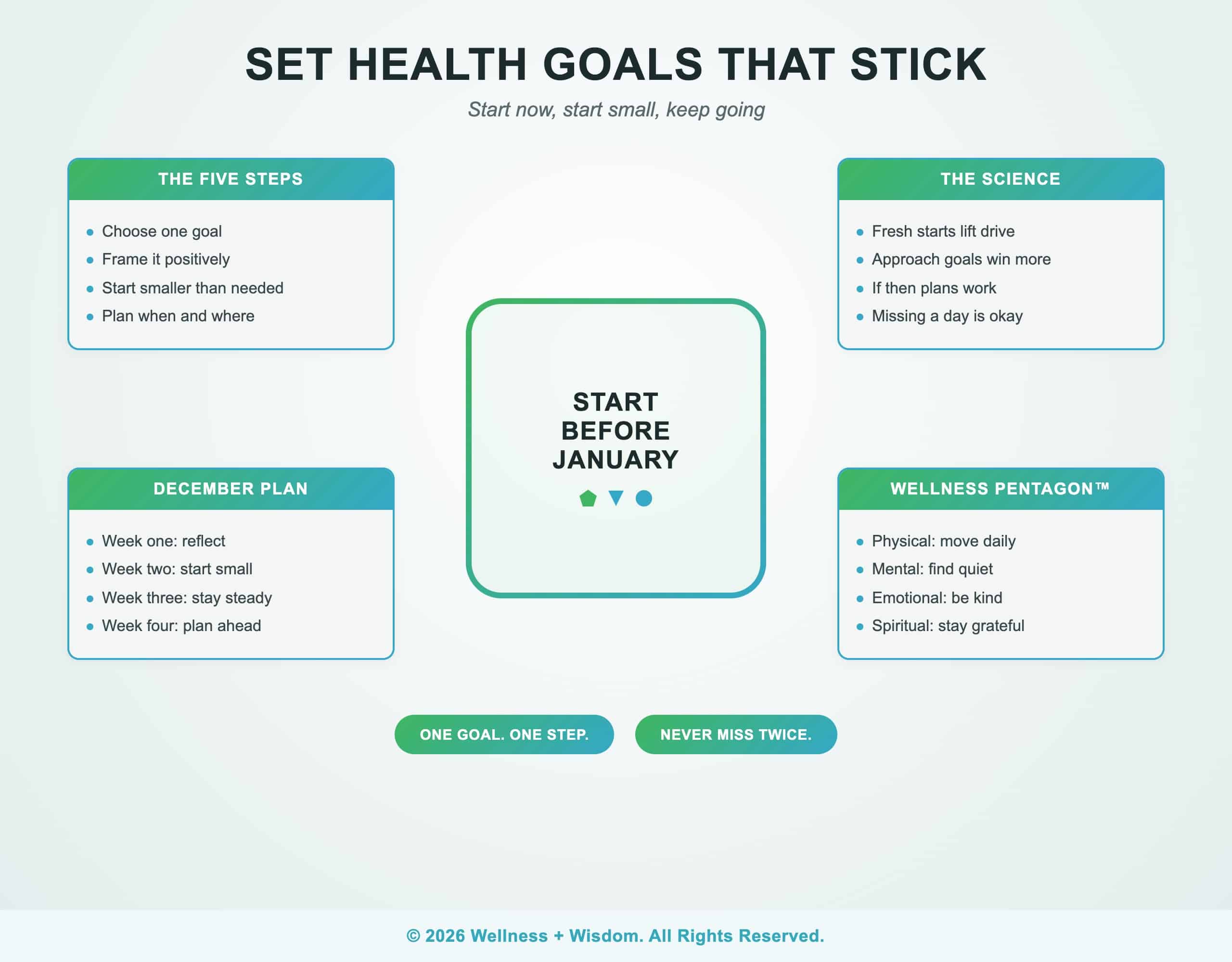
You learn how to set health goals by choosing one goal, framing it positively, starting smaller than feels necessary, planning exactly when and where you will act, and tracking your progress with kindness. These five steps turn intentions into habits. Here is how I practice and teach them.
1. Choose One Goal
The biggest mistake people make is choosing five goals at once. Pick one. Ask yourself, “What single change would make the biggest difference in how I feel day to day?” For many people, it is sleep, movement, or stress. Once that first habit feels automatic, you can add another. One goal done well beats five goals abandoned.
2. Frame It Positively
Turn every goal into something you are moving toward. Instead of “Stop staying up late,” try “Be in bed by 10:30 on weeknights.” Instead of “Quit sugar,” try “Have fruit as my afternoon snack.” The research suggests approach goals are more likely to succeed, and they simply feel better to pursue.
3. Start Smaller Than Feels Necessary
If your goal is to exercise more, start with ten minutes. If your goal is to meditate, start with two. Small goals feel almost too easy, and that is the point. They build confidence and consistency, which are the foundation of every lasting habit. You can always do more once the habit is established. The ideas in how to build healthy habits go deeper on this principle.
4. Plan When and Where
Write an if then plan for your goal. “If it is 12:30 on a weekday, then I will walk for 15 minutes.” “If I finish brushing my teeth at night, then I will put my phone in the kitchen.” Linking your new behavior to an existing routine makes it far easier to remember and repeat. The ideas in how to create a morning routine can help you find natural anchors for new habits.
5. Track Progress With Kindness
Use a simple calendar, a notes app, or a habit tracker to mark each day you follow through. Watching the streak grow is motivating. But be gentle with yourself on the days you miss. The research shows a single missed day does not undo your progress. Just start again the next day. Celebrate every week you show up, and if you want more on this, there is a whole practice around it in celebrating small wins.
Start with these five steps this week. You do not need a perfect plan. You need a first step. And if you would love a supportive community on your journey, the Liberated Life Tribe is a warm place to begin.
Here is a simple exercise if you are wondering how to set health goals starting today. Grab a piece of paper and write three lines. First: “The one goal I am choosing is…” Second: “I will do it when and where…” Third: “This matters to me because…” That third line is your fuel. When motivation fades, and it will, your reason will carry you. Tape the paper somewhere you will see it every day.
Your environment can do a lot of the heavy lifting. Put your walking shoes by the door. Keep a water bottle on your desk. Place fruit on the counter and move snacks out of sight. Charge your phone outside the bedroom. Small changes to your surroundings make healthy choices the easy choices. If screens tend to pull you off track, the ideas in how to reduce screen time offer practical help.
Support matters too. Tell a friend about your goal and ask them to check in with you each week. Find a walking buddy, join a class, or share your progress with your partner. The research on resolutions found that people who received some support were the most successful group. You do not have to do this alone.
Finally, watch out for comparison. It is easy to scroll through social media and feel behind. Remember that your health journey is yours alone, shaped by your body, your history, and your season of life. The ideas in how to stop comparing your health and fitness journey to others can help you stay focused on your own path.
Health Goals Across the Wellness Pentagon™
The Wellness Pentagon™ offers a fuller way to think about health goals, because true health includes five dimensions: physical, mental, emotional, financial, and spiritual. Choosing a goal in the area that needs the most care often creates benefits in all the others.
Physical. Movement, sleep, nutrition, and hydration. A daily walk, a consistent bedtime, or one more vegetable each day can transform how you feel. If rest is your biggest need, the ideas in how to sleep better are a great place to start.
Mental. Focus, learning, and stress management. A few minutes of quiet each morning, reading before bed, or a daily mindfulness practice can sharpen your mind and calm your thoughts. The ideas in how to practice mindfulness offer a simple entry point.
Emotional. Self awareness, compassion, and connection. Journaling, therapy, or simply naming your feelings each evening can help you process stress and grow in resilience. The practices in how to practice self compassion are especially helpful when goals feel hard.
Financial. Financial stress affects health more than many people realize. A simple budget, an emergency fund goal, or a monthly money check in with your partner can reduce worry and free up energy for everything else.
Spiritual. Purpose, meaning, and Connection to Creator and God. A daily gratitude practice, time in nature, prayer, or quiet reflection can ground your goals in something deeper than appearance or performance.
You do not need a goal in every area at once. Choose the one that feels most important right now, and trust that progress in one dimension tends to lift the others.
A Simple December Starter Plan
A simple December starter plan breaks your first month into four gentle weeks: reflect, start small, build consistency, and plan for January. This rhythm lets you build momentum without pressure.
Week One: Reflect
Look back on the past year with curiosity, not judgment. What made you feel your best? What drained your energy? Which habits do you want to bring into the new year, and which do you want to leave behind? Choose your one goal and write your three lines.
Week Two: Start Small
Begin your goal at its smallest possible size. Ten minutes of movement. A bedtime that is fifteen minutes earlier. One glass of water before coffee. Focus only on showing up.
Week Three: Build Consistency
Keep showing up, even during holiday gatherings and busy days. If you miss a day, simply start again. Notice how you feel. Many people find their energy and mood improve within a few weeks. The ideas in how to boost your energy naturally can support you here.
Week Four: Plan for January
Review what worked and adjust what did not. If your habit feels steady, consider growing it slightly in January: twenty minutes instead of ten, or adding a second small habit. Write your plan for the new year, and celebrate the fact that you are not starting from zero.
Carrie and I do a version of this every December. We sit down with a cup of tea, talk through what we loved and what we want to change, and each choose one simple goal. Some years it is more sleep, some years it is more time outside with Nayah and Novah. Starting before the new year has made all the difference. You will hear many guests share how small, early steps changed their health across our latest episodes.
How to Set Health Goals With the L.I.F.E. Method™
The L.I.F.E. Method™ offers a deeper lens for how to set health goals, because lasting change happens at the level of identity, not just behavior. Each pillar helps you build goals that come from love rather than pressure.
Liberation. Release the old stories that say you always quit, you are not a healthy person, or you have to be perfect. Those stories are often inherited, and they can be rewritten. Liberation means giving yourself permission to start fresh without carrying last year's guilt.
Integration. Weave your goals into the life you already have instead of building a separate, unsustainable routine. Walk during phone calls, stretch while the coffee brews, cook a simple meal with your kids. Integration makes health part of who you are rather than one more thing on your list.
Frequency. Notice the emotional tone behind your goals. Goals driven by shame tend to fade, while goals driven by care and joy tend to last. Choose goals that make you feel more alive, and let that feeling guide your choices.
Embodiment. Live your goals in your body each day. Feel the energy after a walk, the clarity after a good night's sleep, the calm after a few deep breaths. Embodiment turns abstract goals into felt experience, which is what makes habits stick. To go deeper with identity level change, explore our L.I.F.E. Method™ programs.
When you approach goals this way, you stop chasing a new version of yourself and start becoming more fully who you already are. If you want to strengthen the belief that change is possible, the ideas in how to develop a growth mindset are a beautiful companion.
A BREATHE™ Reset for Hard Days
A BREATHE™ reset is a simple breathing practice that helps your neural system shift from stress to calm, so you can return to your goals with a clear head on hard days. It takes about two minutes.
Here is how I practice it. Sit or stand comfortably. Inhale slowly through your nose for about four seconds. Exhale gently through your mouth for about six seconds. Repeat five times. As you breathe, remind yourself of your reason, the third line you wrote down. Then ask, “What is the smallest version of my goal I can do right now?” Do that one thing.
This reset is especially helpful during the holidays, when schedules shift and stress runs high. It keeps you connected to your intention without demanding perfection. For more techniques, explore our guide to breathwork and the neural system. If stress tends to derail your goals, the ideas in how to manage stress offer even more support.
When You Slip
When you slip, and everyone does, the most important thing is what you do next. A missed day is not a failure. It is information, and it is part of the process of learning how to set health goals that fit your real life.
Remember the research: missing one opportunity did not materially affect habit formation. What matters is returning. Use the “never miss twice” rule. If you miss a day, make the next day a priority, even if you only do the smallest version of your goal. Ask yourself what got in the way and whether your plan needs a small adjustment. Maybe your walk needs to move to the morning. Maybe your bedtime goal needs to be fifteen minutes later. Adjusting is not quitting. It is wisdom.
Be especially careful with perfectionism. The belief that you have to do everything right or not at all has ended more health journeys than any lack of willpower. The ideas in how to let go of perfectionism can help. If motivation dips, the ideas in how to find motivation can help you reconnect with your why. Simple tools like a habit tracker, a good water bottle, or a journal can support you, and you can find a few we trust in our wellness tools store.
If you are starting a new exercise routine, changing your diet significantly, or managing a health condition, please talk with a qualified health professional first. There is real wisdom in getting support. Wherever you are, the best time to begin is now, one small step at a time.
Ready to go deeper? Join the Liberated Life Tribe and receive your 10 day Self Liberation Blueprint at liberatedlife.com. It is free, it is guided, and each day offers a gentle practice to help you release old patterns and step into the healthiest, most joyful version of yourself.
Frequently Asked Questions
How do I set health goals that actually stick?
Choose one goal, frame it positively, start smaller than feels necessary, plan exactly when and where you will do it, and track progress with kindness. Connect the goal to a reason that matters deeply to you.
Should I wait until January to start my health goals?
No. Starting in late November or December lets you practice without pressure, build momentum, and arrive at the new year with habits already forming instead of starting from zero.
How long does it take to form a healthy habit?
It varies widely. In one study, the time to reach peak automaticity ranged from 18 to 254 days. Consistency over time matters far more than perfection, and missing a single day did not undo progress.
What kind of goals are most successful?
Approach goals, which focus on adding something positive, tend to succeed more often. In a study of New Year's resolutions, 58.9 percent of people with approach goals succeeded compared with 47.1 percent with avoidance goals.
What is an implementation intention?
An implementation intention is an if then plan that links a behavior to a specific time or situation, like “If it is 7 a.m., then I will walk.” A meta analysis of 94 tests found these plans meaningfully improve goal attainment.
What should I do if I miss a day?
Start again the next day and try never to miss twice in a row. Ask what got in the way and adjust your plan if needed. One missed day is information, not failure.
Studies and External Resources
The science in this article rests on peer reviewed research. These are the sources referenced throughout.
- Dai H, Milkman KL, Riis J. (2014). The fresh start effect: temporal landmarks motivate aspirational behavior. Management Science. View the study via DOI
- Oscarsson M, Carlbring P, Andersson G, Rozental A. (2020). A large scale experiment on New Year's resolutions: approach oriented goals are more successful than avoidance oriented goals. PLOS ONE. PubMed: 33296385
- Gollwitzer PM, Sheeran P. (2006). Implementation intentions and goal achievement: a meta analysis of effects and processes. Advances in Experimental Social Psychology. View the study via DOI
- Lally P, van Jaarsveld CHM, Potts HWW, Wardle J. (2010). How are habits formed: modelling habit formation in the real world. European Journal of Social Psychology. View the study via DOI
About Josh Trent
Josh Trent is an Identity Transformation Architect and the award winning host of the Wellness + Wisdom Podcast, with over 15 million downloads since 2015. He is the creator of the L.I.F.E. Method™ Identity Transformation System and steward of the Emotional Epigenetics™ and BREATHE: Breath + Wellness™ systems of self mastery, impacting over 1,000 students worldwide. Join the Liberated Life Tribe and receive your 10 day Self Liberation Blueprint at liberatedlife.com. Josh lives in Austin, Texas with his wife Carrie, daughter Nayah, and son Novah. Peace and power.
Disclosure: We may earn a commission from certain links on this site when you make a purchase, at no extra cost to you. These commissions help support Wellness + Wisdom and do not affect the products or resources we choose to recommend. Full disclosure .